
by Thomas Fernandes
High-acuity vision and depth perception give Portia a detailed and stable visual world. But vision alone does not explain why Portia is famous. What makes this genus remarkable is not just what it can see, but how it uses what it sees to manipulate the perceptual systems of other spiders.
Portia does not simply overpower its prey. It engineers situations in which prey behave in ways that make them vulnerable through careful behavioral manipulation.
Before examining Portia’s hunting strategies, we need to understand how it moves. Unlike almost all animals, spiders have no muscles dedicated to straightening their legs (extensor muscles). Instead, spiders evolved a hydraulic system that does this work for them by using hemolymph, the spider’s blood equivalent, as a hydraulic fluid.
To extend a leg, spiders pressurize hemolymph throughout the body, forcing fluid into each of their eight legs. Connections at the leg–body interface act as valves that open or close to adjust which legs extend. Pressure straightens the joints, while flexor muscles fine-tune movement. This is why dead spiders curl inward. When hydraulic pressure collapses, only the flexor muscles remain active, pulling the legs into the characteristic death curl.
This mechanism has several advantages. First, it reduces muscle mass at the extremities and concentrates it near the center of the body. More importantly, it makes holding an extended posture not just easier but nearly effortless, since legs are maintained by pressure rather than sustained muscle contraction. We say spiders “sit” in their webs, but they do not really sit; they hold their legs extended, waiting for information. Maintaining such stillness for hours would be nearly impossible using constantly tensed extensor muscles, especially in a web where immobility is essential.
This system, inherited from web-dwelling ancestors, can be repurposed in vision-based jumping spiders for explosive movement. During jumps, pressure rises sharply, extending the legs with remarkable force and allowing jumps many times the spider’s body length.
Jumping spiders also repurposed silk. If they seldom make web, all jumping spiders, including Portia, trail silk draglines behind them as they move, serving as both safety line and anchor. Coupled with vision, these elements are already enough to make an effective hunter as this video illustrates. But Portia, which often preys on other spiders, uses draglines in more elaborate ways.
“Portia walks across the forest floor until its attention is drawn to the distinctive cross-shaped stabilimenta (web decoration) adorning the orb web of Argiope appensa (a web dwelling spider twice the size of Portia) about a meter away. Portia moves so that the web is in clear view and approaches the tree to which it is attached. However, the web soon is out of view because of the uneven clutter on the forest floor.
The journey to the tree is anything but direct. Portia has to continuously change direction along a route that twists around leaves, tree roots, and lumps of dirt. Intermittent visual feedback from the tree and occasionally from the web, combined with an internal sense of direction, keeps Portia on course. Portia begins climbing the tree toward Argiope’s web, but Argiope is no ordinary spider. When it detects an intruder on its web, it rocks up and down, shaking the web violently. So, moving directly onto this spider’s web is problematical. One misstep and Argiope may shake Portia off of the web.
Portia stops just short of the web and slowly looks around. Eventually its line of gaze traces a path from the top of the web to a nearby vine and down the vine and into a mass of tangled vegetation adjacent to the tree trunk. Portia then turns and walks away, but it is not giving up. Instead, the spider takes a long, convoluted detour, during the course of which it will temporarily lose sight of the web. After about 20 min, Portia arrives on the vine it saw above the web. Sitting on a leaf connected to the vine, Portia looks down at the resting Argiope and lowers itself on a dragline alongside the web without touching it. When it is level with Argiope, Portia swings in and grabs the unsuspecting prey.”- source and a video of a similar hunt by a Portia labiata.
As this episode shows, Portia routinely hunts prey larger than itself and a single mistake can reverse the roles of hunter and prey. To kill such prey, they use the element of surprise and venom.
Like most spiders, Portia is venomous. If it is harmless to humans, the venom is particularly effective against other spiders. During attacks, Portia often aims its bites just above the prey’s brain, near the central nervous system. Medium spiders are typically paralyzed within ten to thirty seconds. Larger spiders, sometimes twice Portia’s weight, may require up to fifteen precise bites and several minutes to immobilize.
Since venom is energetically costly to produce, spiders use it sparingly. The vibration-sensing Cupiennius, for example, sometimes relies on mechanical damage alone for very small prey, uses some venom for intermediate targets, and deploys its entire venom load only against the largest prey.
If venom is Portia’s weapon, stealth is its defense. At its scale, many animals have limited visual resolution purely based on size constraints. As such, the strategy to identify obejcts and animals is not so much though features than movement, or even more precisely patterns of movement.
Wind-blown leaves, shifting shadows, and drifting debris all move, but they do so irregularly. Animal locomotion, by contrast, tends to be rhythmic and patterned. It is this regularity that often betrays would-be predators and prey both. A dog’s trot, a horse’s walk, a human stride, most animals move in regular rhythms. Gait is made of repeating patterns that are instantly recognizable as life, even without focused attention.
Cupiennius spiders also move with an alternating gait, diagonally opposite legs moving together. The motion is smooth, mechanical, and predictable. That regularity makes it conspicuous to visually guided predators. Only Cupiennius hunts by night where its motion is hidden. As a predator itself, it also uses patterns in others movement for hunting, like the turbulence of insect flight compared to stable wind.
Portia moves nothing like this. When walking, it moves in a slow, choppy gait that helps them stay hidden. They pause frequently and irregularly, moving each leg and palp out of sync with the others. Combined with body hairs and a dull brown-grey coloration that break up their outline and to a casual observer they look like detritus floating about in forest light.
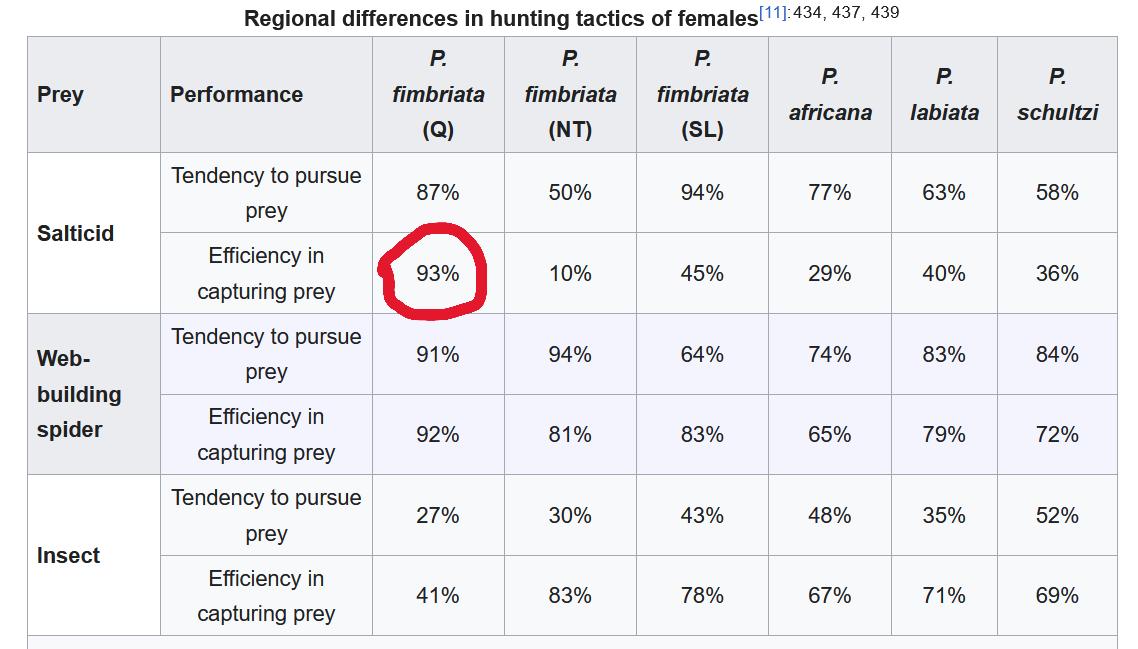
Even the most attentive observer can be fooled. Queensland Portia fimbriata specializes in hunting other jumping spiders, predators with vision as sharp as its own. When stalking salticids, Portia takes its cryptic movement a step further.
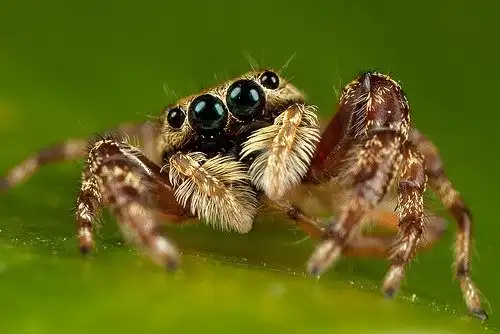
Portia fimbriata exaggerates its slow, jerky gait and pulls its palps (Pedipalps are spider sensory appendage near their mouth that are often quite conspicuous in jumping spider as you can see in Figure 1.) tight against the chelicerae (fangs), reducing the visual signals that would normally betray it.
Experiments show that Portia actively monitors the orientation of the prey’s principal eyes and uses this information to decide when to move and when to remain still. If the prey turns to face it, P. fimbriata freezes and completely hides its palps. When the prey looks away, it advances.
This strategy is prey-specific. When hunting insects or non-salticid spiders, P. fimbriata does not consistently tuck its palps or pause in this way. Most jumping spiders fail to recognize a cryptically stalking P. fimbriata as a threat, although they respond defensively to other Portia species.
“The story begins with Portia slowly walking down the trunk of a tree, perhaps looking for the webs of potential prey. As do all salticids (jumping spiders), Portia trails a line of silk, called a dragline, behind it as it walks. Many animals frequent tree trunks in the forest and before long Portia steps onto the draglines of another salticid. In this case they are the draglines of Jacksonoides queenslandicus, the most abundant salticid in the Queensland rain forest, and among Portia’s favorite prey. Portia is sensitive to the chemical and odor cues from the other spider’s draglines. These cues prime Portia to expect to find J.queenslandicus in the vicinity, and the priming actually makes Portia more effective at visually locating the prey.
When quiescent on a tree trunk, however, J. queenslandicus’s markings make it hard to see, and this time its camouflage is too good. However, Portia has a solution, something called “hunting by speculation Portia makes a sudden leap straight up into the air. J. queenslandicus, resting quietly some 15 cm away, turns to look at what moved, but Portia is already back on the ground, sitting still. J. queenslandicus does not see Portia, but Portia detected J. queenslandicus as it turned. Very slowly, Portia orients toward J. queenslandicus and, once J. queenslandicus turns away, Portia begins to stalk it. When stalking other kinds of spiders, Portia moves slowly, with its palps hanging loosely in front of its face. When stalking a salticid, however, Portia moves even more slowly, exaggerating its choppy, robotlike gait, and pulls its palps back so they are hidden from the prey’s view. Being a salticid, J. queenslandicus can see well, and this time it detects a flicker of movement as Portia comes up from behind, and it turns toward Portia.
Portia freezes the instant its prey’s large eyes come into view. J. queenslandicus looks straight at Portia, but sees nothing to indicate danger. Eventually J. queenslandicus turns and walks away. With J. queenslandicus’s eyes no longer in sight, Portia resumes its slow advance. Portia draws steadily closer to its prey, continuously maneuvering to stay behind the J. queenslandicus. Eventually, from a few millimeters away, Portia lunges, and its fangs pierce the integument just above the brain of the J. queenslandicus. The victim is soon paralyzed; Portia feeds, and our story comes to an end.”- source
Despite being spider-eating specialists, Portia adapts its strategy to each species in a wide range of complex behaviors rendered more accurate via trial and error.
Contrast this with the dragonfly. Its hunting is spectacular, but its perceptual world is comparatively simple with objects rapidly classified as prey or not prey. The same is true for most spiders, whose perception ultimately resolves into a binary distinction between prey and predator. For Portia, the world is made of many different kinds of prey, each requiring different approaches.
Another threatening prey of jumping spiders is the spitting spider, Scytodes. These spiders can immobilize Portia by spitting sticky silk, effectively reversing the hunter–prey relationship. Local populations of Portia labiata, which frequently encounter Scytodes, have evolved highly specific hunting strategies combining several previously described techniques. When targeting Scytodes, they begin with the correct sequence of web-plucking, followed by deceptive signaling on the web to orient the prey, and then take a detour to approach from behind. With all these precautions, local P. labiata achieve prey-capture success rates above 90%.
Non-local Portia, lacking experience with this prey, rely on standard trial-and-error web-plucking or direct detour attacks. These strategies succeed in only about 50% of hunts, and failures often trigger Scytodes‘ aggression from a distance, which is fatal in roughly 70% of those failed attempts (35% of total attempts).
Learning by trial and error is exceptionally difficult when a single mistake can be lethal. For highly dangerous prey, local specialization appears crucial. In the case of P. labiata, a simple bias toward initiating encounters by soft plucking of the web is enough to deceive Scytodes and survive to learn how to engage other prey.
Yet this bias is only the foundation and Portia still learn to recognize individual risk. Female Scytodes carry their eggs in their mouths and must release them to spit, which they are reluctant to do. Egg-carrying females are therefore less dangerous, and Portia preferentially targets them, approaching with greater confidence. This is discrimination within the same prey species, based on situational risk assessment.
Across the genus, P. fimbriata experiences death or injury in only about 0.12% of pursuits. In other Portia species, average mortality can rise to 3% of hunts, with injuries affecting another 5%. Such stakes explain why Portia hunts with extraordinary care.
Previous descriptions, while accurately showcasing the marvel of the hunts, do not transmit the length of time those sequences take to perform. To a human observer, Portia’s hunting can appear excruciatingly slow, sometimes lasting up to ten hours. Their remarkable visual acuity comes at the cost of reduced visual field and extended environmental sampling. Cryptic advancement, precise freezing, and aggressive mimicry all take time. Every step is deliberate, for a single misstep could be fatal. These conditions also strongly favor planning and cognitive sophistication.
Portia’s success comes not from faster reactions or stronger weapons, but from exploiting how other spiders perceive the world. This spider creates perceptual illusions, provokes orienting responses, makes detours, and engineers situations in which prey make themselves vulnerable. It tracks prey eye movements to time freezes, distinguishes between prey species requiring different strategies, and even assesses individual prey state to adjust risk. This uniquely demonstrates how distal senses and cognition co-evolve to enable sophisticated behavior even in animals smaller than 1cm.
*****
To dive into the perception of octopus a well written book review here. You can also find me on substack for a criticism of advice.
Enjoying the content on 3QD? Help keep us going by donating now.