by David Oates
 An empty space sits where I once sat. I miss it. I miss the strangers I shared it with, and a few regulars with whom I achieved a nodding relationship. A couple of baristas I might greet and chat up. Very briefly.
I miss the space itself – long and wide, its tall ceiling held up by industrial concrete pillars of old-fashioned ornateness reflecting its Model-T era use as a Ford manufactory. The space gave room to think and to be connected yet anonymous, with big tables for groups and – the star attraction for me – counter tables all along the windows where for years I have sat for my afternoon writing and reading. Getting lost in a poem or a book. Jotting a few words experimentally, or working on a chapter in progress. Gazing idly at someone at a sidewalk table (peeking at a book title if I can see it). Taking in the rush of cars and trucks, heading towards their 4:30 gridlock.
Strangers walk by with dogs, or with addictions, or with clothes nicer than I even know the words for. They all make me think. . . of what? Hard to say. How much I like a kind face, or a handsome one. Or an old one with lines.
What unknowabilities we all are.
But this space now sits plague-emptied, closed down apparently permanently. Here I wrote large pieces of my last book. And the one before it. I relied on this perfect one-mile walk from my home, an afternoon leg-stretch, a change of scenery, a change of mind. A way to feel connected to the humans. (But not too connected.)
This sociable, urbane space was a bit of what is called the “New Urbanism,” a thing for which Portland, Oregon had become renowned. But New Urbanism is shut down now. Public spaces empty. Restaurants shuttered. Transit deserted.
As if all that was left us was to revert to the 1950s and move back to the suburbs, isolated and safe, bourgie and dull. For the plague, we fear, may be killing cities as well as individuals. Read more »

 There is a story that Clemenceau, the Prime Minister of France, was in conversation with some German representatives during the Paris peace negations in 1919 that led to the Treaty of Versailles. One of the Germans said something to the effect that in a hundred years time historians would wonder what had really been the cause of the Great War and who had been really responsible. Clemenceau, so the story goes, retorted that one thing was certain: ‘the historians will not say that Belgium invaded Germany’.
 We are not where we were one year ago—or have we just returned?
 In the part of my life when I was most actively trying to invent myself as a writer, I was working as a high school teacher and was desperately unhappy. (Notice the way that I put this: “I was working as a high school teacher,” not “I was a high school teacher”; the notion that a job defines a person still disgusts me.) In the evenings, I left work and wrote magazine pitches, not as many, I realize in retrospect, as could have brought me success, but enough to keep me talkative in the teacher’s lounge. I had the impression, back then, that a writer could make a name for himself on the basis of a single strong piece, and since my work was deeply derivative—I was, after all, inexperienced—I hatched a plan.



 Abstract: This article, written by the Digital Philosophy Group of TU Delft is inspired by the Netflix documentary The Social Dilemma. It is not a review of the show, but rather uses it as a lead to a wide-ranging philosophical piece on the ethics of digital technologies. The underlying idea is that the documentary fails to give an impression of how deep the ethical and social problems of our digital societies in the 21st century actually are; and it does not do sufficient justice to the existing approaches to rethinking digital technologies. The article is written, we hope, in an accessible and captivating style. In the first part (“the problems”), we explain some major issues with digital technologies: why massive data collection is not only a problem for privacy but also for democracy (“nothing to hide, a lot to lose”); what kind of knowledge AI produces (“what does the Big Brother really know”) and is it okay to use this knowledge in sensitive social domains (“the risks of artificial judgement”), why we cannot cultivate digital well-being individually (“with a little help from my friends”), and how digital tech may make persons less responsible and create a “digital Nuremberg”. In the second part (“The way forward”) we outline some of the existing philosophical approaches to rethinking digital technologies: design for values, comprehensive engineering, meaningful human control, new engineering education, and a global digital culture.
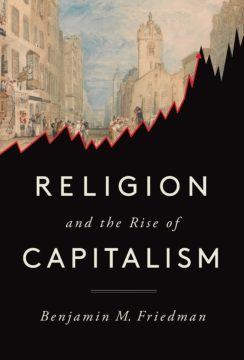 Religion has always had an uneasy relationship with money-making. A lot of religions, at least in principle, are about charity and self-improvement. Money does not directly figure in seeking either of these goals. Yet one has to contend with the stark fact that over the last 500 years or so, Europe and the United States in particular acquired wealth and enabled a rise in people’s standard of living to an extent that was unprecedented in human history. And during the same period, while religiosity in these countries varied there is no doubt, especially in Europe, that religion played a role in people’s everyday lives whose centrality would be hard to imagine today. Could the rise of religion in first Europe and then the United States somehow be connected with the rise of money and especially the free-market system that has brought not just prosperity but freedom to so many of these nations’ citizens? Benjamin Friedman who is a professor of political economy at Harvard explores this fascinating connection in his book “Religion and the Rise of Capitalism”. The book is a masterclass on understanding the improbable links between the most secular country in the world and the most economically developed one.
 Tragically, President Biden’s 21-page “