by Brooks Riley
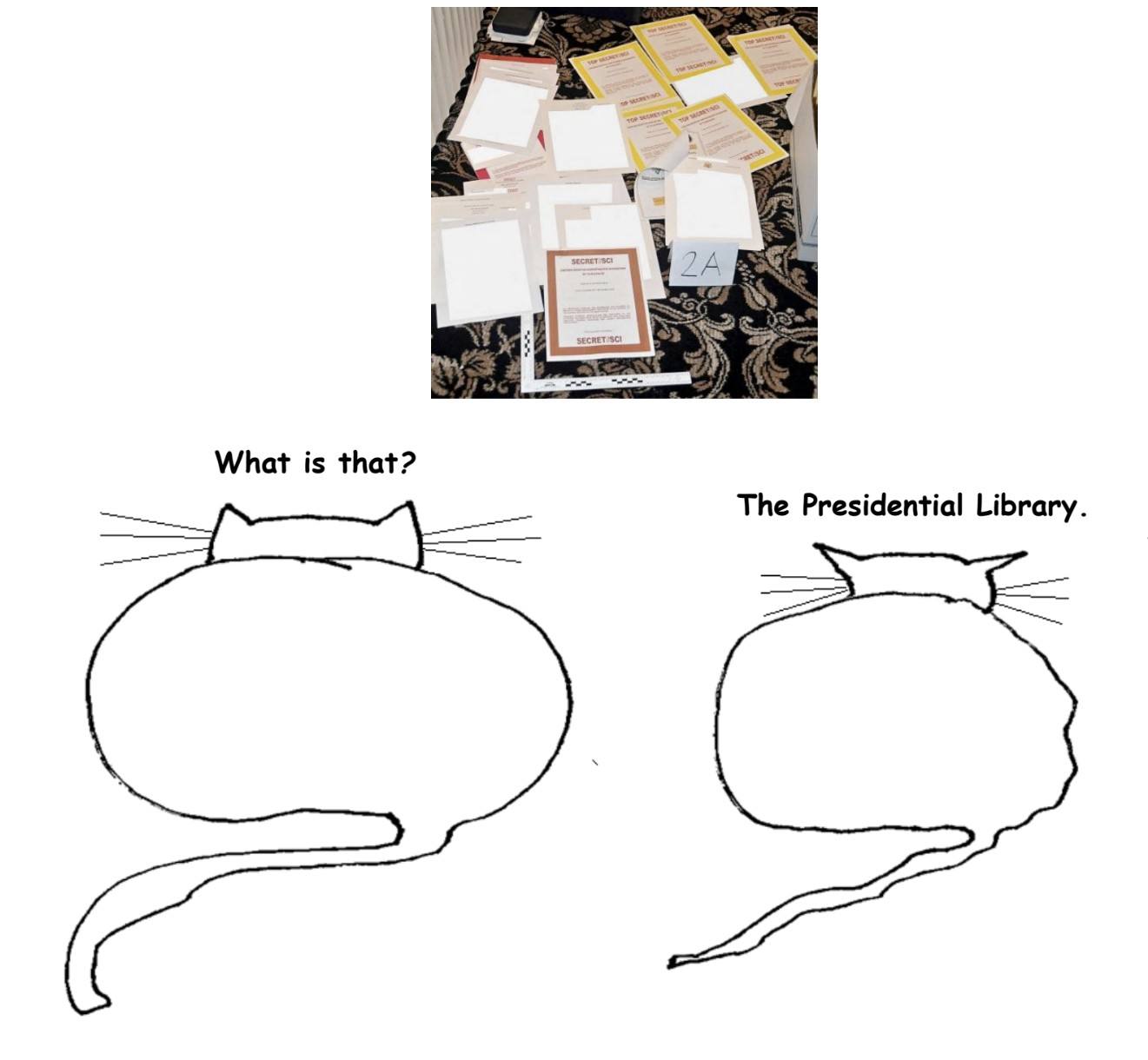

by Brooks Riley
by Ethan Seavey
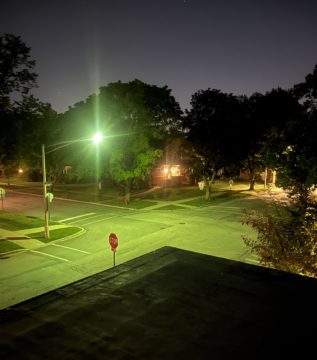 My last night in the house on Euclid Avenue will go one of two ways:
A. When I climb through a window in my bedroom (which will no longer be my bedroom tomorrow) and onto the flat roof outside in order to smoke the very last bowl of cannabis in my home (which will no longer be my home tomorrow), a moth will seize the opportunity to fly into the room.
B. Scenario A won’t happen.
The chances of scenario A occurring can be described as somewhat unlikely but certainly possible. This possibility is mostly blamed on the size and age of the window. It is about thirty square feet in total. This is a blessing in the fact that I can fit through the window easily and even sit in the frame comfortably if it’s raining. But in August its great size becomes a problem. A greater surface area gives moths a greater chance of entering my room. Moths are rather persistent when they’re around, but they’re often exploring other lights. So, they’re rare but not uncommon. I saw one a few days ago, but I haven’t seen one since. When I do see moths, I see them in August. It is August. It is August 26. I leave for New York in late August, August 27, the 27th, August 27, I’ll fly from Chicago to New York on August 27, which is tomorrow, it’s already here. Read more »
by Eric Bies
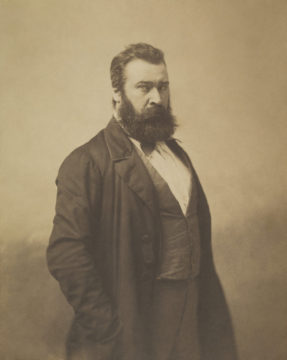 Jean-François Millet, a Frenchman, frowned beneath his full beard as he lay dying in Barbizon. It was 1875, and he was not to be confused with Claude Monet—not yet—who would later paint water lilies and haystacks but wasn’t, in 1875, rich and famous; on the contrary—and in spite of Édouard Manet’s having just painted him painting from the vantage of a covered paddle boat, appearing pretty well-to-do in the process—he was barely getting by. Meanwhile, Millet had already painted some haystacks. And though the stubbier English word his name renovates—the one that rhymes with skillet—happens to be a grain that is rather good for making hay, painters have tended to tend toward other stock. The snow-capped haystacks that we see in Grant Wood, for instance, were in all likelihood made with the same Midwestern alfalfa Verlyn Klinkenborg celebrates and dissects in Making Hay. We know that van Gogh painted a golden haystack or two—probably of wheat—and though the Vermeer Corporation of Pella, Iowa is one of the market leaders in modern hay baling technology, the closest the Dutchman Johannes ever came to a haystack was when he ensconced a common milkmaid in the daylight of a well-windowed kitchen.
Whose haystacks won out? It was only a matter of time for Monet. By now his station in the popular imagination has practically eclipsed those of Millet, Wood, and Vermeer, if not van Gogh. We recognize his water lilies as readily as Picasso’s women, Warhol’s soup cans, and, lately, Kusama’s spotted tentacles. It is true that Millet’s Angelus, an apotheosis of peasant soil, shattered art-market records in 1890, exchanging hands Atlanticly for an astonishing 750,000 French francs. Yet the work itself has gradually absconded into what relative obscurity remains feasible for a canvas hanging in the Musée d’Orsay. Read more »
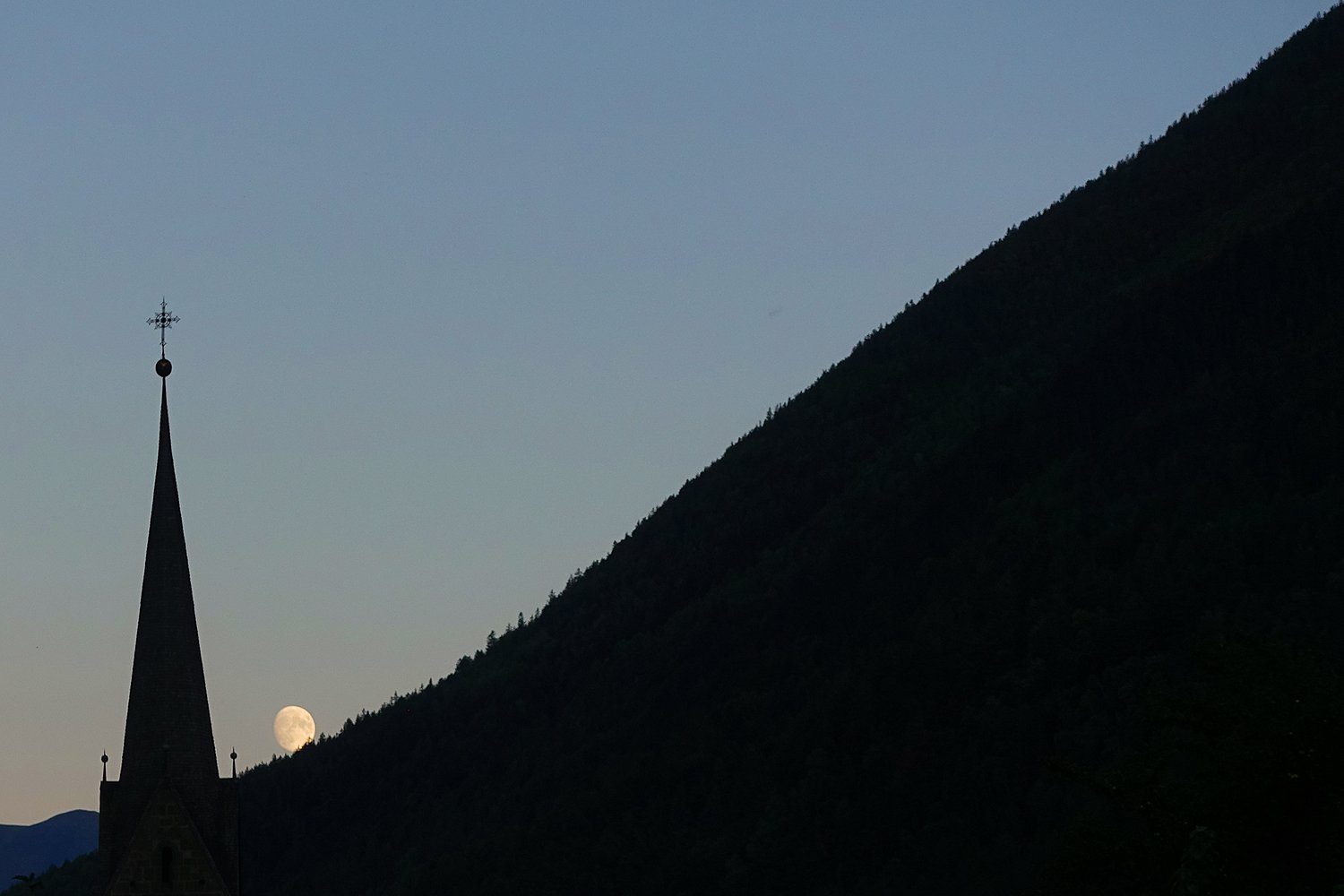
Moonrise from my office window some days ago.
by Chris Horner
Deprivation is for me what daffodils were for Wordsworth –Philip Larkin

William Wordsworth’s poetry can seem all too familiar, what with all that wandering lonely as a cloud. But he is stranger than we often remember him. Take this, for example:
Twilight was coming on, yet through the gloom
I saw distinctly on the opposite shore,
Beneath a tree and close by the lake side,
A heap of garments, as if left by one
Who there was bathing. Half an hour I watched
And no one owned them; meanwhile the calm lake
Grew dark with all the shadows on its breast,
And now and then a leaping fish disturbed
The breathless stillness. The succeeding day
There came a company, and in their boat
Sounded with iron hooks and with long poles.
At length the dead man, mid that beauteous scene
Of trees and hills and water, bolt upright
Rose with his ghastly face.
(The Prelude, ll 266-279, first part, 1799 version)
He is describing an event from when he was eight years old. A teacher from a nearby school had drowned – this was the recovery of the body. Why is he recalling this? We might say that the sheer vivid gruesomeness of the event just stuck in his mind. Surely there is something in that – one might be haunted by a memory like that, it might appear in one’s nightmares. Yet the scene occurs as one of the ‘spots of time’ that Wordsworth presents to us as remembered experiences that act on him in a way that refreshes and restores him. It is somehow acting on his psyche in a positive way. Read more »
by Pranab Bardhan
All of the articles in this series can be found here.
 As with game theory, I also attended some courses in Berkeley in another relatively new subject for me, Psychology and Economics (later called Behavioral Economics). In particular I liked the course jointly taught by George Akerlof and Daniel Kahneman (then at Berkeley Psychology Department, later at Princeton). I remember during that time I was once talking to George when my friend and colleague the econometrician Tom Rothenberg came over and asked me to describe in one sentence what I had learned so far from the Akerlof-Kahneman course. I said, somewhat flippantly: “Kahneman is telling us that people are dumber than we economists think, and George is telling us that people are nicer than we economists think”. George liked this description so much that in the next class he started the lecture with my remark. On the dumbness of people I later read somewhere that Kahneman’s earlier fellow-Israeli co-author Amos Tversky once said when asked what he was working on, “My colleagues, they study artificial intelligence; me, I study natural stupidity.”
Of course, by dumbness or stupidity in this context economists really mean departures from rationality, and knowing that people are often irrational, behavioral economics is really about the systematic departures from rationality which gives the subject its analytical coherence, that there is method in the madness as Polonius says in Hamlet. And in the departures from self-centered individual rationality social norms and fellow-feeling (like empathy and sympathy and social solidarity) often play an important role. In Berkeley I had a friendly colleague for many years, Matthew Rabin (now at Harvard), from whose talks and writings I have learnt a great deal on fairness in social preferences in a modified game-theory framework, apart from common human errors in probabilistic reasoning and human frailties like individual self-control problems. These are big changes in traditional ways of thinking in Economics. Read more »
by Paul Braterman
![Righting America at the Creation Museum (Medicine, Science, and Religion in Historical Context) by [Susan L. Trollinger, William Vance Trollinger]](https://m.media-amazon.com/images/I/511yK1hsSBL.jpg)
For instance, this book will tell you that Ebenezer the Allosaurus, prize exhibit at Answers in Genesis’s Creation Museum in Kentucky, was donated by the Peroutka Foundation. It will also tell you that Michael Peroutka, in a 2013 speech still available on youtube, states that government schools indoctrinate children away from Christian ideas (a theme that recurs throughout this book), and that this is what they were designed to do. The book also points out that he served on the Board of Directors of the League of the South, whose chairman had defined southern people as white. I recently learned that Peroutka is the official Republican Party candidate for the post of attorney general of the State of Maryland in the November 2022 elections. We had better pay attention.

There is no shortage of books refuting antiscientific creationism, but this volume nonetheless manages to find many new and important things to say about the subject, as manifested at the Museum. Susan Trollinger is an Associate Professor (now Professor) of English at the University of Dayton, Ohio, and author of Selling the Amish: The Tourism of Nostalgia, while William is Professor of History at the same university, and author of God’s Empire: William Bell Riley and Midwestern Fundamentalism. Both are committed Christians and critical Catholics. Thus they are unusually well-placed to analyse the rhetorical devices, the historical roots, and the theological assumptions and moral universe of the Museum, and its parent organisation, Answers in Genesis. On their blog, they have applied much the same critique to the Museum’s sister attraction, the Ark Encounter, which was under construction when this book went to press and features here in an epilogue. Read more »
by John Allen Paulos
 Herschel Walker claims that we have enough trees already, that we send China our clean air and they return their dirty air to us, that evolution makes no sense since there are still apes around, and freely offers other astute scientific insights. He may be among the least knowledgeable (to put it mildly) candidates running for office, but he’s not alone and many candidates, I suspect, are also surprisingly innocent of basic math and science. Since innumeracy and science illiteracy remain significant drivers of bad policy decisions, it’s not unreasonable to suggest that congressional candidates (house and senate) be obliged to get a passing grade on a simple quiz.
Nobody expects these candidates to calculate quantum wave functions or spit out the first 10 digits of pi, but reasonable answers to a few elementary questions on mathematics and science would nevertheless be reassuring. After all, high-tech companies often require applicants to take a difficult high-tech test, so why shouldn’t low-tech organizations like Congress require applicants to take a simple low-tech test. I thus propose a biennial Who Wants to Be a Scientifically Literate Candidate test, which could perhaps be broadcast on local TV stations nationwide. (The somewhat snarky answers to it are below.)
If I were the moderator of such a test (the least likely aspect of this wishful fantasy), I would begin by welcoming whichever of the candidates have been shamed or dragooned into taking it. I’d go on, “Let’s start with five simple questions on arithmetic and statistics whose only purpose is to gently ascertain your understanding of some basic facts and notions.”
“I suggest that you write your responses on the special tablets in front of each of you.” The candidates’ answers, I announce, will be private, but their total score – the number of correct responses to the 15 questions I will ask- will be published.
Dramatic music begins and I proclaim, “First off, a very easy question.” Read more »
by Deanna Kreisel [Doctor Waffle Blog]
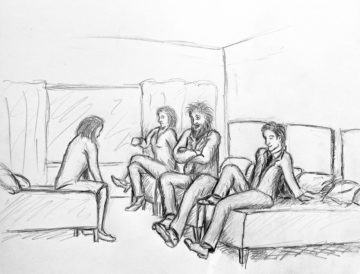
Where do you see yourself in ten years? What is your greatest weakness as an employee? What do you know about our company?
To the best of my recollection, I have never been asked any of these cliché questions during a job interview. Here are the kinds of questions I have been asked instead:
As discomfiting as the first three questions may have been (the answer to all three was Yes), I still contend that university faculty members—which is what I now am, having left my bartending and singing-telegram days behind me[1]—have crazier shit happen to them during job interviews than members of any other profession.[2] Among that rarefied group, humanities professors experience the crème de la … shit. (Sorry.) The reasons are manifold: 1. We are desperate. (For more information, consult any article on the labor situation in the academy published in recent years. Here is one, and another one, and another one). 2. Our interviewing procedure is bananapants. Because academic positions ideally carry the potential for tenure (but see those articles again), and it can be very hard to get rid of an insane/unproductive/lecherous colleague, the interviewing stakes are high. Still, that is no excuse. Just no excuse at all. Read more »
by Charlie Huenemann
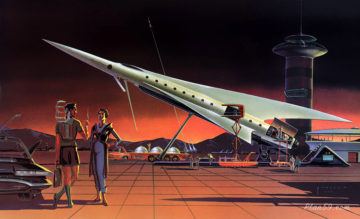 I recently listened to a discussion on the topic of longtermism, or the moral view that we need to factor in the welfare of future generations far more seriously than we do, including generations far, far into the future. No one should deny that the people of the future deserve some of our consideration, but most people soften that consideration with fluffy pillows of uncertainty. We take ourselves to have a rough idea of what the next generation will face, but after that everything gets cloudy fast, and most of us aren’t sure what exactly we should do for those possible people in the clouds, so we start dropping them from our moral calculations.
But if you insist on considering them, and treating them as real (but real elsewhen), their numbers and their interests get big fast. How many people might exist in the whole future of the universe? Millions of billions, maybe, if we go full-on Star Trek. If they each deserve only one millionth of our concern, that still ends up being a whopping amount of concern. Look at things that way, and really just about all of our moral thinking should be focused on the future generations of the universe. The Iroquois who asserted that we should “have always in view not only the present but also the coming generations” were severely understating the magnitude of the task before us.
Look, I’m not about to say anything against caring for the people of the future. But when anyone starts talking about the universe, or the rest of time, I feel compelled to remind them that they have no idea what they are talking about. Even saying “it sure is a big place” or “the scale of the thing is mind-boggling” or “there sure are a lot of possibilities” runs the risk of suggesting we have more of a grip on the business than we really do. It’s slightly safer just to say, “we really have no idea.” Read more »
When I was ten, Grandpa drove me on a crisp autumn evening to see geese, gulls, and ducks descend with expanded wings on Wular. “Asia’s largest freshwater lake,” he said. “They fly in disciplined formation like copper-tipped arrows across the desolation of sky, along Himalayan foothills, arcing between Mughal domes from Kashgar to Kashmir.”
I remember, a pristine mirror polished by the breeze. Geese glinted in wild ochre, gulls mottled in brown, ducks in gold. “We measure time,” Grandpa said, “by their arrival and departure.” On the foothills, encircled by grand mountains white turbans on peaks, trees their grand architecture revealed. Rushlight induced a silence I can still hear 50 years later, at dawn in March as I park
my car across an army bunker secured by barbed wire. Bold white letters on a signpost sound like a mantra: Respect All Suspect All. Soldiers on a watchtower stare at me as I step down to a lookout gazebo.
My heart sinks: strips of land, mud, and peat float on a sullied mirror as do lotus leaves. Foothills are bare, no trees only stump after stump after stump. Weeds are heaped on paddle boats. Walnut saplings line the shore. Freshly axed logs are stacked high. An odd colony of gabled homes has encroached the banks. Rubbish is strewn near a cowshed next to an outhouse. An open drain moves all things raw into the lake. Swallows perched on power lines are sharp and flat notes.
A lone signal tower is flashing red. A tubular beam of sunlight pierces the clouds, spotlighting a flight of ducks emerging from the shelter of water lilies. Flapping their wings rapidly, they ascend from a childhood sanctuary, now the world’s most militarized place. A nightingale perched on the gazebo sings, Respect all Suspect all Respect all Suspect all . . .
for Justine Hardy
by Mary Hrovat
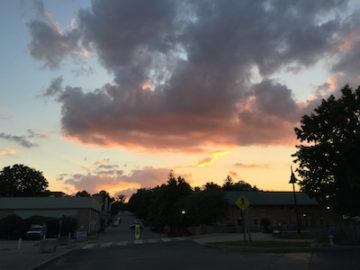 This summer I noticed that I was sharing a lot of sunset photos on social media. I don’t think of myself as a photographer, and I’m much more likely to share words than images. When I thought about it, I realized this wasn’t a sudden change. I’ve been taking the odd set of sunset pictures with my Canon every now and then, and I’ve noticed that my eyes are increasingly drawn to the sky and the light when I look at landscape photos.
And I’ve always loved the sky. It holds so many fascinating things: light, color, clouds, weather. Trees, birds. Moon, planets, stars. Time itself, and change. I like to walk at twilight, when the world is shifting from day to night, so it’s natural that sunsets would become a focus. This spring a friend gave me an old iPhone to use as a camera; it’s easy to carry with me, so I’ve been taking more pictures.
But I can’t really understand why I’m so utterly captivated by the colors of the sky, and their subtle gradations and changes. I feel as if I can never spend too much time just looking, at the sky and at other people’s images of it, and at plants, birds, bugs… . When I try to describe the strong desire to soak up as many experiences of nature as I can, to sense the colors and shapes as deeply as I can, I feel like I’m trying to explain a cannabis-induced insight: Everything is so beautiful! It feels kind of like craving, but not in an itchy unsatisfied way. In her poem “Born Into a World Knowing,” Susan Griffin wrote about hoping for a gentle death, “perhaps in someone’s arms, perhaps tasting chocolate…or saying not yet. Not yet the sky has at this moment turned another shade of blue.” There is always another shade of blue. Read more »
by Mike Bendzela
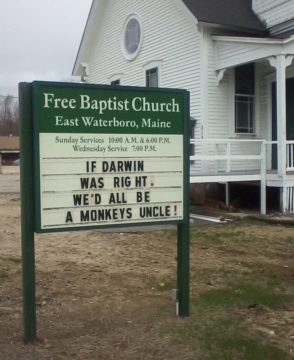
“I am not an animal! I am a human being!”–“John” Merrick, The Elephant Man (1980 film)
“Das ist nicht nur nicht richtig; es ist nicht einmal falsch. [That is not only not right; it is not even wrong.]”–Attributed to Wolfgang Pauli
We get no traction on a problem until we develop a sound theory about it. Not a hypothesis or a hunch, but a theory, a true grasp of what a condition is and how it presents in society.
Imagine how horrible life must have been before we had a sound germ theory of disease. With no concept of viruses, amoebas, spirochetes, parasites, we floundered around with our hit-or-miss salves and poultices, herbs and concoctions, incantations and exorcisms. Ultimately, we just relapsed into fevers and sweats, berated continually with, “Well, you didn’t pray hard enough!”
No theory = no traction. It’s a disaster. Yet, somehow, our species managed to stumble through epochs of disaster. To evolve through it, even.
Such evolution was all but invisible to our ancestors, even though the signs were everywhere in our ancestral environments. We noticed that the war of nature persists non-stop. As a result, everything propagates apace — even unduly. Like begets like, yet variation is endemic. But the incremental ratcheting of species through time — that completely escaped us. We couldn’t know that our great grandmothers were primates and that the chimps are our cousins.
We know it now, though — in spades. But until we all incorporate these biological, universal truths into a fundamental world view, we are bound to continue “blowing and beating each other without mercy” [1] till Kingdom Come. Read more »
by Brooks Riley
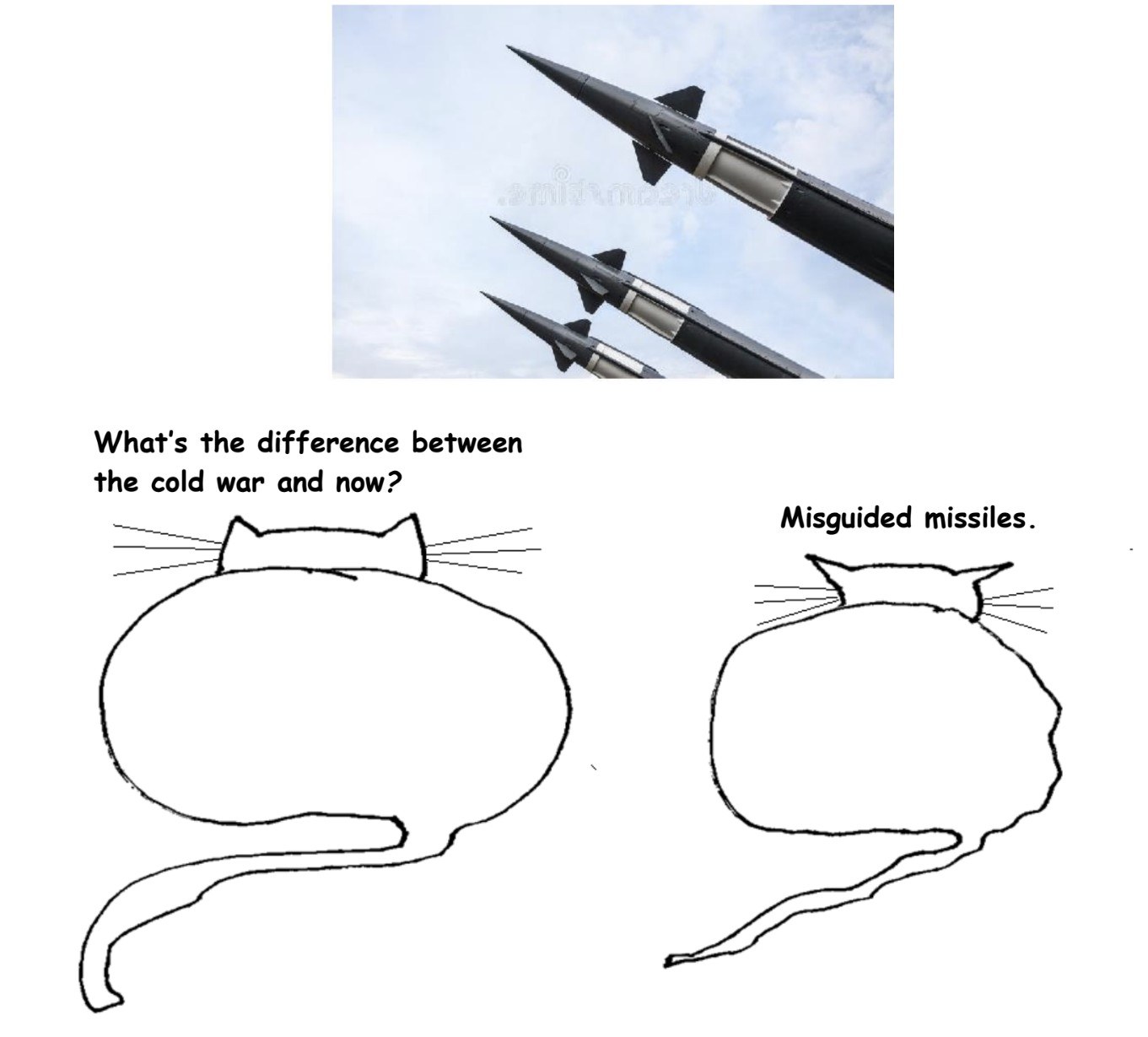

by David J. Lobina
A truism, perhaps, and certainly meant to draw attention, at least in one way. In reality, the title of this post is intended as a playful dig on last month’s post, which really should have been called Animals Don’t Think Like Humans!, even if in the event that post was about how some academics have gone about studying human thought via the study of the psychology of other animal species – and in that event, the post concentrated on the excesses of some philosophers. Similarly, this post will be about how some psychologists have gone about studying adult human thought via the study of the cognition of preverbal children (roughly, children under the age of 4), and about their excesses (the scholars’, in this case, not the children’s, though both go without saying). So, in a nutshell, this is Take 2: The Preverbal Case.
At first sight, the cognition of preverbal infants may be more relevant to the study of human thought than that of other animal species, these being human subjects, though not yet in possession of a natural language, but some caution must be exercised here too. No-one doubts that acquiring a natural language results in great cognitive benefits – a languageless mind is an impoverished mind. The issue here has to do with the sort of conclusions some scholars have derived about (adult) cognition on the basis of data from infant cognition.
The discussion will revolve around two questions: whether it is at all possible to neatly separate thinking and linguistic abilities in the cognition of infants and toddlers, and the question of whether it is possible to conclude that a specific conceptual ability depends upon acquiring a specific linguistic ability. It is in fact quite common to find claims to the effect that a specific conceptual ability depends on acquiring a specific language ability, and it is this particular conclusion that I will argue here ought to be resisted. Read more »
by Mark Harvey

The trouble with theocracies is that they generally lead to crusades. And the trouble with crusades is that if you’re not of the right sect or denomination, you’ll end up crucified. Theocracies lead nowhere, bring great suffering on peoples, stifle creative thought, and have women covered or in the kitchen. They do anything but lead to paradise on earth. But they do give people a taste of hell.
Whether it’s the Taliban in Afghanistan, the Isis caliphate in Iraq and Syria, or The Islamic State of Iran, theocracies are inherently oppressive, and regressive. They subscribe to the idea that there is only one God, he is to be obeyed without question, and that those ruling in a theocratic government have some sort of manifest connection with that God.
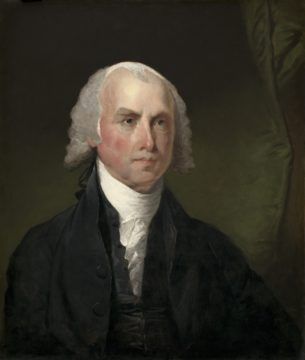
To some degree, Americans have been spared the ravages of theocracies. We are perhaps most indebted to James Madison for that. Madison, sometimes called the father of the Constitution, understood well in advance of 1789 when the framers met in Philadelphia, that the new nation being formed needed to be free and clear of the factionalism so often created by religious zealots. In letters to his close friend Thomas Jefferson, Madison wrote, “When Indeed Religion is kindled into enthusiasm, its force like that of other passions is increased by the sympathy of a multitude….Even in its coolest state, it has been much oftener a motive to oppression than a restraint from it.”
I have no issues with religion per se. I think it genuinely helps some people navigate their lives and having a faith strong enough to maintain an unswerving optimism in the face of life’s hardships is even enviable. For the truly dispossessed and bereaved, a belief in God may be the last thing to cling to. Ralph Waldo Emerson, one of our great writers and a transcendentalist, called the religious sentiment “mountain air” and “the embalmer of the world.”
“It makes the sky and the hills sublime, and the silent song of the hills is it,” he said. Read more »
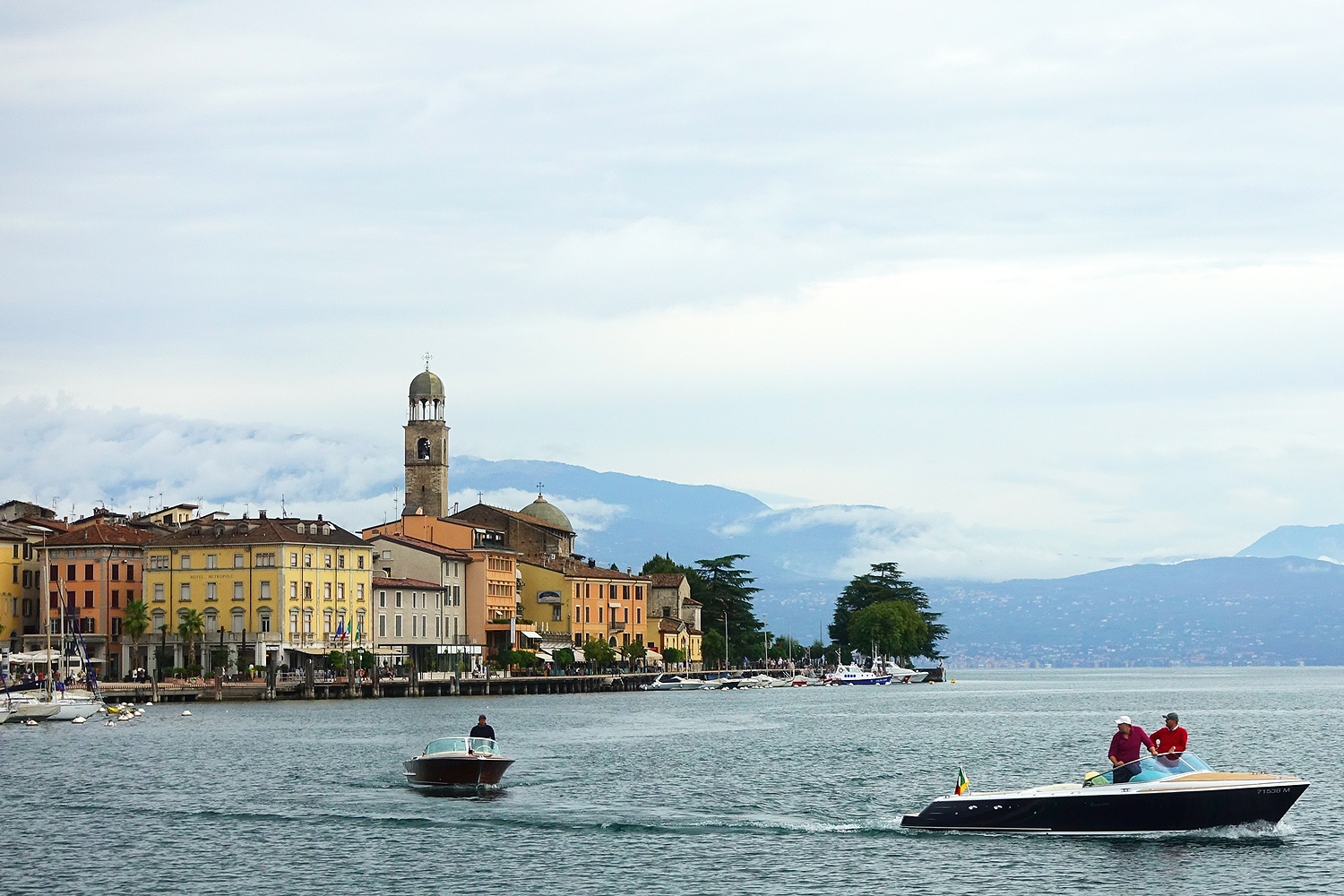
City of Salo on the southwest shore of Lake Garda in Italy. Photo taken last week.
by Mindy Clegg

Music provides a powerful means of shaping emotion and even actions. Most of the times, that’s a positive. A popular song can bring a group of strangers together in a shared experience. In times of uncertainty a good song can be an outlet for fears and frustration. In the wake of the overturning of Roe v. Wade pop stars helped give voice to the anger many Americans felt about the loss of an important civil right for women. Pop star Olivia Rodrigo dedicated her Glastonbury performance of Lily Allen’s “Fuck You” (with Allen) to the members of the Supreme Court who voted to end Roe protections.
https://www.youtube.com/watch?v=Fpc40dmPlVM
Historically, songs were employed by labor unions to create a sense of solidarity and move labor rights forward against overwhelming odds. If music can be a salve and a rallying cry, is the opposite true? History confirms this to be the case. I want to share three examples from global pop music history. First, white power punk bands emerged from the UK and US in the 1980s. Later that same decade also saw the emergence of turbofolk in the Balkans, which became the soundtrack of a violent strain of genocidal nationalism in the Yugoslav wars. More recently, a genre of music known as Hindutva pop found a ready and eager audience among the far right members of the Bharatiya Janata Party (BJP), Prime Minister’s Nerendra Modi’s political party. Read more »
by David Greer
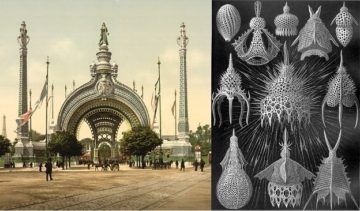
The 1900 Paris Exposition was a grand event, a world’s fair intended to honor the great achievements of the century just completed while heralding those of the century about to begin. In this spirit, architect René Binet designed a daring, futuristic entrance gate unlike anything ever seen before. It was as if he had had a prophetic vision, sixty years into the future, of a rocket launching into space. Binet’s concept, bizarre as it seemed, was far from imaginary. It was modelled after one of the most common creatures on Earth, though not one ever seen by anyone without a microscope. The animal that inspired the design of Binet’s Porte
Monumentale was a radiolarian, a form of zooplankton found in oceans everywhere.
The image of the radiolarian that so entranced Binet had been drawn by the German scientist Ernst Haeckel, a contemporary and admirer of Charles Darwin. Fascinated by the diversity of species and especially of the minute sea creatures seen through his microscope, Haeckel obsessively drew their forms in painstakingly detailed images. Reproduced in book form as Kunstformen der Natur (Art Forms in Nature), Haeckel’s images caught the attention of architects and designers and became an inspiration for the Art Nouveau movement, of which Binet’s radiolarian gate was an early example.
 Philip Guston. Still Life, 1962.