by Brooks Riley


by Brooks Riley
by David Oates
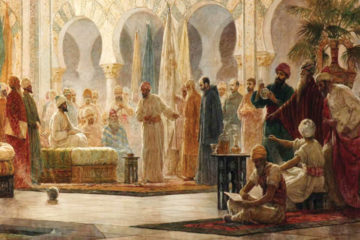
In the short month since the first installment of this exploration, the news has returned to our theme. A few days ago (at this writing) a new squabble broke out over America’s supposed “Judeo-Christian heritage,” this time in Boston itself, seedbed of our original revolution. It seems the city government has rejected a request to fly a “Christian flag” outside the city hall. The reasoning offered for this request (if repetition of cliches based on historical fantasy can be called “reasoning”) was that it sought to “enhance understanding of our Judeo-Christian moral heritage.”
I would suggest that the cultural conservatives who try to rebrand America as a “Judeo-Christian” culture are not, in fact, conservative – since our founders were explicitly not interested in revealed religion as a basis for the new country. As Part I of this essay showed (if briefly!), the Founders looked to reason; they trusted the testimony of experience; they studied the ancient republics and democracies. There is no democracy in the Bible. That founding value came from elsewhere.
So these “cultural conservatives” are better described as reactionary fantasists. It’s the usual thing in backward politics – pining for an imaginary past. Read more »
by Tim Sommers
When I was 15 years old I volunteered at a paleontological dig in Barnhart, Missouri. A car dealership expanding its parking lot had discovered a treasure trove of mastodon bones in the empty lot right next door. Mastodons are woolly mammoths’ smaller, less glamorous, cousins. Furry elephants, basically. They roamed the Americas until about 10,000 years ago. And Jefferson County, Missouri has more than its fair share of mastodon bones. It’s because of the clay. It seals them in airtight. And so we pulled out bones not fossils. We had to coat them with plastic soon after we exposed them to the air, before the decay set in, otherwise they crumbled like vampires exposed to the sun. But slower.
Most of us were amateurs. And we bent some rules. We dug under part of the road, propping up the black-top with bits of wood. Something I wouldn’t have thought possible if I hadn’t seen it. One day a semitruck rode over the propped-up bit of road while a guy was so far under you could only see his feet. He came out pale and shaky and that was the end of that.
It was a nerd’s paradise. For example, we held a 24-hour dance marathon to raise money for carbon-dating.
And I learned a lot. The most important thing I learned was that working at an excavation is a horrible job. Horrible.
It was slow and hot. Or slow and cold. So, slow. And wet. Mostly you dug up useless fragments of bone. If you found anything interesting, someone more experienced took over immediately. The holes – clay pits, really – filled up with water when it rained and had to be bailed out. Once I left there, I never thought about digging anything up ever again. Read more »
by Christopher Horner
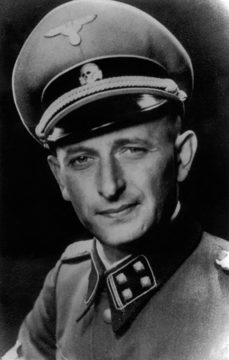
Adolf Eichmann was hanged in Jerusalem on June 1st 1962, a little after midnight. He had been found guilty by an Israeli court of ‘crimes against the Jewish people’ and ‘crimes against humanity’. One of the reasons he is still remembered – apart from the sheer scale of the crimes committed by him – is the he became the subject of a famous book: Eichmann in Jerusalem, by Hannah Arendt. It is a troubling and controversial text, but, I think, one that holds a good deal of interest for us today. For it hs something to say about the modern subject and the way we live today. Eichmann’s significance takes us to the heart of Arendt’s central concern – the very possibility of living together politically in the contemporary world. This is an issue of obvious concern to all of us.
The Banality of Evil
Arendt’s term for what she saw and heard in Eichmann has become famous: ‘The banality of evil’: Arendt’s identification of Eichmann as a somehow thoughtless man, one who replaced reflection on the murder he was committing by clichés and formulae has become famous, so much so that it too risks joining the army of clichés, another formula to replace thought. Yet the question remains: what was it about Eichmann that she saw as significant? What Arendt saw in Eichmann was something that remains present and troubling today. This was the abdication from genuine thinking and judging that she named, an absence that accompanied him through his role in the central crime of the Twentieth Century. The high-ranking Nazi, an agent of genocide was just a colourless bureaucrat. And the manner in which this functionary did evil was as far from the demonic or sadistic as one could imagine –it was banal indeed. Arendt did not claim that evil is a banal concept, but that those who sit in offices and bring it about it are just that: not monsters but ordinary people who do not think. This banality, or ordinariness, is the disturbing reality that makes Eichmann a kind of negative exemplar, a representative figure for our times. The trial gave Arendt the opportunity to encounter the phenomenon right in front of her eyes. Read more »
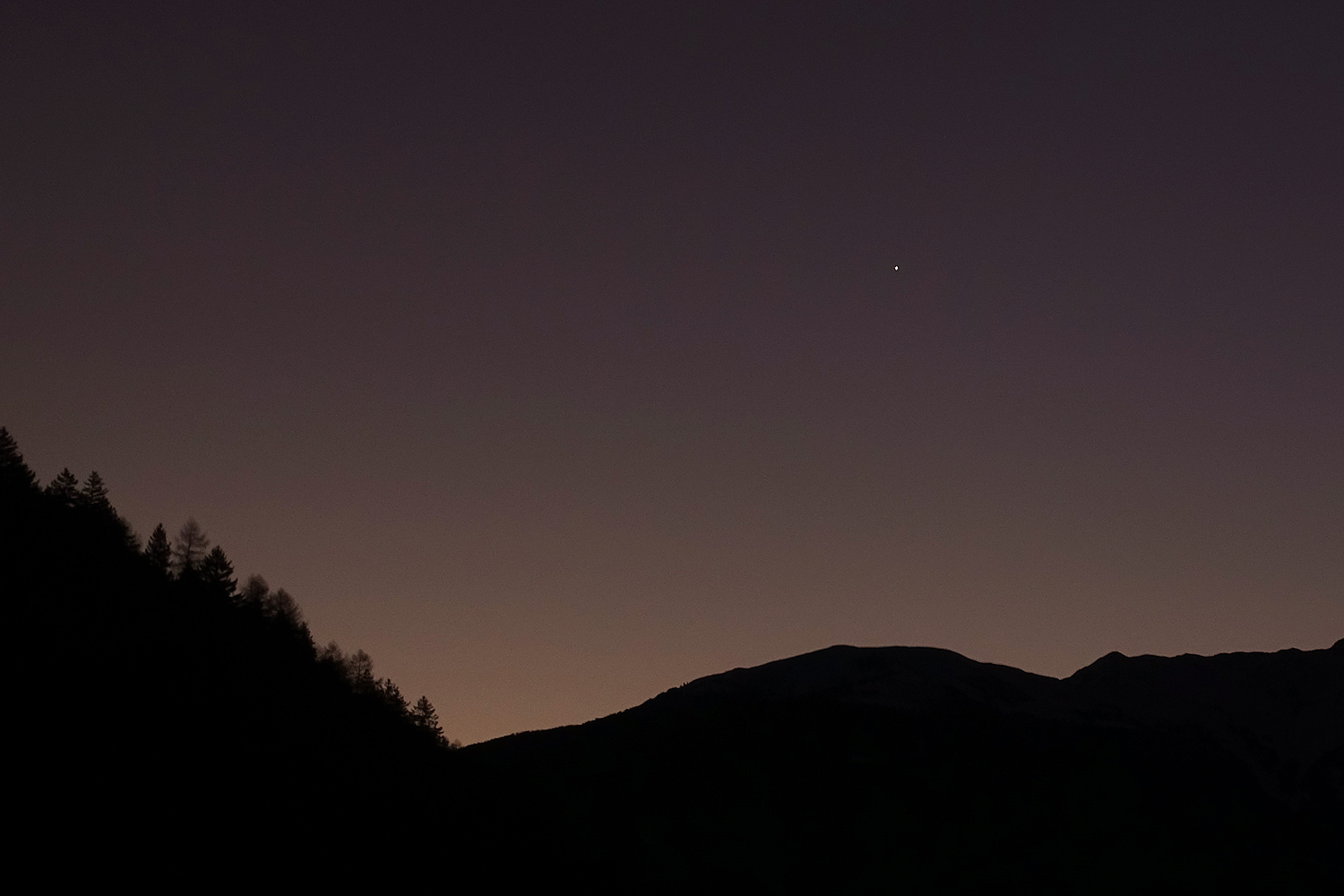
Taken from my window an hour ago.
by Peter Wells
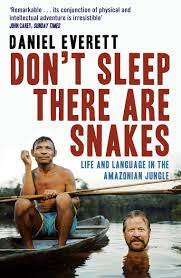 Daniel Everett’s 2008 book, Don’t Sleep, There are Snakes (Life and Language in the Amazonian Jungle), threw what seemed to be a pebble into the world of linguistics – but it is a pebble whose ripples have continued to expand. This might be thought surprising, in view of its curious construction. It contains a detailed description of the writer’s encounters with a small, remote Amazonian tribe, whom he calls the Pirahã (pronounced something like ‘Pidahañ’), but who apparently call themselves the Hi’aiti’ihi, roughly translated as “the straight ones.” They live beside the Maici River, a tributary of a tributary of the Amazon, which is nonetheless two hundred metres wide at its mouth.
Everett includes a harrowing description of a desperate journey to save the lives of his wife and daughter when they became seriously ill, and other incidents when his own life was in danger. He lovingly describes the sights and sounds of the rivers. He relates many anecdotes illustrating the culture of the Hi’aiti’ihi, and the relationships between them and the neighbouring populations. He draws lively thumbnail sketches of memorable characters he met.
He mentions, somewhat incidentally, his unsettled childhood and youth, with an allegedly alcoholic father. He reports that as a teenager he fell in love with, and married, the daughter of a local evangelical pastor, and turned his life around. He became a fervent Christian, and with his wife studied linguistics at the Summer Institute of Linguistics (now SIL International), a Christian non-profit organisation, whose main purpose is to translate the Bible into all the world’s languages. Read more »
by Pranab Bardhan
All of the articles in this series can be found here.
 Sometime before Ashok Rudra and I started on our large-scale data collection, I was already doing some theoretical and conceptual work on agrarian relations. My first, mainly theoretical, paper on share-cropping (jointly with TN) came out in American Economic Review in 1971. That paper was unsatisfactory and had quite a few loose strands, but it was one of the first papers to look theoretically into an economic-institutional arrangement of a developing country at the micro-level. This was a time when development economics was preoccupied with macro-issues like the structural transformation of the whole economy involving transition from agriculture to industrialization or problems of its aggregate interaction with more developed economies.
In a short trip abroad I presented my work on share-cropping in a seminar at Yale where my friend, Martin Weitzman who was teaching there, was present. He later told me that it made him start thinking of a more general context, that of sharing profits or revenues with workers in a modern firm that might resolve some macro-economic problems like unemployment—he later came out with a book on this titled The Share Economy.
Joe Stiglitz by that time had also moved to Yale, and asked me to stay overnight with him after my talk. That night at his home kitchen, as he was washing the dishes after our dinner, we kept on talking on various aspects of share-cropping. I told him that to me share-cropping was clearly an inefficient institution in agriculture, and yet it had been around for millennia in different parts of the world. We were both wondering why. Joe started looking at it from his point of view of imperfect information (the landlord unable to monitor how much effort the peasant put in). That led to his chain of thinking which ultimately produced his classic paper on share-cropping in 1974. Read more »
by David J. Lobina
(This is Part 2 of a brand new series of post, this time about the relationship between language and thought; Part 1 is here)
 A provocative title, perhaps, and perhaps also counterintuitive. One thinks in the language one speaks, everybody knows that. Why would anyone ask bilingual speakers which language they think in (or dream in) otherwise?
I suspect that what people usually have in mind when they ask such questions is related to the phenomenon of inner speech, the experience of internally speaking to ourselves, which may well be ubiquitous in adults (but probably not in children), though not entirely universal. I certainly think that inner speech plays a role in thinking, but not as central a role as most people seem to think (I will come back to this on a later post, probably in Part 4 of this series, where I will also discuss how writers of fiction use the narrative technique of “interior monologue” to outline some of the mental processes of a given character (thinking, feeling, etc.) – but mostly to argue that authors generally go about it the wrong way!).
The point I want to make in this post is that no-one thinks in any natural language; not in English, or Italian, or whatever, but in a language of thought, an abstract, unconscious and moreover inaccessible, conceptual representational system of the mind. Or at least I intend to provide some of the evidence, anecdotal and otherwise, that suggests that this is indeed the state of affairs. Read more »
by Hari Balasubramanian
 The slim, green book Natural History of Western Massachusetts is one of my favorites. Compressed into its hundred odd pages are articles and visuals that describe the essential natural features of the Amherst region, where I’ve lived since 2008. I turn to it every time something outdoors piques my interest — a new tree, bird or mammal, a geological feature.
One section that I particularly enjoy is the ‘Nature Calendar’ at the end. The calendar gives predictions on what to expect in each phase of a month; there’s approximately one prediction for every 3-day period. In early November, for example, it says “dandelions may still be blooming in protected areas”, and indeed some wildflowers do retain their bright colors despite freezing fall temperatures. It also says for the same month that “flocks of cedar-waxwings may be migrating through the region”. This was such a specific claim, but it is accurate: I was startled to see a flock of nearly a hundred waxwings swirling around bare trees on a rocky mountaintop this November.
The scientific analysis of such seasonal patterns is called phenology. Wikipedia defines it as “the study of periodic events in biological life cycles and how these are influenced by seasonal and interannual variations, as well as habitat factors (such as elevation)”. It’s a clunky, textbook kind of definition but the gist is clear enough. I find myself drawn to phenology for many reasons. Read more »
—for Danny, 1949-1976
When you caught that bird in flight,
that was a wild moment, the reflex of it,
as if you’d had the mind and eyes of a hawk,
as if in your world, mysterious to us all,
mother father sisters brothers—
as if in that world you flew above
less bewildered than we,
island brother,
eagle-eyed and quick,
whose aerie was ringed
by an invisible moat
At that time there was not even a name
for your bright, distant, blinking galaxy
so they dredged up whatever seemed useful
from their spent nomenclature:
retarded, they said,
as if a boy who could snatch a bird in flight
had a slow mind.
they should have more accurately called you
distant, as if a galaxy 10 billion light years away,
as far from us as our understanding
of what made you tick
So my mind was no help in knowing you.
Conveniently hobbled I excused myself
from the work of understanding.
Now I see you were in no way slow but
full of crushing frustration, confined by your moat
at the center of your island inarticulate
to the point of slamming your head with a palm
to jar loose what you could not say,
not tongue-tied but mind-tied,
kept by genetic leash from joining
our world of connection, striving to snap it
so that you might join in our jokes
……………………… ……join in our sadness
or have us join with you in yours
And all the while I circled your moat
in relative freedom. I gazed across seeing you
self-contained to the point of desperation
jangling mom’s ring of measuring spoons
next to your ear, gone in the small joy
of hearing the peal of their teaspoon bells
but…………….
……….. dropping them
………… at the quick flicker of wings
……..….to catch your bird
Jim Culleny
4/13/18
by Mary Hrovat
 Everything in the universe that’s visible from your location on Earth passes by overhead every day. We’re usually able see only the stars, galaxies, planets, and so on that are in the sky when the sun is not; we become aware of them when the sun sets and Earth’s shadow rises from the eastern horizon. But all of them are there at some point in the day. We picnic beneath the winter constellation Orion in summer and walk beneath the Summer Triangle on the short days of winter. The moon also crosses the sky every day, sometimes in the daytime, and sometimes too close to the sun to be seen.
Because we associate particular constellations with each season, and because the position of the sun on the sky indicates the time of year, in a sense all of time is up there in the sky too.
∞
The past is always arriving at Earth’s surface. All the visible light and other electromagnetic radiation reaching Earth comes from the past. The light from the sun and other bodies in the solar system is minutes to hours old. The light from the stars is ancient; some of it is older than Earth and the sun.
The oldest light you can see without using binoculars or a telescope may be that from the Andromeda Galaxy, which arrives from approximately 2.5 million years ago. Sensitive instruments can detect light much older than that, from more distant galaxies. The echo of the Big Bang, the cosmic background radiation, is the oldest light to reach Earth. You could say that some of the electromagnetic radiation reaching Earth is as old as time itself. Read more »
by Deanna Kreisel (Doctor Waffle Blog)
 I had my first panic attack at age sixteen, which was (deargod) over 35 years ago. It happened during school, much to my teenage mortification. Some friends and I were hanging out in our high school newspaper office during a free period, sprawled on one of the crapped-out couches under the blinking fluorescent lights, just shooting the shit. All of a sudden, a wave of horror swept over me—no, that’s not the right word. It was a feeling of fear mixed with a kind of existential dread, washing over me in waves, and then my heart was pounding, the walls were closing in, and I was gripped with an intense feeling of unreality. (This is something that people with panic disorder don’t often explain—or maybe it’s different for everyone. But for me the worst part of a panic attack is the feeling that the world is unreal, that you’re trapped in some kind of cruel simulacrum and everything around you is fake. You yourself are fake.[i]) Apparently I was also gasping and sobbing, and saying over and over again “I want to go home. I want to go home.”
The next thing I remember clearly was my father carrying me out of the room in his arms. This part seems so incredible to me—How did he get there? Who called him? How long did it take? Why did he leave work in the middle of the day?—that I sometimes wonder if I’ve misremembered it or mixed it up with another memory. But I have corroborated this detail with semi-reliable sources, so I’m going to leave it here for the sake of my narrative. (I would do a lot for narrative.) The truly odd part is that once we got home, I didn’t stop saying “I want to go home” over and over again, even though my dad kept reassuring me that I was indeed home now. Clearly he was not on board with The Narrative, or he would have recognized a Metaphor when he saw one. Read more »
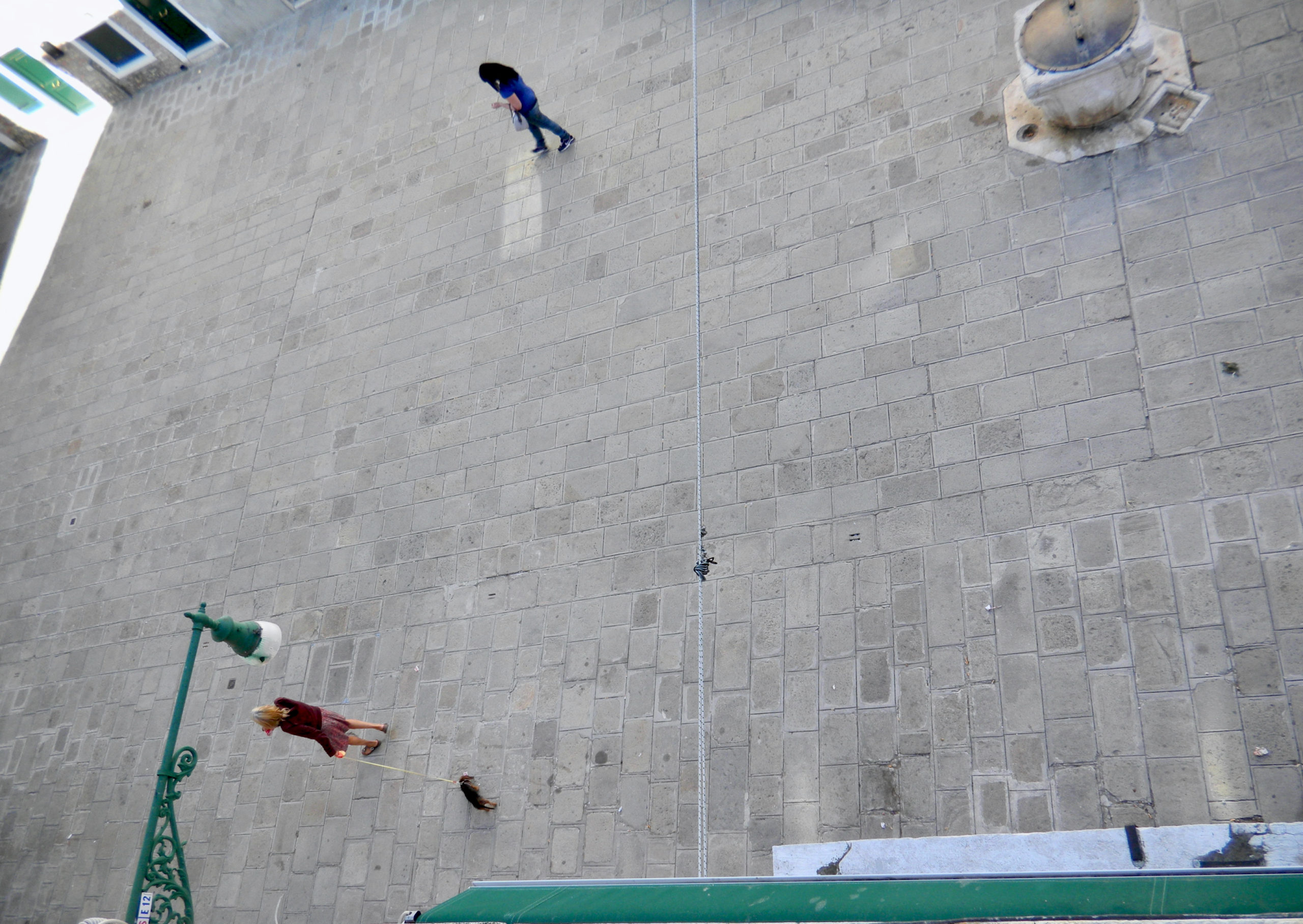 Sughra Raza. Another Morning. Venice, July 2012.
Digital photograph.
by Charlie Huenemann
 We primates of the homo sapiens variety are very clever when it comes to making maps and plotting courses over dodgy terrain, so it comes as no surprise that we are prone to think of possible actions over time as akin to different paths across a landscape. A choice that comes to me in time can be seen easily as the choice between one path or another, even when geography really has nothing to do with it. My decision to emit one string of words rather than another, or to slip into one attitude or another, or to roll my eyes or stare stolidly ahead, can all be described as taking the path on the right instead the path on the left. And because we primates of the homo sapiens variety are notably bad at forecasting the consequences of our decisions, the decision to choose one path and lose access to the other, forever, can be momentous and frightening. It’s often better to stay in bed.
Indeed, because every decision cuts the future in half, the space of possibilities is carved rapidly into strange and unexpected shapes, causing us to gaze at one another imploringly and ask, “How ever did such a state of things come to pass?” And the answer, you see, is that we and our compatriots made one decision, and then another, and then another, and before long we found ourselves in this fresh hot mess. And we truly need not ascribe “evil” intentions to anyone in the decision chain, as much as we would like to, since our own futuromyopia supplies all the explanation that is needed. We stumble along in the forever blurry present, bitching as we go, like an ill-tempered Mr. Magoo. Read more »
by Brooks Riley

by Mark Harvey
Suspended lion face
Spilling at the centre
Of an unfurnished sky
How still you stand –Phillip Larkin

In the very early and still dark hours on August 12, 2018, NASA launched the Parker Solar Probe from the coast of eastern Florida. A Delta rocket lit up the sky with fire as the probe slowly lifted off its launch pad. It gained speed quickly and within a couple of minutes was just a bright light miles above the earth, looking much like the sun for where it was headed. After about six minutes, it was traveling over 14,000 miles per hour and was out of sight. Within three years of its seven-year mission, the probe has broken all speed records of a man-made object, traveling at 330,000 mph this year. Ultimately the craft will reach speeds of 430,000 miles per hour.
Watching the launch live at Cape Canaveral was 91-year-old Eugene Parker, for whom the probe was named. In the video of the launch, Parker looks very much the professor he is, wearing a tweed coat, glasses, and a lanyard around his neck, presumably identifying him for entry into the viewing area. As the rocket launches, Parker’s mouth is agape and he appears to be in awe of the explosive force of the Delta rocket.
A little over a month ago, on December 14, 2021, NASA announced that the probe had flown into the sun’s outer atmosphere, known as its corona, and effectively touched the sun. The event actually had happened on April 28, 2021, some seven months before, but it took the scientists those months to analyze the data and realize what had happened. Read more »

Just a spider spinning a web in Amsterdam that I passed by on the street in November of 2021, stopping for a second to take this photo.
by Thomas O’Dwyer
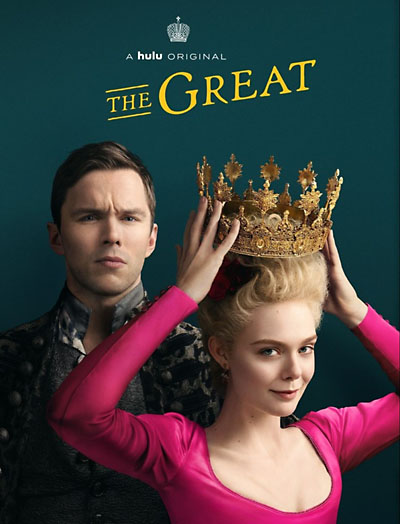
The Great is a splendid historical drama running on the Hulu streaming channel, a delightful and entertaining tale, full of joie de vivre, set in the court of Russian Emperor Peter III and his more famous consort, Catherine the Great. The only annoyance associated with this production is arguments online questioning how true it is. Many commentators seem to have missed the self-mocking tag line in the opening title of each episode: The Great: An Occasionally True Story and, later in the series, The Great: An Almost Entirely Untrue Story. The success of the British-Australian-American production has nothing to do with the quotidian facts of Peter and Catherine’s actual lives but with the racy, outrageous script, terrific cinematography, and endearing performances by Elle Fanning and Nicholas Hoult in the starring roles.
There are similar grumpy and pedantic debates over “how true” were events in The Tudors, Wolf Hall, The Crown. Indeed, any time a writer of historical fiction puts metaphorical pen to paper, the peeves begin. One can only counter by asking “how true” are the books written by professional historians. Does anyone read the anti-Semitic David Irving to learn about the Holocaust, or David Barton’s The Jefferson Lies, which the History News Network ten years ago named as “the least credible history book in print.” Ask just about anyone from any African country what they think of the histories of their continental cultures written by patronising palefaces in faraway imperial capitals. Read more »
A stray dog pulls apart a donkey’s corpse.
A camel pacing into the rushlight stomps on
mini sand-ruins of treads and tracks:
What did this: a quad bike, a Humvee?
A shadow lengthens on the beach.
Stars glow in Hi Rises inland from the sea’s edge.
People live in a bright hour, as Emerson said.
The bright falls. The night rises.
For Beena Sarwar, from photos she shared
by Mindy Clegg
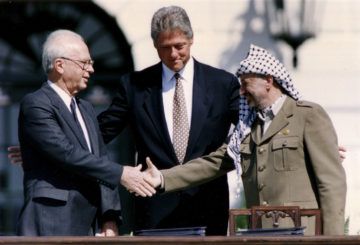
In the 1990s, many Republicans fell victim to Clinton derangement syndrome. Georgia Representative Newt Gingrich built a successful career out of this syndrome. The anti-Clinton antipathy had its adherents on the left, too, but for far more reasonable objections grounded in real policy differences. The Clinton administration in the US pioneered the pro-business, neo-liberalism of third way Democratic politics that continues to haunt the party to this day. Despite this, the far right wing of the GOP (now its core) has made the Clintons into Marxist monsters despite a lack of evidence to support this claim. Donald Trump benefited from the irrational hatred of Hillary Clinton in 2016 (and we’ve all been the worse off for it). She carried the blame for some of the unhappy outcomes of her husband’s administration. In the domestic sphere, we have seen a push further right on social and economic issues. The Clinton foreign policy has largely been rejected, too, as it was focused on multilaterialism and a continuation of George HW Bush’s New World Order concept. The Clinton foreign policy was built on an optimism that America need not do much as the ultimate victor of the Cold War. If the past 22 years have been dominated by terrorism, entrenchment of neo-liberalism (and resistance to it), and subsequent economic instability, the 1990s were a time of uncertainty but also hope that most of our international problems were solved. That turned out to be a false hope. Read more »