by Pranab Bardhan
All of the articles in this series can be found here.
 At age twenty-three, after a brief stint of teaching at Calcutta University, I, accompanied by Kalpana, proceeded to Britain on a Commonwealth Scholarship. The Scholars from different parts of India were asked to assemble in Delhi, from where we were to take the international flight. The only experience I had of an air flight before was when I flew from Kolkata to Guwahati, representing Calcutta University in an inter-University debating competition. That flight experience had not been good, as our propeller-driven Dakota plane had hit a supposed ‘air pocket’. So I had some unnecessary trepidation for the long Delhi-London flight.
A few months before I went to Delhi Jagdish Bhagwati, already a star economist, had written an article in EW advocating the case for devaluation of the Indian rupee, to which I wrote a kind of counter, arguing for a more general policy. When Jagdish read it in EW, he enquired with Sachin Chaudhuri who I was. I got a message from Chaudhuri that as I was soon to be in Delhi, Jagdish wanted to see me there. In Delhi he (and his colleague and partner, Padma Desai) took me to Delhi School of Economics. This was a good opportunity for me to know Jagdish particularly as his expertise was in International Trade Theory, an area I was planning to specialize in, and Jagdish gave me appropriate encouragement. I also met there K.N.Raj (more on him later), the doyen of Indian economists at that time—many years later when Samuelson at MIT challenged me if I knew any low-caste Indian economist, after a frantic mental search Raj’s name came handy. Read more »

 The gender wage gap is a well-documented phenomenon. Many are familiar with the claim that women earn 80 cents on the dollar. A more precise statement would be something like, “In the U.S., according to
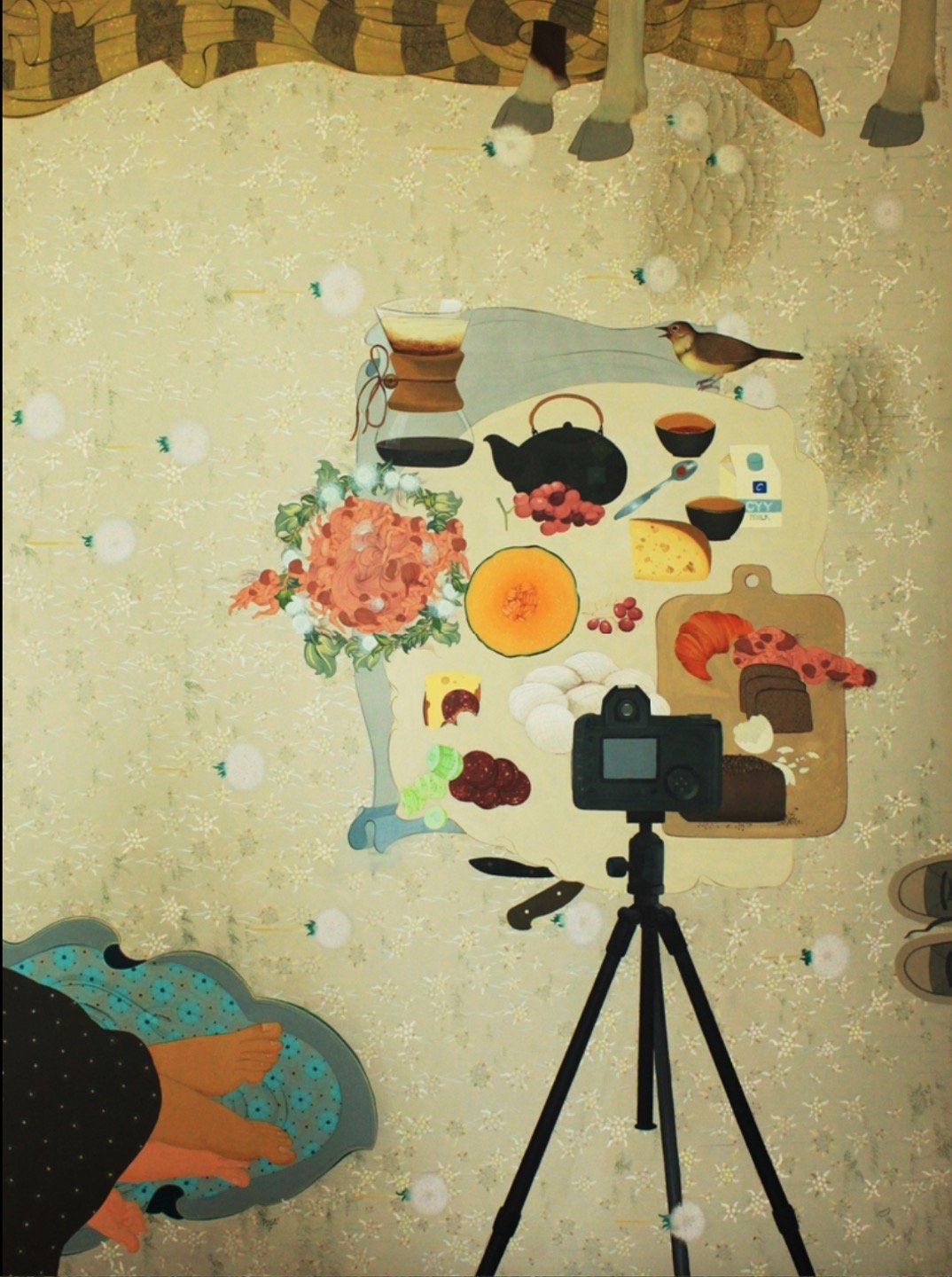 Uuriintuya Dagvasambuu. Aabam Beebem, 2019.



 1859 was not a bad year for publishing in Britain. Books that came out that year included Darwin’s On the Origin of Species, John Stuart Mill’s On Liberty, and George Eliot’s Adam Bede. The first installments of Dickens’ A Tale of Two Cities and Wilkie Collins’ The Woman in White also made their appearance. And Samuel Smiles published Self-Help.


 According to the website Rotten Tomatoes, there are four types of movies: good-good movies, good-bad movies, bad-good movies, and bad-bad movies. These types can be identified using the Rotten Tomatoes score for each movie, particularly the relationship between the critics’ score and the audience’s score. Let me explain. Rotten Tomatoes is a website that collects movie reviews and assigns them a rating of either “fresh” (if the review is positive) or “rotten” (if the review is negative). It then calculates the percentage of fresh reviews and assigns this as a score to the movie. If the score is 60% or greater, the film itself is considered fresh, whereas if the score is lower than 60%, the film is rotten. This is a useful way of rating a movie, but there’s a problem here, too. Let’s imagine every reviewer gives a movie three out of four stars, indicating a good film but not a great one. These reviews would all be classified as fresh, and the film would receive a misleadingly high score of 100% (The Terminator has a 100% rating, for example, while The Godfather does not). Let’s imagine another film receives all two out of four-star reviews. These would be classified as rotten, and the film would receive a rating of 0%, indicating one of the worst movies of all time. But the movie wouldn’t really be that bad.
 Is loneliness a choice? Is love?
 I live on an island. It happens to be a rather densely populated island, with a surface that seems largely covered by steel, masonry, glass, and architectural curtain wall, with nary a coconut or palm tree in sight. Still, it’s an island.
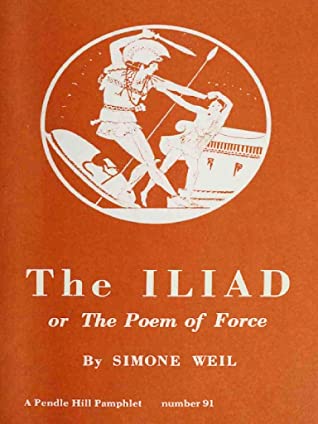 “The Iliad, or The Poem of Force” is a now-canonical lyrical-critical essay by the French anarchist and Christian mystic, Simone Weil. In it, Weil critiques the