
Review of Fernando Castrillon and Thomas Marchevsky (eds) Coronavirus, Psychoanalysis, and Philosophy: Conversations on Pandemics, Politics, and Society (Abingdon: Routledge, 2021)
by Claire Chambers
 In Salman Rushdie’s Midnight’s Children, the first-person narrator Saleem Sinai invites readers to imagine themselves in a large cinema, sitting at first in the back row, and gradually moving up, row by row, until your nose is almost pressed against the screen. Gradually the stars’ faces dissolve into dancing grain; tiny details assume grotesque proportions; the illusion dissolves or rather, it becomes clear that the illusion itself is reality.
This is a figurative way of talking about history’s distortions, or the difficulties of exploring contemporary events given the incomplete view afforded by a nearby vantage point.
Such a confusing closeness to dramatic and discombobulating scenes is discussed in some detail by both the editors of Coronavirus, Psychoanalysis, and Philosophy, as well as by Rocco Ronchi, an Italian philosopher and one of the contributors to the volume. In his essay ‘The Virtues of the Virus’, Ronchi observes: ‘We are too close to the Covid-19 event to be able to catch a glimpse of the future it bears. Our fear is human, and this makes us unreliable wi tnesses’. Meanwhile, in ‘Introduction: Of Pestilence, Chaos, and Time’, editors Fernando Castrillon and Thomas Marchevsky praise their authors’ boldness for investing in the risky business of writing about the coronavirus pandemic even while ‘knowing full well that they might be ridiculed or even dismissed outright for what at a later date could be read as ill-informed, judgmental, or simply short-sighted’. These are salient warnings for those of us who also wish to make a modest intervention into public debate on the current fast-moving and time-sensitive situation. Read more »
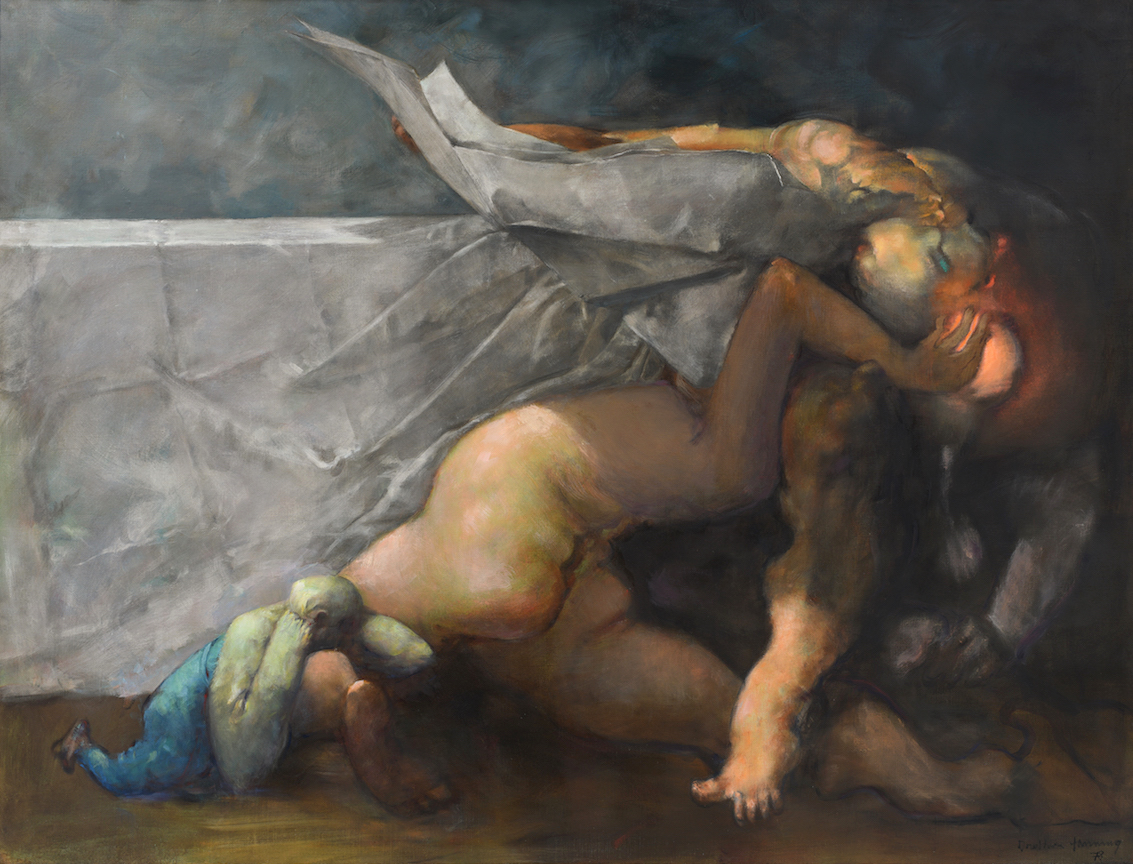 Dorothea Tanning. Notes for An Apocalypse, 1978.



 Covid has given rise to a variety of counterintuitive mathematical outcomes. A good example is this recent headline (link below): One third of those hospitalized in Massachusetts are vaccinated. Anti-vaxxers have seized on this and similar such factually accurate headlines to bolster their positions. They, and others as well, interpret them as evidence that the vaccine isn’t that effective or perhaps hardly works at all since even states with very high vaccination rates seem to have many breakthrough infections that lead to hospitalization. Contrary to intuition, however, such truthful headlines actually indicate that the vaccine is very effective. I could cite common cognitive biases, Bayes’ theorem, graphs, tables, and formulas to explain this, but a metaphor involving fruit may be more convincing and more palatable.
 Growing up in India I knew how hierarchical and status-oriented Indian society was, but the city of New Delhi took it to a bureaucratic extreme. I was told that in those days, if you gave out your Government quarters address, people would immediately know your approximate salary scale. The city’s residential pattern, inherited from the colonial rulers, was highly structured. If you are a top Secretary in a Ministry, your assigned quarters will be a large bungalow with acres of gardens in prize real estate in the city center, often a short distance from your office which you traverse in a chauffeur-driven official car. But if you are a lowly clerk or an orderly/peon in the same office building, you’ll come in a crowded bus from many miles away often outside the city.





 Sometimes our American ideas about social problems and how to fix them are downright medieval, ineffective, and harmful. And even when our methods are ineffective and harmful, we are likely to stick to them if there is some moralistic taint to the issue. We are the children of Puritans, those refugees who came to America in the 17th century to escape King Charles.