The Pilgrim and the Way

by Ethan Seavey

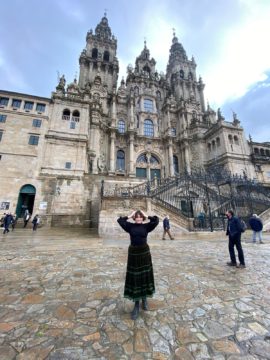
Praza do Obradoira. Photo by Ethan Seavey

On the Praza do Obradoira a young man falls to his knees and cries into his palms. I feel the sharp corners of the rocks dig into his aching knees. He can’t be older than 30 and at the sight of him I feel infantilized, because I am immature in passion and devotion. I could be filled with the feelings that bring him to tears right now but I am immature.

He is a modern-day pilgrim. He wears a large green backpack and his face is unshaven. His blonde hair is messy and his clothes are dirty. His father, standing behind him to the right, and his mother, to his left, are pilgrims too and match this description. But they are not on their knees and he is on his knees.

He has been walking for over thirty days, over ten miles each day, to complete the Camino de Santiago, or the way of Saint-James. And now he is prostrate before this, the revered Santiago de Compostela. Now his vision is spotted with tears which blend and blur the sharp stone lines;
he sees a watercolor of the Cathedral.

He looks up at it, his destination. I’m already inside, looking out on the square. I imagine the Cathedral from his eyes. The Baroque facade raises powerfully into the sky. It is intricate to the point of complication and confusion. You can really only focus on a small section at any given moment. The town is small but many villagers walk through the square around you. Some hug you and some cheer for you and some pray over you.

I don’t know what faith is but I find it beautiful from the exterior. Read more »
Monday Poem

Temporal Christmas

the verge of something new—
solstice, sunrise, a comet coming through,
sometimes it seems that angels tend,
stars align, low meets high—-
even ass and oxen gain a sense
that mutual otherness has been pretense,
a tale begins that glorifies the plain,
low things are magnified:
a snowball rolls through time,
gathers rituals, books, saints,
gains velocity, and multitudes believe
God’s entangled now, today–
homeless, streetwise, poor,
an ordinary human’s deified, yet
ultimately is turned away

Jim Culleny
12/24/17

Modern-Day Fascism: Paul Mason’s Strategy of Resistance

by Adele A Wilby

In today’s political world where liberal democracy is purported to have triumphed and ‘the end of history’ is supposed to be with us, many people might be content to rest on their laurels that fascism has been confined to the dustbin of political history, and at most its supporters on the fringe of contemporary politics. Not so however, for Paul Mason. For him ‘fascism is back’ and poses a real threat to democracies. Indeed, so convinced is he of his argument that fascism is emerging as a force to be reckoned with, his recent book How to Stop Fascism: History, Ideology, Resistance is a call to arms for greater understanding of its modern manifestations, and to resist its influence in politics.
An award-winning writer, Mason has many books to his credit. He is also a broadcaster and filmmaker and his reporting on events during the Greek debt crisis in 2015 while working as the Economics Editor for Channel 4 for several years, are memorable. But Mason is also one of those human beings who matches his intellectual work with political activism. He has been a relentless political activist with decades of resistance to fascism behind him that gives him the edge over the topic he takes on in the book: he has been exposed to the phenomenon and is familiar with fascism in political activist terms. Read more »

Unreliable Witnesses?

Review of Fernando Castrillon and Thomas Marchevsky (eds) Coronavirus, Psychoanalysis, and Philosophy: Conversations on Pandemics, Politics, and Society (Abingdon: Routledge, 2021)

by Claire Chambers

In Salman Rushdie’s Midnight’s Children, the first-person narrator Saleem Sinai invites readers to imagine themselves in a large cinema, sitting at first in the back row, and gradually moving up, row by row, until your nose is almost pressed against the screen. Gradually the stars’ faces dissolve into dancing grain; tiny details assume grotesque proportions; the illusion dissolves or rather, it becomes clear that the illusion itself is reality.

This is a figurative way of talking about history’s distortions, or the difficulties of exploring contemporary events given the incomplete view afforded by a nearby vantage point. 

Such a confusing closeness to dramatic and discombobulating scenes is discussed in some detail by both the editors of Coronavirus, Psychoanalysis, and Philosophy, as well as by Rocco Ronchi, an Italian philosopher and one of the contributors to the volume. In his essay ‘The Virtues of the Virus’, Ronchi observes: ‘We are too close to the Covid-19 event to be able to catch a glimpse of the future it bears. Our fear is human, and this makes us unreliable witnesses’. Meanwhile, in ‘Introduction: Of Pestilence, Chaos, and Time’, editors Fernando Castrillon and Thomas Marchevsky praise their authors’ boldness for investing in the risky business of writing about the coronavirus pandemic even while ‘knowing full well that they might be ridiculed or even dismissed outright for what at a later date could be read as ill-informed, judgmental, or simply short-sighted’. These are salient warnings for those of us who also wish to make a modest intervention into public debate on the current fast-moving and time-sensitive situation. Read more »

Our Judeo-Pagan Heritage, Part 1

by David Oates

U.S. Capitol East Facade Washington, DC.

Once again, wilted evergreen trees are appearing on city streets on trash day, with remorseful hints of tinsel and that gritty feeling of morning-after. And we are reminded that the mightiest of all our mongrel holidays has once again had its way with us.

Though Christmas is of course the master-holiday of the (mostly) (or at least somewhat) Christian West, it has long showcased the curious persistence of non-Christian and pre-Christian ways. Christmas trees and mistletoe ­­­­are holdovers from the forest-worshipping northern Europeans. There’s literally nothing Christian about them. When we welcome “Yuletide” we’re unwittingly celebrating a pagan festival –Yule from the Anglo-Saxon iul or giul ( and behind that from the Old Norse jol)  having been the winter solstice celebration of Druids and Vikings which our Christmas has, um, replaced. Or continued.

So the way we celebrate Christmas offers a fine meditation on the empty fantasy of purity, which plays almost no role in history as actually lived. Heathen traditions and pagan symbols: we just can’t quit you! It’s been on my mind lately because, on some rather more serious fronts of the culture wars, the Judeo-Christian Tradition has once again been trotted out to do battle, like some creaky, rusty old Crusader not allowed to go to a decent rest. Read more »

Why Death Might Not Be As Bad As You Think It Is

by Tim Sommers

Facing immanent death, his friends and followers inconsolable, Socrates, according to Plato, attempted to console them.

He called fear of death “the pretense of wisdom, and not real wisdom, being the appearance of knowing the unknown,” adding that “no one knows whether death, which they in their fear apprehend to be the greatest evil, may not be the greatest good.”

In other words, (i) death should only be feared if it is known to be bad; (ii) no one knows that death is bad; therefore, (iii) death should not be feared. The problem with (i), of course, is that some of our greatest fears, of the dark, for example, are fears about the unknown. Maybe, we should be afraid because we don’t know.

But Epicurus argued. “[D]eath is nothing to us, since everything good and bad lies in sensation, and death is to be deprived of sensation… [W]hen we are, death is not, and when death is present, then we are not.” So, (i) after we die, we no longer exist (or have sensations); (ii) Nothing is bad without being bad for someone who exists (and has sensations). Therefore, (iii) nothing can be bad for us after we die. Of course, (i) depends on already believing that we cease to exist at death, which seems obvious to me, but clearly a lot of people disagree.

But back to Plato. He had a better argument than “we don’t know”. Here it is. (i) Death is either like a peaceful, dreamless sleep, which is a good thing; (ii) Or death involves joining a permanent community of heroes and philosophers, which is also a good thing. Therefore, “Whichever of these it is, death is a good thing.” Now, the “permanent community of heroes and philosophers” bit is very culturally specific, so let’s adjust (ii). Replace the “permanent community of heroes and philosophers” with whatever you think the after life is like. Or we might just say that if death is more than a peaceful sleep, it involves something new and, hopefully, interesting, or at least not terrible. But this has a problem similar to the one that bedeviled Socrates’ first argument. Read more »

Signifying Bullshit

by Chris Horner

It is everywhere: the production of words designed to promote the fiction that something positive and good is happening, even though it isn’t.  It comes courtesy of the people you work for, the retail outlets you shop from, and the government organisations that regulate your life. An example: a large organisation develops and with fanfare publishes a document laying out its ‘values’ – under titles like ‘ trust’, ‘inclusivity’, ‘courage’, diversity’, and ‘respect’. It stresses how the individual is valued, the importance of diversity in the workplace, mental health, freedom from harassment and so on. This extends to recruitment and promotion: everywhere diversity, respect and fairness rule: they are ‘investing in people’. Meanwhile, workers at this place have had no real terms pay increase in a decade, overtime and overwork is commonplace, and the complaints system is bureaucratic and agonisingly slow. In the coronavirus epidemic, while desk bound staff were encouraged to work at home, catering and cleaning staff had to appear at the workplace as usual – and naturally, the lower paid stuff doing this are disproportionately female and black. Feeling stressed by the long hours and low pay? There’s an after hours yoga class for that, and a values document to read. 

The mass production of warm sounding words with minimal interest in real material outcomes is signifying bullshit (SB). It is nearly ubiquitous. A vast amount of time is spend promoting the idea to consumers that a pair of boots, or a coffee or a shampoo is somehow saving the planet or conquering hunger in Africa; the public is encouraged to tweet or post their reviews of the goods they’ve bought, as retailers and the media outlets that boost them all want your warm words, too. There’s an ocean of participation and inclusivity, although it is not clear who is reading all this stuff. Read more »

Wine, Art, and the Language of Representation

by Dwight Furrow

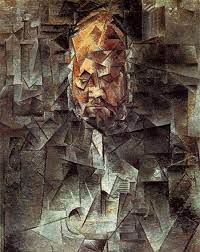
Portrait of Ambroise Vollard, Pablo Picasso

Many works of art seem to be about something. Even if they don’t convey a clear message, they nevertheless invite thought about a subject matter and thus can be said to represent an object, process, or state-of-affairs. Does this language of representation help clarify the sense in which some wines can be considered works of art? In what sense does a wine represent something?

The obvious candidate for the subject matter of a wine is its terroir—the soil, climate, weather, and other geographical and geological features of the place in which the grapes are grown. Wine presents a subject matter—the nature of its terroir—and invites us to explore it via the flavors, aromas, and textures of the wine, just as a painting presents a subject matter and invites us to explore it via line, shape, and color. Thus, wine has the “aboutness” relationship that is generally regarded as a necessary condition for representation.

But how does wine present a subject matter? What is the nature of this “aboutness” relationship? Read more »

The Vaccinated Are a Large Fraction of the Hospitalized — Not a Bad Thing

by John Allen Paulos

Covid has given rise to a variety of counterintuitive mathematical outcomes. A good example is this recent headline (link below): One third of those hospitalized in Massachusetts are vaccinated. Anti-vaxxers have seized on this and similar such factually accurate headlines to bolster their positions. They, and others as well, interpret them as evidence that the vaccine isn’t that effective or perhaps hardly works at all since even states with very high vaccination rates seem to have many breakthrough infections that lead to hospitalization. Contrary to intuition, however, such truthful headlines actually indicate that the vaccine is very effective. I could cite common cognitive biases, Bayes’ theorem, graphs, tables, and formulas to explain this, but a metaphor involving fruit may be more convincing and more palatable.
Let’s assume we have a very large casserole pan full of cherries and a small bowl of grapes. Say there are 500 cherries in the huge pan and 50 grapes in the small bowl. Further assume that the cherries alone have been treated with a substance that very substantially reduces spoilage and that nevertheless 3 of them are spoiled, as are 7 of the untreated grapes. Now for the perhaps obvious punchline, let’s identify these 550 fruit with people in a highly vaccinated state, the cherries with the vaccinated people, the grapes with the unvaccinated people, and the spoiled 10 pieces of fruit with those who are hospitalized. Read more »

Charaiveti: Journey From India To The Two Cambridges And Berkeley And Beyond, Part 24

by Pranab Bardhan

All of the articles in this series can be found here.

Growing up in India I knew how hierarchical and status-oriented Indian society was, but the city of New Delhi took it to a bureaucratic extreme. I was told that in those days, if you gave out your Government quarters address, people would immediately know your approximate salary scale. The city’s residential pattern, inherited from the colonial rulers, was highly structured. If you are a top Secretary in a Ministry, your assigned quarters will be a large bungalow with acres of gardens in prize real estate in the city center, often a short distance from your office which you traverse in a chauffeur-driven official car. But if you are a lowly clerk or an orderly/peon in the same office building, you’ll come in a crowded bus from many miles away often outside the city.
Since I used to go to office by bus (until a colleague started giving me a ride in his car), I also noticed a peculiar pattern in the plying of Delhi state buses, compared to the buses I was familiar in Kolkata. You are waiting at a bus stop along with dozens of other people of different age groups and different amounts of baggage with them, and you’ll see bus after bus skipping your stop, particularly if they don’t have to unload any passengers at that stop. (Economists, of course, will point out that the bus driver and conductor on fixed pay have no incentive to take more passengers). And if the bus does have someone getting off at that stop, it will stop some distance away, and by the time all the waiting passengers with their baggages run to reach there, the bus is likely to have sped off. Read more »

Monday, December 20, 2021

Oh! What A Lovely Christmas

by Thomas O’Dwyer

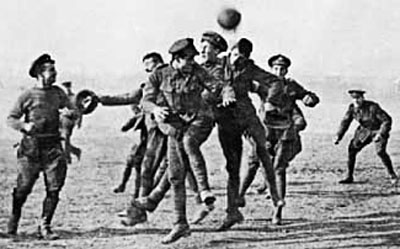
British and German soldiers play ball during the World War I Christmas Truce.
British and German soldiers play ball during the World War I 1914 Christmas Truce. Popperfoto/Getty

Christmas is one of the most remarkable festivals of human invention, a fact acknowledged by non-Christians no less than people of that faith. The arbitrary association of the birth of Jesus with December 25 merely added a new legend to a festival that was already thousands of years old in a variety of iterations that had the winter solstice as the common denominator. The traditions attached to the holiday have evolved down centuries of differing beliefs, legends, politics, lifestyles — though “tradition” may be too kind a word for the crass commercialism of the modern Christmas season in the United States of Dollarmania. It’s a far cry from Neolithic days and the people who built Stonehenge on Salisbury Plain in England and Newgrange in the Boyne Valley of Ireland, who oriented massive monuments to intercept the sunrise on the morning of the midwinter solstice. Archaeologists have revealed that the residents of Durrington Walls near Stonehenge held large festivals coinciding with this turning point from shortening to lengthening days. And so it began, the accretion of customs, festivities, eating and drinking, link after link down the chain of time to our “Ho ho ho! Buy buy buy!”

Romans dedicated the feast to Saturn, and medieval Europeans booted him aside to celebrate Christ’s Mass, dovetailing devotion with drunken partying. Victorians shaped the modern Christmas sentimentally chronicled by Charles Dickens. Drunken public partying of past centuries gave way to sober child and family-centred celebrations inspired by Queen Victoria, Prince Albert and their nine children. Albert introduced the Christmas tree from his native Germany. Children’s gifts, Christmas cards, crackers, and plum pudding followed, and turkey replaced the traditional goose for dinner. Santa Claus, who had morphed from Saint Nicholas of Myra in Byzantium via Sinterklaas, whom Dutch settlers brought to New York, now appeared on his reindeer sleigh in the Christmas Eve sky over England. American poet Clement Clarke Moore had defined the concept of Santa that still endures — costume, sleigh, reindeer, global gift-giving, chimney antics — in his poem A Visit from St. Nicholas (also called The Night Before Christmas). Read more »

Riding an empty suit

by Charlie Huenemann

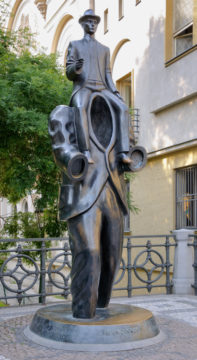
Statue of Kafka by Jaroslav Rona, Prague

A man rides an empty suit. The suit tells others what to think of the man, though it would not fit him. The man does not control the suit, but merely takes a ride upon it, come what may.

In his twenties, Franz Kafka composed a long story, “Description of a Struggle”, which remains one of his most enigmatic works. It follows a dream-like logic from a party, to a stroll through Prague, to an encounter with “a monstrously fat man” being borne in a litter by four naked men, to a supplicant once known by the fat man who prayed by bashing his own head against the stone floor of a church, to a final scene on a mountaintop, where a stabbing takes place, though it does not seem to be very consequential. The end. 

Max Brod thought it was a work of genius, though John Updike thought it was adolescent posturing. (¿Por qué no los dos?) Like all of Kafka’s works, it shows up on your doorstep like a locked desk that you are sure contains something you need, but the key is locked inside it; and when you finally bash the desk open, you find your own corpse with a toe tag reading “GUILTY OF BREAKING THE DESK”. Maybe some of the strange imagery Kafka himself could neither explain nor control, maybe some of it spoke of his own secrets, maybe all of it is an existential parable. 

One thing is for sure: the story shatters in every way. We might expect a story with a beginning, middle, and end: nope. We might expect some clarity about just whose story it is: nope. We might expect facts to stay fixed, or people to inhabit their own bodies: nope. We might expect some thread of consistency, conversations that make even minimal sense, words of wisdom that do not culminate in irrelevant banalities. Nope, nope, nope. That the work is offered as a story, and even as a description, is an exaggeration. It’s something, all right, and we may try to read it as a story, but the damned thing will not cooperate. It keeps falling apart the more we try to hold it together, like a human life, come to think of it. Read more »

Monday Poem

Gabriel’s Mad Ave. Apocalyptic Horn

…. “I’m still dwelling on how ironic all the feverish proclamations of capitalism
…. are going to look someday.” 
—Justin E. H. Smith, Philosopher

I’m through with dumpster dinnersSee the source image
at the corner of Wall Street and New
I’m so unsold by the Coke sign’s faded blush
that thrusts from desiccated dollar dunes,
an embarrassment, a crass embellishment
stuffed in the cleavage of a spent whore
who promised eternal bliss but ended a hag
with smeared lips and hellish scent,
cyclone’s gone that slew the sacred cow
when gangs of suited crooks blew through
with milking stools to sit beside her tits of gold
with digits itching to draw her dry
with lips pursed to suck her blood
with a singeing sort of lust, twisted,
a rusty screw that drills down and down
until nothing’s left to suck or bust,
I’m done . . . we’ve lurched too long through
spoiled earth as Gabriel’s Mad Ave.
apocalyptic horn rather croaked than blew
.
by Jim Culleny
9/13/14

Does AI Need Free Will to be held Responsible?

by Fabio Tollon

We have always been a technological species. From the use of basic tools to advanced new forms of social media, we are creatures who do not just live in the world but actively seek to change it. However, we now live in a time where many believe that modern technology, especially advances driven by artificial intelligence (AI), will come to challenge our responsibility practices. Digital nudges can remind you of your mother’s birthday, ToneCheck can make sure you only write nice emails to your boss, and your smart fridge can tell you when you’ve run out of milk. The point is that our lives have always been enmeshed with technology, but our current predicament seems categorically different from anything that has come before. The technologies at our disposal today are not merely tools to various ends, but rather come to bear on our characters by importantly influencing many of our morally laden decisions and actions.

One way in which this might happen is when sufficiently autonomous technology “acts” in such a way as to challenge our usual practices of ascribing responsibility. When an AI system performs an action that results in some event that has moral significance (and where we would normally deem it appropriate to attribute moral responsibility to human agents) it seems natural that people would still have emotional responses in these situations. This is especially true if the AI is perceived as having agential characteristics. If a self-driving car harms a human being, it would be quite natural for bystanders to feel anger at the cause of the harm. However, it seems incoherent to feel angry at a chunk of metal, no matter how autonomous it might be.

Thus, we seem to have two questions here: the first is whether our responses are fitting, given the situation. The second is an empirical question of whether in fact people will behave in this way when confronted with such autonomous systems. Naturally, as a philosopher, I will try not to speculate too much with respect to the second question, and thus what I say here is mostly concerned with the first. Read more »

Am I a robot?

by Robyn Repko Waller

Photo by ThisIsEngineering from Pexels

Recent news heralds the advancement of the first living robots,” the scientifically exciting xenobots, and their astonishing ability to self replicate.

Xenobots are millimeter-sized life forms comprised of complexes of frog stem cells (from the species Xenopus laevis), whose shape is tailor engineered by AI according to their human-prescribed task. Capable of locomotion and transport, thanks to their rigid structure and contracting, xenobots  have the potential to aid in localized medicine delivery and vital maintenance and clearing functions within a living system. Xenobots may even help gather and clear microplastics. All this from a biodegradable lifeforms, capable of sustaining itself without supplementary nutrients for weeks.

And now researchers Joshua Bongard and Michael Levin and a team of scientists at University of Vermont, Tufts, and Harvard have demonstrated that xenobots can self-replicate, or reproduce, with “parent” xenobots constructing “offspring” xenobots who then in turn produce third-generation offspring xenobots, etc. Evolutionary success? The key being their characteristic Pac-man form — a form determined by an evolutionary algorithm from billions of configurations to be optimally conducive to self-replication.

That xenobots are a medical and environmental breakthrough is obvious and scientifically exhilarating. Here I will set aside their groundbreaking applications and technological potential to ask a more philosophically motivated question. Read more »

Language and Thought, Part 1: Framing the Issue

by David J. Lobina

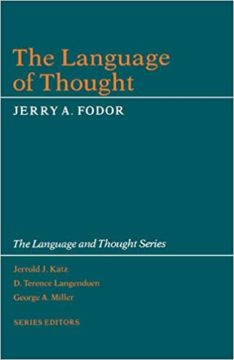
Jerry Fodor’s 1975 book, The Language of Thought, which one day I shall rewrite.

A new post, a novel series, and back to all things cognitive science about language. In this chapter of this column, which hopefully won’t feature any politics but perhaps a little bit of ideology, I will focus on the very thorny issue of how language and thought relate. Or said otherwise, the issue of whether we think in a natural language such as English or Italian, or instead in something else together – in The Language of Thought (LoT), as I shall in fact argue!

The question of how language and thought relate is possibly time immemorial, and the extant literature too large to review satisfactorily in a series of posts. Such a description of the general state of affairs won’t surprise anyone; what may raise a few eyebrows, perhaps, is the claim that large tracts of the modern literature are afflicted by two rather important problems. Firstly, scholars focused on this relationship are hardly ever clear as to what they take language and thought to be exactly, as definitions are rarely put forward; and complementing this, the very same scholars are usually rather vague regarding how language and thought are supposed to relate at all. Read more »