
by Michael Abraham-Fiallos
I knock at the bathroom door.
“You alright, hun?”
No pause. “Yeah, I’m fine! Just bad today.”
I try to keep any sign of pity out of my voice—nobody likes to be treated like a patient—“I’m sorry. Can I get you anything?”
No pause. “No, I’m fine! Love you.”
“Love you, too.”
My husband has a chronic, invisible disability called microscopic colitis. It is a bowel disorder, common in white women in their seventies and eighties. (He likes to joke that at least some part of him is privileged.) It causes pain, bleeding, and, quite often, a violently upset stomach. Marco is remarkably lighthearted about it, but it is the kind of disability for which one could be put on government assistance. Some days, I don’t even notice colitis. And then, some days, Marco is scarcely out of the bathroom. He has developed all of his own ways of coping with this, using music mostly to turn the bathroom into a kind of sanctuary. Most days are somewhere between these extremes. Colitis interrupts things here and there, causes us to miss movie credits or makes us late for dinner. I have no idea what it is like to be the one who suffers through missing movie credits or running late for dinner. I have no idea, either, of the pain—real, physical pain—that I can so simply gloss here as movie credits and dinner. For me, it is abstract. For him, it is embodied and immanently real. I only know what it is like to live adjacent to that suffering, to witness it and to try my best to respond to it with delicacy and care.
The first and most prominent thing I have learned in my five years of living with a man who has a disability is that those who live with disabilities are remarkably resilient. This almost sounds like a cliché. Of course they are, you’re thinking. But resilience is a more expansive thing than our typical idea of it. Read more »



 Sughra Raza. First Snow 2022.
 On the anniversary of the attempt by Donald Trump and some of his supporters to subvert the 2020 US presidential election, Joe Biden denounced those who “place a dagger at the throat of democracy.” To which one can only say: About bloody time! The threat posed by Trump and the Republican party to America’s democratic institutions–highly imperfect though they are–is so obvious that anyone who has a bully pulpit should be pounding out a warning at every opportunity.
 A large number of jobs exist not because they create economic value but because they make business sense given the institutions we have – customer expectations, bureaucratic regulations, and so on. They do not solve a real problem but a fake problem created by inefficient institutions. They therefore do not make our society better off but rather they represent a great cost to society – of many people’s time being expended on something fundamentally pointless instead of something worthwhile. One way of spotting such anti-jobs is to compare staffing in the same industry across different countries. US supermarkets employ people just to greet customers and bag groceries, for example, which would seem a ridiculous waste of time in most of the world. In Japan one can find people standing in front of road construction waving a flag (they are replaced with mechanical manikins on nights and weekends).



 At ISI we were assigned statistical assistants who’d take our large data analysis jobs to the IBM computer at the Planning Commission, but for relatively small jobs they’d do the calculations themselves by furiously rotating the handles of the small Facit mechanical calculator they each had, you could literally hear the noise of ‘data crunching’. This was before electronic desk calculators came to Indian institutions. I remember buying a small Texas Instruments calculator in a short trip abroad and was quite impressed by its capacity; and I told TN that I did not need to learn the operation of Facit machines, which I saw him cranking all the time. (This reminds me of a British economist, Ivor Pearce, who told me that just before the War he used to work for an accounting firm where they had not yet heard of log tables; he said he finished the whole day’s work in just an hour by using the log table and read books in his office the rest of the time). Of course, I am told today our tiny laptops/smartphones contain computing capacity million times larger than the biggest IBM machines in India at that time.




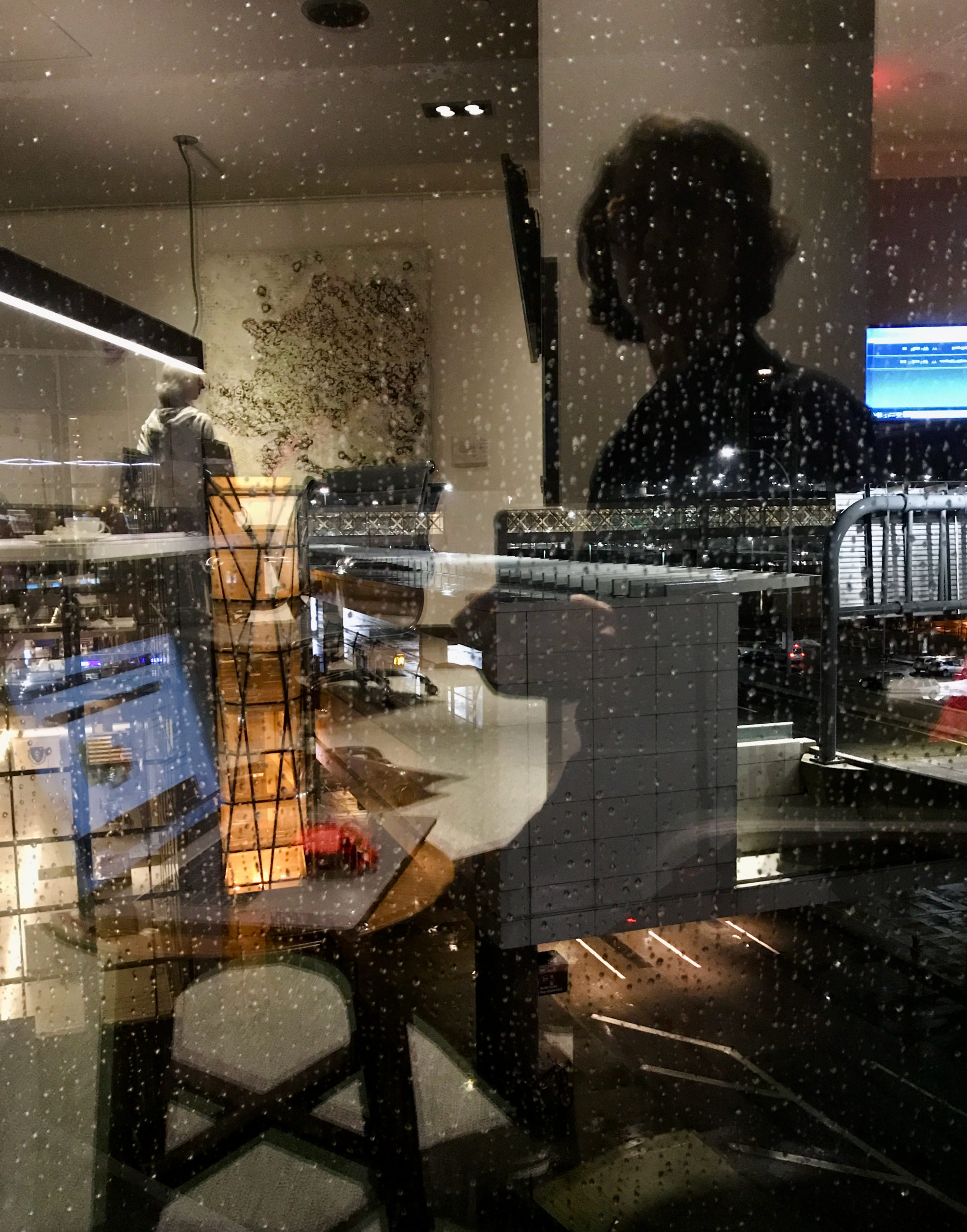 Sughra Raza. Rainy Reflection Self-portrait for 2022.
 January, 2022. East End, Long Island, NY. It’s getting colder. I just recovered from a bout with COVID. I am sitting around the fire pit sipping tequila, drinking homemade bone broth from a mug, and watching lists of very important dead people, ripped from various newspapers and magazines, burn in the fire. Life is good.