
by Bill Benzon
About a month ago Tyler Cowen posed the following question at Marginal Revolution, a blog he runs with along with his collegue Alex Tabarrok: Why has classical music declined? If you do a general web-search on that question you’ll see that it’s a popular topic. The ensuing discussion has had 210 remarks so far. That’s a lot, especially when you consider that Marginal Revolution centers on economics and closed allied social sciences, though Cowen does comment on the arts as well. Some responses are longish, somewhat detailed, and knowledgeable. Most are relatively brief. On the whole the quality of the discussion is high, but scattered, which is to be expected on the web.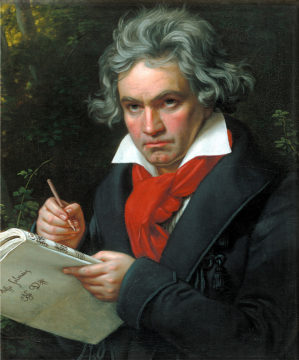
Cowen posed the question in response to a request from one of his readers, Rahul, who had asked:
In general perception, why are there no achievements in classical music that rival a Mozart, Bach, Beethoven etc. that were created in say the last 50 years?
Cowen offered several observations of his own. Here’s the first:
The advent of musical recording favored musical forms that allow for the direct communication of personality. Mozart is mediated by sheet music, but the Rolling Stones are on record and the radio and now streaming. You actually get “Mick Jagger,” and most listeners prefer this to a bunch of quarter notes. So a lot of energy left the forms of music that are communicated through more abstract means, such as musical notation, and leapt into personality-specific musics.
Yikes! From Mozart to the Rolling Stones, that’s quite a lot of musical territory – one reason, perhaps, that the discussion was scattered.
In this piece I treat the discussion as a collection of dots. I draw lines between some of them and color in some of the shapes that emerge. Read more »
 The Naxalite phase in Bengal was a short, tragic chapter in politics, but in Bengal’s cultural-emotional life its implications were deeper, and reflected in its literature (and films)—most poignantly yet forcefully captured by the writer Mahshweta Devi, one of Bengal’s most powerful political novelists. Again and again in the 20th century some of Bengali youth have been fascinated by the romanticism of revolutionary violence–as was the case in the early decades in the freedom struggle against the British (I have earlier mentioned about my maternal uncle caught in its vortex), then again in the 1940’s when the sharecroppers’ movement (called tebhaga) was soon followed by a period of communist insurgency in 1948-50, and then in the Naxalite movement of the late 60’s and early 70’s.


 Whitfield Lovell. Kin XLV (Das Lied von der Erde), 2011.
 Not long ago, having steeled myself for the read-through of yet another dry but informative assessment of the body’s immune response to Covid 19 and her variant offspring, I was pleasantly surprised to find myself being dragged into a barbaric tale of murder and mayhem, full of gory details and dire strategies.
 We tell ourselves stories in order to live.

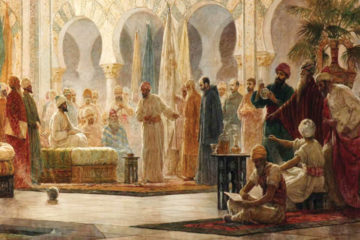


 Daniel Everett’s 2008 book, Don’t Sleep, There are Snakes (Life and Language in the Amazonian Jungle), threw what seemed to be a pebble into the world of linguistics – but it is a pebble whose ripples have continued to expand. This might be thought surprising, in view of its curious construction. It contains a detailed description of the writer’s encounters with a small, remote Amazonian tribe, whom he calls the Pirahã (pronounced something like ‘Pidahañ’), but who apparently call themselves the Hi’aiti’ihi, roughly translated as “the straight ones.” They live beside the Maici River, a tributary of a tributary of the Amazon, which is nonetheless two hundred metres wide at its mouth.
 A provocative title, perhaps, and perhaps also counterintuitive. One thinks in the language one speaks, everybody knows that. Why would anyone ask bilingual speakers which language they think in (or dream in) otherwise?
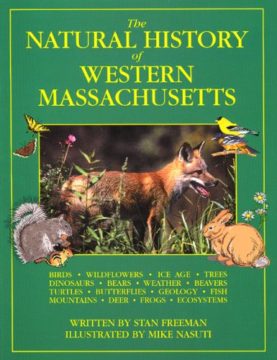 The slim, green book Natural History of Western Massachusetts is one of my favorites. Compressed into its hundred odd pages are articles and visuals that describe the essential natural features of the Amherst region, where I’ve lived since 2008. I turn to it every time something outdoors piques my interest — a new tree, bird or mammal, a geological feature.