
by Jochen Szangolies
Time presents itself, depending on the context, under two different modalities: cyclical and linear. Linear time moves always forward, carrying us from past to present, ever towards an uncertain future; while circular time, the time of clock hands, sunrise and sunset, and recurring seasons, sees us back again at our origin.
These would seem to be somewhat in tension. But I find that time, perhaps like all the great mysteries, is only enriched by its seeming contradictions. Take ‘stopping time’, as it is sometimes portrayed in movies—that is, holding everything frozen. How long does such a state last? What is the difference between it lasting an hour, a day, or an eternity? In the absence of change, time is robbed of duration. But in an instant of time, there can be no change. Hence, any instant, it seems, might as well be an infinity, held in the palm of your hand.
We have just come out the tail end of one of the cycles of time punctuating our lives, and emerged into a new one—at least according to the Gregorian calendar. Perhaps it is natural, then, to muse about the way time seems to both sweep us away while, on the arc traced by the Earth around the Sun, always returning us to the same places again—changed, but the same. Read more »
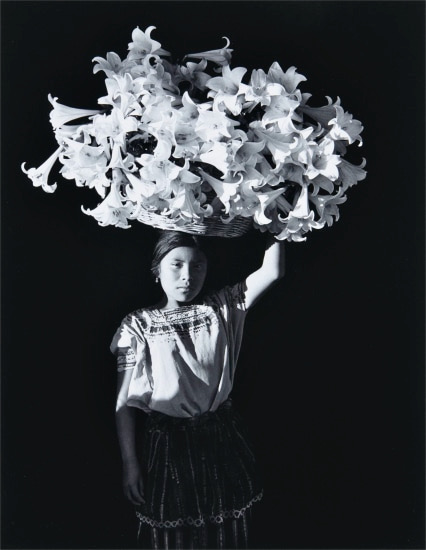 Flor Garduno. Basket of Light, Sumpango, Guatemala. 1989.
 In 1965, John McPhee wrote an article for The New Yorker titled “
 Watching the Oathkeepers cry during the federal court trials under the charge of sedition, I considered the fate of seditious Loyalists during the Revolutionary War whom they most closely resemble in the topsy-turvy world of contemporary politics. The Revolutionary War was a civil war, combatants were united with a common language and heritage that made each side virtually indistinguishable. Even before hostilities were underway, spies were everywhere, and treason inevitable. Defining treason is the first step in delineating one country from another, and indeed, the five-member “Committee on Spies’ ‘ was organized before the Declaration of Independence was written.
 In 2022, I worked harder than before to keep my students’ tables free of smartphones. That this is a matter for negotiation at all, is because on the surface, the devices do so many things, and students often make a reasonable, possibly-good-faith case for using it for a specific purpose. I forgot my calculator; can I use my phone? No, thank you for asking, but you won’t be needing a calculator; just start with this exercise here, and don’t forget to simplify your fractions. Can I listen to music while I work? Yeah, uhm, no, I happen to be a big believer in collaborative work, I guess. Can I check my solutions online please? Ah, very good; but instead, use this printout that I bring to every one of your classes these days. I’m done, can I quickly look up my French homework? That’s a tough one, but no; it’s seven minutes to the bell anyway and I prepared a small Kahoot quiz on today’s topic. (So everyone please get your phones out.)
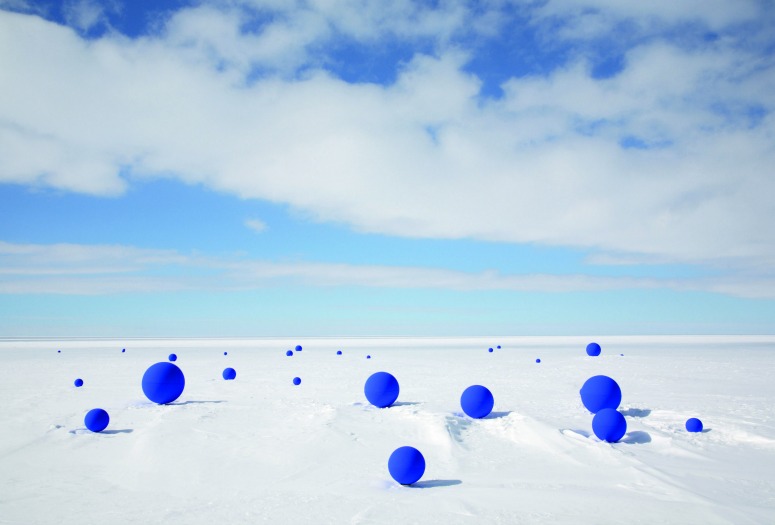 Lita Albuquerque. Southern Cross, 2014, from Stellar Axis: Antarctica, Ross Ice Shelf, Antarctica, 2006.
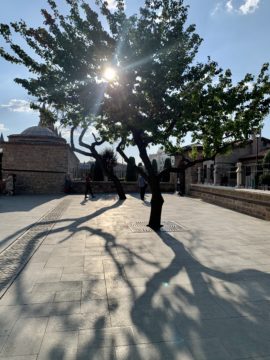 A tree in the vicinity of Rumi’s tomb has me transfixed. It isn’t the tree, actually, it is the force of attraction between tree-branch and sun-ray that seems to lift the tree off the ground and swirl it in sunshine, casting filigreed shadows on the concrete tiles across the courtyard. The tree’s heavenward reach is so magnificent that not only does it seem to clasp the sun but it spreads a tranquil yet powerful energy far beyond itself. It is easy to forget that the tree is small. I consider this my first meeting with Shams.
 I’m going to date myself in a significant way now: when I was in high school, we had to use books of trigonometric tables to look up sine and cosine values. I’m not so old that it wasn’t possible to get a calculator that could tell you the answer, but I’m assuming that the rationale at my school was that this was cheating in some way and that we needed to understand how actually to look things up. I know that sounds quaint now. I also remember when I used an actual book as a dictionary to look up how to spell words. Yes, youth of today, there were actual books that were dictionaries, and you had to find your word in there, which could be challenging if you didn’t know how to spell the word to begin with.