by Joseph Shieber

In a recent short post on “ChatGPT and My Career Trajectory,” the prominent blogger, public intellectual, and GMU economist Tyler Cowen sees AI as posing a threat to the future of public intellectuals. (For what it’s worth, Michael Orthofer, the writer of the excellent Complete Review book review website, seems to agree.)
Cowen writes:
For any given output, I suspect fewer people will read my work. You don’t have to think the GPTs can copy me, but at the very least lots of potential readers will be playing around with GPT in lieu of doing other things, including reading me. After all, I already would prefer to “read GPT” than to read most of you. …
Well-known, established writers will be able to “ride it out” for long enough, if they so choose. There are enough other older people who still care what they think, as named individuals, and that will not change until an entire generational turnover has taken place. …
Today, those who learn how to use GPT and related products will be significantly more productive. They will lead integrated small teams to produce the next influential “big thing” in learning and also in media.
I share Cowen’s sense that intellectuals (public or not) shouldn’t ignore the rapidly ever-more-sophisticated forms of AI, including ChatGPT. However, I’m not sure that Cowen is right to suggest that AI output will supplant human output – particularly if he’s making the stronger, normative claim that such a development is actually commendable.
There seem to be three reasons to interact with ChatGPT, all of which can be teased out from Cowen’s comments. First, you could treat ChatGPT as a content creator. Second, you could treat ChatGPT as a facilitator for your own content creation. Finally, you could treat ChatGPT as an interlocutor. (Of course, these ways of interacting with ChatGPT are not mutually exclusive.)
Let’s deal with these ways of interacting with ChatGPT in order. Read more »
 Flor Garduno. Basket of Light, Sumpango, Guatemala. 1989.
 In 1965, John McPhee wrote an article for The New Yorker titled “
 Watching the Oathkeepers cry during the federal court trials under the charge of sedition, I considered the fate of seditious Loyalists during the Revolutionary War whom they most closely resemble in the topsy-turvy world of contemporary politics. The Revolutionary War was a civil war, combatants were united with a common language and heritage that made each side virtually indistinguishable. Even before hostilities were underway, spies were everywhere, and treason inevitable. Defining treason is the first step in delineating one country from another, and indeed, the five-member “Committee on Spies’ ‘ was organized before the Declaration of Independence was written.
 In 2022, I worked harder than before to keep my students’ tables free of smartphones. That this is a matter for negotiation at all, is because on the surface, the devices do so many things, and students often make a reasonable, possibly-good-faith case for using it for a specific purpose. I forgot my calculator; can I use my phone? No, thank you for asking, but you won’t be needing a calculator; just start with this exercise here, and don’t forget to simplify your fractions. Can I listen to music while I work? Yeah, uhm, no, I happen to be a big believer in collaborative work, I guess. Can I check my solutions online please? Ah, very good; but instead, use this printout that I bring to every one of your classes these days. I’m done, can I quickly look up my French homework? That’s a tough one, but no; it’s seven minutes to the bell anyway and I prepared a small Kahoot quiz on today’s topic. (So everyone please get your phones out.)
 Lita Albuquerque. Southern Cross, 2014, from Stellar Axis: Antarctica, Ross Ice Shelf, Antarctica, 2006.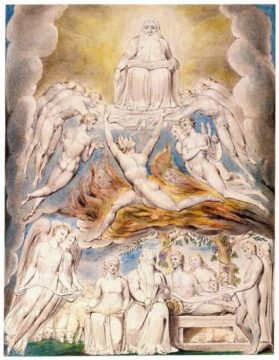
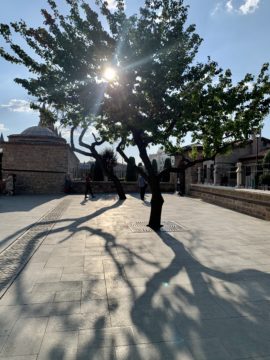 A tree in the vicinity of Rumi’s tomb has me transfixed. It isn’t the tree, actually, it is the force of attraction between tree-branch and sun-ray that seems to lift the tree off the ground and swirl it in sunshine, casting filigreed shadows on the concrete tiles across the courtyard. The tree’s heavenward reach is so magnificent that not only does it seem to clasp the sun but it spreads a tranquil yet powerful energy far beyond itself. It is easy to forget that the tree is small. I consider this my first meeting with Shams.