
The Literature of Limits IV: Hinduism, Forms, and the Infinite

by Muhammad Aurangzeb Ahmad
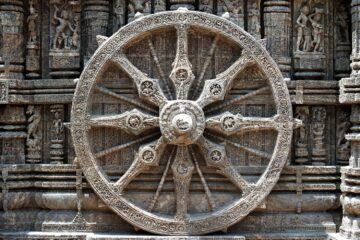
Image by Photo by Chaithanya Krishnan Creative Commons License

This is the last part of our discussion on the culture of limits (Part I, Part II, and Part III). In Hindu thought limits that define finitude and infinity were never opposed in a simple or antagonistic way. Instead, they were understood as mutually implicated. One could even say that they were woven together through cycles of manifestation and withdrawal, form and formlessness, appearance and return. The infinite was not something to be reached beyond the world, it was something already present within it. It was always unfolding rhythmically through time, consciousness, and matter. Philosophical expressions of Hinduism resisted the idea that ultimate reality could be exhausted by conceptual knowledge. The Upanishads repeatedly returned to the intuition that what is most real is also what is least graspable. Brahman, the ground of all being, was not an object among other objects, nor even the highest object of thought. It was that in which all objects, thoughts, and selves already participated. To know Brahman was not to acquire information, but to undergo a transformation of orientation. It was meant to be an inward turning in which the knower, the known, and the act of knowing were gradually revealed as inseparable.

The Upanishads, rather than offering systematic doctrines, offered sustained interrogations into the nature of self, reality, and knowledge, repeatedly returning to what resists articulation. Their method was deliberately indirect: aphorism, dialogue, paradox, and negation were used not to obscure meaning, but to prevent it from hardening into concept. Brahman was described as “not this, not that” (neti neti), not because it was inaccessible, but because any positive description would prematurely limit what was fundamentally unbounded. Knowledge, in the Upanishadic sense, did not accumulate toward mastery. It is supposed to turn inward, loosening the distinction between knower and known until insight emerged as recognition rather than discovery. In this respect, the Upanishadic discipline of unknowing closely paralleled later Sufi practices of ḥayra and self-refinement, where the failure of conceptual grasp was likewise treated not as an impasse, but as a necessary condition for deeper apprehension of reality.

This inseparability reshaped how limits were understood. Read more »

Monday, July 13, 2009

Desire Paths: Reading, Memory and Inscription

by Daniel Rourke

The urban landscape is overrun with paths. Road-paths pulling transport, pavement-paths and architectural-paths guiding feet towards throbbing hubs of commerce, leisure and abode.Beyond the limits of urban paths, planned and set in tarmac or concrete, are perhaps the most timeless paths of all. Gaston Bachelard called them Desire Paths, physical etchings in our surroundings drawn by the thoughtless movement of human feet. In planning the layout of a city designers aim to limit the emergence of worn strips of earth that cut through the green grass. People skipping corners or connecting distinct spaces vote with their feet the paths they desire. Many of the pictures on the right (from this Flickr group) show typical design solutions to the desire path. A delimiting fence, wall or thoroughfare, a row of trees, carefully planted to ease the human flow back in line with the rigid, urban aesthetic. These control mechanisms have little effect – people merely walk around them – and the desire path continues to intend itself exactly where designers had feared it would.

The technical term for the surface of a planetary body, whether urbanised, earth covered or extra-terrestrial, is regolith. As well as the wear of feet, the regolith may be eroded by wind, rain, the path of running water or the tiny movement of a glacier down the coarse plane of a mountain. If one extends the meaning of the term regolith it becomes a valuable metaphor for the outer layer upon or through which any manner of paths may be inscribed.

The self-titled first Emperor of China, Qín Shǐhuáng, attempted, in his own extravagant way, to re-landscape the regolith of time. By building the Great Wall around his Kingdom and ordering the burning of all the books written before his birth Qín Shǐhuáng intended to isolate his Kingdom in its own mythic garden of innocence. Far from protecting his people from the marauding barbarians to the West or the corrupting knowledge of the past Qín Shǐhuáng's decision to enclose his Kingdom probably expanded his subject's capacity for desire beyond it. There is no better way to cause someone to read something than to tell them they cannot; no better way to cause someone to dream beyond some kingdom, or attempt to destroy it, than to erect a wall around it. As we demarcate paths we cause desire to erupt beyond them. The regolith, whether physical or ethereal, will never cease to degrade against our wishes.

Read more »