
by Muhammad Aurangzeb Ahmad
This is the last part of our discussion on the culture of limits (Part I, Part II, and Part III). In Hindu thought limits that define finitude and infinity were never opposed in a simple or antagonistic way. Instead, they were understood as mutually implicated. One could even say that they were woven together through cycles of manifestation and withdrawal, form and formlessness, appearance and return. The infinite was not something to be reached beyond the world, it was something already present within it. It was always unfolding rhythmically through time, consciousness, and matter. Philosophical expressions of Hinduism resisted the idea that ultimate reality could be exhausted by conceptual knowledge. The Upanishads repeatedly returned to the intuition that what is most real is also what is least graspable. Brahman, the ground of all being, was not an object among other objects, nor even the highest object of thought. It was that in which all objects, thoughts, and selves already participated. To know Brahman was not to acquire information, but to undergo a transformation of orientation. It was meant to be an inward turning in which the knower, the known, and the act of knowing were gradually revealed as inseparable.
The Upanishads, rather than offering systematic doctrines, offered sustained interrogations into the nature of self, reality, and knowledge, repeatedly returning to what resists articulation. Their method was deliberately indirect: aphorism, dialogue, paradox, and negation were used not to obscure meaning, but to prevent it from hardening into concept. Brahman was described as “not this, not that” (neti neti), not because it was inaccessible, but because any positive description would prematurely limit what was fundamentally unbounded. Knowledge, in the Upanishadic sense, did not accumulate toward mastery. It is supposed to turn inward, loosening the distinction between knower and known until insight emerged as recognition rather than discovery. In this respect, the Upanishadic discipline of unknowing closely paralleled later Sufi practices of ḥayra and self-refinement, where the failure of conceptual grasp was likewise treated not as an impasse, but as a necessary condition for deeper apprehension of reality.
This inseparability reshaped how limits were understood. The world of multiplicity, namarupa (name and form) did not conceal reality so much as articulate it. Forms were not errors to be corrected, but expressions through which the infinite became perceptible. An implication of this way of thinking is that that without limit, nothing could appear. This logic found one of its most influential philosophical articulations in Adi Shankara. His non-dualism insisted that ultimate reality was without division, even while the world of experience appeared irreducibly plural. For Shankara, this plurality was neither absolutely real nor simply illusory. It was provisionally real i.e., true within the conditions of ordinary perception, yet surpassed in deeper insight. Limits existed, but they existed within a more fundamental continuity. Another thing that distinguishes Hindu thought from other civilizations is that the Hindu thinkers did not envision this continuity as being non-static. Hindu cosmology imagined reality as cyclical rather than linear. It was governed by vast rhythms of creation (sṛṣṭi), preservation (sthiti), dissolution (pralaya). Then then whole cycle repeats. Time itself became a medium through which the infinite expressed itself. There was no final culmination, no ultimate end point toward which history progressed. This cosmological vision shaped Hindu understandings of selfhood as well. The individual self (atman) was not conceived as an isolated unit bounded sharply against the world, but as a locus where cosmic reality became reflexive. The limit between self and world softened, not through erasure, but through insight.
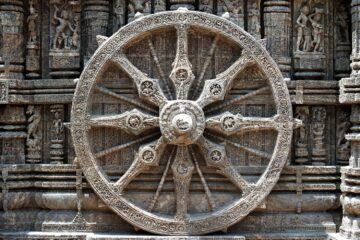
Hindu aesthetics mirrored this metaphysics. Temple architecture was meant to represent multiplied divine forms without fragmenting divinity itself. Iconography presented gods in countless manifestations, none of which claimed finality. The infinite appeared not through singular representation, but through abundance, through an excess of form that resisted reduction to a single image or meaning. Even philosophical disagreement became part of this rhythm. Competing schools debated but rarely aimed at total synthesis. This theory of metaphysics posited that the truth was not owned by a single system. This kind of thinking emerged via emphasis on plurality and contestation. It posited that limits, whether they are conceptual, doctrinal, and experiential, were not signs of failure, but markers of perspective. Seen in this light, the Hindu engagement with limits was neither tragic nor anxious. It did not seek to conquer the infinite, nor to dissolve entirely into it. Instead, it cultivated a way of living within a cosmos where finitude and infinity continually generated one another. Limits mattered not because they constrained reality, but because they gave it tempo.
This way of inhabiting limits was inseparable from Hindu conceptions of time, which unfolded across scales so vast that finitude itself became relative. Cosmological cycles of yugas, manvantaras, and kalpas stretched creation and dissolution across durations that dwarfed individual lifetimes and even entire civilizations. Against such immensities, no single moment or epoch could claim final significance. Insight unfolded not toward a terminal point, but across layered temporal horizons, each revealing only what its scale allowed. Time, in this vision, does not race toward completion. The limit was not an ending in time, but a measure within it, a way of situating human understanding within a cosmos whose rhythms exceeded comprehension. Across this series, different responses to the boundary of knowing have come into view: fracture, dissolution, encounter, and now rhythm. Hindu thought suggests that the deepest relation to the infinite may not lie in crossing boundaries or standing before them, but in moving with them i.e., again and again. We experience it in a where meaning is inexhaustive. Across these essays, the question of limits has returned in different guises, shaped by distinct intellectual temperaments and spiritual imaginations. In one tradition, the boundary of reason appeared as a fracture i.e., an abrupt recognition that the tools of thought could not complete the world they sought to explain. In another, the boundary dissolved, revealing that the self who sought to know was itself provisional. Elsewhere, the limit endured as a threshold, inviting reverent attention rather than conquest or erasure. And lastly, we talked about how the limit took on the character of rhythm. One way to think about it is in the form of a pulse within reality itself. What unites these responses is not a shared doctrine but a shared restraint. Each tradition, in its own way, learned that limits or lack thereof are a condition of meaning.