
Category: Recommended Reading
The Bobby Fischer Defense
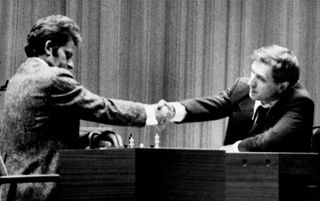
It would be impossible for me to write dispassionately about Bobby Fischer even if I were to try. I was born the year he achieved a perfect score at the US Championship in 1963, eleven wins with no losses or draws. He was only twenty at that point but it had been obvious for years that he was destined to become a legendary figure. His book My 60 Memorable Games was one of my earliest and most treasured chess possessions. When Fischer took the world championship crown from my countryman Boris Spassky in 1972 I was already a strong club player following every move as it came in from Reykjavík. The American had crushed two other Soviet grandmasters en route to the title match, but there were many in the USSR who quietly admired his brash individuality along with his amazing talent.
I dreamed of playing Fischer one day, and we eventually did become competitors after a fashion, though in the history books and not across the chessboard. He left competitive chess in 1975, walking away from the title he coveted so dearly his entire life. Ten more years passed before I took the title from Fischer’s successor, Anatoly Karpov, but rarely did an interviewer miss a chance to bring up Fischer’s name to me. “Would you beat Fischer?” “Would you play Fischer if he came back?” “Do you know where Bobby Fischer is?”
Occasionally I felt as though I were playing a one-sided match against a phantasm. Nobody knew where Fischer was, or if he, still the most famous chess player in the world at the time, was out there plotting a comeback. After all, at forty-two in 1985 he was still much younger than two of the players I had just faced in the world championship qualification matches. But thirteen years away from the board is a long time. As for playing him, I suppose I would have liked my chances and I said as much, but how can you play a myth? I had Karpov to worry about, and he was no ghost. Chess had moved on without the great Bobby, even if many in the chess world had not.
To the End of the Land

David Grossman is the Israeli writer of the hour. Although a celebrated novelist, he is also a distinguished journalist who, over the last 30 years, has written steadily in newspapers and magazines in response to almost every social and political event of any size or significance that has taken place in his country. The difference between the story-telling Grossman and the essayistic Grossman is instructive. In 1987 Grossman wrote The Yellow Wind, a journalistic account of three months spent in the West Bank, where he looked hard at Palestinian life under the Israeli occupation. Until that time, he had lived all of his 33 years in Jerusalem. By his own admission, when he looked at an Arab he saw not a fellow creature; he saw only an Arab. Those three months in the West Bank radicalized him. When, upon its publication, I read the book, it reminded me of books that had been written by white, middle-class American kids who’d gone south in the ’60s to discover for themselves what it really meant to be black in America.
more from Vivian Gornick at Boston Review here.
After Nature
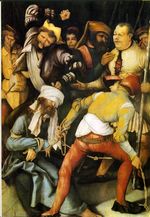
W.G. Sebald’s long poem Nach der Natur (1988) contributed significantly to the swift recognition of his literary talent among fellow writers and poets, yet it received scant attention by the larger public and literary scholars alike.1 To the English-speaking world it was not even available until 2002, a year after its author’s death, when it appeared in Michael Hamburger’s excellent translation under the title After Nature. Like a triptych, it is divided into three untitled parts, each with a distinct thematic concern involving a specific historical period and a writer or artist: the first focuses on the Renaissance painter Matthias Grünewald, the second on the eighteenth-century naturalist, travel writer, and Arctic explorer Georg Wilhelm Steller, and the last on elements from Sebald’s own biography.2 As opposed to Sebald’s later practice, apart from the landscape photographs that are reproduced on the end sheets of the first edition of Nach der Natur, there are no visuals in the volume, although paintings play a prominent role, especially in the first and final sections of the poem. In what follows, I shall support my reading of Sebald’s poem with reproductions of Grünewald’s paintings. I do so, however, in an attempt to provide a glossary, and I do not want to confuse this with Sebald’s own, later practice of including visuals in his texts.
more from Dorothea von Mücke at Nonsite here.
subversive Soviet superstructures
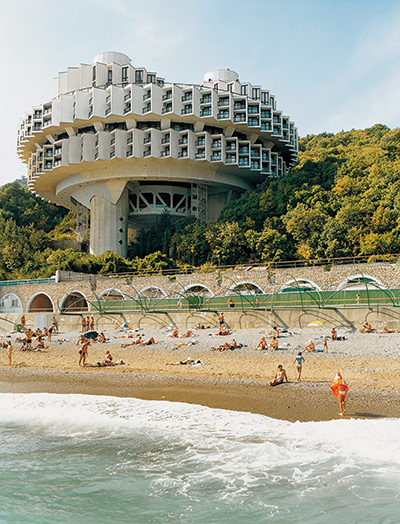
more from Frédéric Chaubin at The Guardian here.
The Negro as an American
From EmersonKent.com
Robert C. Weaver's The Negro as an American speech, delivered at Chicago, Illinois — June 13, 1963.
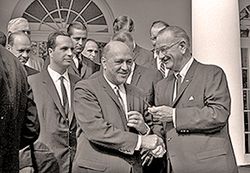
Most middle-class white Americans frequently ask, “Why do Negroes push so? They have made phenomenal progress in 100 years of freedom, so why don't their leaders do something about the crime rate and illegitimacy?” To them I would reply that when Negroes press for full equality now they are behaving as all other Americans would under similar circumstances. Every American has the right to be treated as a human being and striving for human dignity is a national characteristic. Also, there is nothing inconsistent in such action and realistic self-appraisal. Indeed, as I shall develop, self-help programs among non-whites, if they are to be effective, must go hand-in-glove with the opening of new opportunities. Negroes who are constantly confronted or threatened by discrimination and inequality articulate a sense of outrage. Many react with hostility, sometimes translating their feelings into overt anti-social actions. In parts of the Negro community a separate culture with deviant values develops. To the members of this subculture I would observe that ours is a middle-class society and those who fail to evidence most of its values and behavior are headed toward difficulties. But I am reminded that the rewards for those who do are often minimal, providing insufficient inducement for large numbers to emulate them.
More here.
One benefit to a world hooked on oil and gas: Al Jazeera
Our own Morgan Meis in The Smart Set:
The high expense of printing has created an environment where Wal-Mart is essentially subsidizing the Baghdad bureau. This isn’t because of any deep link between advertising and reporting, nor is it about any real desire on the part of Wal-Mart to have their marketing budget go to international correspondents. It was just an accident of economics. Advertisers had little choice other than to have their money used that way, since they didn’t have any other vehicle for display ads.
One of the big questions, then, is who is going to pay for all the investigative reporting and in-depth analysis that used to get paid for by the big media giants and their advertisers? The quick answer is that no one has any idea. But there is another answer, temporary and partial as it may be. It is called Al Jazeera.
More here.
Tuesday poem
Blizzard
Snow:
years of anger following
hours that float idly down —
the blizzard
drifts its weight
deeper and deeper for three days
or sixty years, eh? Then
the sun! a clutter of
yellow and blue flakes —
Hairy looking trees stand out
in long alleys
over a wild solitude.
The man turns and there —
his solitary track stretched out
upon the world.
……………..
by William Carlos Williams
Experts determine age of book ‘nobody can read’
Daniel Stolte in Physorg.com:
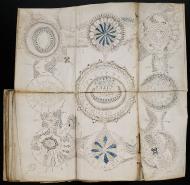
Using radiocarbon dating, a team led by Greg Hodgins in the UA's department of physics has found the manuscript's parchment pages date back to the early 15th century, making the book a century older than scholars had previously thought.
This tome makes the “DaVinci Code” look downright lackluster: Rows of text scrawled on visibly aged parchment, flowing around intricately drawn illustrations depicting plants, astronomical charts and human figures bathing in – perhaps – the fountain of youth. At first glance, the “Voynich manuscript” appears to be not unlike any other antique work of writing and drawing.
But a second, closer look reveals that nothing here is what it seems. Alien characters, some resembling Latin letters, others unlike anything used in any known language, are arranged into what appear to be words and sentences, except they don't resemble anything written – or read – by human beings.
More here.
Is solitary confinement torture?
The Looting and Protection of Egypt’s Treasures
Christopher Heaney in Not Even Past:
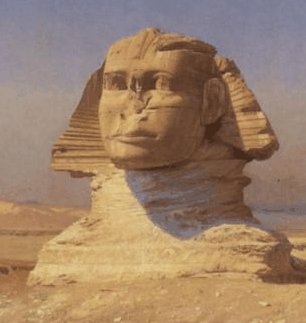
The museum had haunted the protests since they began in late January. In the first few days of the unrest that toppled President Hosni Mubarak on Friday, newspapers were quick to note that a group of looters had broken through a skylight, apparently searching for gold. Although Tut’s famous mask was thankfully under lock-and-key, the intruders knocked over or damaged approximately 70 artifacts. In one of the many exciting turns of the last several weeks, however, Egyptian neighborhood patrols surrounded the museum and caught the would-be thieves.
“I’m standing here to defend and to protect our national treasure,” one man told the AP. “We are not like Baghdad!” shouted another. The looting of Iraq’s National Museum in 2003 was on every observer’s mind.
The Egyptian military arrived soon after, took the looters into custody and made the museum a base of operations. Just outside, Tahrir Square became the protests’ center. It seemed to be a victory for Egypt’s people and its military.
More here.
Imagining a World of Total Connectedness, and Its Consequences
From The New York Times:
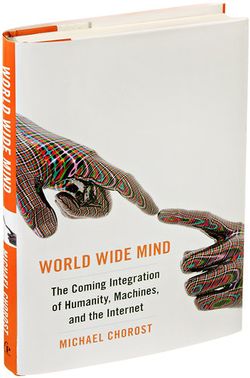
Vittorio glimpses a flickering image of a metallic barrel pointed at Sarsen, who is projecting overwhelming shock and alarm. By deducing how far Sarsen might have gone into the room and where the gunman is likely to be standing, Vittorio fires shots into the wall that will, at the very least, distract the gunman and allow Sarsen to shoot back. Sarsen is saved; the gunman is dead. That scene, from his new book, “World Wide Mind,” is an example of what Mr. Chorost sees as “the coming integration of humanity, machines, and the Internet.” The prediction is conceptually feasible, he tells us, something that technology does not yet permit but that breaks no known physical laws.
More here.
Monday, February 14, 2011
Colin Marshall
 | Colin Marshall writes about film but doubles as the host of a public radio show, triples as a blogger on culture and self-engineering, quadruples as the host of a book club podcast and quintuples as a reviewer of podcasts. He loves tea, old-school R&B and the work of Abbas Kiarostami. Email: colinjmarshall [at] gmail.com List of writings at 3QD, in reverse chronological order:
|
“That’s funny…” Incongruity in humor, art, and science
by Julia Galef
–Groucho Marx
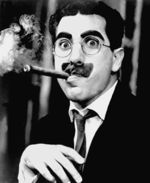
Like most jokes, Groucho’s works almost instantaneously. We hear the joke, we laugh, and we don’t need to think consciously about the process connecting those two points. But what if we played that process in slow motion?
Here’s a plausible account of what that might look like: the joke’s first sentence triggers an image, or at least a concept, of Groucho wearing pajamas and shooting an elephant. But the next phrase, “How he got in my pajamas,” doesn’t make sense in the framework of our current model of the situation, and we’re thrown into confusion. So we think, Hang on, I must’ve missed something, and we go back and re-evaluate the first sentence to see if there was some other, alternative way of interpreting it. Sure enough, now that we’re looking for it, there it is: an alternate meaning of “I shot an elephant in my pajamas” pops out, and you can almost hear the gears grinding as we shift from “I, in my pajamas, shot an elephant” to “I shot an elephant who was wearing my pajamas.”
Groucho’s joke is an example of paraprosdokia, a figure of speech whose latter half surprises us, forcing us to go back and reconsider the assumptions we’d made about what was going on in the first half. Other examples include Mitch Hedberg’s “I haven’t slept for two weeks — because that would be too long,” and Stephen Colbert’s “Now, if I am reading this graph correctly… I’d be very surprised.” The jolt of gratification we feel at converting confusion into clarity is exactly what Incongruity Resolution Theory, a popular theory in the psychological study of humor, predicts: humor is the satisfying “click” of an incongruity within the joke being resolved after you find the appropriate interpretive framework.
perceptions

Shizuka Yokomizo. Stranger No 8. 1999
From blanketmagazine.com: This was just one of a series titled ‘Stranger’ which shows a person standing at their window. Surprisingly the artist has never met the people she photographed. She randomly selected addresses and then wrote letters to the occupants asking them to stand at their window on a certain day at a certain time of night so she could photograph them from the street. She promised she would be there waiting.
Monday Poems
Dear Readers-
Hope you'll forgive a couple of re-runs appropriate
to the day. I've had an over 34 year string of luck
Valentine-wise so posting these again does not
seems out of line.
……………………………………………………. -Jim
—for Pat
Luck
Every now and then you’ll say,
I love our life, and I think
what’s not to love,
the sky's here,
sweet water,
food and breath,
family and health
pretty much,
and what goes back and forth
between us
and whatever comes,
good or ill,
being friends we split:
ascent/decline
what’s mine is yours
what’s yours is mine—
what in this (with this luck
above all) is not sublime?
Sunday, February 13, 2011
Moral Combat
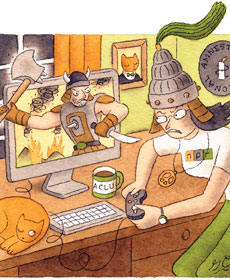
I eventually got the hang of The Sims, the best-selling computer game in history, and my Sim self became productive and happy. She always reached the top of her career, her children always did well in school, and she always had enough money for a comfortable simulated life. Another pattern emerged as well, one that I feel powerless to stop: My Sims are conservative. I'm in complete control of them, but for some reason their lives aren't anything like the life I consider ideal in the real world. I'm a feminist graduate of an all-women's college who has vowed to never change my name or end my career to raise children full time–though I would never undervalue the work that many women do in their home. By contrast, my Sims rarely remain single long into adulthood. My wives always take their husbands' last names. They don't just have children; they bear lots of them. And they leave their careers to take on the lion's share of care-giving duties.
In fact, all of the video games I play tend to have a decidedly anti-liberal tilt. From the seemingly innocuous Sims to more obviously hawkish games like Call of Duty, many video and computer games seem to have a built-in conservative worldview. After all, they have to sell in the heartland as well as on the coasts. It's always difficult for liberals to figure out how much they should enjoy pop culture that contradicts their values. Skipping Fox's 24 because it promotes torture, for example, would have meant missing out on a tense and exciting drama–and missing out on the water-cooler talk about it the next day. But liberals who enjoyed it did so while making our criticisms known. Jack Bauer, we pointed out, might have been a less threatening protagonist if there hadn't been a real-life Vice President Dick Cheney. Video games are just the newest medium through which our social mores are expressed, and questioning whether they do so accurately and responsibly is a natural corollary to their ascendancy.
Whether prohibiting the sale of violent video games to minors violates the First Amendment is the subject of a Supreme Court case this term. But if anyone who wanted to promote “traditional family values” actually played a game like The Sims, they would love it. There are plenty of other games of which conservatives should approve as well. Sim City, which preceded The Sims, has players create a virtual metropolis instead of a virtual family. As a Sim City expert, I can tell you that things function much more smoothly if taxes are low and city government caters to corporate interests. In the most recent version of the game, low-income housing is associated with higher crime rates, which necessitate more police stations. Low-income housing, however, packs in more workers per block, and I need all those workers in order to generate more revenue. To keep them productive–if employees are unhappy, they go rogue, which, in the game's terms, means striking and shutting down their textile factories or meatpacking plants–I have to lull them into complacency with plenty of movie theaters, bowling allies, and pizza shops where they can “blow off steam.” These workers produce until the city's coffers are full enough for me to raze their tenements and put in expensive brownstones instead. My cities become a checkerboard of tony lofts and corporate office buildings, peppered with the occasional opera house or art gallery no working family could afford to visit. Those cities also always end up polluted: Wind energy is fine in theory, but old-fashioned petroleum and coal facilities really make them run.
Poetry in the Streets

Imperious despot, insolent in strife,
Lover of ruin, enemy of life!
You mock the anguish of an impotent land
Whose people’s blood has stained your tyrant hand,
And desecrate the magic of this earth,
sowing your thorns, to bring despair to birth-Abul Qasim al-Shabi
While protesters in Tunisia chanted these words, written by the poet Abul Qasim al-Shabi, two weeks ago, Iraqi poets staged a reading in solidarity. In Egypt, where al-Shabi’s verses had become a rallying cry, Al Jazeera reported poetry readings in the middle of the protests at Tahrir Square.
The readings and poetic chants in Tunisia and Egypt are only the latest instance in a long history of political poetry in the Middle East, going back all the way to pre-Islamic times, when the sa-alik (roughly translated as “vagabond”) wrote about living outside the tribal system. In modern times, poetry has been a tool for creating a sense of political unity, giving voice to political aspirations, and excoriating governments and leaders. Maybe most surprising to an American used to poetry’s increasing confinement to college campuses, poetry is a tool for galvanizing people to political action.
“Outside the West poetry is still very powerful,” says Muhsin Jassim al-Musawi, professor of Arabic literature at Columbia University. “It might not be very conspicuous, but it is there, an undercurrent, and whenever there is a need for it you will be surprised that people have something to say.” Postcolonial literary criticism has neglected the political power of poetry, says Musawi, focusing instead on the way narrative defines cultural and national identities. But when those identities are first being formed, he says, when people are taking to the streets in protest or trying to establish a new government, it’s poetry people turn to. It’s easier to rally around a verse than a novel.
abdel halim hafez
Interview with Daniel Bell
Roberto Foa and Thomas Meaney in The Utopian:
Are you a utopian?
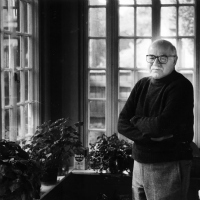
But the historical difficulty of utopianism is precisely that it doesn’t have a messiah, or a similarly overarching, emotionally powerful actor. So that the tension between utopianism and messianism is frequently to the unfair advantage of the messianic. I believe more and more that if we can have utopian movements we’ll do better than if we have messianic movements.
More here.