Hit Liszt

2781

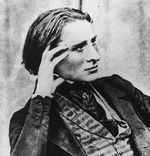
The extraordinary thing about Franz Liszt is that he remains one of the most famous composers of the 19th century despite the fact that the overwhelming majority of his music is forgotten — and likely to stay forgotten. He wrote enough of it, that’s for sure. If you were to listen to his works one after another without interruption, it would take about a week. I’m basing that estimate on the fact that Leslie Howard’s 98 CDs of Liszt’s complete piano music, which are just about to be reissued by Hyperion, last for just over five days. That’s nine million notes spread over 12 miles of printed pages, in case you were wondering. Add the orchestral and sacred music and you’d have about 120 CDs. But, even though 2011 is Liszt’s bicentenary year, there was never any danger of Radio 3 giving us ‘Liszt Week’. Even his fervent champions — who are always telling us that he beat Wagner to the Tristan chord, reinvented symphonic form, anticipated Schoenberg in his frighteningly spare last piano style, etc. — might blanch at the prospect of wall-to-wall Liszt. (Radio 3 announcer: ‘And that was the Marche pour le Sultan Abdul Medjid-Khan. Next, the Tarantella d’après la Tarantelle de “la Muette de Portici” d’Auber.’)

more from Damian Thompson at The Spectator here.

wild animal sex

SplendidWren_HL

The Australian splendid fairy-wren has a peculiar way of passing on its genetic material. It starts off in a manner that might seem familiar to anyone who’s seen a 1950s family sitcom: Boy meets girl, boy partners with girl for life, boy and girl raise family together. But that’s where the similarities end. After the baby wrens grow up, they don’t pair up with other wrens right away; instead, they help their parents raise the next brood. Except that next brood is likely not the true genetic offspring of the “father” of this family. You see, while splendid fairy-wrens do pair up in family units for life, they rarely mate with their original partners. Instead, both males and females like to get together for dangerous sex with other wrens, who in turn may be socially paired with other wrens. And calling this sex “dangerous” may be only a slight exaggeration. Science writer Rob Mitchum blogged last week about research showing that these tiny wrens not only mate primarily outside the family unit, they may be more interested in mating in the presence of one of their primary predators, the butcherbird.

more from Dave Munger at Seed here.

The Essential Karel Capek is essential

Kimball_02_11

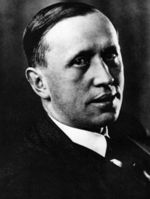
Jacques Barzun once observed that Walter Bagehot was ‘”well-known” without being known well’. Something similar, I suspect, might be said of the great Czech writer Karel Capek (1890-1938). The Insect Play (1921), co-authored with his brother Josef, is a classic in the library of anti-totalitarian satire, as is the proto sci-fi fantasy War with the Newts (1936). Janácek adapted The Makropulos Case (1922) for the libretto of his 1926 opera, and Punch declared Capek’s travel book Letters from England (1925) ‘the best book about our race since the Germania of Tacitus’. And yet how many Anglophone readers really know Capek’s work? Not many, I’d wager. The chief datum that the multitude possesses about Capek is that he coined the term ‘robot’. That is nearly correct. The word – from an old Czech word for ‘labour’ – does appear in his play RUR (Rossum’s Universal Robots, 1920). But ‘robot’ was actually coined by Josef (Karel was toying with ‘laborator’, a clearly inferior alternative). The true story of Capek’s most famous linguistic benefaction is told in a paragraph-long newspaper column called ‘About the Word Robot’ (1933). You’ll find it, and scores of other charming vignettes, observations, expostulations, comments, remarks and (alas) love letters, in Believe in People, an eminently likeable book that lives up to its subtitle: read this journalistic miscellany and you really will come close to ‘The Essential Karel Capek’.

more from Roger Kimball at Literary Review here.

Sex and violence linked in the brain

From Nature:

News82-i1_0 Sex and violence are intertwined in mice. A tiny patch of cells buried deep within a male's brain determines whether it fights or mates, and there is good reason to believe humans possess a similar circuit. The study, published in Nature today1, shows that when these neurons are quieted, mice ignore intruding males they would otherwise attack. Yet when the cells are activated, mice assault inanimate objects, and even females they ought to court. The cells lie within an area of the hypothalamus with known links to violent behaviour. An electrical jolt to this vicinity causes cats and rats to turn violent, but neurophysiological experiments conducted decades ago stimulated too big an area to identify the specific brain circuits, let alone the individual neurons, involved in aggression.

More recently, scientists studying mice engineered to lack specific genes have found that some of them act more aggressively than normal mice. “We really don't know which part of the brain went wrong in those mice. Consequently it's tough to make sense of that behaviour,” says Dayu Lin, a neuroscientist now at New York University and an author of the study, who began searching for the seat of aggression in mice while working with David Anderson at the California Institute of Technology in Pasadena.

More here.

Friday Poem

Men Made of Words

a rondeau

Men made of words live in migraine hotels
And talk not of music, but speaker cables;
Stay up to drink whisky with red lemonade,
Point out the mistakes one other has made –
Of pronunciation, directions and sales.

Some compare charts before prints of Kandinsky;
Some pick on the barmaid – Nebraskan and pretty –
Their guiding philosophy never needs telling;
The Fauvists, so colourful: what is it they’re selling?
Art never hurts for the men made of words.

So if you, like I, often let down your guard
When you’re drunk in the hush of a theatre courtyard;
Or, forced to find work beneath travestied arches,
You find yourself under the weight of their glances,
Make your excuse while the handshakes are hard
And run for your life from the men made of words.

by Luke Lennard
from The Migraine Hotel
Salt Publishing, Cambridge, 2009


Yoga: Neither as Old as You Think, Nor Very Hindu

Meera Nanda in Open:

ScreenHunter_04 Feb. 11 11.51 Indians tend to affirm their claims on yoga by trotting out the familiar icons of the ‘5,000-year-old Vedic tradition,’ which supposedly stretches from the Pashupati seal of the (actually very unVedic) Indus Valley civilisation to the Bhagvad Gita and the venerable Yoga Sutras of Patanjali. Yoga, Indians like to solemnly declare, is ‘eternal’ and ‘timeless’ and all the great yoga masters, from Swami Vivekananda to BKS Iyengar to Baba Ramdev of our own time, have only restored or reinstituted an ancient practice. It is also commonplace to hear Indians—even those who are not particularly spiritual themselves—blame Americans and other ‘decadent’ Westerners for reducing their spiritually rich tradition to mere calisthenics.

Lately, Hindus in America have started flying the saffron flag over American-style yoga, which consists largely of yogic asanas and stretches. The leading Indo-American lobby, Hindu American Foundation (HAF), has recently started a vocal campaign to remind Americans that yoga was made in India by Hindus. Not just any ordinary Hindus, but Sanskrit-speaking, forest-dwelling Brahmin sages who learned to discipline their bodies in order to purify their atman. The purist Hindu position, articulated by the HAF, is that all yoga, including its physical or hatha yoga component, is rooted in the Hindu religion/way of life that goes all the way back to the Vedic sages and yogis.

There is only one problem with this purist history of yoga: it is false.

More here.

The Memristor: The first new passive circuit element since the 1830s might transform computer hardware

Brian Hayes in American Scientist:

9723_memristor_circuit When Bell Telephone Laboratories announced the invention of the transistor in 1948, the press release boasted that “more than a hundred of them can easily be held in the palm of the hand.” Today, you can hold more than 100 billion transistors in your hand. What’s more, those transistors cost less than a dollar per billion, making them the cheapest and most abundant manufactured commodity in human history. Semiconductor fabrication lines churn out far more transistors than the world’s farmers grow grains of wheat or rice.

In this thriving transistor monoculture, can a new circuit element find a place to take root and grow? That’s the question posed by the memristor, a device first discussed theoretically 40 years ago and finally implemented in hardware in 2008. The name is a contraction of “memory resistor,” which offers a good clue to how it works.

Memristor enthusiasts hope the device will bring a new wave of innovation in electronics, packing even more bits into smaller volumes. Memristors would not totally supplant transistors but would supplement them in computer memories and logic circuits, and might also bring some form of analog information processing back into the world of computing. Farther out on the horizon is a vision of “neuromorphic” computers, modeled on animal nervous systems, where the memristor would play the role of the synapse.

More here.

You’re Parking Wrong: it’s almost always better to back into a space than pull into it head-on

Tom Vanderbilt in Slate:

110209_TRANS_backInTN The logic, presented by many readers, is breathtakingly clear and simple. To quote one:

“When backing in, I have to drive past the slot, then back in. On my way past it, I can look in the slot to ensure it is clear. I have situational awareness, so it is pretty safe to back in. When I leave, I just have to drive out and that is safer than backing out. If I don't back in, when I leave I have to back out into what is basically unknown traffic.”

Backing into traffic in parking lots is more hazardous than you might think. Parking lot crash statistics are a bit hazy, particularly for crashes involving only property damage, but a study by the Insurance Institute for Highway Safety in 2001 and 2002 found that 14 percent of all damage claims involved crashes in parking lots (some number of which must have involved vehicles moving in and out of spaces). More seriously, there is a whole category of crashes, often fatal, tracked by the National Highway Traffic Safety Administration, called “backover crashes“: These typically occur in driveways and parking lots, often involve children, and happen at a higher rate to drivers of SUVs and “light-duty trucks,” owing to the reduced visibility they offer (not just to their drivers but to those parked adjacent). Indeed, the last crash I was involved with occurred when a driver backed his SUV from a parking space into my driver's side door as I waited for traffic to clear. The driver said he never saw me, even though our cars were only a few feet apart, and it's almost certain the crash would not have happened had the driver employed “back-in, head out” parking.

More here.

Thursday, February 10, 2011

Egypt, and the Post-Islamic Middle East

Asef Bayat in Jadaliyyah:

Slide_17032_236455_large For years, western political elites and their local allies have charged the Arab peoples with political apathy and lethargy. The argument that Arabs are uninterested in seeking to wrest greater democratic freedoms from their authoritarian rulers always rested on shaky foundations. But now that millions of Egyptians, following the Tunisians’ example, have proved it wrong by mobilising against power, the sceptical ground has adjusted: toward the murmured fear that Egypt’s uprising would develop into an “Islamist revolution” along the lines – demagogic, violent, intransigent, expansionist, anti-western – of that of Iran in 1979.

The idea of an “Islamic revolution in Egypt” is voiced by four sources. The first is the Hosni Mubarak regime, in the attempt to dissuade its western allies from supporting the uprising. The second is Binyamin Netanyahu’s Israel and its allies in the United States and Europe, which wish to maintain the autocratic regime more or less intact by keeping such players as Omar Suleiman (the new vice-president and former intelligence chief) in power after Mubarak. The third is Iran’s Islamist hardliners, who are making a desperate effort to downplay the democratic thrust of the Egyptian revolution and present it as Islamic and Iran-inspired one. The fourth is a section of Egypt’s own citizens who express genuine concerns about a possible new Islamic revolution in the heart of the Arab world.

More here.

Are We Hard-Wired to Doubt Science?

Felicity Barringer in the New York Times:

ScreenHunter_03 Feb. 11 10.41 The absence of scientific evidence doesn’t dissuade those who believe childhood vaccines are linked to autism, or those who believe their headaches, dizziness and other symptoms are caused by cellphones and smart meters. And the presence of large amounts of scientific evidence doesn’t convince those who reject the idea that human activities are disrupting the climate.

What gives? A recovering journalist, David Ropeik, who is an instructor at the Harvard University extension school and the author of a book, “How Risky Is It Really?” offers one explanation.

He uses peer-reviewed science to explain the limits of peer-reviewed science as a persuasive tool.

Humans, he argues, are hard-wired to reject scientific conclusions that run counter to their instinctive belief that someone or something is out to get them.

More here.

How to Make Anything Signify Anything

FriedmanNYPL2_FINAL

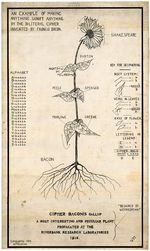
At first glance, the photo looks like a standard-issue keepsake of the kind owned by anyone who has served in the military. Yet Friedman found it so significant that he had a second, larger copy framed for the wall of his study. When he looked at the oblong image, taken in Aurora, Illinois, on a winter’s day in 1918, what did Friedman see? He saw seventy-one officers, soon to be sent to the war in France, for whom he had designed a crash course on the theory and practice of cryptology. He saw his younger self at one end of the mysterious group of black-clad civilians seated in the center; and at the other end he saw the formidable figure of George Fabyan, the director of Riverbank Laboratories in nearby Geneva, where Friedman found not just his cryptographic calling but also his wife Elizebeth (flanked here by two other instructors from Riverbank’s Department of Ciphers). And he saw a coded message, hiding in plain sight. As a note on the back of the larger print explains, the image is a cryptogram in which people stand in for letters; and thanks to Friedman’s careful positioning, they spell out the words “KNOWLEDGE IS POWER.” (Or rather they almost do: for one thing, they were four people short of the number needed to complete the “R.”) The photograph was an enduring reminder, then, of Friedman’s favorite axiom—and he was so fond of the phrase that some fifty years later he had it inscribed as the epitaph on his tomb in Arlington National Cemetery.2 It captures a formative moment in a life spent looking for more than meets the eye, and it remained Friedman’s most cherished example of how, using the art and science of codes, it was possible to make anything signify anything. This idea will no doubt strike us as quintessentially modern, if not postmodern, but Friedman took it straight from the great Renaissance scholar-statesman Sir Francis Bacon (1561–1626), along with both the hidden motto in the image and the method used to convey it. In other words, the graduation photo from Friedman’s earliest course in military cryptanalysis is at once a tribute to Bacon’s philosophy and a master class in the use of his biliteral cipher.

more from William H. Sherman at Cabinet here.

the book

TLS_Hunt_734099a

The King James Bible is a book that attracts superlatives. To David Norton it is “the most important book in English religion and culture”, to Gordon Campbell “the most celebrated book in the English-speaking world” and “the most enduring embodiment of Scripture in the English language”. To Robert Carroll and Stephen Prickett it is simply the Bible translation that defines Bible translations: “All other versions still exist, as it were, in its shadow. It has shaped, formed and moulded the language with which the others must speak”. No one present at the birth of the KJB, least of all the translators themselves, could have imagined that it would live so long. King James’s offer to commission a new Bible translation had been made quite casually at the Hampton Court Conference in 1604, chiefly, it seems, to console the Puritans for their failure to secure any other changes to the religious settlement. To many contemporaries, it seemed little more than a royal vanity project. In the preface to the first edition of 1611, the translators admitted that many people saw no need for a new translation at all: “Many men’s mouths have been opened a good while (and yet are not stopped) with speeches about the translation so long in hand, or rather perusals of translations made before: and ask what may be the reason, what the necessity of the employment”.

more from Arnold Hunt at the TLS here.

Orpheus awoke in the poem of disguises

9780982237649_260x260

Perhaps individuals are real and deserve our attention; perhaps they are not. Perhaps each of us has an individual self, an inner life, partly mysterious, partly explicable, partly traceable to biographical fact, and partly evident in the sometimes songlike, sometimes speech-like works called lyric poems. But what if such selves are a bourgeois illusion, an outmoded epiphenomenon, produced by ideas in which we should no longer believe? So much of what seems like personal experience arises from systems far larger (the English language, the global economy) or smaller (a cluster of neurons) than persons can be; so much of what seems like artistic expression may also be traced to systems of convention. Perhaps poets—whose art form, more than others, appears tied to the history of individualism—should find ways to deny, or avoid, the hoary pretense that my words, my emotions, arise from causes within me, uniquely mine. I have just drawn a simplistic and binary picture, one that philosophers, cognitive scientists, and literary thinkers have for decades tried to improve. Those efforts have inspired, and found analogies in, much of the best poetry of the last 30 years. To the questions, linked arm in arm, “Should we believe that we have genuine, unique, consequential, inward selves? Do you have one? Do your poems express it? Do they participate in the tradition called ‘lyric’?” poets from Ashbery to Armantrout, from Jorie Graham to Juan Felipe Herrera, have given the answer, “it’s complicated.” Young poets still pursue intricately ambivalent answers. But poets can also answer “yes” or “no.” Two of this year’s best books by youngish poets illustrate the powers both answers still have.

more from Stephen Burt at Boston Review here.

Ant Harm

From Scientific American:

Ant In 1907 Argentine ants (Linepithema humile) arrived in Los Angeles via a cargo ship. Within just a few years of their arrival the six-legged stowaways formed a single, massive colony—known as a supercolony—that stretched through California from south of the Mexico border to San Francisco

A liberal spraying of pesticides in the past century has done nothing to diminish the ants' numbers—L. humile infestations are the most common cause of pest control calls in southern California. The Argentine ant's takeover of coastal California is marked by small shifts in the local, native ecosystem. Populations of the coast horned lizard (Phrynosoma coronatum) have declined sharply in recent years due to the displacement of native ants the lizard depends on for food. Citrus farmers have required increasing quantities of pesticides to cope with rising numbers of aphids, scale insects and other pests that the Argentines actively protect in exchange for the sweet honeydew they produce.

More here.

Mind vs. Machine

In the race to build computers that can think like humans, the proving ground is the Turing Test—an annual battle between the world’s most advanced artificial-intelligence programs and ordinary people. The objective? To find out whether a computer can act “more human” than a person. In his own quest to beat the machines, the author discovers that the march of technology isn’t just changing how we live, it’s raising new questions about what it means to be human.

Brian Christian in The Atlantic:

ScreenHunter_02 Feb. 10 11.51 Each year for the past two decades, the artificial-intelligence community has convened for the field’s most anticipated and controversial event—a meeting to confer the Loebner Prize on the winner of a competition called the Turing Test. The test is named for the British mathematician Alan Turing, one of the founders of computer science, who in 1950 attempted to answer one of the field’s earliest questions: can machines think? That is, would it ever be possible to construct a computer so sophisticated that it could actually be said to be thinking, to be intelligent, to have a mind? And if indeed there were, someday, such a machine: how would we know?

Instead of debating this question on purely theoretical grounds, Turing proposed an experiment. Several judges each pose questions, via computer terminal, to several pairs of unseen correspondents, one a human “confederate,” the other a computer program, and attempt to discern which is which. The dialogue can range from small talk to trivia questions, from celebrity gossip to heavy-duty philosophy—the whole gamut of human conversation. Turing predicted that by the year 2000, computers would be able to fool 30 percent of human judges after five minutes of conversation, and that as a result, one would “be able to speak of machines thinking without expecting to be contradicted.”

Turing’s prediction has not come to pass; however, at the 2008 contest, the top-scoring computer program missed that mark by just a single vote. When I read the news, I realized instantly that the 2009 test in Brighton could be the decisive one. I’d never attended the event, but I felt I had to go—and not just as a spectator, but as part of the human defense.

More here.

Project Nim: we are the real chumps in this chimp’s story

Jeremy Kay in The Guardian:

ScreenHunter_01 Feb. 10 11.36 “They fuck you up, your mum and dad,” Hull's most celebrated librarian-poet Philip Larkin once wrote, and the sentiment behind that bilious opening bark from This Be the Verse will not be lost on viewers of Project Nim. It's probably a sentiment that would raise a wry, bushy eyebrow from Nim himself, the chimpanzee subject of Academy Award-winning James Marsh's absorbing return to the Sundance film festival.

Everyone knows chimps are smart, but what the British film-maker's follow-up to his 2008 Sundance hit and Oscar winner Man on Wire reveals is more interesting. Project Nim, one of several opening night films that kicked off the festival yesterday, spans 26 years and recounts the story of the titular primate as he is plucked from his mother in infancy and thrust into a succession of experiments that range from the pseudo-scientific to something altogether more unsettling.

More here.

Wednesday, February 9, 2011

Cultural Pluralism

Pluralism200 Bhikhu Parekh in The Philosopher's Magazine:

Western thought has long been dominated by the view that while error is plural, truth is singular. We can be wrong in many different ways but can be right in only one way. According to this view, which we might call monism or singularism, there is only one correct way of understanding the world, only one true system of morality, only one true way of leading the good life, only one true religion, only one correct way of organising society, and so on. We are supposed to arrive at truth, be it cognitive, moral or religious, by means of reason, which is understood as a transcendental and quasi-divine faculty rising above the psychological, social, cultural and other constraints. This view has had both good and bad consequences. It has inspired most rigorous intellectual inquiries, rules of rational debate, and a determination to expose and fight errors. It has also however led to arrogance, intolerance, failure to appreciate differences, tendency to equate diversity with deviation, and much violence.

Cultural pluralism challenges this view of truth and goodness. It sees reason as a human rather than a quasi-divine or transcendental with all that it implies. Since it takes the view that human beings are culturally embedded, it argues that reason is shaped and structured by culture. This does not mean that they cannot criticise and revise their culture, but rather that they cannot transcend all its subtle and deepest influences and view it from a nonexistent Archimedean standpoint. They may replace one culture with another but cannot stand outside the realm of culture altogether. For cultural pluralism the world can be understood in several different ways depending on our conceptual apparatus, language, interests, purposes, the questions we ask and the kind of knowledge we seek and value. Like truth in general, moral truth or good too is also plural. Human capacities and moral values conflict and cannot all be integrated into a harmonious system without loss. Different cultural communities organise themselves on the basis of different visions of the good life, and foster different human capacities, dispositions and virtues. Every cultural community represents a particular form of human excellence with all its characteristic strengths and limitations. No culture is perfect or exhaustively embodies goodness, and none is wholly devoid of at least some degree of goodness.

Cost Analysis

1297102612sari-380 Adam Kirsch in Tablet:

Jews who reach the point of hopeless frustration with the Israel-Palestine problem have been known to demand, “Where is the Palestinian Gandhi?” Especially during the years of Yasser Arafat’s leadership of the PLO, this was a way of criticizing the Palestinian leadership for its rejectionism and commitment to violence, which so obviously failed to advance the Palestinian cause. It’s also a kind of rhetorical throwing up of hands, a way of saying that only a miraculously virtuous and charismatic figure could possibly break the impasse in the Middle East.

But underneath the reproach and the frustration, the longing for a Palestinian Gandhi is an expression of the Jewish desire to be enabled to make peace by being morally compelled to make peace.