You will commit a crime in the future

Youwillcommittacrimeinthefuture__1298057304_2670

The ability to predict what someone will do in the future would be a seriously handy superpower. And it’s one that companies like Netflix and Amazon, by crunching the massive trails of data most of us leave behind these days, have come pretty close to acquiring. Surely, though, there is something more ambitious to be done with our dazzling modern technology than trying to guess what kind of microwave someone’s going to want next. Something like preventing murders. It’s a seductive notion, that we could know who will and who won’t commit a crime in the future. And while it may call to mind the science-fiction world of “Minority Report,” making judgments about people’s potential to be dangerous is in fact an essential — and routine — part of how the American justice system works. It is what parole boards do, and what sentencing hearings are for. The consequences of getting such high-stakes decisions wrong can be devastating, as was made tragically plain last Christmas when police say a fellow officer from Woburn was shot and killed by 57-year-old Domenic Cinelli, a career criminal who had been paroled in 2008 while serving three concurrent life sentences for armed robbery. What if we had a better method for reliably identifying threats like Cinelli?

more from Leon Neyfakh at The Boston Globe here.

Rosa Parks (1913-2005)

This article is posted in honor of Black History Month:

From Biography.com:
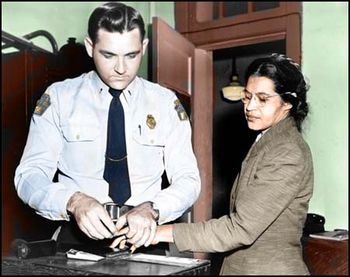
Rosa The Montgomery, Alabama city code required that all public transportation be segregated and that bus drivers had the “powers of a police officer of the city while in actual charge of any bus for the purposes of carrying out the provisions” of the code. While operating a bus, drivers were required to provide separate but equal accommodations for white and black passengers by assigning seats. This was accomplished with a line roughly in the middle of the bus separating white passengers in the front of the bus and African-American passengers in the back. When an African-American passenger boarded the bus, they had to get on at the front to pay their fare and then get off and re-board the bus at the back door. When the seats in the front of the bus filled up and more white passengers got on, the bus driver would move back the sign separating black and white passengers and, if necessary, ask black passengers give up their seat.

On December 1, 1955, after a long day at work at the Montgomery Fair department store, Rosa Parks boarded the Cleveland Avenue bus for home. She took a seat in the first of several rows designated for “colored” passengers. Though the city's bus ordinance did give drivers the authority to assign seats, it didn't specifically give them the authority to demand a passenger to give up a seat to anyone (regardless of color). However, Montgomery bus drivers had adopted the custom of requiring black passengers to give up their seats to white passengers, when no other seats were available. If the black passenger protested, the bus driver had the authority to refuse service and could call the police to have them removed. As the bus Rosa was riding continued on its route, it began to fill with white passengers. Eventually, the bus was full and the driver noticed that several white passengers were standing in the aisle. He stopped the bus and moved the sign separating the two sections back one row and asked four black passengers to give up their seats. Three complied, but Rosa refused and remained seated. The driver demanded, “Why don't you stand up?” to which Rosa replied, “I don't think I should have to stand up.” The driver called the police and had her arrested. Later, she recalled that her refusal wasn't because she was physically tired, but that she was tired of giving in. The police arrested Rosa at the scene and charged her with violation of Chapter 6, section 11 of the Montgomery City code. She was taken to police headquarters where later that night she was released on bail. On December 8, Rosa faced trial and in a 30 minute hearing was found guilty of violating a local ordinance. She was fined $10, plus a $4 court fee.

More here.

Tuesday Poem

The Tao Te Ching
of Lao Tzu
Verse 1.

Existence is beyond the power of words
To define:
Terms may be used
but none of them are absolute
In the beginning of heaven and earth there were no words,
Words came out of the womb of matter;
And whether a man dispassionately
Sees to the core of life
Or passionately sees the surface,
The core and the surface
are essentially the same,
Words making them seem different
Only to express appearance.
If name be needed, wonder names them both:
From wonder to wonder
Existence opens.

version by Witter Bynner
from The Way of Life According to Lao Tzu, 1944

Twisted Light Could Enable Black Hole Detection

From Scientific American:

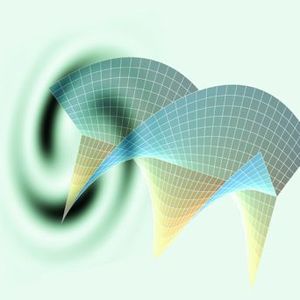
Twisting-light-oam_1 Black holes, as their name suggests, are dark. Perfectly dark. A black hole's gravity is so intense that beyond a certain boundary in its vicinity, known as the event horizon, nothing can escape. Not a rocket with its boosters on full blast nor a photon of light. Nothing. Despite the fact that astronomers cannot peer at what goes on inside the event horizon, a black hole's gravitational effects on its neighborhood allow for a number of indirect observations. Swirls of infalling gas heat up and give off radiation to illuminate a black hole's vicinity, and the orbits of stars around a black hole allow astronomers to estimate its mass. Now researchers have proposed a new optical technique to observe and study black holes by measuring the imprint they should leave on the light that passes near an event horizon.

A black hole's gravitational pull is so strong that it warps the spacetime around it. And if a black hole rotates, as would be the case for a hole that forms from the collapse of a spinning star, it drags spacetime along with it, a phenomenon known as frame dragging. (Less massive bodies also cause frame dragging on a smaller scale; NASA's Gravity Probe B launched in 2004 to measure the frame-dragging effects of Earth's rotation with sensitive gyroscopes.) According to a new analysis, the frame dragging of a black hole should put a detectable twist on nearby photons by imparting a trait known as orbital angular momentum. A light beam with orbital angular momentum looks a bit like a helix or coil when its component waves are mapped out. Whether any point along the beam is a wave peak, a trough or something in between depends on where that point lies with respect to the helix's central axis.

More here.

From Sea Stories to Scientology: L. Ron Hubbard at 100

Our own Morgan Meis in The Smart Set:

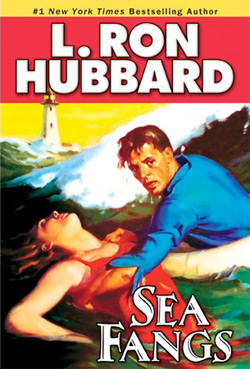
ID_IC_MEIS_LRON_AP_001 His name was L. Ron Hubbard. This year, 2011, happens to be the 100th anniversary of his birth (on March 13, to be exact). By the mid-1950s, Hubbard was a legend. He'd written in every field and form imaginable. The pulps were his bread and butter. He churned out stories and novels. He wrote adventures and mysteries and thrillers and sci-fi. In 1934 he published, among other things, a mystery story called “Calling Squad Cars!”; a sea adventure featuring black pearls called “Pearl Pirate”; a Western called “Maybe Because—!”; an adventure story called “Yellow Loot” that includes a race along China's Great Wall; a detective story called “The Carnival of Death,” in which a U.S. Treasury agent solves murders at a carnival; and “Tooby,” a musical story about a tuba.

In 1940, Hubbard really seemed to hit his stride. He published a story called “Fear” in Unknown, one of the pulp magazines of the time. In the story, a professor publishes a paper debunking myths about the existence of devils and demons and is then hounded by said devils and demons. Ray Bradbury liked “Fear” a lot, calling it “a great scare.” Hubbard also wrote a sci-fi story called “Final Blackout.” It's the story of a lieutenant who comes to rule England after years of atomic warfare. Robert Heinlein (Starship Troopers, Stranger in a Strange Land) famously said the story was, “as perfect a piece of science fiction as has ever been written.”

More here.

Is all of technology the equivalent of an evolving seventh kingdom of life?

David E. Nye in American Scientist:

ScreenHunter_01 Feb. 22 10.26 Whether it’s intended to be so or not, the title of Kevin Kelly’s What Technology Wants is a provocation to most historians of technology, who would reply almost unanimously that technology has no wants or desires. Each tool or machine has latent uses, but each is only an inert object until human beings decide whether and how to use it. In contrast, Kelly talks about technology as a composite whole that emerged before human beings existed and that facilitated their rapid domination of the planet. For him, technology has intentions, and it is radically accelerating evolution.

Kelly has been thinking about technology for most of his life, first as a backpacker wandering the Third World, later as one of the pioneers of what became the Internet, and finally as one of the founders and editors of Wired magazine. He overcame his early suspicion of Western technology largely as a result of his encounter with interactive computer technologies. He was one of several in the counterculture to move from working on the Whole Earth Catalog to celebrating the Internet as a new online facilitator of grassroots movements.

Kelly argues that all technologies, from the stone ax to the computer chip, should be seen as a collectivity—the technium, which is “the greater, global, massively interconnected system of technology vibrating around us” and includes “culture, art, social institutions, and intellectual creations of all types.” He coins the term because he wishes to emphasize the idea of technology as an overarching entity that constitutes the equivalent of an evolving “seventh kingdom of life,” one that “predated our humanness.”

More here.

What would Feynman do?

Eric Lippert in Fabulous Adventures in Coding:

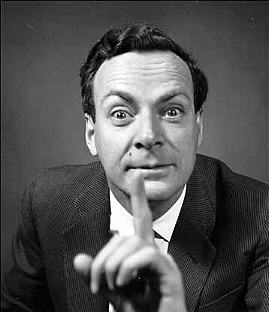
Feynman No one I know at Microsoft asks those godawful “lateral-thinking puzzle” interview questions anymore. Maybe someone still does, I don't know. But rumour has it that a lot of companies are still following the Microsoft lead from the 1990s in their interviews. In that tradition, I present a sequel to Keith Michaels' 2003 exercise in counterfactual reasoning. Once more, we dare to ask the question “how well would the late Nobel-Prize-winning physicist Dr. Richard P. Feynman do in a technical interview at a software company?

Interviewer: Now we come to the part of the interview where we test your creative thinking. Don't think too hard about it; just apply common sense and explain your reasoning. Here's the problem.

You are in a room with three switches that each control a different light fixture in another room. You cannot see from the switch room into the lamp room. Your task is to determine which switches control which light fixtures, but you may only go into the room with the lights once. How do you determine which switch controls which light?

RPF: That seems straightforward. I could obtain a number of large mirrors, and, if necessary, a telescope. I enter the room with the lights once and position the mirror so that it reflects all three lights out the door of the room. I continue placing mirrors, aligning them as necessary to reflect the photons emitted by the lights until I am back in the room with the switches. Now I can see the lights, possibly through the telescope if the distance is large, and I can toggle the switches on and off so as to determine which light is controlled by which switch.

More here.

Is this Irony or Absurdity?: Saif al-Islam Al Qadhafi’s Disseration

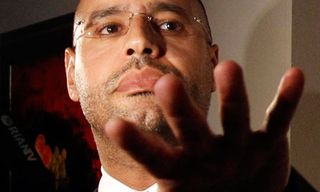
Saif-Al-Islam-Gaddafi-007 Saif “will fight to the last minute, until the last bullet” Qadhafi's dissertation :”THE ROLE OF CIVIL SOCIETY IN THE DEMOCRATISATION OF GLOBAL GOVERNANCE INSTITUTIONS: From ‘Soft Power’ to Collective Decision-Making? (seriously)

This dissertation analyses the problem of how to create more just and democratic global governing institutions, exploring the approach of a more formal system of collective decision-making by the three main actors in global society: governments, civil society and the business sector. The thesis seeks to make a contribution by presenting for discussion an addition to the system of international governance that is morally justified and potentially practicable, referred to as ‘Collective Management’. The thesis focuses on the role of civil society, analysing arguments for and against a role for civil society that goes beyond ‘soft power’ to inclusion as voting members in inter-governmental decision-making structures in the United Nations (UN) system, the Bretton Woods institutions, the World Trade Organisation (WTO) and other institutions.

The thesis defends the argument that inclusion of elected representatives of non-governmental organisations (NGOs) in tripartite decision-making structures could potentially create a more democratic global governing system. This conclusion is supported by a specially-commissioned survey of leading figures in NGOs and IGO decision-making structures.

[H/t: John Western]

Monday, February 21, 2011

Sunday, February 20, 2011

Egypt, Tunisia . . . and Iran

AntiAmerica Shibley Telhami in The National Interest:

This is a moment in history to watch in awe: Millions of newly empowered citizens peacefully overthrew a regime that has been an anchor of regional politics and American policy in the Middle East. It is a moment to savor the pride, the dignity, the empowerment.

While the immediate focus will inevitably be on the start of a new era with all its unknowns and complexities, we need to think deeply about the meaning of the Egyptian uprising and its implications for American foreign policy. A good place to start is to reflect on three powerful conclusions of one of the key young organizers of the uprising, Wael Ghonim, as he was interviewed on Egyptian Dream TV and elsewhere since.

First, this uprising is less about food and more about dignity. Sure, poverty, especially in the extreme, can add to people’s sense of humiliation and powerlessness, particularly where the gap between rich and poor is growing. But neither Ghonim nor his fellow organizers were poor or underprivileged—even if the revolution ultimately became far broader in its scope and more varied in its makeup.

Second, Ghonim, weeping, pronounced to his audience repeatedly, “We are not traitors, we are not traitors,” without any prodding from his interviewer. It is hard to overestimate the deep fear of foreign control that is prevalent in the political culture, not only in Egypt, but elsewhere in the Arab world, and which is cultivated by governments in the region to rally the public behind them. Egyptians and Arabs want liberty and freedom from repressive regimes, but many fear imperialism and outside domination even more.

Secrets of a Mind-Gamer

CoverJoshua Foer in the NYT Magazine:

Dom DeLuise,the comedian (and five of clubs), was implicated in the following unseemly acts in my mind’s eye: He hocked a fat globule of spittle (nine of clubs) on Albert Einstein’s thick white mane (three of diamonds) and delivered a devastating karate kick (five of spades) to the groin of Pope Benedict XVI (six of diamonds). Michael Jackson (king of hearts) engaged in behavior bizarre even for him. He defecated (two of clubs) on a salmon burger (king of clubs) and captured his flatulence (queen of clubs) in a balloon (six of spades). This tawdry tableau, which I’m not proud to commit to the page, goes a long way toward explaining the unexpected spot in which I found myself in the spring of 2006. Sitting to my left was Ram Kolli, an unshaven 25-year-old business consultant from Richmond, Va., who was also the defending United States memory champion. To my right was the lens of a television camera from a national cable network. Spread out behind me, where I couldn’t see them and they couldn’t disturb me, were about 100 spectators and a pair of TV commentators offering play-by-play analysis. One was a blow-dried mixed martial arts announcer named Kenny Rice, whose gravelly, bedtime voice couldn’t conceal the fact that he seemed bewildered by this jamboree of nerds. The other was the Pelé of U.S. memory sport, a bearded 43-year-old chemical engineer and four-time national champion from Fayetteville, N.C., named Scott Hagwood. In the corner of the room sat the object of my affection: a kitschy, two-tiered trophy of a silver hand with gold nail polish brandishing a royal flush. It was almost as tall as my 2-year-old niece (if lighter than most of her stuffed animals).

The audience was asked not to take any flash photographs and to maintain total silence. Not that Kolli or I could possibly have heard them. Both of us were wearing earplugs. I also had on a pair of industrial-strength earmuffs that looked as if they belonged to an aircraft-carrier deckhand (in the heat of a memory competition, there is no such thing as deaf enough). My eyes were closed. On a table in front of me, lying face down between my hands, were two shuffled decks of playing cards. In a moment, the chief arbiter would click a stopwatch, and I would have five minutes to memorize the order of both decks.

After Egypt

Adam Shatz in the LRB:

After the battle for Tahrir Square, the conceptual grid that Western officials have used to divide the Islamic world into friends and enemies, moderates and radicals, good Muslims and bad Muslims has never looked more inadequate, or more irrelevant. A ‘moderate’ and ‘stable’ Arab government, a pillar of US strategy in the Middle East, has been overthrown by a nationwide protest movement demanding democratic reform, transparent governance, freedom of assembly, a more equitable distribution of the country’s resources and a foreign policy more reflective of popular opinion. It has sent other Arab governments into a panic while raising the hopes of their young, frustrated populations. If the revolution in Egypt succeeds, it will have swept away not only a corrupt and autocratic regime, but the vocabulary, and the patterns of thought, that have underpinned Western policy in the greater Middle East for more than a half century.

The fate of Egypt’s revolution – brought to a pause by the military’s seizure of power on 11 February, after Mubarak’s non-resignation address to his ‘children’ – remains uncertain. Mubarak is gone, but the streets have been mostly cleared of protesters and the army has filled the vacuum: chastened, yet still in power and with considerable resources at its disposal. Until elections are held in six months, the Supreme Council of the Armed Forces will be ruling by decree, without the façade of parliamentary government. The parliament, voted into office in rigged elections, has been dissolved, a move that won wide support, and a new constitution is being drafted, but it’s not clear how much of a hand the opposition will have in shaping it. More ominously, the Supreme Council has vowed to punish anyone it can accuse of spreading ‘chaos and disorder’. The blunt rhetoric of its communiqués may be refreshing after the speeches of Mubarak, his son Gamal and the industrialists who dominated the ruling National Democratic Party, with their formulaic promises of reform and their talk of the nobility of the Egyptian people but ten days ago in Tahrir Square the protesters said – maybe even believed – that the army and the people stood together. Today the council’s communiqués are instructions, not proposals to be debated, and it has notably failed to answer the protesters’ two most urgent demands: the repeal of the Emergency Law and the release of thousands of political prisoners.

Barack Obama (born 1961)

From EmersonKent:

This article is posted in honor of Black History Month:

My fellow citizens:

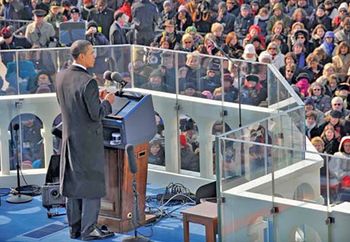
Inaugural_address_obama I stand here today humbled by the task before us, grateful for the trust you have bestowed, mindful of the sacrifices borne by our ancestors. I thank President Bush for his service to our nation, as well as [for] the generosity and cooperation he has shown throughout this transition. Forty-four Americans have now taken the presidential oath. The words have been spoken during rising tides of prosperity and the still waters of peace. Yet, every so often the oath is taken amidst gathering clouds and raging storms. At these moments, America has carried on not simply because of the skill or vision of those in high office, but because we the people have remained faithful to the ideals of our forebears, and true to our founding documents. So it has been. So it must be with this generation of Americans.

That we are in the midst of crisis is now well understood. Our nation is at war, against a far-reaching network of violence and hatred. Our economy is badly weakened, a consequence of greed and irresponsibility on the part of some, but also our collective failure to make hard choices and prepare the nation for a new age. Homes have been lost; jobs shed; businesses shuttered. Our health care is too costly; our schools fail too many; and each day brings further evidence that the ways we use energy strengthen our adversaries and threaten our planet.
These are the indicators of crisis, subject to data and statistics. Less measurable but no less profound is a sapping of confidence across our land—a nagging fear that America's decline is inevitable, that the next generation must lower its sights. Today I say to you that the challenges we face are real. They are serious and they are many. They will not be met easily or in a short span of time. But know this, America—they will be met. On this day, we gather because we have chosen hope over fear, unity of purpose over conflict and discord. On this day, we come to proclaim an end to the petty grievances and false promises, the recriminations and worn-out dogmas, that for far too long have strangled our politics.

More here.

Sunday Poem

Tomorrow W.H. Auden would have been 104, but
here he is
reminding us again that all things pass:

Auden

The Fall of Rome

The piers are pummelled by the waves; In a lonely field the rain Lashes an abandoned train; Outlaws fill the mountain caves.  Fantastic grow the evening gowns; Agents of the Fisc pursue Absconding tax-defaulters through The sewers of provincial towns.  Private rites of magic send The temple prostitutes to sleep; All the literati keep An imaginary friend.  Cerebrotonic Cato may Extol the Ancient Disciplines, But the muscle-bound Marines Mutiny for food and pay.  Caesar's double-bed is warm As an unimportant clerk Writes I DO NOT LIKE MY WORK On a pink official form.  Unendowed with wealth or pity, Little birds with scarlet legs, Sitting on their speckled eggs, Eye each flu-infected city.  Altogether elsewhere, vast Herds of reindeer move across Miles and miles of golden moss, Silently and very fast.

by W.H. Auden

If Marxism is the answer, what is the question?

From The Independent:

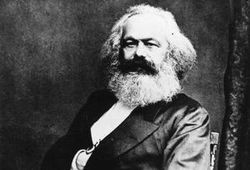
Marx When I worked at the Foreign Office many moons ago, one of the more venerated research analysts explained to me why his job was impossible. “It is not the job of political science to predict the future,” he said. “The job of political science is to explain, once the future has become the past, why it was inevitable that History should have transpired thus.” This is one half of Karl Marx's interminable beef with the march of civilisation. Too many people read him as a political scientist, and in its fullest form, his Forecast for Man shows no sign of materialising. Once his utopian vision has become an everyday reality for a vast number of people, perhaps he will be supremely right. Until then, he's mainly just usefully wrong. The other half of Marx's beef with civilisation is the 20th century. Though he doesn't admit it, Eric Hobsbawm, the most eminent Marxist historian writing in English today, must be at least a little annoyed that a chunky portion of the horrors of modernity were perpetrated in his hero's name. Of course, the likes of Stalin and Mao were Stalinist and Maoist long before they were Marxist, but Hobsbawm's ongoing refusal to confront this basic truth depletes his contribution to political thought. It is a great shame, because as this collection shows, he is a brilliant writer, erudite critic and, as he approaches his 94th birthday, a joyfully unrepentant communist.

In just over 400 pages of essays and lectures written between 1957 and 2010, Hobsbawm's Marx emerges as a man burdened by History. It is ironic that silly conservatives accuse leftists of being uninterested in the authority of custom, experience and tradition – all ciphers of past practices – when the doyen of the left was obsessed with the past. Not just that: in German, there is a distinction between Historie, which refers to the past, and Geschichte, which refers to a process relating past and present with future. Marx's intellectual life, as presented by Hobsbawm, was based on his incorporation of the latter into politics.

More here.