How Cairo’s Authoritarian Regime Is Adapting to Preserve Itself

Joshua Stacher in Foreign Affairs makes the case:

Despite the tenacity, optimism, and blood of the protesters massed in Tahrir Square, Egypt's democratic window has probably already closed.

Contrary to the dominant media narrative, over the last ten days the Egyptian state has not experienced a regime breakdown. The protests have certainly rocked the system and have put Mubarak on his heels, but at no time has the uprising seriously threatened Egypt's regime. Although many of the protesters, foreign governments, and analysts have concentrated on the personality of Egyptian President Hosni Mubarak, those surrounding the embattled president, who make up the wider Egyptian regime, have made sure the state's viability was never in question. This is because the country's central institution, the military, which historically has influenced policy and commands near-monopolistic economic interests, has never balked.

As the headquarters of the ruling National Democratic Party burned to the ground, NDP members chaotically appeared on TV with a pathetically incoherent message; meanwhile, the message from the ruling military elite was clear, united, fully supportive of Mubarak, and disciplined practically down to a man. Indeed, this discipline could be seen throughout the military ranks. Despite the fact that a general with a megaphone stated his solidarity with the protesters while other protesters painted “Down to Mubarak” on tanks across central Cairo, no acts of organizational fragmentation or dissent within the chain of command have occurred.

Since January 28, the Mubarak regime has sought to encircle the protesters. Egypt's governing elites have used different parts of the regime to serve as arsonist and firefighter. Due to the regime's role in both lighting the fire and extinguishing it, protesters were effectively forced to flee from one wing of the regime to another. This occurred on two levels: first, the regime targeted the protesters, using the police as its battering ram. During the first days of demonstrations, uniformed officers fired rubber bullets and tear gas into the crowds. Beginning on February 2, plain-clothes officers posing as Mubarak supporters — some on horseback and camels — carried whips and sticks to intimidate and injure those protesting against the system, teaching them a repressive lesson.


Wednesday Poem

Two poems by Kenneth Patchen

To a Certain Section of our Population

It is ordered now
That you push your beliefs
Up out of the filth high enough
For the inchworm to get their measure.

'For Whose Adornment'

For whose adornment the mouths
Of roses open in langourous speech;
And from whose graces the trees of heaven
Learn their white standing

(I must go now to cash in the milk bottles
So I can phone somebody
For enough money for our supper.)

from Kenneth Patchen/Selected Poems
New Directions Books ©1936 & 1957

……………………

Courage at the Greensboro Lunch Counter

From Smithsonian:

Black On February 1, 1960, four young African-American men, freshmen at the Agricultural and Technical College of North Carolina, entered the Greensboro Woolworth’s and sat down on stools that had, until that moment, been occupied exclusively by white customers. The four—Franklin McCain, Ezell Blair Jr., Joseph McNeil and David Richmond—asked to be served, and were refused. But they did not get up and leave. Indeed, they launched a protest that lasted six months and helped change America. A section of that historic counter is now held by the National Museum of American History, where the chairman of the division of politics and reform, Harry Rubenstein, calls it “a significant part of a larger collection about participation in our political system.” The story behind it is central to the epic struggle of the civil rights movement. William Yeingst, chairman of the museum’s division of home and community life, says the Greensboro protest “inspired similar actions in the state and elsewhere in the South. What the students were confronting was not the law, but rather a cultural system that defined racial relations.”

Joseph McNeil, 67, now a retired Air Force major general living on Long Island, New York, says the idea of staging a sit-in to protest the ingrained injustice had been around awhile. “I grew up in Wilmington, North Carolina, and even in high school, we thought about doing something like that,” he recalls. After graduating, McNeil moved with his family to New York, then returned to the South to study engineering physics at the technical college in Greensboro. On the way back to school after Christmas vacation during his freshman year, he observed the shift in his status as he traveled south by bus. “In Philadelphia,” he remembers, “I could eat anywhere in the bus station. By Maryland, that had changed.” And in the Greyhound depot in Richmond, Virginia, McNeil couldn’t buy a hot dog at a food counter reserved for whites. “I was still the same person, but I was treated differently.” Once at school, he and three of his friends decided to confront segregation. “To face this kind of experience and not challenge it meant we were part of the problem,” McNeil recalls.

More here.

Bats Are Social Networking Rockstars

From Science:

Bats They can't use Facebook, but bats still manage to keep in touch with their social network. Bat colonies, which are made up of a few dozen members, split and reform many times throughout the year as individuals go off to roost in small groups or hibernate alone during the winter. But researchers have found that female bats, like humans and elephants, form subgroups that stick together over long periods of time. In a study published today in the Proceedings of the Royal Society B, researchers marked bats from two colonies with data loggers and tracked their nesting behaviors over 5 years. They found that it's not just family members who stay together; a network analysis showed that these girls' clubs were made up of bats from many different lineages and age groups. (Male bats are always solitary.) The researchers propose that bat society probably benefits from cooperative behaviors such as grooming and communication, which are always more fun with your girlfriends.

More here.

Inside the Secret Service

When President Obama and two-thirds of the world’s leaders gather in New York City, it is up to the U.S. Secret Service to keep them all safe. Granted unprecedented access, our author tells the story of how the agency pulls off the most complicated security event of the year, from counter-surveillance to counter-assault, hotel booking to event scheduling.

Marc Ambinder in The Atlantic:

Ambinder-secret-service-wide There have been 38 “National Special Security Events” since President Clinton first coined the term in a classified 1998 national-security directive. Most of these NSSEs have occurred since September 11, 2001, and 14 of them since 2007, including the two presidential conventions, President-elect Obama’s pre-inauguration whistle-stop train tour, the inauguration itself, and the 2008 and 2009 G-20 summits. The General Assembly poses greater security and logistical challenges than many, if not most, of these events. This is due in part to its size, and in part to the fact that habit is the worst enemy of protective security, and the assembly offers an extremely attractive, recurring target: many foreign leaders stay in the same hotels and attend the same events at the same times each year. But despite all this, the General Assembly has not been categorized as an NSSE since 2001. The Secret Service has it down to a science.

This is the story of a dog that didn’t bark, and of the men and women who kept it muzzled. The Secret Service receives dozens of requests each year from reporters who want a peek inside the agency; most are quickly turned down. Typically, the service provides context for media coverage of its major security events by opening its training facility in Beltsville, Maryland. There, it can put on a show—complete with motorcades and simulated attacks—in a tightly controlled environment. It took me more than 18 months to persuade the service to let me be the first reporter to see the process from the inside in a real-world, real-time situation.

More here.

Studying how snakes got legless

Jonathan Amos at BBC News:

ScreenHunter_03 Feb. 09 11.34 A 95-million-year-old fossil is helping scientists understand how snakes lost their legs through evolutionary time.

Found in Lebanon, the specimen is one of only three examples of an ancient snake with preserved leg bones.

One rear leg is clearly visible but researchers had to use a novel X-ray technique to examine another leg hidden inside the fossil rock.

Writing in the Journal of Vertebrate Paleontology, the team says the snake records an early stage in limb loss.

The scientists' high-resolution 3D images suggest the legs in this particular species, Eupodophis descouensi, grew more slowly, or for a shorter period of time.

It is a conclusion made possible only after seeing all the bones obscured inside the limestone, and determining that although the creature possessed ankle bones, it actually had neither foot nor toe bones.

More here.

Israel & Palestine: Breaking the Silence

David Shulman in the New York Review of Books:

ScreenHunter_02 Feb. 09 11.15 A few weeks ago I was in al-Nabi Salih, a Palestinian village northwest of Ramallah in the occupied West Bank. It wasn’t so easy to get there; the Israeli army had closed off the area on every side, and we literally had to crawl through the olive groves, just beneath one of the army’s roadblocks, before we managed to reach the village. Al-Nabi Salih is a troubled place. The large Israeli settlement of Halamish nearby has taken over nearly half of the village lands, including a precious freshwater spring. Most Fridays there are dramatic confrontations between the soldiers and the villagers protesting this land grab and the other difficulties of life under occupation.

Yet the first thing I saw in al-Nabi Salih was a huge sign in Arabic and English: “We Believe in Non-Violence. Do You?” It was World Peace Day, and speaker after speaker reaffirmed a commitment to peace and to nonviolent resistance to the occupation. Particularly eloquent was Ali Abu Awwad, a young activist who runs a new organization, the Palestinian Movement for Non-Violent Resistance, with its offices in Bethlehem and growing influence throughout the occupied territories. “Peace itself is the way to peace,” he said, “and there is no peace without freedom.”

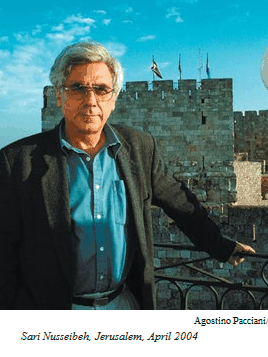
All of this is, in some ways, rather new in Palestine, although in his latest book the philosopher Sari Nusseibeh, the president of al-Quds University in Jerusalem, traces an earlier stage of organized Palestinian civil disobedience in the popular struggle of the first intifada in 1988 and 1989, in which he had a significant part.

More here.

Tuesday, February 8, 2011

The real threat of Glenn Beck’s fantasies

Frances Fox Piven in The Guardian:

ScreenHunter_01 Feb. 09 11.10 About two years ago, Glenn Beck, the Fox News personality, began a series of tirades against what he called the Cloward-Piven plan for orchestrated crisis to collapse the system. The plan, he explained to his audience, had been laid out in an article written by Richard Cloward and me, and published in the Nation magazine in May 1966. In the article, we proposed a mobilisation of poor people and their advocates to claim the welfare benefits to which poor families were legally entitled, but that they often did not receive. We thought that the ensuing problems of rising rolls and costs would create pressures for federal reform of the archaic welfare system.

Whatever you think of that article, and I still like it, it was written some 45 years ago in a magazine with a rather small readership. But, astonishingly, in Glenn Beck's world, it had led to most of America's ensuing troubles, including the rise of SDS, Acorn, George Soros and the Open Society Institute, the election of Barack Obama and the financial crisis. Beck depicts this on his chalkboard as the “tree of revolution”, and he continued to feature this theory of American history on some 50 subsequent shows, as well as on the Blaze, his blog.

Other rightwing blogs were quick to pick up the orchestrated crisis theory. Together with the Blaze, the news stories elicited many hundreds, if not thousands of rude and insulting postings directed at me, and many lurid death threats, as well. (My husband Richard Cloward, who would have enjoyed this more than I, has been dead for a decade.)

More here.

Sebastian Junger’s Documentary Film Restrepo Deserves an Oscar, but His Theory of War is Wrong

02-07-war_junger John Horgan in Scientific American:

Junger reiterated his war-is-in-our-genes view when he spoke after a screening of Restrepo in my hometown. Describing himself as an antiwar liberal (who thinks the U.S. botched its occupation of Afghanistan but fears that worse bloodshed will result if the U.S. abruptly withdraws), he said his reporting and research led him to the disturbing conclusion that war stems from innate male urges. I disagree. Here are some counterarguments to Junger's contention that we're “hardwired” for war:

*The evidence that war is in our genes is flimsy to nonexistent. Lethal raiding among chimpanzees, our closest relatives, is often cited as strong evidence that human warfare is ancient and innate. But as I pointed out in a previous post, scientists have observed a total of 31 chimpicides over the past half century; many chimp communities have never been observed engaging in deadly raids. Even Wrangham has acknowledged that chimpanzee raids are “certainly rare.”

*The oldest clear-cut evidence for lethal group violence by humans dates back not millions or hundreds of thousands of years but only 13,000 years. Moreover, as an excellent recent article on this Web site points out, tribal societies in regions such as the U.S. Southwest did not fight continuously; they lived peacefully for centuries before erupting into violence. These patterns are not consistent with behavior that is instinctual or “hardwired.”

A Literary Glass Ceiling?

Books women Ruth Franklin in TNR:

The first shots were fired last summer, when Jennifer Weiner and Jodi Picoult called the New York Times Book Review a boys’ club. (I weighed in then, too, calling on the Times to respond to statistics posted by Double X regarding the disparity between books by male authors and female authors reviewed in their pages.) Now, the war is on. A few days ago, VIDA, a women’s literary organization, posted on its website a stark illustration of what appears to be gender bias in the book review sections of magazines and literary journals. In 2010, as VIDA illustrated with pie charts, these publications printed vastly more book reviews by men than by women. They also reviewed more books by male authors.

The numbers are startling. At Harper’s, there were 27 male book reviewers and six female; about 69 percent of the books reviewed were by male authors. At the London Review of Books, men wrote 78 percent of the reviews and 74 percent of the books reviewed. Men made up 84 percent of the reviewers for The New York Review of Books and authored 83 percent of the books reviewed. TNR, I’m sorry to say, did not compare well: Of the 62 writers who wrote about books for us last year, only 13 (or 21 percent) were women. We reviewed a total of 64 books, nine of them by women (14.5 percent). “We know women write,” poet Amy King writes on the VIDA website. “We know women read. It’s time to begin asking why the 2010 numbers don’t reflect those facts with any equity.”

But let’s slow down for a moment. There’s some essential data missing from these moan-inducing statistics. What’s the gender breakdown in books published last year? It’s crucial to both of the categories VIDA explores, because freelance book reviewers, who make up the majority of the reviewing population, tend to be authors themselves. If more men than women are publishing books, then it stands to reason that more books by men are getting reviewed and more men are reviewing books. So TNR’s Eliza Gray, Laura Stampler, and I crunched some numbers. Our sample was small and did not pretend to be comprehensive, and it may not represent a cross-section of the industry, because we did not include genre books and others with primarily commercial appeal. But it gave us a snapshot. And what we found helps explain VIDA’s mystery.

Tuesday Poem

They'll Say: 'She Must Be
From Another Country'

When I can’t comprehend
why they’re burning books
or slashing paintings,
when they can’t bear to look
at god’s own nakedness,
when they ban the film
and gut the seats to stop the play
and I ask why
they just smile and say,
‘She must be
from another country.’

When I speak on the phone
and the vowel sounds are off
when the consonants are hard
and they should be soft,
they’ll catch on at once
they’ll pin it down
they’ll explain it right away
to their own satisfaction,
they’ll cluck their tongues
and say,
‘She must be
from another country.’

Read more »

Antipsychotic drugs could shrink patients’ brains

From Nature:

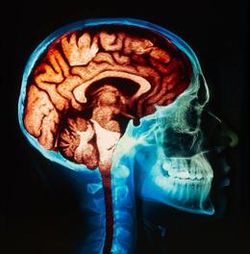
Brain Evidence that prescription drugs shrink patients' brains would, one might think, suggest only one course of action: stop prescribing them. But the matter turns out to be much more complicated, according to research published today in Archives of General Psychiatry on the effects of antipsychotic drugs in people with schizophrenia1.

In the past 15 years, research has indicated that people with schizophrenia have smaller cerebral volumes than the general population, and that this reduction is particularly large in 'grey-matter' structures, which contain the cell bodies of neurons. For instance, one meta-analysis points to 5–7% reductions in the size of the amygdala, hippocampus and parahippocampus2, which are all involved in memory storage and retrieval. But scientists have debated whether the decrease is caused by the disease alone, or whether powerful antipsychotic drugs also have a role. According to the latest findings, the more antipsychotics patients receive, the more likely they are to have a decreased amount of grey matter.

More here.

What It Means to be Colored in the Capital of the United States

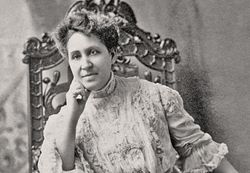
The full text transcript of Mary E. Church Terrell's What It Means to Be Colored in the Capital of the United States speech, delivered at the United Women's Club in Washington D.C. – October 10, 1906 from EmersonKent.com:

Mary_church_terrell Washington D.C. has been called The Colored Man's Paradise. Whether this sobriquet was given to the national capital in bitter irony by a member of the handicapped race, as he reviewed some of his own persecutions and rebuffs, or whether it was given immediately after the war by an ex-slaveholder who for the first time in his life saw colored people walking about like free men, minus the overseer and his whip, history saith not. It is certain that it would be difficult to find a worse misnomer for Washington than The Colored Man's Paradise if so prosaic a consideration as veracity is to determine the appropriateness of a name.

It is impossible for any white person in the United States, no matter how sympathetic and broad, to realize what life would mean to him if his incentive to effort were suddenly snatched away. To the lack of incentive to effort, which is the awful shadow under which we live, may be traced the wreck and ruin of score of colored youth. And surely nowhere in the world do oppression and persecution based solely on the color of the skin appear more hateful and hideous than in the capital of the United States, because the chasm between the principles upon which this Government was founded, in which it still professes to believe, and those which are daily practiced under the protection of the flag, yawns so wide and deep.

More here.

Twenty reasons why it’s kicking off everywhere

Paul Mason of the BBC's Newsnight in his blog:

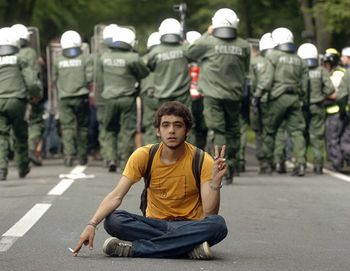
Protest We've had revolution in Tunisia, Egypt's Mubarak is teetering; in Yemen, Jordan and Syria suddenly protests have appeared. In Ireland young techno-savvy professionals are agitating for a “Second Republic”; in France the youth from banlieues battled police on the streets to defend the retirement rights of 60-year olds; in Greece striking and rioting have become a national pastime. And in Britain we've had riots and student occupations that changed the political mood.

What's going on? What's the wider social dynamic?

My editors yesterday asked me put some bullet points down for a discussion on the programme that then didn't happen but I am throwing them into the mix here, on the basis of various conversations with academics who study this and also the participants themselves.

At the heart of it all are young people, obviously; students; westernised; secularised. They use social media – as the mainstream media has now woken up to – but this obsession with reporting “they use twitter” is missing the point of what they use it for.

In so far as there are common threads to be found in these different situation, here's 20 things I have spotted:

1. At the heart if it all is a new sociological type: the graduate with no future

2. …with access to social media, such as Facebook, Twitter and eg Yfrog so they can express themselves in a variety of situations ranging from parliamentary democracy to tyrrany.

3. Therefore truth moves faster than lies, and propaganda becomes flammable.

4. They are not prone to traditional and endemic ideologies: Labourism, Islamism, Fianna Fail Catholicism etc… in fact hermetic ideologies of all forms are rejected.

5. Women very numerous as the backbone of movements. After twenty years of modernised labour markets and higher-education access the “archetypal” protest leader, organizer, facilitator, spokesperson now is an educated young woman.

More here.

Mubarak, he’s no dictator

Chase Madar in the London Review of Books blog:

Biden%20candidate When asked by Jim Lehrer, the host of Newshour on PBS, if Hosni Mubarak was a dictator, the US vice president, Joseph Biden, said: ‘Mubarak has been an ally of ours in a number of things and he’s been very responsible on, relative to geopolitical interests in the region, Middle East peace efforts, the actions Egypt has taken relative to normalising the relationship with Israel… I would not refer to him as a dictator.’

Here are some excerpts from the rest of Lehrer’s interview with Biden, containing more of the VP’s candid assessments.

On Darth Vader: Look, I know Darth fairly well, and Jim, I just want to mention that Darth has overcome asthma, some serious, serious asthma, and it’s just a really inspiring story, he’s written a children’s book about it, I gave a signed copy to my granddaughter for Christmas. Anyway our position is that before Darth blows up the planet Alderaan with his so-called Death Star, which is really just a large weather satellite with a few dual-use components, Darth should, you know, take some of that planet’s concerns into account. He should take their concerns seriously, and it should be a peaceful process. They have a right to protest against their planet getting blown up. But Jim, it’s a two-way street, and Alderaan shouldn’t be vandalising the Death Star’s weapon systems, which, of course, not that they exist. There’s been a concern that some of the more radical elements, you know, the Wookie Street, might try to do this. So no, we don’t think Darth Vader should resign. But if he does – if he does – we can find the recent appointment of Darth Maul as his acolyte Dark Lord of the Sith to be really, really encouraging from a human rights perspective. Just remember, the Empire is a fragile beacon of democracy in a turbulent universe.

More here.

A Mathematician Explores Claims of Prejudicial Treatment in the Media

John Allen Paulos in his Who's Counting column at ABC News:

John-allen-paulos A claim of prejudicial treatment is the basis for many news stories. The percentage of African-American students at elite universities, the ratio of Hispanic representatives in legislatures, and, just recently, the proportion of women among Wikipedia contributors have all been written about extensively.

Oddly enough, the shape of normal bell-shaped (and other) statistical curves sometimes has unexpected consequences for such situations. This is because even a small divergence between the averages of different population groups is accentuated at the extreme ends of these curves, and these extremes, as a result, often receive a lot of attention.

There are policy inferences, most of them wrong-headed, that have been drawn from this fact, but I certainly don't want to delve into questionable claims. I merely want to clarify a couple of mathematical points. To illustrate one such point, assume two population groups vary along some dimension – height, for example. Let's also assume that the two groups' heights vary in a normal or bell- shaped manner. Then even if the average height of one group is only slightly greater than the average height of the other, people from the taller group will make up a large majority of the very tall.

Likewise, people from the shorter group will make up a large majority of the very short. This is true even though the bulk of the people from both groups are of roughly average stature. So if group A has a mean height of 5'8″ and group B a mean height of 5'7″, then (depending on the variability of the heights) perhaps 90% or more of those over 6'3″ will be from group A. In general, any differences between two groups will always be greatly accentuated at the extremes.

More here.

Monday, February 7, 2011

Kelly Amis

3QD-Banner-High-Contrast

Kelly

Kelly Amis is the founder and president of Loudspeaker Films, a new independent film production company focused on social justice and education equity issues. Its first project, TEACHED, exposes disparities in the American public education system, especially as they impact urban minority youth.

After graduating magna cum laude from Georgetown University, Amis taught fourth and fifth grades in South Central, Los Angeles as a charter corps member of Teach for America. This experience inspired Amis to earn a master’s degree in Education Policy Analysis from Stanford University and to research local school governance as a Fulbright Scholar at the Australian Council for Educational Research in Melbourne.

Since then, Amis has worked as a legislative aide to U.S. Senator Dianne Feinstein—handling education, labor and foreign policy issues—and for a variety of education reform organizations, including: the Thomas B. Fordham Foundation, where she launched one of the nation’s first charter school incubators; the Sallie Mae Fund, where she helped design and start-up Building Hope, a charter school facilities fund; and Fight For Children, where she devised the “three sector strategy” that helped increase educational options for low-income District of Columbia students.

Amis is the co-author of “Making it Count: A Guide to High-Impact Education Philanthropy,” and numerous articles on education reform.  She lives in Northern California.

Email: k_amis [at] yahoo.com

  • Blah blah…
  • Blah