A Week in Culture: Nico Muhly, Composer

From The Paris Review:

Nico_BLOG 5:45 A.M. I wake up in a panic—an anxiety dream about an e-mail argument, which is prescient given the early-morning realities of my inbox. To calm myself, I buy music online manically. The new Iron and Wine cover is neurosis-provoking neon, but I buy it anyway. While listening on headphones, I fall back asleep and iTunes continues and mysteriously plays Paula Deen’s “Thanksgiving Special,” in which she makes oyster dressing. I actually like her accent, although the way she pronounces the word for (as in, “I’ll let this fry up here for a minute”) strikes me as uncharacteristically Vietnamese.

12:00 P.M. Car trip into downtown Reykjavík with my boyfriend! An assistant is sorting through this afternoon’s brass sheet music, so I feel at liberty to give my boyfriend free run of the iPod in the car. He deftly assembles an outgoing play list of “Canadians” (Tegan and Sara, the Arcade Fire, Katy Perry—we both assume she is Canadian but cannot verify) and an incoming play list of “Lesbians of Color” (Tracy Chapman and Toshi Reagon).

6:00 P.M. This afternoon’s work is to record brass arrangement for the upcoming album of Mia Maestro, an Argentine songstress. I’m still surprised by the magical lift the two horns and two trombones offer to the surface of a song. The trick is to delay their entrance longer than you think is right, and then, after one more bar’s worth of waiting, sneak in.

More here. (Note: For Anjuli Raza Kolb…in case you missed it!)
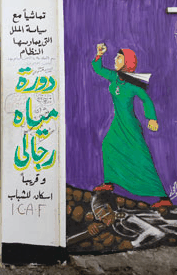
This is an Arab 1848. But US hegemony is only dented

Tariq Ali in The Guardian:

ScreenHunter_06 Feb. 24 13.36 The refusal of the people to kiss or ignore the rod that has chastised them for so many decades has opened a new chapter in the history of the Arab nation. The absurd, if much vaunted, neocon notion that Arabs or Muslims were hostile to democracy has disappeared like parchment in fire.

Those who promoted such ideas appear to the most unhappy: Israel and its lobbyists in Euro-America; the arms industry, hurriedly trying to sell as much while it can (the British prime minister acting as a merchant of death at the Abu Dhabi arms fair); and the beleaguered rulers of Saudi Arabia, wondering whether the disease will spread to their tyrannical kingdom. Until now they have provided refuge to many a despot, but when the time comes where will the royal family seek refuge? They must be aware that their patrons will dump them without ceremony and claim they always favoured democracy.

If there is a comparison to be made with Europe it is 1848, when the revolutionary upheavals left only Britain and Spain untouched – even though Queen Victoria, thinking of the Chartists, feared otherwise. Writing to her besieged nephew on the Belgian throne, she expressing sympathy but wondered whether “we will all be slain in our beds”. Uneasy lies the head that wears a crown or bejewelled headgear, and has billions stored in foreign banks.

More here.

Egypt’s Protest Comedy Show

035636_Ben_Ali_FB_request

Early in the protests, many signs drew comparisons between Mubarak and just-ousted Tunisian President Ben Ali, depicted here asking his Egyptian counterpart to become Facebook friends (above) and here's Mubarak as Colonel Sanders (below):

035944_Mubarak_as_the_Colonel

Anna Louie Sussman in The Atlantic:

Revolutions can be messy. They can be tragic. As long as the Internet is working, they can be tweeted. And, as Egyptians demonstrated during their 18 days of protest, they can also be funny.

In the English-language press, the post-game wrap-up of Egypt's uprising has largely focused on the role of new media tools (as well as old ones, namely satellite television), which allowed people to connect, organize and inform. Absent from most of this analysis was an examination of one of the oldest and most subversive political tools there is: humor. The steady stream of comedy flowing throughout the square functioned much as Twitter and Facebook did: to build community, strengthen solidarity, and provide a safe, thug-free outlet for Egyptians to defy the regime.

More here.

Once upon a life: Hisham Matar

Hisham Matar in The Observer:

ScreenHunter_05 Feb. 24 13.12 I can pinpoint the exact moment when I first began to think about what profession I should go into. It was 1978, I was seven and had just been handed over by the women of my family to the earnest and self-important gatherings of the men. I was no longer the responsibility of my aunts and older female cousins. I was now a man. This was a tragedy. Women were fun. They produced things: feasts and gossip. They sang, played the goblet drum and danced that miraculous Libyan dance where the hips seem to move independent of the body. They painted their hands and feet with henna. They cut up aloe plants to extract the slimy stuff for their skin. They were like mad scientists, whisking up egg, honey, olive oil and God-knows-what to bathe their hair in the mixture. They plotted social manoeuvres, planned parties and funerals, and had an opinion about everything. As a young boy in Libya it was hard to escape the conclusion that the women were the most feeling and most functional part of society.

As part of the ritual of becoming a man, my maternal uncle, a judge, and his four sons, each older than me, took me deer hunting. I had heard about these trips before, and once saw the Range Rover return caked in yellow sand. There were carcasses roped to the roof. One deer had its head over the rail of the roof rack, its mouth open and, like an offering, a bright purple tongue hung out of it.

More here. [Thanks to Laila Lalami.]

It’s Time To Intervene In Libya

Shadi Hamid in Slate:

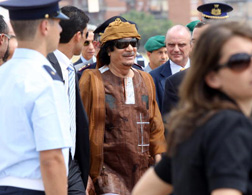
110223_FOR_quaddafiTN During an otherwise bizarre, incoherent speech on Tuesday, Libyan leader Muammar Qaddafi clarified one thing: He is ready and willing to slaughter his own people if his survival requires it.

In confirming what many had already suspected, Libya has moved from one stage of conflict to another. The more appropriate model here is not Egypt or Tunisia but rather Bosnia, Kosovo, or Iraq after the first Gulf War—civil conflicts in which leaders perpetrated premeditated, mass killing of noncombatants.

Only a few days after pro-democracy protests first broke out, the death toll has risen as high as 1,000, according to some estimates. It is likely to get worse, threatening a repeat of Syrian President Hafez Assad's destruction of Hama in 1982, which claimed at least 10,000 lives. To prevent a similar outcome, the international community—specifically the United States, the United Nations, and NATO—must intervene.

The international response to the Libyan crisis has so far been lacking in both vision and resolve. Initial reactions, with their by now tiresome phrasing—”expressing grave concern” and “urging restraint”—suggested a limited vocabulary that was not commensurate with the gravity of the crimes being committed.

More here.

Thursday Poem


Meditation on Yellow

‘The yellow of the Caribbean seen from Jamaica at three in the afternoon.’
– Gabriel García Márquez

1

At three in the afternoon
you landed here at El Dorado
(for heat engenders gold and
fires the brain)
Had I known I would have
brewed you up some yellow fever-grass
and arsenic

but we were peaceful then
child-like in the yellow dawn of our innocence

so in exchange for a string of islands
and two continents

you gave us a string of beads
and some hawk’s bells

which was fine by me personally
for I have never wanted to possess things
I prefer copper anyway
the smell pleases our lord Yucahuna
our mother Attabeira
It’s just that copper and gold hammered into guanin
worn in the solar pendants favoured by our holy men
fooled you into thinking we possessed the real thing
(you were not the last to be fooled by our
patina)

Read more »

Wednesday, February 23, 2011

the whirling dervish of Dia

23_whirling_04

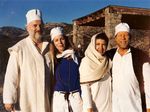
Launched under several aliases and in near-secrecy in 1974, Dia was the well-funded lovechild of a German art visionary named Heiner Friedrich and Philippa de Menil, a strikingly beautiful spiritual seeker and youngest scion of the Schlumberger oil fortune. De Menil’s largesse had created a kind of refuge from the speculative market in art then taking shape in New York, and a new canon of monumental, spiritually charged epics: a SoHo gallery floor buried, permanently, with black earth; a hollowed-out volcano, transformed into a science-fictional archaeo-astronomical laboratory for perceptual flight; a Promethean bed of nails poking dangerously into the desert sky, awaiting some gargantuan penitent. … But it took even less time to come apart. Amid falling share prices and rumors of an investigation of financial improprieties by New York’s attorney general, a group of concerned de Menils had launched a coup in 1984, replacing the original board with a respectable firewall of uptown lawyers and suits, putting much of Dia’s real estate and art holdings on the auction block and sequestering Philippa’s money in a trust. The stage was set for an epic confrontation between the suits and the dreamers… that never quite came to pass. The enigmatic Friedrich quit New York, disappeared into a wandering, art-mad exile; Philippa de Menil, the embattled heiress, had long since ceased to exist. In 1980, the woman she was had become a Sufi dervish named Fariha al-Jerrahi, and when the house of Dia fell, she moved on.

more from Alexander Keefe at Bidoun here.

the art of feud

Wittgenstein

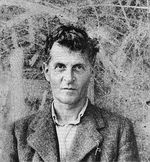
In general outline at least the historical record is not in dispute. In 1946 Karl Popper addressed the Cambridge Moral Sciences Club on the subject Are There Philosophical Problems?. The subsequent discussion, chaired by Russell, is known to have been lively. At one point Wittgenstein, brandishing a poker, is said to have demanded of Popper that he offer an example of a moral rule: “Not to threaten visiting lecturers with pokers”, Popper is said to have replied. At which point Wittgenstein, perhaps deciding it was a case of “thereof one must be silent”, stormed out. It has been suggested that the title and content of Popper’s paper were intended to provoke Wittgenstein who by this time is thought to have become sceptical of the existence of philosophical problems, and to believe that such “problems” were instead reducible to the misuse of language. Whether his scepticism was as well defined as many think is open to question. An alternative reading of Wittgenstein might be that he was developing a metaphilosophical perspective from which standard philosophical problems were drained of their force. Thus in the Blue and Brown Books he remarks that “philosophy really is purely descriptive”. Presumably, also, Popper thought that Wittgenstein, a former pupil of Russell and Moore, and by this time a Cambridge Don, had never come across a philosopher who took seriously the existence of philosophical problems. None of this is important of course. What is most notable about the “Poker incident” is its delicious status as an originator of that most wonderful thing: the philosophical feud.

more from Andy Walsh at Talking Philosophy here.

mining afghanistan

Woods-01-thumbnail

The miners take turns chopping the coalface. All around us a jury-rigged jumble of tree trunks is wedged against the tunnel’s ceiling, our only protection from being crushed by the five hundred meters of rock between here and the floor of the northern Afghan desert. My claustrophobia mounts with every chunk of coal that dings off my plastic helmet. One miner crouches in the access shaft and shovels coal into an iron railcar. My headlamp catches his face, and I see his teeth are flecked with black. His wiry muscles are straining with the effort, but he works fast. The afternoon shift divides a two-dollar bonus for every tonne of coal they haul. The crew is a half-hour into the afternoon shift, and they’re already filthy. Sweat mixed with coal dust trickles in rivulets down their bare backs. Superfine particles of coal swirl through the beams of their lamps. No one wears a mask; everyone breathes the black mist. The miners work down here, eight hours a day, for next to nothing—about a hundred dollars a month. And the statistics show they’ll spend ten percent of that income on petty bribes to the Afghan government. The whole of the Karkara coalmine runs on a budget of only four hundred thousand dollars a year, less than a sixth of what director Abdel Munir says he needs to hire a full complement of workers and to bring the mine up to international safety standards.

more from Elliott D. Woods at VQR here.

The Nominees for the 2011 3QD Prize in Arts & Literature Are:

Alphabetical list of blog names followed by the blog post title:

(Please report any problems with links in the comments section below.)

For prize details, click here.

And after looking around, click here to vote.

  1. 3 Quarks Daily: Are Our Writers As Lousy As Our Bankers?
  2. 3 Quarks Daily: Bringing It All Back Home (to Shillong)
  3. 3 Quarks Daily: In Praise of Yamato Spirit(s) : Passing By in Tokyo Part II
  4. 3 Quarks Daily: Joothan: A Dalit’s Life
  5. 3 Quarks Daily: New York’s Empire State of Mind: The Colonization of ‘Up’ Part I
  6. 3 Quarks Daily: Shadow Catchers: Camera-less Photography
  7. 3 Quarks Daily: Tokyo, Almost-Encounters, and “Passing By”
  8. 3 Quarks Daily: What We Talk About When We Talk About the Weather
  9. Abbas Zaidi Writes, Innovates & Educates: Perspective Enrichment For A Better World
  10. Accidental Blogger: The Leopard _ Giuseppe Tomasi Di Lampedusa
  11. Amardeep Singh: The Demand’s of Honesty: On Amitava Kumar’s “Nobody Does the Right Thing”
  12. AngelSpeak: If I Wasn’t Scared Before… Writing Memoir in Genzlinger’s Age
  13. Belonging to a Different Macro-Quantum State of Mind: Time, talk to me!
  14. Bibliographing: Let us keep each other’s secrets
  15. Bookslut: In Search of Spiraling Time
  16. Book Snob: Gilead by Marilynne Robinson
  17. Busy Being Born: If Facebook Didn’t Exist, It Would Be Necessary to Invent It
  18. Butcheredswitch: Subway Writing
  19. Chapati Mystery: I am a Bhains
  20. Chapati Mystery: Oscar, Wow!
  21. Chapati Mystery: Peccavistan
  22. Chapati Mystery: The Stay-at-Home Man
  23. Fame and Fortune: The Honesty of the Person
  24. Fernham: Pearls and Power
  25. Ground Views: We Regret To Inform You That Your Condolences Cannot Be Accepted At This Time
  26. Guernica: The Un-Victim
  27. Hundred Mountain: Thinking of Turtles
  28. I Have Become Accustomed To Rejection: I Wonder How Long I Could Sit There
  29. Jadaliyya: The Poetry of Revolt
  30. Kuzhali Manickavel: Conversations–The Gee Oh
  31. Kuzhali Manickavel: What Is Your Native
  32. Literal Life: Freedom ~ Jonathan Franzen
  33. M. A. Peel: Oh Frabjous Day: Woolverton’s FanFic Love for Alice
  34. Mark Athitakis’ American Fiction Notes: Adam Haslett, Lionel Shriver, and the Bygone Age of Order
  35. Millicent and Carla Fran: On The Face That Launched a Thousand Clicks, Or What The Social Network Isn’t About
  36. Millicent and Carla Fran: Why Don’t Women Submit?
  37. Pank: This Modern Writer: 28, NO, MAKE THAT 30, ABSOLUTELY TRUE BLACK HISTORY FACTS ON THE OCCASION OF BLACK HISTORY MONTH (FORMERLY NEGRO HISTORY WEEK). 1 FOR EACH DAY, PLUS 1 IN THE CASE OF LEAP YEAR & 1 FOR GOOD LUCK
  38. Plum: Hair Myth
  39. Religious Left Law: Sufi Poetry
  40. Sepia Mutiny: Letter to a Young Islamophobe
  41. Stuck In A Book: Is there no balm in…
  42. Tales from the Reading Room: The Precious Things
  43. Tang Dynasty Times: A vase filled with perfumes (proust & the king of bhutan)
  44. Tang Dynasty Times: Shipwrecked
  45. The Awl: If You Have Only One Week in L.A.
  46. The Millions: Beyond Harry, Oz, and Narnia: Lev Grossman’s The Magicians
  47. The Millions: Brideshead Revisited
  48. The Millions: Chasing the Whale: Banksy, Obsession, and the Sea
  49. The Millions: Dispatch from the Borders-Land
  50. The Millions: Every Day I Open A Book
  51. The Millions: Her Story Next to His: Beloved and The Odyssey
  52. The Millions: In Search of Iago
  53. The Millions: In the Room: Against a Cultural Boycott of the Galle Literary Festival
  54. The Millions: On Bad Reviews
  55. The Millions: Reading and Race: On Slavery in Fiction
  56. The Millions: The Sorry State of the Rejection Letter
  57. The Morning News: A Song for Aretha
  58. The Nervous Breakdown: Authors and Tattoos, Part I of II
  59. The Nervous Breakdown: Authors and Tattoos, Part II of II
  60. The Platform: which is to say: time bends like a weak knee, or so fresh and so clean, clean
  61. This Space: The Shadow Cast by Writing
  62. [TK] Reviews Blog: Aspiring Grownups: Editorial Assistants
  63. Tolstoy Is My Cat: Flash Fiction: Snow
  64. Vanity Fair Online: The Venerable, Vulnerable Taxi Drivers of New York
  65. Vanity Fair Online: The Ground Zero Mosque’s Missing Muslims
  66. Walter Kirn’s Permanent Morning: My Honest Impressions of Islam in the Biographical Order They Occured
  67. Wellywood Woman: I feel the earth move under my feet
  68. Writing Without Paper: Consider the Pomegranate

Thank Wisconsin’s courageous state senators who have joined with protesters to block the Republican attack on public employees

From the website of Credo:

Wi_solidarity200 Amazing. Inspiring. This is what people power can do.

When Republican Governor Scott Walker attacked state workers and threatened to call out the National Guard if they protested, it sparked a popular uprising in Wisconsin. And now the extreme proposal to take collective bargaining rights away from public employees is temporarily blocked as a result of mass protests.

Tens of thousands of people — including members of CREDO Action — have been out in the streets and in the Rotunda in Madison, Wisconsin. Students and citizens are protesting in solidarity with nurses, teachers and workers.

And the people are not alone. Instead of caving to the opposition, their elected representatives are fighting with them. In fact, Democratic state senators boldly left the state in order to deny Republicans the quorum they need to pass Governor Walker's radical anti-worker, anti-union bill. As long as every Democratic state senator refuses to go to the capitol, a vote cannot be held.

More here.

The Next Wall Street Collapse

Jonathan Kirshner in the Boston Review:

ScreenHunter_04 Feb. 23 12.52 …the economy is poised to head down the same road that led to the recent collapse. This is the dispiriting conclusion of four recent books by particularly well-positioned observers. Nouriel Roubini can take credit for getting the crisis almost exactly right, long before it hit; this alone should make his Crisis Economics (coauthored with Stephen Mihm) required reading. Nobel laureate Joseph Stiglitz reprises his role as one of the world’s foremost critics of “market fundamentalism” in Freefall. Richard Posner is closely associated with the free-market “Chicago School” of economics, and, as such, his bracing and intellectually admirable A Failure of Capitalism demands attention. (Posner explores similar themes in a recent academic work, The Crisis of Capitalist Democracy.) Simon Johnson, former Chief Economist at the International Monetary Fund (IMF), and James Kwak, a businessman and consultant, wrote the best book of a fine bunch. Their 13 Bankers is a brilliant, important, and extremely unsettling work. Four big lessons emerge from these analyses.

Keynes was right and classical economics wrong. The economist John Maynard Keynes argued that the market has its limits. Most markets work well most of the time, but financial markets left alone are prone to dysfunction, and an economy stuck in a rut can stay in a rut for some time. Thus the necessity of the stimulus.

More here.

This is our revolution, too

Frederick Bowie in Open Democracy:

ScreenHunter_03 Feb. 23 12.10 Ongoing protests and actions in places from Madison, Wisconsin, to Central London have already appealed to the Egyptian experience, both explicitly, and symbolically. American public service workers last week brandished Egyptian flags to express their rejection of the state's attempts to deprive them of their union rights, while British activists have called for a day of action in March to “bring Tahrir Square to Hyde Park”. While the nature of every act of human revolt is specific and, at some level, untranslatable, the energy of empowerment which it releases is by its nature infectious, and transgressive. How long before here, in the West, our own governments' politically-motivated “austerity” programmes create the conditions in which a thousand Tahrirs can bloom? Looking back to recent events in France and Greece, we may feel that day is perhaps not so far away.

Noam Chomsky recently claimed that what western leaders are really afraid of is not an Islamist takeover in the Arab region, but the emergence of genuinely independent and democratic Arab states which will no longer kow-tow to Washington and do its bidding. That is surely part of the story. But I believe that what they are most afraid of is not just the emergence of democracy in the Arab world. However uncomfortable and embarrassing that may be, they know they can live with it. What they are most afraid of is that, having slept through the last 60 years of democracy, their own citizens/subjects may be about to wake up again to their own power: that, having seen what it is like when a people dictate to their government what it should do for them, rather than the reverse, we might start to take our own rights back, wholesale, rather than waiting for our rulers to grant us them in homeopathic doses – or fob us off with a placebo.

More here. [Thanks to Kris Kotarski.]

Nearer to Truth than History

From Guernica:

Reza_500 The day before the 2010 midterm elections, I sat down with Reza Aslan at his home in Los Angeles to discuss poetry, politics, and what comes next. In the most literal sense, “next” for Aslan is, in large part, centered around the publication of the groundbreaking anthology, Tablet & Pen: Literary Landscapes from the Modern Middle East. As controversial as it is revelatory, the anthology marks a new phase in the life of the scholar and artist who, perhaps unenviably, is one of the most recognizable commentators on the modern Middle East (a term that Aslan is quick to point out is a Western invention). Through his appearances on The Daily Show and The Colbert Report, not to mention mainstream news outlets (after we spoke he was on his way to record an interview with Australia’s Insight news program), Aslan has become something of a celebrity. As I was reading Aslan’s books to prepare for this interview, I was stopped no less than five times by people who can only be described as fans. Most of these people had read his books, but all knew him from television. As we spoke, the subject of social media came up repeatedly, both in terms of the implications it’s had on his own career and, on a deeper level, how notions of borders and identity are shifting as the demarcations between local and global are increasingly blurred. I wondered what possibilities and challenges these issues offered Aslan in his new role as an anthologist.

Aslan describes Tablet and Pen as a “pivot” in his career’s mission to “build bridges between peoples of the West and the Middle East,” and while that is true, it’s equally important to note that the book can also be seen as an entirely new way of envisioning the anthology form. As opposed to the usual compendium of poems and stories whose sheer critical mass is meant to signify the historical importance of the anthology’s subject, Aslan has created a book that functions more like a novel.

More here.

In defense of low-alcohol brews

Jason Wilson in The Smart Set:

ID_QT_WILSO_SESSI_AP_001 I love a good argument. I particularly love a good argument about drinks. And I especially love a good drinks argument in which manifestos are published. This is why — whether we're talking about wine, spirits or beer — it's endlessly amusing to bring up the topic of alcohol content.

In wine, there are supporters of high-alcohol fruit bombs versus sommeliers who refuse to put any wine over 14 percent on their lists. In spirits, it's the opposite: Many craft bartenders thumb their noses at whiskey that falls below 100 proof. And in beer, there's the perennial issue of the session beer.
Session beers are low-alcohol, high-flavor, easy-drinking, reasonably priced beers that one might drink all night long and still be able to walk home without doing something stupid. Essentially, a session beer is the opposite of the 8 to 12 percent hop/sour/funk monsters that so many beer geeks love.

The idea of finding a really good session beer occurred to me when I was at my local bar, a place with two dozen craft beers on tap. I noticed that more than half the bar was drinking bottles of Miller Lite (4.17 percent alcohol by volume) or Bud Light (4.2 percent). This, while right at their disposal was everything from Maudite (8 percent) to Dogfish Head 90-Minute IPA (9 percent) to Scaldis Bush de Noel (12 percent) to even my own current session beer, Victory Prima Pils (5.3 percent).

I asked one of the guys — a tough-looking dude with a chinstrap beard and lots of tattoos — why he wasn't drinking any of the great beers on tap. He glared at me. “I'm gonna drink for, like, the next five hours. Do you want to see what happens when I drink more than one of those?”

More here.

The Invisible Line Between Black and White

This article is posted in honor of Black History Month:

From Smithsonian:

Black For much of their history, Americans dealt with racial differences by drawing a strict line between white people and black people. But Daniel J. Sharfstein, an associate professor of law at Vanderbilt University, notes that even while racial categories were rigidly defined, they were also flexibly understood—and the color line was more porous than it might seem. His new book, The Invisible Line: Three American Families and the Secret Journey from Black to White, traces the experience of three families—the Gibsons, the Spencers and the Walls—beginning in the 17th century. Smithsonian magazine's T.A. Frail spoke with Sharfstein about his new book:

People might assume that those who crossed the line from black to white had to cover their tracks pretty thoroughly, which would certainly complicate any research into their backgrounds. But does that assumption hold?

That’s the typical account of passing for white—that it involved wholesale masquerade. But what I found was, plenty of people became recognized as white in areas where their families were well known and had lived for generations, and many could cross the line even when they looked different. Many Southern communities accepted individuals even when they knew those individuals were racially ambiguous—and that happened even while those communities supported slavery, segregation and very hard-line definitions of race.

More here.

Tuesday, February 22, 2011

Paradigms Lost? Cowboys and Indians in the Battle Over Economic Ideas

_63G1654_2Mark Blyth over at Triple Crisis:

By the time the G20 met in Paris last weekend only the degree of fiscal rectitude was up for grabs, Obama having joined the consolidators. And as for the lofty goals of INET [Institute for New Economic Thinking], it is significant that their next meeting will be held at the Bretton Woods hotel where the post-war Keynesian order was assembled. These new economic thinkers seem to be searching for ‘Paradigms lost.’

All of which makes me wonder about the conditions under which the economic ideas that, as Keynes put it, “dominate the economic thought, both practical and theoretical, of the governing and academic classes of this generation” change? As I argue in a new piece for the journal Governance, if one views the problem of paradigm shift as one where some series of events act as anomaly generators that undermine the theory, leading to its eventual and ultimate collapse and replacement, then the 2008 crisis was as close to a perfect natural experiment as you can get. To list some of the howlers: prices were not right in any sense, liquidity turned out to be a social property after all, VaR and associated techniques of risk management proved to be worse than useless, and the whole experiment cost (so far) around $2-3 trillion dollars.

You might then think that given such large losses and red faces we really should now be living in a post-neoclassical world. Yet we are not. Here are two reasons why this is the case: one that I don’t buy and one that I do buy.

“There is (still) no Alternative” – There is No New Paradigm.

This is a very odd but powerful form of argument. Odd, when you consider that this blog, INET, and hundreds of other sources are actively building one. Powerful, in that by saying that ‘unless you replace one complete integrated mathematically perfect theory with another one you should stick with the one you have got.’

I have always been suspicious of this form of argument for three reasons. First, part of the pathology of the old paradigm was precisely its perfectly integrated general form, which made it quite useless for acting in the world. Any new paradigm should be robust to the world, which means partial and revisable in the light of experience. Economists tend not to like that idea.

A History, a Theory, a Flood

Dyson_1-031011_jpg_470x453_q85

The vision of the future as an infinite playground, with an unending sequence of mysteries to be understood by an unending sequence of players exploring an unending supply of information, is a glorious vision for scientists. Scientists find the vision attractive, since it gives them a purpose for their existence and an unending supply of jobs. The vision is less attractive to artists and writers and ordinary people. Ordinary people are more interested in friends and family than in science. Ordinary people may not welcome a future spent swimming in an unending flood of information. A darker view of the information-dominated universe was described in a famous story, “The Library of Babel,” by Jorge Luis Borges in 1941.3 Borges imagined his library, with an infinite array of books and shelves and mirrors, as a metaphor for the universe. Gleick’s book has an epilogue entitled “The Return of Meaning,” expressing the concerns of people who feel alienated from the prevailing scientific culture. The enormous success of information theory came from Shannon’s decision to separate information from meaning. His central dogma, “Meaning is irrelevant,” declared that information could be handled with greater freedom if it was treated as a mathematical abstraction independent of meaning. The consequence of this freedom is the flood of information in which we are drowning. The immense size of modern databases gives us a feeling of meaninglessness. Information in such quantities reminds us of Borges’s library extending infinitely in all directions. It is our task as humans to bring meaning back into this wasteland. As finite creatures who think and feel, we can create islands of meaning in the sea of information. Gleick ends his book with Borges’s image of the human condition: We walk the corridors, searching the shelves and rearranging them, looking for lines of meaning amid leagues of cacophony and incoherence, reading the history of the past and of the future, collecting our thoughts and collecting the thoughts of others, and every so often glimpsing mirrors, in which we may recognize creatures of the information.

more from Freeman Dyson at the NYRB here.