Three Uses for Charlie Sheen (a Wittgensteinian appreciation)

Walter Kirn in his new blog Walter Kirn's Permanent Morning:

1. As Cautionary Tale.

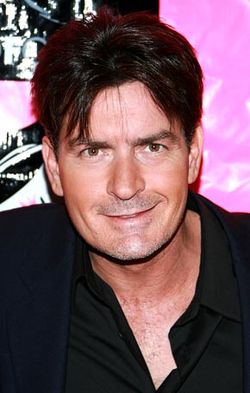
Charlie-sheen-rehab Acutely problematic. Since Sheen's biography bears little relationship to the experiences of most civilians, it's hard to know where exactly he went wrong or how, under the circumstances (father a hyper-observant Roman Catholic political activist thinking-person's movie star; brother a frozen-in-pop-culture-time non-thinking person's teen-dream idol; face a peculiar demonic composite of both of them that's somehow been robbed of its individuality; ex-wife a robotic sex kitten projection deemed real only for legal and gossip purposes; TV show a fiendishly exploitative mechanism which invites the viewer to superimpose what he knows to be Sheen's degraded consciousness on a generic asshole background of a character) he might have avoided going wrong.

Yes, in theory, cocaine abuse is something human beings should avoid and probably ought to condemn when it's observed, but Charlie Sheen does not exist in theory. Indeed, no theory can account for Charlie Sheen. Indeed, the possibility of his existence proves that theory has no useful part in any account of lived human reality.

More here.

My first date with Kurt Vonnegut

Charles J. Shields, whose biography of Kurt Vonnegut is due out from Henry Holt & Co. in 2011, in his blog Writing Kurt Vonnegut:

These are the notes that I typed back in my hotel room a few hours after I met Kurt for the first time on December 13, 2006.

Kurt-at-typewriter1-e1276260510218 Vonnegut lives in an off-white brick home on E. 48th Street; a long flight of stairs in front. He greeted me at the door in light grey denim trousers, walking shoes, and a Xavier College sweatshirt. His face was drawn, his skin was gray, and his large hazel eyes had a rheumy stare. His hair— brushed and blown until it stood out— was the color of nicotine and cigarette paper.

I presented him with a bouquet of flowers for his wife, the photojournalist Jill Krementz. Kurt instructed their housekeeper, Maria to “put them in water and say who they’re from.” He was eager to show me where he worked, which was on the third floor, at the top of two staircases that curled up the right-hand wall. I had the feeling we were like two boys who had just met and he was making friends in the time-honored way of showing me his room.

His study, L-shaped, about 12’ x 15’ looks like where a man could spend a good deal of time alone. There’s a double bed in there; and his framed lithographs appear on the walls. A stack of them, about 50, leaned against the wall beside the fireplace. The sinuous figures were done in heavy black line and primary colors.

“Who’s your influence?” I asked. They reminded me of abstracts from the 1950s.

“Paul Klee,” he said, pleased that I wanted to know.

More here.

Monday, February 28, 2011

Woman

by Haider Shahbaz

Dear M,

Today, Lahore is drenched. A shy sun has disappeared. The night hides in darkness muddy water invading the streets. It jumps from under car’s tyres on to unsuspecting pedestrians. It is mid-July; I am back from boarding school to watch a dirty, white, rather ungraceful minaret. There are strange things that the first sight, after three years, of a fog-covered minaret – the same minaret you watched everyday for fifteen long years – can do to a man, a boy. You are here to watch it with me, wearing that disgusting plaid you love, plastic glasses askew on your small nose, thin-lipped smile and a long neck. The nights of full moon have passed. We have just come back from our fifteenth trip to a bakery in fifteen days. I and you are in a search for the perfect dessert.

Yes, for the perfect dessert. Amongst low, Lahori rooftops, parallel Islamabad streets, ruined Greek cities, bright bakeries, semi-naked sword wielding emperors, and idlers, monochrome family pictures of uncles in stiff military suites, dilapidating Mughal art, grand old castles and wrinkled storytellers.

But will we ever find the perfect dessert? The perfect ending? The perfect good-bye? Maybe we shouldn’t, so we keep coming back to find it again.

To many more waves.

Much love,

************************************************************************

Well, can I kiss you, then?

Thoroughly unromantic. She thought.

But we’re friends. And I’m seeing someone.

Thoroughly unromantic. He thought.

But it’s just a kiss.

Pause.

Okay.

Forty minutes.

It’s never just a kiss.

************************************************************************

Read more »

Laila Lalami to Judge 2nd Annual 3QD Arts & Literature Prize

UPDATE 3/21/11: The winners have been announced.

UPDATE 3/13/11: List of finalists.

UPDATE 3/12/11: List of semifinalists.

UPDATE 3/4/11: See full list of nominees: Voting round is now open.

Dear Readers, Writers, Bloggers,
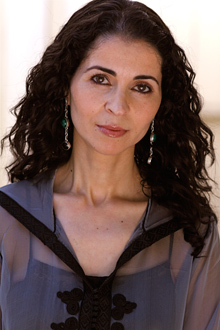
Llalami We are very honored and pleased to announce that Laila Lalami has agreed to be the final judge for our second annual prize for the best writing in a blog or e-zine in the category of Arts & Literature. (Details of last year's A&L prize, judged by Robert Pinsky, can be found here.) Laila Lalami was born and raised in Morocco. She attended Université Mohammed-V in Rabat, University College in London, and the University of Southern California, where she earned a Ph.D. in linguistics. Her essays have appeared in the Boston Globe, the Los Angeles Times, The Nation, the New York Times, the Washington Post and elsewhere. She is the recipient of a British Council Fellowship and a Fulbright Fellowship. She was short-listed for the Caine Prize for African Writing in 2006 and for the National Book Critics’ Circle Nona Balakian Award in 2009. She is the author of the short story collection Hope and Other Dangerous Pursuits and the novel Secret Son. Her work has been translated into ten languages. She is currently Associate Professor of Creative Writing at the University of California at Riverside. Dr. Lalami has also been responding to the recent upheavals in Arab countries, and you may see some of that work here. Her well-known blog is here, and you may also follow her on Twitter here.

As usual, this is the way it will work: the nominating period is now open, and will end at 11:59 pm New York City Time (EST) on March 2, 2011. There will then be a round of voting by our readers which will narrow down the entries to the top twenty semi-finalists. After this, we will take these top twenty voted-for nominees, and the four main editors of 3 Quarks Daily (Abbas Raza, Robin Varghese, Morgan Meis, and Azra Raza) will select six finalists from these, plus they may also add up to three wildcard entries of their own choosing. The three winners will be chosen from these by Dr. Lalami.

The first place award, called the “Top Quark,” will include a cash prize of one thousand dollars; the second place prize, the “Strange Quark,” will include a cash prize of three hundred dollars; and the third place winner will get the honor of winning the “Charm Quark,” along with a two hundred dollar prize.

(Welcome to those coming here for the first time. Learn more about who we are and what we do here, and do check out the full site here. Bookmark us and come back regularly, or sign up for the RSS feed.)

PrizeArtsAnnounce2011 Details (please read carefully before nominating):

The winners of this Arts & Literature Prize will be announced on March 21, 2011. Here's the schedule:

February 23, 2011:

  • The nominations are opened. Please nominate your favorite blog entry or e-zine piece by placing the URL for the blog post (the permalink) in the comments section of this post. You may also add a brief comment describing the entry and saying why you think it should win. (Do NOT nominate a whole blog, just one individual blog post.)
  • Blog posts or e-zine articles longer than 4,000 words are not eligible.
  • Each person can only nominate one blog post.
  • We will accept poems and fiction, as well as book or art reviews, criticism, and other types of writing about arts or literature.
  • Entries must be in English.
  • The editors of 3QD reserve the right to reject entries that we feel are not appropriate.
  • The blog entry may not be more than a year old. In other words, it must have been written after February 22, 2010.
  • You may also nominate your own entry from your own or a group blog or e-zine (and we encourage you to).
  • Guest columnists at 3 Quarks Daily are also eligible to be nominated, and may also nominate themselves if they wish.
  • Nominations are limited to the first 200 entries.
  • Prize money must be claimed within a month of the announcement of winners.

March 2, 2011

  • The nominating process will end at 11:59 PM (NYC time) of this date.
  • The public voting will be opened soon afterwards.

March 11, 2011

  • Public voting ends at 11:59 PM (NYC time).

March 21, 2011

  • The winners are announced.

One Final and Important Request

If you have a blog or website, please help us spread the word about our prizes by linking to this post. Otherwise, post a link on your Facebook profile, Tweet it, or just email your friends and tell them about it! I really look forward to reading some very good material, and think this should be a lot of fun for all of us.

Best of luck and thanks for your attention!

Yours,

Abbas

Sunday, February 27, 2011

The Return of Crowds and Power

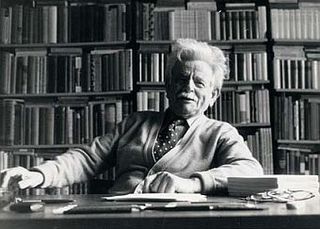
Elias-canetti I've noticed that in response to all the uprisings in the Arab world analysts, pundits and writers reaching for their copies of Elias Canetti's Crowds and Power. Here's Will Self in The New Statesman:

It's been a fantastic three months for those of us gripped by the dynamics of crowds. First, we had student demonstrations here in Britain spiralling out of control; then, we saw Tunisians link arms to push out their corrupt regime; finally, millions took to the streets of Egyptian cities, pitting their sheer weight of numbers against the sclerotic – but still vicious – government of Hosni Mubarak.

Perhaps the most celebrated analyst of the crowd was the Nobel laureate Elias Canetti, whose 1960 magnum opus, Crowds and Power, aimed to do for modern mass movements what Frazer's Golden Bough did for “primitive” ritual. To Canetti, both socialism and capitalism were political systems defined by “the modern frenzy of increase”, in which production led to ever bigger crowds of goods and consumers.

This sense of industrialised society as a crowd, at root, directs Canetti to his definition of power as the coincidence of the desires of the ruler(s) and the ruled.

By this view, it's easy to understand the presence of crowds of people on the streets as symptomatic of a disjunction between the two: only when the crowd has been reabsorbed into the social fabric has synchronous equilibrium been achieved. In Canetti's jargon, the crowd in Tahrir Square was “stagnating”, whereas the crowds of the quiescent Cairene unemployed before the revolt could be characterised as “rhythmic”.

Dubstep revolutions

Canetti showed a nice understanding of how masses of people make their own political weather when he caustically observed that “fire unites a theatre more than a play can” – but his vision was underscored by the apocalyptic mood music of mutually assured destruction. “Rulers tremble today,” he wrote, not “because they are rulers but as the equals of everyone else . . . Either everyone will survive or no one.”

What is X-Phi Good For?

Rembrandtphilosopher200 David Papineau in The Philosopher's Magazine:

When philosophers study knowledge, consciousness, free will, moral value, and so on, their first concern is with these things themselves, rather than with what people think about them. So why exactly is it so important to philosophy to discover experimentally that people differ in their views on these matters? We wouldn’t expect physicists to throw up their hands in excitement just because somebody shows that different cultures have different views about the origin of the universe.

Experimental philosophers are surprisingly vague on this issue. If pressed, they tend to mutter something about discrediting the role played by “intuitions” in traditional philosophy, before rushing off to design their next questionnaire. But this is far too quick. Exactly what role intuitions play in philosophy is a matter of debate, and the details of this debate matter to the significance of experimental philosophy.

Experimental philosophy does itself a disservice by not stopping to explain what it is good for. My own view is that it has an important if limited contribution to make to orthodox philosophical debates, in ways I’ll explain later. But its advocates often claim much more, suggesting that their new method somehow discredits all traditional philosophy. Out with the old, in with the new! In the absence of any reasoned support for this radical manifesto, it is all too easy for critics to dismiss the movement as a fad without foundations.

Isn’t it enough that experimental philosophy is interesting in its own right? Aren’t we all fascinated by the quirks in human thinking that it uncovers? Maybe so, but this doesn’t explain why these findings matter to philosophy. The human mind is very quirky in its attitudes to snakes, spiders, and sex, in ways which are well worth studying, but nobody thinks that these quirks are the province of experimental philosophy.

The “official X-phi” website proclaims that “experimental philosophy involves the collection of empirical data to shed light on philosophical issues.” But how, to repeat the question I started with, do empirical data about everyday thinking help us with real philosophical issues? The comparison with physics is telling once more. Psychologists have done much to investigate everyday thinking about physical topics – “folk physics” as it is sometimes called – and their findings are certainly interesting. Who would have believed that everyday thought is so committed to outmoded Aristotelian laws of motion? But knowing about folk physics doesn’t help with real physics. So why should knowing about folk philosophy help with real philosophy?

Teodorin’s World: Playboy bunnies. $2 million Bugattis. Bags full of cash. Meet the world’s richest minister of agriculture and forestry

Ken Siverstein in Foreign Policy:

ScreenHunter_06 Feb. 27 20.04 The owner of the estate at 3620 Sweetwater Mesa Road, which sits high above Malibu, California, calls himself a prince, and he certainly lives like one. A long, tree-lined driveway runs from the estate's main gate past a motor court with fountains and down to a 15,000-square-foot mansion with eight bathrooms and an equal number of fireplaces. The grounds overlook the Pacific Ocean, complete with swimming pool, tennis court, four-hole golf course, and Hollywood stars Mel Gibson, Britney Spears, and Kelsey Grammer for neighbors.

With his short, stocky build, slicked-back hair, and Coke-bottle glasses, the prince hardly presents an image of royal elegance. But his wardrobe was picked from the racks of Versace, Gucci, and Dolce & Gabbana, and he spared no expense on himself, from the $30 million in cash he paid for the estate to what Senate investigators later reported were vast sums for household furnishings: $59,850 for rugs, $58,000 for a home theater, even $1,734.17 for a pair of wine glasses. When he arrived back home — usually in the back seat of a chauffeur-driven Rolls-Royce or one of his other several dozen cars — his employees were instructed to stand in a receiving line to greet the prince. And then they lined up to do the same when he left.

The prince, though, was a phony, a descendant of rulers but not of royals. His full name is Teodoro Nguema Obiang Mangue — Teodorin to friends — and he is the son of the dictator of Equatorial Guinea, a country about the size of Maryland on the western coast of Africa.

More here.

Jed Perl on Giuseppe Arcimboldo and Franz Xaver Messerschmidt

From The New Republic:

Arcimboldo When artists of earlier eras become subjects of renewed interest, you can be sure that big changes are in the air. All too often relegated to specialized studies in the history of taste, such shifts in an artist’s fortunes are among our most reliable guides to current attitudes and values, a look into the dark glass of the past that can also function as a mirror in which we see reflected some aspect of ourselves. There is certainly as much to be learned about the present as about the past from two small and beautifully focused museum shows in recent months, one at the National Gallery in Washington devoted to the sixteenth-century Italian painter Giuseppe Arcimboldo, the other at the Neue Galerie in New York devoted to the eighteenth-century German sculptor Franz Xaver Messerschmidt.

While the revival of interest in both these artists began a century ago, the impact that Arcimboldo and Messerschmidt are now having, among artists and art historians, is on a scale unknown a generation earlier. Both Arcimboldo and Messerschmidt are in many respects confounding personalities, connoisseurs of strangeness and disquietude, administrators of shocks and surprises who were in search of a form that almost by definition violated the norm. Are they just what we need in our seen-it-all-done-it-all era? Or are they merely the latest sideshow at the funhouse that the art world has become?

More here.

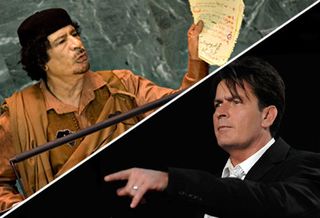
Charlie Sheen or Muammar Qaddafi?

Michael Solomon in Vanity Fair:

Qaddafi-sheen The Two and a Half Men star and the Libyan dictator delivered rambling rants this week. Can you tell who said what?

1. “Remember these are my people…not yours…we will continue on together…”

2. “…maybe they should let their women and their daughters go out.”

3. “We won’t lose victory from these greasy rats and cats…”

4. “Clearly I have defeated this earthworm with my words—imagine what I would have done with my fire breathing fists.”

5. “Walk with me side-by-side as we march up the steps of justice to right this unconscionable wrong.”

6. “I fire back once and this contaminated little maggot can't handle my power.”

7. “Shame on you, you gangsters. Surrender…”

8. “They are trigger happy and they shoot especially when they are stoned with drugs.”

9. “I am like the Queen of England.”

10. “I’m not Thomas Jefferson. He was a pussy.”

Answers here. [Thanks to David Schneider.]

Strange Fruit

This is the last article being posted in honor of Black History Month. Do take a moment to listen to Billie Holiday's sublime rendition here:

From Wikipedia.com:

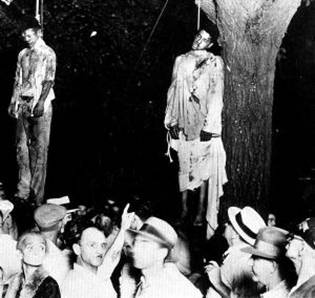
Strange_fruit_clip_image002 “Strange Fruit” was a poem written by Abel Meeropol, a Jewish high-school teacher from the Bronx, about the lynching of two black men. He published under the pen name Lewis Allan. In the poem, Meeropol expressed his horror at lynchings, possibly after having seen Lawrence Beitler's photograph of the 1930 lynching of Thomas Shipp and Abram Smith in Marion, Indiana. He published the poem in 1936 in The New York Teacher, a union magazine. Though Meeropol/Allan had often asked others (notably Earl Robinson) to set his poems to music, he set “Strange Fruit” to music himself. The piece gained a certain success as a protest song in and around New York. Meeropol, his wife, and black vocalist Laura Duncan performed it at Madison Square Garden.[5] (Meeropol and his wife later adopted Robert and Michael, sons of Julius and Ethel Rosenberg, who were convicted of espionage and executed by the United States.)

Barney Josephson, the founder of Cafe Society in Greenwich Village, New York's first integrated nightclub, heard the song and introduced it to Billie Holiday. Other reports say that Robert Gordon, who was directing Billie Holiday's show at Cafe Society, heard the song at Madison Square Garden and introduced it to her.[7] Holiday first performed the song at Cafe Society in 1939. She said that singing it made her fearful of retaliation, but because its imagery reminded her of her father, she continued to sing it. She made the piece a regular part of her live performances.[8] Because of the poignancy of the song, Josephson drew up some rules: Holiday would close with it; second, the waiters would stop all service in advance; the room would be in darkness except for a spotlight on Holiday's face; and there would be no encore.

Southern trees bear strange fruit,
Blood on the leaves and blood at the root,
Black body swinging in the Southern breeze,
Strange fruit hanging from the poplar trees.
Pastoral scene of the gallant South,
The bulging eyes and the twisted mouth,
Scent of magnolia sweet and fresh,
Then the sudden smell of burning flesh!
Here is fruit for the crows to pluck,
For the rain to gather, for the wind to suck,
For the sun to rot, for the tree to drop,
Here is a strange and bitter crop.

More here. (Note: Abbas, thank you for introducing me to this song.)

The destiny of this pageant lies in the Kingdom of Oil

Robert Fisk in The Independent:

Fisk The Middle East earthquake of the past five weeks has been the most tumultuous, shattering, mind-numbing experience in the history of the region since the fall of the Ottoman empire. For once, “shock and awe” was the right description. The docile, supine, unregenerative, cringing Arabs of Orientalism have transformed themselves into fighters for the freedom, liberty and dignity which we Westerners have always assumed it was our unique role to play in the world. One after another, our satraps are falling, and the people we paid them to control are making their own history – our right to meddle in their affairs (which we will, of course, continue to exercise) has been diminished for ever. The tectonic plates continue to shift, with tragic, brave – even blackly humorous – results. Countless are the Arab potentates who always claimed they wanted democracy in the Middle East. King Bashar of Syria is to improve public servants' pay. King Bouteflika of Algeria has suddenly abandoned the country's state of emergency. King Hamad of Bahrain has opened the doors of his prisons. King Bashir of Sudan will not stand for president again. King Abdullah of Jordan is studying the idea of a constitutional monarchy. And al-Qa'ida are, well, rather silent.

But a lighter note. I've been hunting for the most memorable quotations from the Arab revolution. We've had “Come back, Mr President, we were only kidding” from an anti-Mubarak demonstrator. And we've had Saif el-Islam el-Gaddafi's Goebbels-style speech: “Forget oil, forget gas – there will be civil war.” My very own favourite, selfish and personal quotation came when my old friend Tom Friedman of The New York Times joined me for breakfast in Cairo with his usual disarming smile. “Fisky,” he said, “this Egyptian came up to me in Tahrir Square yesterday, and asked me if I was Robert Fisk!” Now that's what I call a revolution.

More here.

Saturday, February 26, 2011

Grit, Strategy, and the Way Out of Afghanistan

Dexter Filkins in the New York Times Book Review:

ScreenHunter_05 Feb. 27 13.50 The new religion, of course, is counterinsurgency, or in the military’s jargon, COIN. The doctrine of counterinsurgency upends the military’s most basic notion of itself, as a group of warriors whose main task is to destroy its enemies. Under COIN, victory will be achieved first and foremost by protecting the local population and thereby rendering the insurgents irrelevant. Killing is a secondary pursuit. The main business of American soldiers is now building economies and political systems. Kill if you must, but only if you must.

The showcase for COIN came in Iraq, where after years of trying to kill and capture their way to victory, the Americans finally turned the tide by befriending the locals and striking peace deals with a vast array of insurgents. In 2007 and 2008, violence dropped dramatically. The relative stability in Iraq has allowed Americans to come home. As a result, counterinsurgency has become the American military’s new creed, the antidote not just in Iraq but Afghanistan too. At the military’s urging, President Obama has become a convert, ordering thousands of extra young men and women to that country, in the hopes of saving an endeavor that was beginning to look doomed. No one in the Obama administration uses the phrase “nation-building,” but that is, of course, precisely what they are trying to do — or some lesser version of it. Protect the Afghan people, build schools and hold elections. And the insurgents will wither away.

So what’s wrong? Why hasn’t the new faith in Afghanistan delivered the success it promises? In his remarkable book, “The Wrong War,” Bing West goes a long way to answering that question. “The Wrong War” amounts to a crushing and seemingly irrefutable critique of the American plan in Afghanistan. It should be read by anyone who wants to understand why the war there is so hard.

More here.

Breast Milk Ice Cream A Hit At London Store

Bill Chappell at NPR:

ScreenHunter_04 Feb. 27 13.36 Anyone pining for some ice cream in London now has an unusual option to consider: ice cream made from mothers' breast milk. The Icecreamists shop has made headlines for using milk from as many as 15 women to make its new “Baby Gaga” flavor.

The rare offering proved a hit with customers at the Covent Garden store — the first batch sold out within days of being introduced. A serving of Baby Gaga, which is reportedly flavored with vanilla and lemon zest, goes for 14 pounds — or about $22.50.

The milk came from women found on an Internet advertisement. And the folks at Icecreamists say all the milk “was screened in line with hospital/blood donor requirements.”

In an interview for British TV, store founder Matt O'Connor says, “It's pure, it's natural, it's organic, and it's free range — and if it's good enough for our kids, it's good enough to use in our ice cream.”

More here. [Thanks to Yousaf Hyat.]

Scientists’ Nightstand: Massimo Pigliucci

Greg Ross in American Scientist:

201092293208119-pigliucci Massimo Pigliucci is professor of philosophy at the City University of New York. His most recent book is Nonsense on Stilts: How to Tell Science from Bunk (University of Chicago Press, 2010).

Could you tell us a bit about yourself?

I began my academic career as an evolutionary biologist, first at the University of Tennessee, then at Stony Brook University. However, when my midlife crisis hit I decided to switch to philosophy, went back to graduate school, got a proper degree in the field, and started publishing in philosophy of science. As a result, now I am the Chair of Philosophy at Lehman College in New York and a faculty member at the City University of New York's Graduate Center.

What books are you currently reading (or have you just finished reading) for your work or for pleasure? Why did you choose them, and what do you think of them?

Let me check my Kindle list . . . I am about to finish Sherlock Holmes: The Complete Illustrated Novels (Chancellor Press, 2001), because I always wanted to do that. I have been endlessly fascinated with the hyperrational detective, and I often quote from him (yes, I know he is fictional) in my classes on the nature of science. I am also reading Kathryn Schulz's Being Wrong: Adventures in the Margin of Error (HarperCollins, 2010), a delightful book about how and why we are so often wrong about things, and what is the best attitude about it. Recent readings include Noam Chomsky's Failed States: The Abuse of Power and the Assault on Democracy (Metropolitan, 2006); Lee Smolin's The Trouble with Physics: The Rise of String Theory, The Fall of a Science, and What Comes Next (Houghton Mifflin, 2006); and Sunnyside, a novel by Glen David Gold (Knopf, 2009).

More here.