Christopher Hitchens in Slate:

More here.

Christopher Hitchens in Slate:
More here.
From The Australian:

“He is not an Arab,” the officer told each of them. “He is a Jew.”
As related yesterday in the Tel Aviv daily Yediot Ahronot, the story had begun a decade earlier when security officials decided to plant agents in Israeli Arab villages and towns. Israel's War of Independence, in which the newborn state battled for a year against Palestinian Arabs and the invading armies of surrounding Arab states, had ended just a few years before, in 1949. The purpose of the sleeper agents was to warn if Israeli Arabs would revolt in the event of another war.
Ten young Jewish immigrants from Iraq were trained for a year before being sent into Israeli Arab communities, posing as refugees from the war who had escaped to a neighbouring Arab country and had now infiltrated back.
It quickly became apparent that in order to maintain credibility the men would have to marry. “It would have been suspicious for young, vigorous men to remain alone, without a spouse,” said Shmuel Moriah, the security officer who headed the operation. “We didn't order them to marry, but there was such an expectation.”
More here.
Pervez Hoodbhoy in Dawn:
A turning point could possibly come with Mumbai-II. This is no idle speculation. The military establishment’s reluctance to clamp down on anti-India jihadi groups, or to punish those who carried out Mumbai-I, makes a second Pakistan-based attack simply a matter of time. Although not officially assisted or sanctioned, it would create fury in India. What then? How would India respond?
There cannot, of course, be a definite answer. But it is instructive to analyse Operation Parakram, India’s response to the attack on the Indian parliament on December 13, 2001. This 10-month-long mobilisation of nearly half a million soldiers and deployment of troops along the LOC was launched to punish Pakistan for harbouring the Jaish-e-Mohammad, which, at least initially, had claimed responsibility for the attack. When Parakram fizzled out, Pakistan claimed victory and India was left licking its wounds.
More here.
From The New York Times:
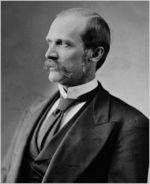
In an illuminating and aptly titled book, “The Invisible Line,” Daniel J. Sharfstein demonstrates that African-Americans of mixed ancestry have been crossing the boundaries of color and racial identity since the early colonial era. An associate professor of law at Vanderbilt University and an author with a literary flair, Sharfstein documents this persistent racial fluidity by painstakingly reconstructing the history of three families. In a dizzying array of alternating chapters, he presents the personal and racial stories of the Gibsons, the Spencers and the Walls. The result is an astonishingly detailed rendering of the variety and complexity of racial experience in an evolving national culture moving from slavery to segregation to civil rights.
More here.
This article is posted in honor of Black History Month:
From The Huffington Post:
…

More here.

Daniel Cohn-Bendit once said that he knew the '68 movement in Germany had won by a comment from a conservative colleague: “It doesn't work with the Muslims, they harass their women.” We've been hearing for years that multiculturalism has failed, and now the German chancellor – who, incidentally, could only become chancellor because '68 and '89 did work – has added her voice to the chorus. Gender equality a success, integration of immigrants a failure?
Despite the flak it's coming in for at the moment, multiculturalism lives and will prevail. As the one to import the term “Multikulti” to Germany (I titled a book after Don Cherry's eponymous band in 1990), allow me to explain not only what Cohn-Bendit, but also liberal conservatives like Heiner Geissler, meant by it. Not, namely, as Angela Merkel recently put it, in front of an audience of cheering young Christian Democrats: “Now we'll do a bit of multikulti and live side-by-side and everyone's happy.” Anyone who has read the original arguments and the numerous subsequent studies knows that multiculturalism was not demanding arbitrariness or the Sharia, but rather the republican integration of diversity.
That included abandoning an utterly antiquated law on nationality, adopting forwards-looking social and employment policy, guaranteeing religious freedom as stipulated in the constitution, and a whole range of educational initiatives. The problems today indicated by terms such as “parallel society” and “schooling failure” were predicted by the advocates of multiculturalism pretty exactly. It was they who were the realists.
Also see pieces by Cécile Laborde and Kenan Malik.
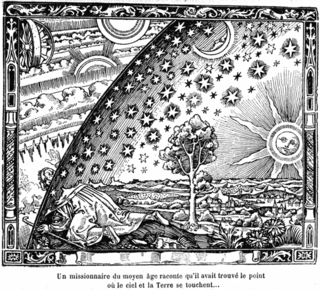
[Image, via Wikipedia: The Flammarion engraving (1888) depicts a traveller who arrives at the edge of a flat Earth and sticks his head through the firmament.]
A scientific experiment avoids confusion by holding as much as possible constant, while systematically varying some factor of interest. When you are trying to think through a complex train of thought it can be helpful to do something similar, especially when sorting out separate arguments that might be confused. My previous Boing Boing post, “Should employers be blind to private beliefs?,” could be seen as raising four separate questions. These were in danger of being confused with each other, and it is helpful to consider them one at a time, setting the others on one side temporarily–the equivalent of holding other variables constant in an experiment. The four questions were:
1. Should Martin Gaskell have been turned down by the University of Kentucky? I got rid of this one by explicitly stating that I was not concerned with it. I shall continue to ignore it here.
2. Should employers ever discriminate on grounds of the beliefs of candidates? If the answer to this is no, there is no point in going on. I tried to dispose of it by reductio ad absurdum. I postulated hypothetical extremes (flat earth geographer, stork theory doctor, astronomer who thinks Mars is a mongoose egg). I presumed that everybody would agree to discriminate against such obviously preposterous extremes, and that we would therefore have a non-controversial baseline from which to move on to more subtle questions. As it turned out, I was wrong: I underestimated the emotive impact of the very word 'discrimination'. I may also have underestimated the power of the relativist doctrine that all opinions are equally worthy of respect. But in any case my purpose was not to erect a straw man and knock it down. I wanted to find a baseline of agreement, which would enable us to set Question 2 on one side, while we went on to the other questions.
3. Should employers discriminate on grounds of religion per se? Here, I had thought we could establish a baseline agreement that there are at least some religious beliefs that nobody would wish to discriminate against. None of us, certainly not I, would rule out Georges Lemaître when employing a physics professor, on the grounds that he was a Catholic priest. But there could be beliefs, which might happen to have their origins in religion, but which some people might otherwise have considered grounds for rejecting a candidate under Question 2. We are not talking about discriminating against religion per se but against a counterfactual belief that happens to come from religion, and this leads me to Question 4:
4. Suppose you are one of those who will allow a yes answer to Question 2, and are prepared to contemplate at least some discrimination, say against flat-earthers. Would you allow religion to serve as a special, privileged, protective shield against such otherwise-agreed discrimination: a shield not available to non-religious flat-earthers?

Here is a partial list of sentences that open the chapters in a new book, Mumbai Fables:
It is just before two o’clock in the afternoon in April, the hottest month of the year.
Bombay is now officially Mumbai. The colonial era is abolished, dismissed as history.
Marine Drive is no ordinary place.
On October 9, 1947, a young Muslim woman committed suicide in Bombay.
It was April 27, 1959. As the day wore on, the oppressive humidity hung like a pall over the city.
On the night of Friday, June 5, 1979, Krishna Desai was stabbed to death.
A jeep careens recklessly through Bombay’s streets. It is filled with ruthless goons of the notorious Panther gang.
“Haay Haay Haay Haay…” On the pavement by the sea, a dark thin man is smacking his blood-spattered naked back with a whip made of rags.
Mumbai Fables is the work of Gyan Prakash, who teaches at Princeton and has long been a member of the Subaltern Group of historians. These chapter openings are drawn from the following sources: a novel in English and another in Hindi, a now-defunct tabloid, a book of history, also one from urban studies, and an ordinary news-report. This eclectic range of materials is one indication of the nature of history-writing that Prakash is doing, but these openings also convey a point about form. They tell the reader right away that the author is interested both in story and in history.
This is a split discourse. The chapter pushes into the narrative waters with sentences like “It is just before two o’clock in the afternoon in April, the hottest month of the year” and sooner rather than later the engine is churning through a different order of turbulence: “Urban theorists contend that capitalist globalization has also overwhelmed the modernist city of the nineteenth and early twentieth centuries. Prototypical political movements and ideologies nursed in the heyday of modernist cities have lost their appeal, and new informational networks and ‘pirate modernity’ have marginalized older urban solidarities. As globalization produces different kinds of legal regimes and citizens, new hierarchies of cities and urban dwellers, it poses a new set of questions for citizenship, identity, and politics.” When I asked him about it, Prakash wrote to me in an e-mail that he had been interested in doing two opposed things: tracking and explaining what was found on the street and was situational, but also in examining the archive and analyzing how the historical document had been produced by historical forces. He added, “In one sense, the difference is that between the account of the everyday that one encounters in a novel, and the picture of broad forces and institutions that social sciences draw. I wanted to be able to do both, that is, read one in the other. For this reason, I did both kinds of research.”
How does this method work?
In Argentina, you see boys wearing their hair long and wild. For this, shampoo must be foregone for weeks and haircuts for months so that maximum unctuousness may be achieved. The savage impulse must withstand the perennial opposition of forces for shortness—for there is always a national mythology of hair to grow out of and into. The goal is to achieve a look that embodies a descriptor that a century ago would have conveyed deep derision, but which today in Argentina means “awesome” or “perfect”: bárbaro. Argentina is one of the places in the world where the hairdo of European “civilization” has most earnestly (and anxiously) been worn. This is a country that spent more than a century looking back over its shoulder, longing to restore the umbilical connection to a Europe that largely peopled its shores, while horrified to face its own uncivilized interior—the vast Pampan expanse. Hair became one site for this national psychodrama between civilization and barbarism.
more from Jorian Polis Schutz at Cabinet here.
This article is posted in honor of Black History Month:
From Smithsonian:
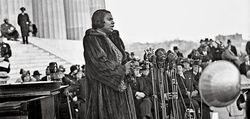
A Scurlock camera was “present at almost every significant event in the African-American community,” recalls former D.C. Councilwoman Charlene Drew Jarvis, whose father, Howard University physician Charles Drew, was a Scurlock subject many times. Dashing all over town—to baptisms and weddings, to balls and cotillions, to high-school graduations and to countless events at Howard, where he was the official photographer—Addison Scurlock became black Washington’s “photographic Boswell—the keeper of the visual memory of the community in all its quotidian ordinariness and occasional flashes of grandeur and moment,” says Jeffrey Fearing, a historian who is also a Scurlock relative.
More here.
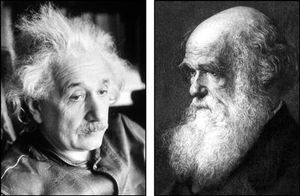
Here's an edited question-and-answer transcript of the interview:
MSNBC: Einstein and Darwin seem to hold two different places in our society. One is virtually a pop culture icon, while some people almost want to take down the other guy's statues. Why is that we have two different approaches to these people, even though they developed theories that are in very similar states of evidence?
Neil deGrasse Tyson: While they were both scientists, Einstein was the first very public scientist who was visibly active in social causes as well as political causes. I don’t know that the same was true with Darwin. I know he was well known in his day. I know his book, “On the Origin of Species,” was a best seller. But I don’t know that he was active in politics, influencing governments. I don’t know that he was approached by a sovereign nation and was asked to be its president, as Einstein was with the new state of Israel, for example.
More here.
Seyla Benhabib in Transformations of the Public Sphere:

Yet we know that the spring of revolutions is followed by the passions of summer and the chilling discord of fall. At least since Hegel’s analysis of the follies of the French Revolution in his 1807 Phenomenology of Spirit, it has become commonplace to think that the Revolution will devour its own children. Such warnings were expressed not only by Hillary Clinton in the first days of the Egyptian uprising, but many commentators who have hid their distrust in the capacity of the Arab peoples to exercise democracy, are now rejoicing that the first signs of contention between religious and secular groups are breaking out in Egypt and Tunisia. The journalists and intellectuals of the European right, who have spilt a lot of ink on whether or not “Islamophobia” is racist, are now attempting to cover their own tracks, while the “pseudo-friends” of Israel among European conservatives are warning of doomsday scenarios of imminent attacks on Israel by Hizbollah in the North and Egypt cum Hamas on the South.
None of this is inevitable: it is not inevitable, or even likely, that fundamentalist Muslim parties will transform Tunisia or Egypt into theocracies; nor is it inevitable that Iran will gain ascendance and that the Arab states will conduct a new war against Israel. What we have witnessed is truly revolutionary, in the sense that a new order of freedom – a novo ordo saeclorum – is emerging transnationally in the Arab world.
More here.
Joel Whitney in Tricycle:
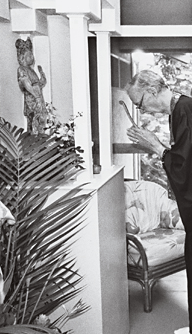
I had been invited by Tricycle to fly to Maui and interview the new U.S. poet laureate, W. S. Merwin. A longtime fan of Merwin’s writing, I jumped at the chance, not hesitating when asked if I could also interview the Zen roshi Merwin originally went to Hawaii to study under. Recognizing Aitken’s name from my older habit, hardly kept up, of reading Zen classics, and knowing this would make the trip all the more worthwhile for the magazine, I said yes enthusiastically. Only later did I realize I’d have little time to prepare for both interviews. All of which would prove even more complicated when, the day after I sent follow-up questions to a difficult interview, Robert Aitken Roshi died of pneumonia.
More here.
Scott Atran in The National Interest:
But here’s the rub: the road to redemption is blocked by religious conservatives who “believe that values must come from a voice in a whirlwind.” Then, seeping from “the ivory tower,” come “secular liberals,” with their “multiculturalism, moral relativism, political correctness” borne of collective guilt “for the crimes of Western colonialism, ethnocentrism, and racism,” which leads to cowardice in the face of dogmatic bullies. So blow ye the trumpet and sound the alarm: if we don’t act soon in the ways this man suggests, then Western civilization could well succumb: “The juxtaposition of conservative dogmatism and liberal doubt . . . has hobbled the West in its generational war against radical Islam; and it may yet refashion the societies of Europe into a new Caliphate.”
More here.
An ongoing trial in Tel Aviv is set to determine who will have stewardship of several boxes of Kafka’s original writings, including primary drafts of his published works, currently stored in Zurich and Tel Aviv. As is well known, Kafka left his published and unpublished work to Max Brod, along with the explicit instruction that the work should be destroyed on Kafka’s death. Indeed, Kafka had apparently already burned much of the work himself. Brod refused to honour the request, although he did not publish everything that was bequeathed to him. He published the novels The Trial, The Castle and Amerika between 1925 and 1927. In 1935, he published the collected works, but then put most of the rest away in suitcases, perhaps honouring Kafka’s wish not to have it published, but surely refusing the wish to have it destroyed. Brod’s compromise with himself turned out to be consequential, and in some ways we are now living out the consequences of the non-resolution of Kafka’s bequest.
more from Judith Butler at the LRB here.
In an early essay reproduced in Doubling the Point (1992), J. M. Coetzee chose to “put it baldly” when he wrote that “in South Africa it is not possible to deny the authority of suffering and therefore of the body”. When we think of those novels imaginatively connected with the state of the South African nation – Waiting for the Barbarians (1980), say, or Age of Iron (1990) – it is hard to ignore their vivid testimony about bodily reality, the suffering of the afflicted. We recall the frail form of Elizabeth Curren and the “cold, obscene swellings” of her cancer (that “parody” of pregnancy), or the Magistrate creepily fingering the “firm-fleshed calves, manipulating the bones and tendons” of the tortured barbarian girl. But to put the case for Coetzee even more baldly (or boldly): in all of his fiction, he is our best authority on suffering, our most credible literary authority on the body. Coetzee has elsewhere sought to affirm this belief in the importance of physicality: “the body with its pain becomes a counter to the endless trials of doubt. (One can get away with such crudeness in fiction; one can’t in philosophy, I’m sure)”. We must learn, however, that Coetzee never writes in bold. The self-sealing parentheses are a giveaway: by ostentatiously highlighting what he wishes to convince us he is so “sure” about, Coetzee is pointing out the artificiality of its separation from the “trials of doubt”. A body with “its pain”, its own pain, may be something certain, but the nature of someone else’s pain must always be in question. Indeed, we can read the Coetzeean canon as a sustained investigation into the notion that pain can be shared, and its inevitable recognition of the doubtful results.
more from Stephen Abell at the TLS here.
This article is posted in honor of Black History Month:
From Smithsonian:
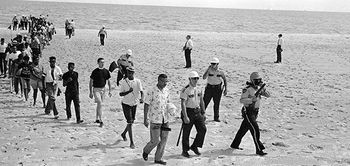
To comprehend how a beautiful beachfront became a laboratory for social unrest, consider Dr. Mason’s Biloxi arrival in 1955. A Jackson, Mississippi native, the general practitioner moved with his family after completing medical studies at Howard University and an internship in St. Louis. Many of Biloxi’s white doctors respected Mason, who died in 2006. “Some would ask him to scrub in for surgeries,” said his son, Dr. Gilbert Mason Jr. Still, gaining full privileges at Biloxi Hospital took 15 years. In northern cities, he’d dined at lunch counters and attended cinemas alongside whites. Here, change lagged. “Dad was not a traveled citizen, but he was a citizen of the world,” his son noted. “Things that he barely tolerated as a youth, he certainly wasn’t going to tolerate as an adult.”
More here.