Brutal Sympathy: Women in Peckinpah’s Westerns

Amanda Shubert in Critics at Large:

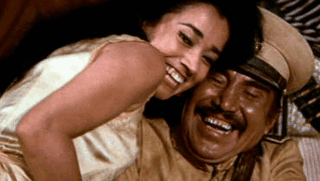
ScreenHunter_22 Jun. 04 13.11Can a filmmaker obsessed with machismo also be feminist? With Sam Peckinpah, you wonder. His luminous westerns – Ride the High Country (1962), The Wild Bunch (1969), The Ballad of Cable Hogue (1970) and Junior Bonner (1972) – are lyric meditations on machismo. They’re about cowboys, outlaws, drifters and rodeo stars caught in a changing world, and the last flaring up of their spirits before they are pinioned by the machinery of that change. But they are also about how those men relate to the women they encounter on their journeys, women, like them, trapped by circumstance and fighting to retain some glimmer of their humanity. The gloriously spacious landscapes of the American west (shot in each case by Lucian Ballard), with the teeming blues and yellows of wide skies and sweeping country, express the paradoxical entrapment these characters feel, their longing to break free and their uncertainty of what they’d be breaking free to, but they also infuse the movies with a kind of moral spaciousness. The characters, male and female, have room to be who they are, without judgment before the eyes of the camera. That’s the romanticism of Peckinpah’s westerns, and it often comes out in romantic plots that bring together pairs of lovers in sublime meetings of equals.

It’s not exactly that Peckinpah stands out among the work of other American New Wave directors for his sensitivity to female experience – not in a generation that includes Robert Altman (McCabe and Mrs. Miller, Thieves Like Us), Arthur Penn (Bonnie and Clyde, Alice’s Restaurant), Robert Towne (Personal Best) and Brian De Palma (Carrie, Blow Out). It’s the way he gets at that experience that is so unusual and so dazzling. I can’t think of another filmmaker who can refract a feminist sensibility through male, at times misogynistic, perspectives.

More here.

Monday, June 4, 2012

Sunday, June 3, 2012

Filming The Reluctant Fundamentalist: Three Days In Delhi

Mohsin Hamid at his own website:

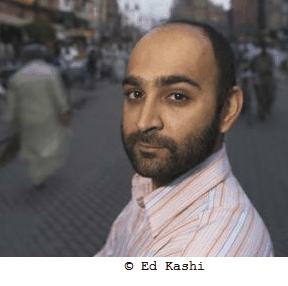
ScreenHunter_21 Jun. 03 17.23My sister Nissa and I arrive in Delhi Airport. There was a time when being in Delhi Airport was a lot like being in Lahore Airport or Karachi Airport. No longer. The new version is impressive and efficient and ultra-modern and tasteful. (“Our fast bowlers are still a hell of a lot better,” I console myself, “even the ones who aren't in jail.”) Nissa and I exchange a glance at customs. Our suitcases are packed with props to make a Delhi film set look like a real Lahori street: posters, flags, fliers. We have a copy of a letter granting government permission to film in Delhi. But we don't relish the idea of explaining to an Indian customs officer why we, a pair of Pakistanis, are bringing in a bunch of political-looking banners in Urdu. Luckily no-one opens our bags. I turn on my phone and get an email from an Indian friend who says the local press is full of stories about the movie. She sends a photo of a newspaper as an attachment. There are pictures of Mira Nair (the director), Riz Ahmed (the lead actor), and Meesha Shafi (who plays Riz's sister, and who will be flying back to Lahore in a couple hours on the same plane that brought us in). As for the “exclusive” details about the film exposed in the article, well, they're mostly pretty far off. There is, for example, no “border-crossing-into-India scene” and Om Puri's character isn't “a village thakur.” At least I hope not. Better get my hands on a copy of the latest script fast.

More here.

Why New Yorker writers and others keep pushing bogus controversies

Steven Pinker in Slate:

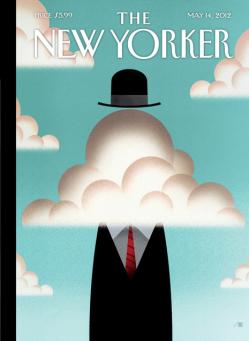
120530_GOODWORD_May14NewYor.jpg.CROP.article250-mediumNature or nurture. Love it or leave it. If it doesn’t fit, you must acquit.

If you didn’t already know that euphonious dichotomies are usually phony dichotomies, you need only check out the latest round in the supposed clash between “prescriptivist” and “descriptivist” theories of language. This pseudo-controversy, a staple of literary magazines for decades, was ginned up again this month by The New Yorker, which has something of a history with the bogus battle. Fifty years ago, the literary critic Dwight Macdonald lambasted the Third Edition ofWebster’s New International Dictionary for aiming to be “a recording instrument rather than … an authority” and insufficiently censuring such usages as “deprecate” for depreciate, “bored” fordisinterested, and “imply” for infer. And in a recent issue, Joan Acocella, the magazine’s dance critic, fired a volley of grapeshot at the Fifth Edition of the American Heritage Dictionaryand at a new history of the controversy by the journalist Henry Hitchings, The Language Wars. Acocella’s points were then reiterated this week in a post by Ryan Bloom on the magazine’s Page-Turner blog. The linguistic blogosphere, for its part, has been incredulous that The New Yorker published these “deeply confused” pieces. As Language Log put it, “Either the topic was not felt to be important enough to merit elementary editorial supervision, or there is no one at the magazine with any competence in the area involved.”

According to the sadly standard dichotomy, prescriptivists believe that certain usages are inherently correct and others inherently incorrect, and that to promote correct forms is to uphold truth, morality, excellence, and a respect for the best of our civilization. To indulge incorrect ones, meanwhile, is to encourage relativism, vulgar populism, and the dumbing down of literate culture.

Descriptivists, according to this scheme, believe that norms of correctness are arbitrary shibboleths of the ruling class, designed to keep the masses in their place. Language is an organic product of human creativity, and the people should be given the freedom to write however they please.

More here.

Interrogations

From lensculture:

This work stopped me cold the first time I saw it. It looked terrifyingly real, but how could it be? Are some of these people being forced to write confessions while loaded guns are pressed into their heads? It must have been staged. But soon I came to realize that these are indeed real photographs of real interrogations of suspected criminals in Ukraine. Canadian photojournalist Donald Weber first went to Ukraine during the Orange Revolution of 2004, on assignment. Following that first trip, he soon returned, and spent the next six years in Russia and Ukraine trying to photograph contemporary life, and its hardships, as well as the vestiges of a still-powerful, hidden system.

Interrogations is the result of his personal quest to uncover the hidden meaning of private, unpleasant encounters with unrestricted Power. It is a simple, elegant book that sears itself into your memory.

More here.

Sunday Poem

Spanish Harlem Incident

Gypsy gal, the hands of Harlem
Cannot hold you to its heat
Your temperature’s too hot for taming
Your flaming feet burn up the street
I am homeless, come and take me
Into reach of your rattling drums
Let me know, babe, about my fortune
Down along my restless palms

Gypsy gal, you got me swallowed
I have fallen far beneath
Your pearly eyes, so fast an’ slashing
An’ your flashing diamond teeth
The night is pitch black, come an’ make my
Pale face fit into place, ah, please!
Let me know, babe, I’m nearly drowning
If it’s you my lifelines trace

I been wond’rin’ all about me
Ever since I seen you there
On the cliffs of your wildcat charms I’m riding
I know I’m ’round you but I don’t know where
You have slayed me, you have made me
I got to laugh halfways off my heels
I got to know, babe, will you surround me?
So I can tell if I’m really real

by Bob Dylan
from Another Side of Bob Dylan

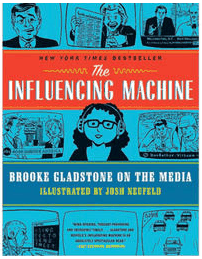
Brooke Gladstone entertainingly recounts media history in a graphic novel

Justin Moyer in the Christian Science Monitor:

ScreenHunter_20 Jun. 03 12.49“I wanted to write a comic book long before I wanted to write a book about the media,” Brooke Gladstone explains in The Influencing Machine, her new book about the news business. The host of NPR’s “On the Media,” Gladstone makes what could have been a chewy book on media theory – snooze – more fun with the help of something unavailable at her day job: pictures.

“I thought writing in bubbles would be easier, more like radio,” Gladstone writes. “It was more like radio, but it wasn’t easier.”

Although writing it wasn’t easier for the radio host, “The Influencing Machine” will prove easier on her readers than most of the inside-baseball navel-gazing done by media personalities. As digital publishing buries newspapers and books, writers either wax nostalgic for dead trees (like former Sunday Times editor Harold Evans in his memoir “My Paper Chase”) or drool over the possibilities of the Internet age (like Cory Doctorow, publisher of the tech blog BoingBoing, who blurbed “The Influencing Machine”).

Gladstone, more level-headed, charts a middle course.

“Everything we hate about the media today was present at its creation,” she writes. “Also present was everything we admire – and require – from the media: factual information, penetrating analysis, probing investigation, truth spoken to power. Same as it ever was.”

More here.

Peaks

From The New York Times:

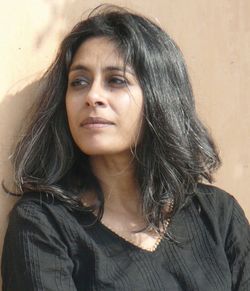
ArunLate in this quietly mesmerizing novel, set in a Himalayan hill town in the north of India, Anuradha Roy describes the crystalline beauty of the peaks in winter, viewed long after the haze of the summer months and the fog of the monsoon, held in secret for those who choose to brave the cold: “After the last of the daylight is gone, at dusk, the peaks still glimmer in the slow-growing darkness as if jagged pieces of the moon had dropped from sky to earth.” In the mountains, one of Roy’s characters observes, “love must be tested by adversity.” It’s the inherent conflict in human attraction — the inescapable fact that all people remain at heart unknown, even to those closest to them — that forms the spine of the novel. In marrying a Christian, the narrator, Maya, has become estranged from her wealthy family in Hyderabad. But after six happy years together, her husband has died in a mountaineering accident. Rather than return to her parents, she seeks refuge in Ranikhet, a town that looks toward the mountains that so entranced her husband. Overcome with grief, she stows away his backpack, recovered from the scene of the accident, and refuses to inspect its contents. She can’t bear to know the details surrounding his death.

In Ranikhet, Maya settles into a routine: teaching at a Christian school; spending time with her landlord, Diwan Sahib; and observing the sometimes comic rhythms of the village and its army garrison. Roy manages to capture both the absurd and the sinister in even minor characters, like a corrupt local official who embarks on a beautification plan that includes posting exhortatory signs around town. (One, meant to welcome trekkers, is vandalized to read “Streaking route.”) His crusade, inspired by the Sing­aporean Prime Minister Lee Kuan Yew, who embraced caning as a punishment, also includes the persecution of a simple-­minded but harmless herder. Of course, a sedate world exists only to be shaken, and soon enough the town is disturbed from all sides.

More here.

Saturday, June 2, 2012

A Dirty Twist on Beating the Prisoner’s Dilemma

Mg21428663.900-1_300Michael Marshall in New Scientist:

In the prisoner's dilemma, if both players keep quiet, each gets a brief sentence. But if one betrays the other, the snitch gets off scot-free while their partner suffers a long sentence. If both players betray each other, each gets a medium sentence. As a united pair, players do better if they both keep shtum. But crucially, if criminal A thinks B won't blab, it is in A's best interest to snitch, as he will then walk free – at B's expense.

The dilemma has obsessed economists for over 50 years because it helps to explain why individuals sometimes don't cooperate even when it is in their combined best interests to do so. Even climate change negotiations can be thought of as a prisoner's dilemma: no country wants to pay the cost of cutting emissions (keep shtum) if everyone else is going to keep on emitting (snitch).

The game becomes interesting when the same two partners play it over and over again. The way to minimise jail time under these conditions is usually to “play nice”: don't snitch, on the assumption that your partner won't either, and if they betray you then snitch on them in the next round, as a warning. So essentially, the best strategy is to collaborate.

Now, William Press at the University of Texas at Austin says he has uncovered a strategy to win that is not collaborative. And players who adopt his strategy end up spending much less time in prison than their opponents – in collaborative games, both players end up spending roughly equal time in prison.

Why Are We Abandoning the Afghans?

AP120323155180a_jpg_470x420_q85Ahmed Rashid in the NYRB blog:

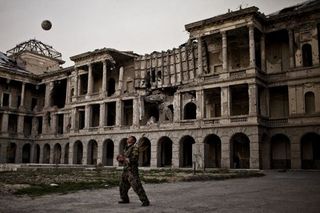
What will Afghanistan look like in 2014, after a dozen years of occupation, more than 2,800 NATO soldiers killed, and an expenditure of $1 trillion? If the participants in this week’s NATO summit in Chicago are to be believed, what they will leave behind is little more than a series of fortresses in enemy territory: Kabul and the other major cities will be protected by Afghan forces, while the countryside falls back into the hands of the Taliban. NATO leaders all but acknowledged that much of Kandahar and Helmand provinces—where 30,000 US marines had launched “the surge” two years ago to root out the Taliban—would quickly revert back to Taliban control once the Americans left.

President Barack Obama has said that the promise to end combat operations by next summer and withdraw all Western troops by 2014 is “irreversible.” In other words, whatever happens on the ground when authority is handed over to the fledgling, largely illiterate, and drug infested Afghan army will not stop US and NATO forces from going home. The 350,000-strong Afghan army and police will be downsized by 100,000 men—not because they are not needed on the battlefield, but because the West will not pay for their upkeep. “Are there risks involved in it? Absolutely,” Obama conceded while winding up the summit.

The US and NATO long ago abandoned any pretense that that they are trying to build a modern, democratic state in Afghanistan. But the lackluster meeting in Chicago showed just how far support for the Afghan mission has eroded in recent months. Now, even limited aims—like working infrastructure, a functioning civil service and judiciary, and basic economic stability—will be difficult to realize. Clearly there is a rush for the exits by Western leaders, but there is no Plan B to address worsening battlefield conditions and political crises if they occur.

Diamond jubilee: writers reflect on growing up Elizabethan

From The Guardian:

Hilary-Mantel-001Hilary Mantel

I count myself less a child of the Elizabethan age than a child of the 1944 Education Act, which gave a free grammar school education to those selected at 11. It was bad in that it wrote off most children as second-class. But it was a golden chance for a few, and it is what has made my life different from the lives of my eloquent foremothers. They were storytellers but I could become a writer. At the age I was studying Hard Times and Great Expectations they were minding looms; “mill girls,” they were called, even when they had left girlhood behind. My cousin, 10 years my senior, was the first in our family to have a secondary education. But at 16 she needed to get out and earn, so she became a secretary. In 1970, my way was clear to university and whatever lay beyond. I try not to idealise those days. I don't forget the intense pressure and anxiety, the furiously competitive nature of my schooling, the need not to let my family down; and also the difficulty of moving between classes. I find it hard to decide whether Britain is less divided now. It's still true that you are judged as soon as you open your mouth. If you are asked: “Where do you come from?” it's because you're not white or have a regional accent. Those whose accent is heard as neutral are seen to come from a social class, not a place. Geography does not define or limit them. If no one enquires after your origins, it means you hold, unquestioned, the centre ground in life.

When I left university in 1973 I was already married; that was early, but not unthinkably early for those days. I graduated into the Womb Wars. “First comes love, then comes marriage / Then comes the baby in the baby carriage.” In the 1970s, when a young woman was interviewed for a job, she was asked when she hoped to wed. “And when do you plan to start your family?” If you admitted you had such plans, you wouldn't get the job. If you disclaimed them, up would go the eyebrow. “What! A pretty girl like you! Of course you'll want to get married!” It is hard now to convey how demeaning this exchange was to all concerned: the more demeaning, because both parties saw it as perfectly normal. It drove many of us into the women's trades, the “caring professions,” ill-paid and low-status. It used to be routine to recommend that a clever girl became a teacher, “because it's something to fall back on”. I think the assumption was that if you were bright, then in the course of time your husband would probably leave you. I have great admiration for those who can sustain a teaching career, but there was something profoundly depressing about the idea that women were a sort of recycling facility; girls grew up and taught girls who taught girls, and so on to the crack of doom.

More here.

Craig Venter’s Bugs Might Save the World

From The New York Times:

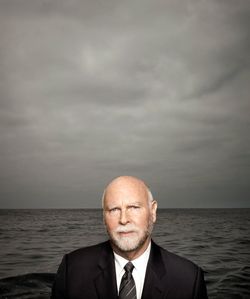
VenterIn the menagerie of Craig Venter’s imagination, tiny bugs will save the world. They will be custom bugs, designer bugs — bugs that only Venter can create. He will mix them up in his private laboratory from bits and pieces of DNA, and then he will release them into the air and the water, into smokestacks and oil spills, hospitals and factories and your house. Each of the bugs will have a mission. Some will be designed to devour things, like pollution. Others will generate food and fuel. There will be bugs to fight global warming, bugs to clean up toxic waste, bugs to manufacture medicine and diagnose disease, and they will all be driven to complete these tasks by the very fibers of their synthetic DNA. Right now, Venter is thinking of a bug. He is thinking of a bug that could swim in a pond and soak up sunlight and urinate automotive fuel. He is thinking of a bug that could live in a factory and gobble exhaust and fart fresh air. He may not appear to be thinking about these things. He may not appear to be thinking at all. He may appear to be riding his German motorcycle through the California mountains, cutting the inside corners so close that his kneepads skim the pavement. This is how Venter thinks. He also enjoys thinking on the deck of his 95-foot sailboat, halfway across the Pacific Ocean in a gale, and while snorkeling naked in the Sargasso Sea surrounded by Portuguese men-of-war. When Venter was growing up in San Francisco, he would ride his bicycle to the airport and race passenger jets down the runway. As a Navy corpsman in Vietnam, he spent leisurely afternoons tootling up the coast in a dinghy, under a hail of enemy fire.

What’s strange about Venter is that this works — that the clarity he finds when he is hurtling through the sea and the sky, the dreams he summons, the fantasies he concocts in his most unhinged moments of excess actually have a way of coming true.

More here.

Saturday Poem

New Mexican Mountain

I watch the Indians dancing to help the young corn at Taos
pueblo. The old men squat in a ring
And make the song, the young women with fat bare arms, and a
few shame-faced young men, shuffle the dance.

The lean-muscled young men are naked to the narrow loins,
their breasts and backs daubed with white clay,
Two eagle-feathers plume the black heads. They dance with
reluctance, they are growing civilized; the old men persuade them.

Only the drum is confident, it thinks the world has not changed;
the beating heart, the simplest of rhythms,
It thinks the world has not changed at all; it is only a dreamer,
a brainless heart, the drum has no eyes.

These tourists have eyes, the hundred watching the dance, white
Americans, hungrily too, with reverence, not laughter;
Pilgrims from civilization, anxiously seeking beauty, religion,
poetry; pilgrims from the vacuum.

People from cities, anxious to be human again. Poor show how
they suck you empty! The Indians are emptied,
And certainly there was never religion enough, nor beauty nor
poetry here … to fill Americans.

Only the drum is confident, it thinks the world has not changed.
Apparently only myself and the strong
Tribal drum, and the rockhead of Taos mountain, remember
that civilization is a transient sickness.

by Robinson Jeffers
from The Seashell Anthology of Great Poetry
Park Lane Press, 1996

very much not a toady

Burrow_06_12

In 1591 Spenser was granted a pension of £50 a year by Queen Elizabeth. This was around three times the annual income of many schoolmasters. After his death in 1599 he was regularly described as England’s ‘arch-poet’ or ‘the prince of poets’. His body was interred next to Chaucer’s tomb in Westminster Abbey. The Faerie Queene had a formative influence on Milton, Wordsworth, and Keats, and was read throughout the eighteenth century, when it played a central part in the Gothic revival. Nonetheless Spenser is now high on the list of great poets that nobody reads. Just about the only thing that Karl Marx had in common with Philip Larkin was a loathing for Spenser. Marx described him as ‘Elizabeth’s arse-kissing poet’. Larkin as an undergraduate wrote: ‘Now I know that the Faerie Queene is the dullest thing out. Blast it.’ The history of Spenser scholarship suggests that Larkin and Marx are not alone. Shakespeare, Marlowe, and Jonson are treated to biographies every few years – or every few minutes, it seems, in the case of Shakespeare – but the last major biography of Spenser appeared in 1945. Earlier biographies of the poet did him no favours: they suggested that he was a servile panegyrist of Elizabeth, while also accepting the myth that sprang up shortly after Spenser’s death, which presented him as unfairly neglected by his contemporaries and by the Crown. Was Spenser really that most unappealing of creatures, a neglected toady?

more from Colin Burrow at Literary Review here.

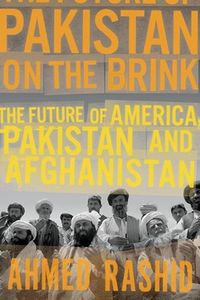
Ahmed Rashid’s Af-Pak

Vijay Prasad in Himal:

Prashad_AfPak_coverIt is always a delight to read Ahmed Rashid, as his highly informative material comes packaged in crisp prose (perhaps under the lasting influence of Derek Davies, the flamboyant editor of the Far East Economic Review and a very capable stylist). What is less pleasurable is his claustrophobic political vision, which gets more and more airless with each of his books. I remember reading with great pleasure Rashid’s The Resurgence of Central Asia (1994), written when Rashid was in full flower at, among others, the Far East Economic Review, and a decade after he had returned from the hills of Balochistan, where he had gone with his comrades from the London Group, including Najam Sethi, to join the armed struggle. Rashid’s superb reporting from Afghanistan informed his book, Taliban (2000), which became a primer on that movement after 9/11. Its partner volume, Jihad, appeared in 2002, and took the story of political Islam further north into Central Asia. Rashid’s next major book, Descent into Chaos (2008), took his work in a different direction. It was a book of great melancholia, worrying that both Pakistan and Afghanistan were on the precipice of disaster. In that book, Rashid laid the onus firmly on the Pakistani elite and on his friend, Afghan president Hamid Karzai. The US received a free pass, coming off as an honest actor trying its best to defeat the remnants of the Taliban.

There is a reason why Rashid frequently tells the reader of the recently released Pakistan on the Brink to go back and read Descent into Chaos. The former book lays out the argument that is simply brought up to date here. It was inDescent into Chaos that Rashid made his point that the Pakistani military had pulled the wool over American eyes, leading the US to believe that it was the only force that stood between the current ‘peace’ and a future Taliban-ruled Af-Pak. Now, in Pakistan on the Brink, Rashid suggests that the US has pulled the wool away, seen things clearly, and decided to act in northern Pakistan (largely through the drone program) and elsewhere without coordinating with the Pakistani military.

More here.