
The period for nominating entries is now over.
To browse the full list of nominees and then vote, go here.
Voting will end on Saturday, June 16 at 11:59 pm NYC time.
Good luck to all!

The period for nominating entries is now over.
To browse the full list of nominees and then vote, go here.
Voting will end on Saturday, June 16 at 11:59 pm NYC time.
Good luck to all!
Yto Barrada. La Cage Aux Singes 2008/2011.
From the solo show titled Riffs.
“…The show´s title is inspired by music, where “Riff” stands for a rhythmic figure, a musical phrase that some players add to a written score. Riff relates also to the rugged Rif mountains of Morocco, home to insurgencies and a splinter Republic, and to the art deco Rif Cinema, which houses the Tangier Cinémathèque.”
Thanks to David and Margaret Gullette!
Chris Vaughan in Metapsychology:

My own impressions were formed when the neighbourhood where I live, at the time a decaying inner city suburb of large Victorian houses, many of them sublet, was invaded by a posse of street prostitutes who had been driven out from the city's traditional 'red light' area by angry residents taking direct action. His broadly researched description of this form of selling sex match my own observations as we, as residents, strove with the help of the police, the civil courts, city officers and social workers to get them to desist or move on and stop using our neighbourhood as their place of work and all the attendant ills it visited on us. He lists these: the initial transaction is in a public place: the sex act takes place in a public or semi-public place: many underage prostitutes are runaways in a new locale with no resources and little recourse but to engage in some kind of criminal activity – theft, drug dealing, selling sex. They sell sex out of dire necessity or to support a drug habit.
More here.
Rebecca Foresman in The New Yorker:

Her poem, “Native Guard,” for example, draws its title and narrative focus from the so-called Union Army regiment of black soldiers, primarily liberated slaves, who watched over Confederate prisoners of war. Trethewey, in an agile shift from poetry to prose, past to present, and national to personal history, continues her investigation of race relations in her non-fiction book, “Beyond Katrina: A Meditation on the Mississippi Gulf Coast.” Here, Trethewey applies an autobiographical lens to the vertiginous power dynamics and fractured identity politics of being black in America. She delves into her memories of childhood as the daughter of an interracial marriage, deemed illegal under Mississippi law at the time of her parents’ union.
More here.
David Luban in the Boston Review:

The lengthy Times story isn’t based on a leak—it is clearly news that the White House wants the world to know. The reporters interviewed three dozen current and former Obama advisors to assemble their picture of the target-selection process. In his new book, Kill or Capture: The War on Terror and the Soul of the Obama Presidency,Newsweek reporter Daniel Klaidman notes that Obama’s presidential campaign “is painting a portrait of a steely commander who pursues the enemy without flinching.” Three days after the drones article, the Times ran an equally detailed article, again with obvious White House consent, about U.S. cyberattacks against Iran, reporting that “Mr. Obama, according to participants in the many Situation Room meetings . . . was acutely aware that with every attack he was pushing the United States into new territory.” This image of the president firmly in command of the drone campaign is precisely what the White House wishes to convey in the run-up to the election.
So why did the president put his hand on the helm? The Times reports:
Aides say Mr. Obama has several reasons for becoming so immersed in lethal counterterrorism operations. A student of writings on war by Augustine and Thomas Aquinas, he believes that he should take moral responsibility for such actions.
This image of a president schooled in just war theory is remarkable. At least one Catholic Web site has poured scorn on “the wise, judicious philosopher-king consulting Aquinas and Augustine before sending a drone missile on a ‘signature strike’ on a group of picnickers in Yemen or farmers in Pakistan.”
More here.
Angelique Richardson in the Times Literary Supplement:
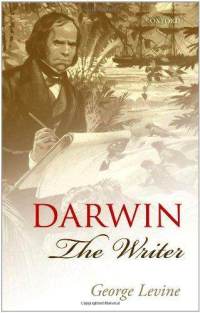
More here.
Geoff Dyer in The Observer:
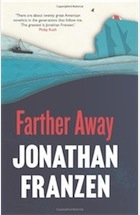
When the plane lifted off from Heathrow, Franzen must have breathed a sigh of relief and said to himself that it would be a cold day in hell before he'd set foot on that loud-dump again. So I admired the courage it took to revisit the site of these serial traumas in print.
Except, it turns out, the essay is about another, less ferocious place: Más Afuera, the island way down in the South Pacific where Alexander Selkirk (the model for Robinson Crusoe) was a castaway. Franzen retreats there after months of promoting his book, armed with a tent, a copy of Defoe's novel and some of the ashes of his friend David Foster Wallace. Once installed on the island – installed in the sense of barely able to erect his tent – Franzen reflects on the ludicrousness of the endeavour (“I hadn't felt so homesick since, possibly, the last time I'd camped by myself”), the rise of the novel in the age of Defoe and on his “friendship of compare and contrast and (in a brotherly way) compete” with Wallace.
More here.
Marcella Sirhandi in Islamic Arts:

In the 1970s, she became famous for her White series, delicate minimalist paintings with cotton ball shapes delineated by calligraphic lines and sweeps of black and red paint. The press reacted as never before. Each journalist, trying to outdo one another, saw something symbolic in these paintings, from the erotic to the sublime. These paintings were purely formalist concerns but Lubna enjoyed the spin. In 1973, when she was in her 20s, Lubna was awarded second prize in the National Exhibition in Pakistan, an exhibition dominated by senior Pakistani artists.
At the height of her career in Pakistan, Lubna and her family moved to Sacramento, California. Lubna took up drawing, print making and painting small watercolors in her new home. Her drawings expressed feelings of alienation from her home in Pakistan. California was truly a foreign place for her. Her watercolors held similar meaning with falling figures and limbs detached from their bodies. Several exhibitions, including one-person shows, followed both in California, the United Kingdom and on her periodic return to Pakistan. By the year 2000, Lubna was gripped by political concerns. She produced the Ja-namaaz series to address her grievances. Pakistan, her homeland, had become increasingly dependent on foreign institutions. She painted prayer rugs mocking allegiance to these institutions, including the White House, the IMF and even McDonalds.
More here.
Dear Reader,
Thanks very much for participating in our contest. For details of the prize you can look at the announcement here, and to read the nominated posts you can go here for a complete list with links.
If you are new to 3 Quarks Daily, we welcome you and invite you to look around the site after you vote. Learn more about who we are and what we do here, and do check out the full sitehere. Bookmark us and come back regularly, or sign up for the RSS feed. If you have a blog or website, and like what you see here, we would very much appreciate being added to your blogroll. Please don’t forget!
Voting ends on June 16 at 11:59 pm NYC time.
Results of the voting round (the top twenty most voted for posts) will be posted on the main page on June 17, 2012. Winners of the contest will be announced on or around June 25, 2012.
Now go ahead and submit your vote below!
PLEASE BE AWARE: We have multiple ways of detecting fraud such as multiple votes being cast by the same person. We will disqualify anyone attempting to cheat.
Cheers,
Abbas
Kishwar Desai in The Independent:

But it was only in my thirties that I stumbled upon two Urdu authors, Ismat Chughtai (1911-1991) and Saadat Hasan Manto (1912-1955), whose work had a seminal impact on me – and whose rebellious lives I carry about with me like a talisman. Since I was drawn to the unconventional, was I searching for iconoclastic writers who challenged social and moral attitudes, but who had roots in the East? Their image of the “outsider” was something I could identify with, and they wrote in a very accessible style. It was a collection of short stories by the perceptive and outspoken Muslim woman author Ismat Chughtai, which contained an astonishingly provocative story called “Lihaaf” or “The Quilt” (originally published in 1941), that finally deflected my staid career as a TV professional in the 1990s. The other stories could be considered equally inflammatory, but “Lihaaf” was an unusual narrative for a woman writer in India. It was about a rather thinly disguised lesbian relationship.
More here.
From PhysOrg:

In the traditional religion, menstrual taboos are strictly enforced, with women exiled for five nights to uncomfortable menstrual huts. According to Strassmann, the religion uses the ideology of pollution to ensure that women honestly signal their fertility status to men in their husband's family. “When a woman resumes going to the menstrual hut following her last birth, the husband's patrilineage is informed of the imminency of conception and cuckoldry risk,” Strassmann said. “Precautions include postmenstrual copulation initiated by the husband and enhanced vigilance by his family.” Across all four of the religions practiced by the Dogon people, Strassmann and colleagues detected father-son Y DNA mismatches in only 1.8 percent of father-son pairs, a finding that contradicts the prevailing view that traditional populations have high rates of cuckoldry. A similar rate of cuckoldry has been found in several modern populations, but a key difference is that the Dogon do not use contraception.
More here.
Alphabetical list of blog names followed by the blog post title:
(Please report any problems with links in the comments section below.)
For prize details, click here.
And after looking around, click here to vote.
- 13.7: Physics Vs. Philosophy: Really?
- 3 Quarks Daily: In the Kingdom of Decay
- Above the Market: We Suck at Math
- Accidental Blogger: Psychology’s Quest for Scientific Respectability
- Aetiology: Hemolytic uremic syndrome (HUS): history and implications
- Alien Plantation: Agave de Mayo
- Amy Shira Teitel: Was NASA’s First Launch Delay its Most Significant?
- Antimatter: A tribute to Stephen Hawking
- Astrobites: Let’s Lasso Us Some Space Rocks: Asteroid Mining And You
- Astrobites: The WISE way to deal with 2.7 million images: a public data release
- Astrobites: This star lives in exciting times, or, How did Betelgeuse make that funny shape?
- Astronomy Picture of the Day: Red Aurora Over Australia
- Azimuth: Information Geometry
- Backreaction: The hunt for the first exoplanet
- Baloon Juice: I’m Shocked! Shocked To Find That There Are Neutrinos Going On Here
- Basic Space: Supernova turns inside out and kicks neutron star
- Beach Chair Scientist: An important call for more forage fish to remain in the sea
- Big in Science: Why Your Next Doctor May Be A Computer
- Boing Boing: What Fukushima can teach us about coal pollution
- Boundary Vision: Do scientific explanations have to ruin wonder? Stargazing and more with songwriter Jim Fitzpatrick
- Cedar’s Digest: Purple Doesn’t Exist: Some thoughts on Male Privilege and Science Online
- Context and Variation: Vaginal pH Redux: Broader Perspectives on Douching, Race… and Lime Juice
- Cool Physics: Einstein, Darwin & the 21st Century…
- Cosmology Science Blog: Cosmic Microwave Angular Resolution Surprise
- Cosmology Science Blog: Observation of two early yet mature galaxies: Rare objects or is Big Bang model inaccurate?
- Delfikorakle: Pizza and Panini
- Denim and Tweed: Baby steps versus long jumps: The “size” of evolutionary change, and why it matters
- Disease Prone: Antibiotics with a side of steak
- Do the Math: Can Economic Growth Last?
- Doing Good Science: Methodology versus beliefs: What did Marcus Ross do wrong?
- Don’t Mind the Mess: The Whole Truth About Autism
- Double X Science: From alchemist to chemist: What kind of chemistry is that?
- Double X Science: Pregnancy 101: Peas made me puke, but not just in the morning
- Double X Science: Real science vs. fake science: How can you tell them apart?
- Double X Science: The path from science to alarmism: How science gets twisted before it gets to you
- Eastern Blot: Make history, not vitamin C
- Empirical Zeal: The crayola-fication of the world: How we gave colors names, and it messed with our brains
- Empirical Zeal: What it feels like for a sperm, or how to get around when you are really, really small
- Eruptions: The Mysterious Missing Eruption of 1258 A.D.
- Eruptions: The Right (and Wrong) Way to Die When You Fall Into Lava
- From the Lab Bench: Old News for Carbon Dioxide, New Threats for Climate Change
- Gaines, On Brains: Seeing into the future? The neuroscience of déjà vu
- Galileo’s Pendulum: Is Cosmology in Shambles?
- Good Thinking: Mammograms and PSA Tests: What Your Doctor Needs to Tell You
- If We Assume: Plots as Art
- Information Processing: “Only he was fully awake”
- Inkfish: Life Advice: Think More about Death
- Inspiring Science: Through the gut: how plants in food regulate genes in animals
- Katie Ph.D.: What exactly is a genetically modified plant?
- Not Exactly Rocket Science: A world within a tumour – new study shows just how complex cancer can be
- Nottingham Science Blog: Interview : Prof Alfonso Aragón-Salamanca
- Of Particular Significance: What’s a Proton, Anyway?
- Percolator: Birds Lose Their Magnetic Maps as Scientists Reverse Direction
- Physics Buzz Blog: Physicist Uses Math to Beat Traffic Ticket
- Puff the Mutant Dragon: Do vaccines contain toxic chemicals?
- Quantum Diaries: Helicity, Chirality, Mass, and the Higgs
- Resonaances: How to make a line
- Science Sushi: Mythbusting 101: Organic Farming > Conventional Agriculture
- Science Sushi: Time – and brain chemistry – heal all wounds
- Scientific American: Why Is Memory So Good and So Bad?
- Scientific American Guest Blog: Catalytic Clothing–Purifying Air Goes Trendy
- Scientific American Guest Blog: Reflections on biology and motherhood: Where does Homo sapiens fit in?
- Scientific American Guest Blog: The educational value of creative disobedience
- Scientific American Guest Blog: Too Good to Be True: Sea Mammals, Plastic Pollution and a Modern Chimera
- Scientific American Guest Blog: Trayvon Martin’s Psychological Killer: Why We See Guns That Aren’t There
- Scientific American Guest Blog: Your Appendix Could Save Your Life
- Sentence First: “Who to follow” is grammatically fine
- Shtetl-Optimized: My visit to D-Wave: Beyond the roast-beef sandwich
- Side Effects: Antidepressant Withdrawal Syndrome: Findings, Recommendations, and Resources
- Skulls in the Stars: The secret molecular life of soap bubbles (1913)
- Southern Fried Science: Climbing Mount Chernobyl
- Starts With A Bang!: So, you’ve learned that the Sun is going to explode…
- Starts With A Bang!: The Most Astounding Fact About The Universe
- Starts With A Bang!: Why is there something instead of nothing?
- Talk Nerdy To Me: My Evening With Stephen Hawking
- The Beast, the Bard, and the Bot: Are Humans Still Evolving?
- The Crux: What Is the “Bible of Psychiatry” Supposed to Do? The Peculiar Challenges of an Uncertain Science
- The Dayside: Sine-wave speech recognition in Mandarin
- The Hammock Physicist: Einstein Got It Wrong, Can You Do Better?
- The Loom: Neanderthal Neuroscience
- The Mermaid’s Tale: Forget bipedalism. What about babyism?
- The Neurocritic: Little Evidence for a Direct Link between PTSD and Chronic Traumatic Encephalopathy
- The Neurocritic: The Disconnection of Psychopaths
- The Primate Diaries: Freedom to Riot: On the Evolution of Collective Violence
- The Scorpion and the Frog: Decisions, Decisions
- The Scorpion and the Frog: Snakes Deceive to Get a Little Snuggle
- The Scorpion and the Frog: The Love Hormone of 2012
- The Scorpion and the Frog: Why This Horde of Idiots is No Genius
- The Sky’s the Limit: Saturn’s Rings Explained…
- The Spectrum of Riemannium: Time of Flight
- The Stochastic Scientist: Carbon monoxide as therapy?
- The Thoughtful Animal: Can You Hear Me Now? Human Noise Disrupts Blue Whale Communication
- The Thoughtful Animal: Contagious Yawning: Evidence of Empathy?
- The Thoughtful Animal: Four Loko Is Just Like The Copenhagen Philharmonic
- The Thoughtful Animal: Hyenas Give Up Eating Garbage for Lent, Hunt Donkeys Instead
- The Thoughtful Animal: Music and Memory: Robert Sherman, Voice of Your Childhood, Dies at 86
- The Trenches of Discovery: The War of the Immune Worlds
- Theobrominated: How can a flower like this exist?
- Three-toed Sloth: In Soviet Union, Optimization Problem Solves You
- Uncertain Principles: Watching Photons Interfere: “Observing the Average Trajectories of Single Photons in a Two-Slit Interferometer”
- viXra log: Higgs Boson Live Blog: Analysis of the CERN announcement
- Weird Things: Oh quantum causality, we hardly knew ye…
- Where is Yvette?: Artie Aardvark’s Amazing ASTRON Adventures
- Why We Reason: Does Pinker’s “Better Angels” Undermine Religious Morality?
- World Science Festival: E.O. Wilson’s Controversial Rethink of Altruism
- Write Science: Pigeons, the Internet, and the Meaning of Science
- Write Science: Smartphones and the Enduring Silence of the Cosmos
Charles Simic in the New York Review of Books:

My turn came next, though I was in near-comatose condition from uninterrupted drinking, smoking and talking since my arrival to the festival after a twenty-hour long journey from San Francisco with barely any sleep. Nevertheless, roused back to life by the drivel of the previous speaker, I said that predicting the future of poetry is a total waste of time, because poetry has not changed fundamentally in the last twenty-five centuries and I doubted it would do so in the next hundred years. Since that was all the energy I had, I fell silent and didn’t open my mouth again for the rest of the session. As for my fellow-panelists, I have no memory of any of them responding to anything I said as they continued arguing with each other about the future of poetry.
What I said that day was as much of a surprise to me as it must have been to the other people in the room, for I was then known as a surrealist poet, someone who routinely proclaimed a belief in the avant-garde. I and my friends were like those old-time Marxists who were sure that they understood the laws of history. We were convinced that abstract painting was an advance over figurative painting, that free verse was superior to meter and rhyme. To me, novelty was an essential requirement in the arts, and it still is.
More here.
Sean Carroll in Cosmic Variance:

Back in the later years of the 19th century, physicists had put together an incredibly successful synthesis of electricity and magnetism, topped by the work of James Clerk Maxwell. They had managed to show that these two apparently distinct phenomena were different manifestations of a single underlying “electromagnetism.” One of Maxwell’s personal triumphs was to show that this new theory implied the existence of waves traveling at the speed of light — indeed, these waves arelight, not to mention radio waves and X-rays and the rest of the electromagnetic radiation spectrum.
The puzzle was that waves were supposed to represent oscillations in some underlying substance, like water waves on an ocean. If light was an electromagnetic wave, what was “waving”? The proposed answer was the aether, sometimes called the “luminiferous aether” to distinguish it from the classical element. This idea had a direct implication: that Maxwell’s description of electromagnetism would be appropriate as long as we were at rest with respect to the aether, but that its predictions (for the speed of light, for example) would change as we moved through the aether. The hunt was to find experimental evidence for this idea, but attempts came up short. TheMichelson-Morley experiment, in particular, implied that the speed of light did not change as the Earth moved through space, in apparent contradiction with the aether idea.
So the aether was a theoretical idea that never found experimental support. In 1905 Einstein pointed out how to preserve the symmetries of Maxwell’s equations without referring to aether at all, in the special theory of relativity, and the idea was relegated to the trash bin of scientific history.
More here.
In a written exchange, associate professor Michael Alfaro and postdoctoral scientist Sharlene E. Santana described their investigation with American Scientistsenior editor Catherine Clabby.
Catherine Clabby in American Scientist:
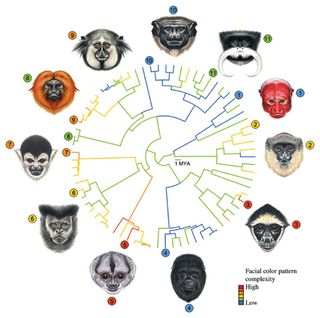
When you see the faces of primates, you see an extraordinary diversity of shapes, colors and patterns, so we wondered what were the factors behind this diversity. Social behaviors seemed to be a very likely candidate underlying the diversity of primate faces, so that drew us in to further explore how behaviors can shape the evolution of anatomy in these mammals. Neotropical primates were ideal to start our studies of facial diversity because they are a single evolutionary radiation spanning a wide variety of habitats and social systems, and they have an extraordinary variation in their facial features.
Are the faces of primates really that different from the faces of other mammals?
What is particular about primates is their high reliance on facial cues to interact socially, more so than many other mammals. Primates use characteristics of their faces and facial expressions to recognize individuals in their groups and to assess each other’s behaviors. Related to this, primates have evolved a very well-developed visual system and neural centers for facial recognition. Such an important role in communication has shaped the evolution of primate faces, along with ecological and physiological functions.
More here.
Mark Edmundson in the Chronicle of Higher Education:

For those of us who teach, the question is especially pressing. Our students tend to spend hours a day plugged into their tunes. Yet, at least in my experience, they are reluctant to talk about music. They'll talk about sex, they'll talk about drugs—but rock 'n' roll, or whatever else they may be listening to, is off-limits. What's going on there?
When I first heard Bob Dylan's “Like a Rolling Stone” in 1965, not long after it came out, I was amazed. At the time, I liked to listen to pop on the radio—the Beatles were fine, the Stones were better. But nothing I'd heard until then prepared me for Dylan's song. It had all the fluent joy of a pop number, but something else was going on too. This song was about lyrics: language. Dylan wasn't chanting some truism about being in love or wanting to get free or wasted for the weekend. He had something to say. He was exasperated. He was pissed off. He'd clearly been betrayed by somebody, or a whole nest of somebodies, and he was letting them have it. His words were exuberantly weird and sometimes almost embarrassingly inventive—and I didn't know what they all meant. “You used to ride on the chrome horse with your diplomat / Who carried on his shoulder a Siamese cat.” Chrome horse? Diplomat? What?
More here.
Jim Holt in the New York Times:

This is hardly the first occasion on which physicists have made disobliging comments about philosophy. Last year at a Google “Zeitgeist conference” in England, Stephen Hawking declared that philosophy was “dead.” Another great physicist, the Nobel laureate Steven Weinberg, has written that he finds philosophy “murky and inconsequential” and of no value to him as a working scientist. And Richard Feynman, in his famous lectures on physics, complained that “philosophers are always with us, struggling in the periphery to try to tell us something, but they never really understand the subtleties and depths of the problem.”
Why do physicists have to be so churlish toward philosophy? Philosophers, on the whole, have been much nicer about science. “Philosophy consists in stopping when the torch of science fails us,” Voltaire wrote back in the 18th century. And in the last few decades, philosophers have come to see their enterprise as continuous with that of science. It is noteworthy that the “moronic” philosopher who kicked up the recent shindy by dismissing the physicist’s book himself holds a Ph.D. in theoretical physics.
More here. [Photo shows David Albert.]