Cancer meets its nemesis in reprogrammed blood cells

Andy Coghlan in New Scientist:

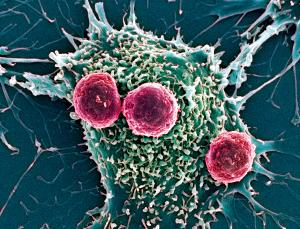
Mg22029442.800-1_300“The results are holding up very nicely.” Cancer researcher Michel Sadelain is admirably understated about the success of a treatment developed in his lab at the Memorial Sloan-Kettering Cancer Center in New York.

In March, he announced that five people with a type of blood cancer called acute lymphoblastic leukaemia (ALL) were in remission following treatment with genetically engineered immune cells from their own blood. One person's tumours disappeared in just eight days.

Sadelain has now told New Scientist that a further 11 people have been treated, almost all of them with the same outcome. Several trials for other cancers are also showing promise.

What has changed is that researchers are finding ways to train the body's own immune system to kill cancer cells. Until now, the most common methods of attacking cancer use drugs or radiation, which have major side effects and are blunt instruments to say the least.

The latest techniques involve genetically engineering immune T-cells to target and kill cancer cells, while leaving healthy cells relatively unscathed.

More here.

Wednesday Poem

Mother Earth: Her Whales

An owl winks in the shadows
A lizard lifts on tiptoe, breathing hard
Young male sparrow, stretches up his neck,
big head watching—

The grasses are working in the sun. Turn it green.
Turn it sweet. That we may eat.
Grow our meat.

Brazil says “sovereign use of Natural Resources”
Thirty thousand kinds of unknown plants.
The living actual people of the jungle
sold and tortured—
And a robot in a suit who peddles a delusion call “Brazil”
can speak for them?

The whales turn and glisten, plunge
and sound and rise again,
Hanging over subtly darkening deeps
Flowing like breathing planets
in the sparkling whorls of
… living light—

Read more »

7 Tips for Getting Through Thanksgiving

Akim Reinhardt at The Public Professor:

Deviled-eggsSome people host Thanksgiving, drawing loved ones to their home. Others eschew traveling to family affairs, and instead congregate with friend at local, low stress gatherings. But most are among the millions who plod near and far to spend it with their ragged clan. For them, I offer some tips on how to make the most of it and avoid the worst of it.

1. Stand near the deviled egg plate. Like most every other human on the planet, you love them more than you care to admit. If you try to play it cool, they’ll be gone before you know it. And then you’ll cry. Don’t cry on Thanksgiving because you missed out on the deviled eggs. Just scarf them up til your heart’s content. Or until its cholesterol level maxes out.

2. Put in some early face time with other people’s kids. Enjoy those rug rats while you’ve still got the energy. That way later on, when you’re porked out, half-drunk, and exhausted, you can tell ‘em to piss off in good conscience.

3. Watch some football. If you like watching football, this is a given. But if you don’t like watching football? Well, if you don’t like talking to Aunt Mathilda either, this is an easy way out when there’s nowhere else to turn.

More here.

Project ranks billions of drug interactions

Sara Reardon in Nature:

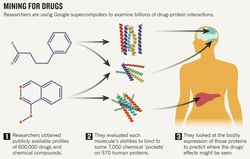
Drug-discoveryFor decades, drug development was mostly a game of trial and error, with brute-force candidate screens throwing up millions more duds than winners. Researchers are now using computers to get a head start. By analysing the chemical structure of a drug, they can see if it is likely to bind to, or ‘dock’ with, a biological target such as a protein. Such algorithms are particularly useful for finding potentially toxic side effects that may come from unintended dockings to structurally similar, but untargeted, proteins.

Last week, researchers presented a computational effort that assesses billions of potential dockings on the basis of drug and protein information held in public databases. “It’s the largest computational docking ever done by mankind,” says Timothy Cardozo, a pharmacologist at New York University’s Langone Medical Center, who presented the project on 19 November at the US National Institutes of Health’s High Risk–High Reward Symposium in Bethesda, Maryland. The result, a website called Drugable (drugable.com) that is backed by the US National Library of Medicine (NLM), is still in testing, but it will eventually be available for free, allowing researchers to predict how and where a compound might work in the body, purely on the basis of chemical structure (see ‘Mining for drugs’).

More here.

Tuesday, November 26, 2013

the rage of franzen and kraus

Kraus-ViennaJacob Mikanowski at The Point Magazine:

The Kraus Project’s annotators are admirably upfront about Kraus’s failings, taking up the vexed question of his putative self-hatred head-on. Paul Reitter, who devoted a whole book to the subject, argues that Kraus was being deliberate with his stereotypes, strategically deploying an anti-Semitic discourse in order to critique it. This seems to me to be too clever an explanation by half. I think it more likely that he simply didn’t care. Kraus was a bully and a snob, a lover of Offenbach and a pursuer of aristocratic ladies. He affected the tastes of an older, landed generation, even as he scandalized their manners, and he elevated their haute-bourgeois prejudices into a dissident religion with the force of his personality. He was too caught up in his genius and gigantic self-worth to care about everyday politics, much less “discourse.”

So why has Franzen expended so much effort to bring him back? In a word: rage. Kraus taught Franzen how to be angry, and how to channel that anger at the world. He writes about this as if it was a revelation: “Anger descended on me so near in time to when I fell in love with Kraus’s writing that the two occurrences are practically indistinguishable.” Revisiting Kraus thirty years later gives Franzen an opportunity to vent about all his favorite subjects. He complains that Macs are too sleek, Twitter too shallow, France too pleasurable and book critics too nice. Some of his criticisms have a vaguely anti-capitalist tenor. For some reason, Jeff Bezos, intent on enserfing writers and critics alike with the power of Amazon’s (wholly mythical) “one-day free shipping,” emerges as one of his main villains. The “Internet” comes in for repeated beatings, for its “ninth-grade” social dynamics, its snarkiness and its tendency toward solipsism. That he is leveling these charges from the platform of a particularly bitter and minutiae-filled memoir goes blissfully unmentioned.

more here.

C.S. Lewis’s first love was poetry

Lewis-coverLaura C. Mallonee at Poetry Magazine:

In 1926, at the height of modernism’s golden age, a young C.S. Lewis and a few of his friends decided to play a literary prank. As told in Alister McGrath’s clear-eyed biography, they wrote a spoof of T.S. Eliot’s poetry and submitted it for publication atThe Criterion, where Eliot was editor. “My soul is a windowless façade,” the poem began, and went on to ruminate over the Marquis de Sade, upholstered pink furniture, and mint juleps. If the older poet took the bait and published the poem, Lewis, who was then 27 years old and a fellow at Magdalene College, would use the event “for the advancement of literature and the punishment of quackery.” If not, it might prove there was something more to modernist poetry than he thought.

But Eliot never answered Lewis’s letter, and looking back on the ruse now is like watching a mouse brazenly challenge a cat. Eliot was then at the pinnacle of his career, having already published Prufrock and Other Observations (1917) and The Waste Land (1922); the younger Lewis’s literary future was still nebulous. Eliot has been called the most important poet of the 20th century; few today are aware that Lewis, the mastermind behind The Chronicles of Narnia, wrote poetry at all. But poetry was his first love, and his devotion to the form will be officially honored this month with the unveiling of a monument at the Poets’ Corner in Westminster Abbey, 50 years after his death.

more here.

The miraculous novels and life of Penelope Fitzgerald

201346penelopeNeel Mukherjee at The New Statesman:

The word that immediately occurs to one when thinking of Penelope Fitzgerald’s last four novels – Innocence (1986), The Beginning of Spring(1988), The Gate of Angels (1990), and The Blue Flower (1995) – is “miraculous”. There is nothing quite like them in English literature: in fact, they are not really English novels at all, except in language. They are inexhaustible in their meanings; mysterious and oblique, even baffling, in craft, beauty and effect; and every reader who has come to them has asked, at one time or other, a variant of the question, “How is it done?”

In this first ever biography of Fitzgerald, which comes 13 years after her death, Hermione Lee, pointedly using the (madeup) words of Novalis in The Blue Flower as her epigraph (“If a story begins with finding, it must end with searching”), has set out to attempt some answers to that question. The result is a luminous masterpiece of life-writing.

more here.

Tuesday Poem

Poem
.

A man applying gold leaf
to the window's word backwards
combed his hair to charge
his gilder's tip with static,
so he charged his hair with gold.
He was electrically the gold-
haired father of the gold word
GOODS! and god of the store's
attractions. When he waved his maul-
stick I went in to buy
the body of his mystery.
.

by Alan Dugan
from New and Collected Poems 1091-1983
The Ecco Press 1983

The Fall of India’s Conscience

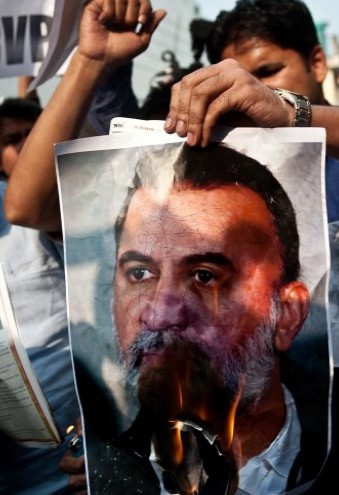
The biggest story in India right now is that one of the country’s most famous and controversial journalists stands accused of sexual assault. How did a man known for skewering the powerful end up this way?

Tunku Varadarajan in The Daily Beast:

ScreenHunter_419 Nov. 26 13.10Why is this story dominating the Indian news media? The most obvious reason is the identity of the accused. Tejpal is at the moral heart of the Indian elite, a man who has given his last 10 years to a (sometimes gaudy) fight against everything that is insufferable in India, and that includes sexual violence. In February of this year, the magazine produced a special issue on sexual violence with an electrifying cover. “I Am Every Woman,” it said, and Tehelka was widely lauded for its pugnacity. This right-on man is now accused of rape, and the news has come to everyone in the media—friends, colleagues, and competitors—as a tectonic jolt. (A nation accustomed to Tejpal the Crusader is stunned.)

“What made Tejpal do this?” everyone asks. Some answers suggest themselves, the most unsettling of which is that, for all his rhetoric in the cause of women, Tejpal is, perhaps, just another unreconstructed, predatory Indian male who was playing the part of PC editor for commercial effect.

More here.

Three Weeks Before Vladimir Nabokov’s Lolita, There Was Dorothy Parker’s

Galya Diment in Vulture:

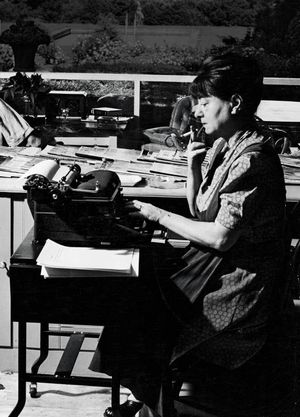
DorothyBy 1955, the writing careers of Vladimir Nabokov and Dorothy Parker were headed in opposite directions. Parker’s was in a deep slump. The New Yorker—a magazine she had been instrumental in founding—had not published her fiction in fourteen years. Nabokov, by contrast, was becoming a literary sensation. The New Yorker had published several of his short stories as well as chapters of his autobiography Conclusive Evidence and of his novel Pnin. His next novel, Lolita, would bring him worldwide recognition for its virtuosic prose and the shocking story of a middle-aged man’s relationship with his pubescent stepdaughter and her aggressive mother. It was a manuscript that Nabokov circulated very little because he feared the controversy that would erupt when it was published. Yet three weeks before Lolita arrived in bookstores in France, where it first came out that September, Parker published a story—in The New Yorker, of all places—titled “Lolita,” and it centered on an older man, a teen bride, and her jealous mother. How could this have come to pass?

Nabokov had initially discussed his forthcoming book with his editor at The New Yorker, Katharine White, in 1953. “Don’t forget,” she wrote to him on ­November 4, “that you promised to let us read the manuscript … Sometimes a chapter or several chapters can be made into separate short stories.” At the end of that year, Nabokov’s wife, Véra, contacted White on his behalf: “He finished his novel yesterday,” Véra wrote to White, “and is bringing two copies, one for you, the other for the publisher. There are some very special reasons why the MS would have to be brought by one of us for there are some things that have to be explained personally.”

More here.

Families: our changing definition

Natalie Angier in The New York Times:

GayKristi and Michael Burns have a lot in common. They love crossword puzzles, football, going to museums and reading five or six books at a time. They describe themselves as mild-mannered introverts who suffer from an array of chronic medical problems. The two share similar marital résumés, too. On their wedding day in 2011, the groom was 43 years old and the bride 39, yet it was marriage No. 3 for both. Today, their blended family is a sprawling, sometimes uneasy ensemble of two sharp-eyed sons from her two previous husbands, a daughter and son from his second marriage, ex-spouses of varying degrees of involvement, the partners of ex-spouses, the bemused in-laws and a kitten named Agnes that likes to sleep on computer keyboards. If the Burnses seem atypical as an American nuclear family, how about the Schulte-Waysers, a merry band of two married dads, six kids and two dogs? Or the Indrakrishnans, a successful immigrant couple in Atlanta whose teenage daughter divides her time between prosaic homework and the precision footwork of ancient Hindu dance; the Glusacs of Los Angeles, with their two nearly grown children and their litany of middle-class challenges that seem like minor sagas; Ana Perez and Julian Hill of Harlem, unmarried and just getting by, but with Warren Buffett-size dreams for their three young children; and the alarming number families with incarcerated parents, a sorry byproduct of America’s status as the world’s leading jailer. The typical American family, if it ever lived anywhere but on Norman Rockwell’s Thanksgiving canvas, has become as multilayered and full of surprises as a holiday turducken — the all-American seasonal portmanteau of deboned turkey, duck and chicken.

…In increasing numbers, blacks marry whites, atheists marry Baptists, men marry men and women women, Democrats marry Republicans and start talk shows. Good friends join forces as part of the “voluntary kin” movement, sharing medical directives, wills, even adopting one another legally. Single people live alone and proudly consider themselves families of one — more generous and civic-minded than so-called “greedy marrieds.”

More here.

American Anarchist

Noam-Chomsky-2

Matthew Robare in The American Conservative:

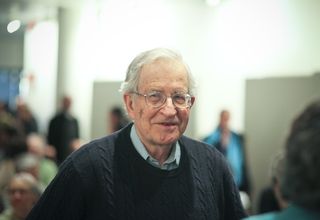
The main currents of anarchist thought were derived from classical liberal ideas that emerged in the Enlightenment and the Romantic era. The central idea, Chomsky said, was that “institutions that constrain human development are illegitimate unless they can justify themselves.” Anarchists seek to challenge those institutions and dismantle the ones that cannot be justified, while creating new institutions from the ground up based on cooperation and benefits for the community. This tradition of libertarian socialism or anarcho-syndicalism was still alive, Chomsky claimed, despite challenges and suppression.

Paraphrasing the German-American anarchist Rudolf Rocker, Chomsky said that anarchism seeks to free labor from economic exploitation and society from ecclesiastical guardianship. This meant that workers struggle for their well-being and dignity—“for bread and roses,” as he put it—while rejecting the convention of working for others in exchange for money, which he described as a kind of slavery. The other opposition, to ecclesiastical guardianship, he explained as not necessarily an opposition to organized religion—he praised Dorothy Day’s Catholic Worker movement and the Christian anarchism of the Basque Country. Rather, Chomsky articulated an opposition to the idea that society should be regulated by an elite group, whether they are liberal technocrats, religious clerics, or corporate executives.

Chomsky also addressed some of the issues confronting anarchist activism, noting that while anarchists stand against the state, they often advocate for state coercion in order to protect people from “the savage beasts” of the capitalists, as he put it. Yet he saw this as not a contradiction, but a streak of pragmatism. “People live and suffer in this world, not one we imagine,” Chomsky explained. “It’s worth remembering that anarchists condemn really existing states instead of idealistic visions of governments ‘of, by and for the people.’”

More here.

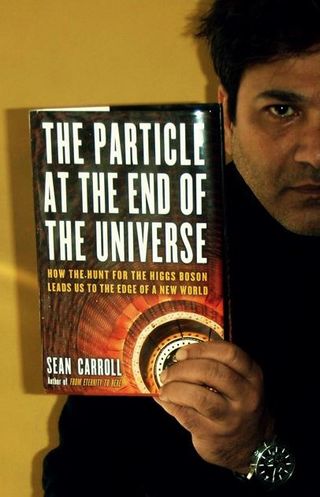
Higgs boson book scoops Royal Society Winton Prize

Congratulations, Sean!

Long-time 3QD friend and supporter Sean Carroll has won the £25,000 Royal Society Winton Prize for his book The Particle at the End of the Universe. I am proud to say that I was one of the people Sean had sent the manuscript to for comment before publication and I loved it immediately. Here is what I had said on Facebook about it when it was published:

It is a tour de force of science writing. If you don't have a good understanding of what all the fuss was about when the LHC announced the discovery of the Higgs boson earlier this summer, you will after you read this brilliantly accessible account of the science behind the discovery and also all its attendant human drama.

Am very happy the Royal Society agreed! This is from the BBC:

ScreenHunter_418 Nov. 26 09.45Theoretical physicist Sean Carroll scoops the £25,000 award for his book The Particle at the End of the Universe.

His work beat five other titles that ranged across topics that broadly focussed on life in its many forms and its internal workings.

But the judges were unanimous in their decision to give Dr Carroll the prize.

Prof Uta Frith, from University College London and chair of the judges, said of the winning book: “It is an exceptional example of the genre and a real rock star of a book. Though it's a topic that has been tackled many times before.

“Carroll writes with an energy that propels readers along and fills them with his own passion. He understands their minds and anticipates their questions. There's no doubt that this is an important, enduring piece of literature.”

The prize was announced at the society's central London headquarters.

Dr Carroll said it was “completely unexpected”.

“It was a great thrill. I honestly thought of the six people in this room, anyone could have won.

More here.

In Defense of a Loaded Word

TaNehisi_img-articleInline

Ta-Nehisi Coates in the NYT:

It might be true that you refer to your spouse as Baby. But were I to take this as license to do the same, you would most likely protest. Right names depend on right relationships, a fact so basic to human speech that without it, human language might well collapse. But as with so much of what we take as human, we seem to be in need of an African-American exception.

Three weeks ago the Miami Dolphins guard Richie Incognito, who is white, was reported to have addressed his fellow Dolphin as a “half-nigger.” About a week later, after being ejected from a game, the Los Angeles Clippers forward Matt Barnes, who is black, tweeted that he was “done standing up for these niggas” after being ejected for defending his teammate. This came after the Philadelphia Eagles wide receiver Riley Cooper, who is white, angrily called a black security guard a “nigger” in July.

What followed was a fairly regular ritual debate over who gets to say “nigger” and who does not. On his popular show “Pardon the Interruption,” Tony Kornheiser called on the commissioners of the National Football League, the National Basketball Association and Major League Baseball to ban their players from publicly using the word. The ESPN host Skip Bayless went further, calling “nigger” “the most despicable word in the English language — verbal evil” and wishing that it could “die the death it deserves.”

Mr. Bayless and Mr. Kornheiser are white, but many African-Americans have reached the same conclusion. On Thursday, the Fritz Pollard Alliance Foundation, a group promoting diversity in coaching and in the front offices of the N.F.L., called on players to stop using “the worst and most derogatory word ever spoken in our country” in the locker rooms. In 2007 the N.A.A.C.P. organized a “funeral” in Detroit for the word “nigger.” “Good riddance. Die, n-word,” said Kwame Kilpatrick, then the mayor. “We don’t want to see you around here no more.”

But “nigger” endures — in our most popular music, in our most provocative films and on the lips of more black people (like me) than would like to admit it. Black critics, not unjustly, note the specific trauma that accompanies the word. For some the mere mention of “nigger“ conjures up memories of lynchings and bombings. But there’s more here — a deep fear of what our use of the word “nigger” communicates to white people.

More here.

Monday, November 25, 2013

Perceptions

48_Tomas-Saraceno_On-Space-Time-Foam-600x400

Tomas Saraceno. On Space Time Foam. HangarBicocca in Milan, Italy, 2012.

“… is a multi-layered habitat of membranes suspended 24 meters above the ground that is inspired by cosmology and life sciences. Each level has a different climate and air pressure and will react to the movement of visitors through it. In a later iteration, the work will become a floating biosphere above the Maldives Islands that is made habitable with solar panels and desalinated water.”

More here, here, and here.

Sunday, November 24, 2013

Islam and Social Democrats

1380587648laurenceweb

Jonathan Laurence in Dissent:

The first serious divergences between Muslims and the left in Europe began with the fatwa issued by Iranian Ayatollah Khomeini against Salman Rushdie in 1989 and religious demands to censor his novel, The Satanic Verses. The split widened later that year, when France began to restrict the wearing of girls’ headscarves in schools.

Until then, parties on the left had embraced the mostly working-class minority as a natural ally. Migrants from Muslim majority countries first began settling permanently in Western Europe in the 1970s and ’80s. The unexpected transformation of receiving countries into “immigration societies” provoked nationalist and racist reactions on the right, while parties on the left appeared the likely beneficiary of the influx of future voters. German trade unions were already enrolling Gastarbeiter (guest workers) in the 1960s, decades before the German state considered granting Turks easy access to citizenship. When the Socialist leader François Mitterrand was elected French president in 1981, he authorized foreigners to create cultural and political associations—mostly benefiting Algerians, Moroccans, and Tunisians—that party leaders hoped would federate under the Socialist banner.

Parties of the left began supporting civic integration efforts at the same moment that center-right parties began battling an ascendant extreme right. While Christian Democrats repeated the mantra that “Germany is not a country of immigration,” for example, German Greens and Social Democrats lobbied for dual nationality for Turks. Conservative coalitions at the time portrayed the immigrant population as a drain on resources and a threat to security and the national way of life. The Social Democratic defense of the second generation’s “right to be different” and to participate in politics allowed center-left parties to defend their ideals while making inroads into a budding electorate of millions.

More here.

Adorno’s Negative Dialectic and So On

Rms-206148

Richard Marshall interviews Brian O’Connor in 3:AM Magazine:

3:AM: How should we understand what Adorno meant when he discussed the social world as a ‘damaged life’? How far was this a reaction to the times he lived through and was it an overreaction that can’t make a distinction between Nazi society and totalitarianism, and contemporary liberal ones?

BO: We could say that Adorno endorses the notion, that we consider broadly Aristotelian, that a well-ordered society provides us with wholesome and indeed happy ways of living. But, obviously enough, Adorno believes that we have anything but such a society: forms of human interaction are shaped by the supposedly all-consuming experience of self-preservation within capitalism. This produces coldness in people’s dealings with each other. Because of the particularities of German culture, according to Adorno, National Socialism could pose as a substitute for the sense of belonging lost through the capitalism driven rationalization of society. But it is a freakish social world. The coldness is not overcome, and togetherness is achieved through exclusionary myths. If we take the broadly Aristotelian picture as some kind of baseline, the life that Adorno describes is about as damaged as life can be.

It’s important to point out that critical theory’s worry about liberalism actually precedes the catastrophe of the Nazi era. There are familiar interpretations of liberalism as a theory primarily of the freedom of the ‘bourgeois’ actor rather than of the experience of life without stress or of substantive values about human dignity. At no time, however, is it lumped in with totalitarianism. Post-war, liberalism, in the vague forms in which it was generally conceived, was not perceived as a candidate for the solution to the forms of behaviour into which Germany in particular seemed so easily to slide.

More here.

The School of Arthur Danto

15stone-img-blog427 (1)

Crispin Sartwell in the NYT's The Stone:

Art and philosophy, it seemed to me then, had gone their separate ways, and were conceived as opposing and incompatible cultural zones. Danto developed an ingenious (if not unproblematic) reconnection that was also a revival and transformation of all the traditional questions of philosophical aesthetics. Indeed, in his view, the avant-garde art of the period and analytic philosophy were not just compatible, they were made for each other. In developments like pop art and conceptualism, he asserted, art had become a form of philosophy, which is one thing he meant when he said that art was over. Whether this was exactly true or not, it mirrored his own development in its synthesis of the sensual and the intellectual.

For Danto not only wrote about art; he wrote with art. This is what really impressed (I want to say “transfigured”) me as a graduate student. As it turned out, I didn’t particularly agree with his philosophy. But I loved his writing inordinately and have often tried to emulate it. Among my first publications was an attack, written in an admiring simulation of Danto’s own style, on what I took to be the basic argument of “The Transfiguration of the Commonplace”; he thrilled me by sending me a letter, administering gracious correction.

More here.