The Writer and the Rebellion

Tonimilaqi5-086-11

Matthew Davis in Guernica:

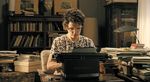
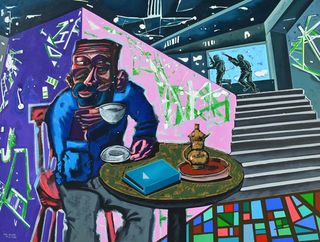
The Qasabji bar in Damascus, on an unremarkable road just outside the Old City, was where Khaled Khalifa and I had our best conversations. Khaled always entered first and greeted the customers sitting at tables near the door. He bent down, kissed the men, flirted with the women, and strutted to where Nabil, Qasabji’s owner, had cleaned a spot for us. He ordered either a glass of arak or the local Damascene beer, Barada, pulled a cigarette from his pack, lit it, and added to the purplish haze of smoke. Qasabji was a singular room shaped like a boxcar, crowded with wood tables, benches and chairs that pushed against one another and three walls. I only saw it at night, crowded and smoke-filled, loud, dim. Khaled always faced out, better to see the men and women, but mostly the women, and when an attractive one entered he banged the table with his fist and hooted like a wolf.

I met Khaled Khalifa in 2007. He was a fellow at the International Writing Program at the University of Iowa, where I was working. His third novel, In Praise of Hatred had come out in Arabic the year before, and within the year would be short-listed for the International Prize for Arabic Fiction, commonly known as the Arab Booker, and Khaled would be profiled by the New York Times.

Qasabji was one of two Damascene locales where Khaled had often written In Praise of Hatred. He had worked until the early hours of the morning, Nabil serving him cup after cup of coffee. It was a romantic image, the focused writer, the devoted bartender, but everything about Khaled was romantic—his outsized personality (he once orchestrated an entire club to dance while standing atop a bar), his love of women (his womanizing is notorious), his capacity to drink (he buys Smirnoff vodka in two gallon jugs, places them around his apartment, and fills them with olive oil when they’re empty). And when he talked about writing, he spoke with a refreshing earnestness…

More here.

michael fried on anthony caro

CARO-2012-In-the-Forest-600x412Michael Fried at nonsite:

Several years ago Anthony Caro was invited to propose a large-scale work for one of the central malls on Park Avenue in midtown Manhattan. This was in connection with Park Avenue Malls, on ongoing program begun more than ten years ago under the auspices of the Park Avenue Authority and in which a number of sculptors had already taken part. Typically, Caro had his own approach to the project: it mattered to him that in addition to passersby there were countless cars moving in both directions, and he began to think in terms of making a work long enough to lend itself to being viewed meaningfully from passing cars as well as by pedestrians. This involved building maquettes of the street, trying out various possible designs for the construction itself, visiting New York more than once to study the site in detail and pursue various questions on the ground, returning to London and modifying the models in accordance with his new findings, and so on.

Before long, Caro’s proposal envisioned a construction fully three city blocks long, represented in his Camden Town, London, studio by a model built to 1:4 scale and erected at waist height with trees and bushes made of wire and plastic.

more here.

putting hannah arendt on film

Rieff_hannahandheradmirers_ftrDavid Rieff at The Nation:

If films were horses, almost no one would have placed even a $2 bet on Hannah Arendt, the recent biopic by the independent German filmmaker Margarethe von Trotta. How did a film that reprises the fifty-year-old controversy about what the German-Jewish refugee and political philosopher thought and wrote in 1963 about the kidnapping and trial of Adolf Eichmann become the most talked-about art-house movie of this past summer, and one of the most improbable independent-film successes in recent memory? There have been any number of movies about writers and artists, from Michelangelo to Truman Capote, made by directors of varying intellectual abilities in both Hollywood and Europe, but very few biopics made about intellectuals or philosophers. And with good reason: however wrongly, the lives of writers are thought to be sexy and exciting—think Hemingway, Fitzgerald, Dinesen, Lillian Hellman. In contrast, the lives of intellectuals are thought to be deadly dull. It was said of Kant that one would be hard-pressed to infer the existence of the two sexes from his work. So imagine a biopic in which the philosopher is portrayed tramping around eighteenth-century Königsberg, giving his tutorials, writing The Critique of Pure Reason and, perhaps in order to spice up the plot, dashing off a stern letter to his erstwhile disciple Johann Gottlieb Fichte, warning him of the dangers of radical idealism. Its appeal would be, shall we say, somewhat circumscribed, no matter how buttery the popcorn.

But having made biographical films about the medieval mystic Hildegard of Bingen and Rosa Luxemburg—both of which starred Barbara Sukowa, who also plays the title role in Hannah Arendt—von Trotta is the only living director with a major body of work who could conceivably have mastered so austere and complicated a figure as Arendt.

more here.

ian buruma’s “Year Zero”

Cover00Siddhartha Mahanta at Bookforum:

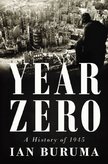
Vichy France was a disgusting place. Harper's readers were reminded of that in the October issue of the magazine, which included an excerpt from a 1945 handbook for American soldiers in occupied France. It featured useful tips on navigating filthy streets (where “the acute shortage of gasoline prevents refuse trucks from making daily rounds”), making do with corroded plumbing systems, and coping with villagers' “malodorous custom of piling manure in front of houses.” These descriptions set the stage for Ian Buruma's Year Zero: A History of 1945, which illustrates in harrowing detail how forging a new world order out of the remains of war can be nasty business. One might have expected that the end of World War II would have immediately ushered in a period of international peace. Buruma demonstrates that before it did, the world descended into a brutal free-for-all, full of reprisal killings against religious and ethnic minorities, political disarray, and carnal excess.

What Buruma delivers in Year Zero is a counter-narrative to the widely accepted idea of 1945 as a year of global reconciliation. At the close of the war, the victors were faced not only with the problems of widespread starvation and ruined cities, but also with the task of creating a new political and economic order, and of resolving (or at least learning to manage) old rivalries.

more here.

The biggest victory for the left since the election of President Obama

David Weigel in Slate:

ScreenHunter_409 Nov. 22 12.34One can, as most Republicans prefer to do, remember what happened in 2005, when Republicans wanted to end filibusters on judicial nominees and every Democrat—including our current president—predicted nuclear fallout, brimstone, and exploding skulls.

We do know how the Senate came to change its rules today, a vote that represented the biggest victory for the left since the election of President Barack Obama. That process started in the first weeks of 2009, after a Democratic landslide mighty enough to sweep even Al Franken into the upper house. The Republicans, who’d held 55 seats during the 2005 “nuclear option” fight, were down to 41. A new class of Democrats, including Oregon Sen. Jeff Merkley and New Mexico Sen. Tom Udall, buckled in for action.

They got a slog. An economic stimulus package, once expected to get up to 80 votes, got over the 60-vote cloture line only with huge concessions to three Republicans. A simple omnibus parks funding bill took weeks to pass. Then, in May, just enough Republicans held together to filibuster the president’s nominee for deputy secretary of the Interior. To Majority Leader Harry Reid’s surprise, the Democratic left honed in quickly on the filibuster, demanding that he change it.

More here.

BREAKING BAD NEWS

From More Intelligent Life:

Badnewscrop_0Every year, 1.17m people die in road accidents around the world. As of January 2011, 7,066 soldiers from coalition forces had been killed in the wars in Iraq and Afghanistan, along with an estimated 110,000 civilians; in 2007, the last year for which there are full figures, 521,303 people died of cancer in western Europe. Behind all these statistics are families who need to be informed and someone whose job it is to inform them. There is now a widespread belief that the way the news is delivered has a profound effect on the way the dead person is remembered and the way the survivors heal.

There are some textbook examples of what not to do. Putting a note through the letterbox; getting the victim’s name wrong; using euphemisms such as “lost” or “passed on” (confusing at a time when someone is trying hard not to believe it); and turning up in shorts and flip-flops, like the British diplomats who greeted one woman as she arrived in Bahrain in 2006 after her husband’s death in a boat disaster. A vision that has stuck in her mind, rather than anything that was said.
And what of the bearers of bad news? What is it like to knock on a door knowing you are about to instigate the worst moment in someone’s life, and then have to confront the ways in which they do or do not deal with the fact that a life has ended?

More here.

Why science would benefit from a symbiosis-driven history of speciation

Bradford Harris in American Scientist:

EndoWhen it comes to the story of evolutionary science, people know the name Charles Darwin, but most do not know the names Ivan Wallin or Lynn Margulis—two more recent, groundbreaking evolutionary theorists. Over the past several decades, these and other researchers have revealed that organisms’ cooperation and interdependence contribute more to evolution than competition. Symbiogenesis—the emergence of a new species through the evolutionary interdependence of two or more species—is at least as important in the history of life as survival of the fittest. Such insight has failed to gain traction in American minds—including those of American scientists—because of cultural history traceable back through the popularization of Adam Smith’s individualist philosophy.

By the time Darwin published On the Origin of Species in 1859, the Western European and American mind had long been intellectually primed to interpret complexity by reducing perspective to the individual. Adam Smith’s publication of The Wealth of Nations 83 years earlier had set the tone of philosophical and scientific approaches to understanding complex systems. Fundamental to Smith’s philosophy, as economic historian Warren Samuel reminds us, was the notion that large organizations like the economy were to be “comprehended in terms of self-interest or maximization of personal well being.” Smith’s influence on Darwin was as strong as it was on the rest of the reading public.

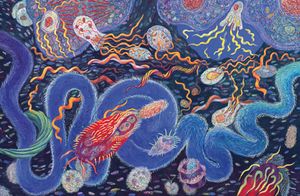
Picture: Endosymbiosis: Homage to Lynn Margulis, a painting by Shoshanah Dubineer, occupies a hallway in the Morrill Science Center at the University of Massachusetts, Amherst, where Margulis was a professor until her death in 2011. Margulis maintained that genetic variation emerges primarily through symbiosis, not through competition, a once-controversial view that is gaining increasing acceptance

More here.

Thursday, November 21, 2013

What Are Radicals Good For? An Interview with George Scialabba

Lindsey Gilbert in the Boston Review:

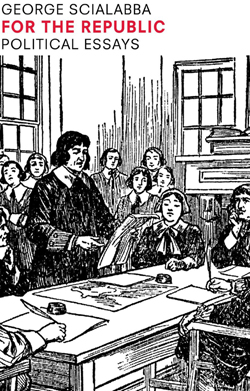
For-the-Republic-webLindsey Gilbert: I’ve heard it said that there aren’t a whole lot of independent scholars and thinkers left—either they’ve been swallowed by the academy or given up and started blogging about their cats. Except you, you’ve been called an independent scholar, haven’t you? What does that mean?

George Scialabba: I have been miscalled, I think. I certainly don’t consider myself a scholar. In fact, I mostly read magazines. But an independent thinker—well, if it’s true, it’s because I have a day job [at Harvard]. The day job is a mixed blessing, of course. It’s dull, but it’s undemanding. It swallows half my time, but it doesn’t swallow my imagination, my reserves. I do feel lucky that I fell into a job like that; just as I owe some of my independence to rent control in Cambridge, I owe some of it to the fact that Harvard has a good union, at least for my kind of employees, clerical and technical workers. But I really worry about whether my good fortune is replicable for someone starting out with the same aspirations.

LG: Why is that?

GS: It’s all laid out very well and presciently by Russell Jacoby in The Last Intellectuals. It’s about why the kind of intellectual that flourished in the thirties, forties, and fifties is a dying breed. That sounds a little bit nostalgic, but it’s just that the situation is less and less tenable. There’s no cheap urban real estate, it’s hard to survive without a regular salary, and academia has become professionalized in a way that it wasn’t in the thirties and forties.

More here.

Scientists Confirm Existence of Moon

Sean Carroll in Preposterous Universe:

Moon-icecube

There it is! I can definitely make out the Moon.

Bit of old news here — well, the existence of the Moon is extremely old news, but even this new result is slightly non-new. But it was new to me.

Ice Cube is a wondrously inventive way of looking at the universe. Sitting at the South Pole, the facility itself consists of strings of basketball-sized detectors reaching over two kilometers deep into the Antarctic ice. Its purpose is to detect neutrinos, which it does when a neutrino interacts with the ice to create a charged lepton (electron, muon, or tau), which in turn splashes Cherenkov radiation into the detectors. The eventual hope is to pinpoint very high-energy neutrinos coming from specific astrophysical sources.

For this purpose, it’s the muon-creating neutrinos that are your best bet; electrons scatter multiple times in the ice, while taus decay too quickly, while muons give you a nice straight line. Sadly there is a heavy background of muons that have nothing to do with neutrinos, just from cosmic rays hitting the atmosphere. Happily most of these can be dealt with by using the Earth as a shield — the best candidate neutrino events are those that hit Ice Cube by coming up through the Earth, not down from the sky.

More here.

How Is Hamid Karzai Still Standing?

William Dalrymple in the New York Times Magazine:

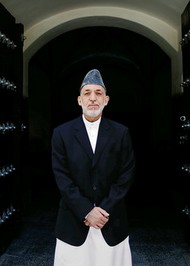
ScreenHunter_408 Nov. 21 19.07The Karzai family graveyard lies a few miles outside Kandahar, on the edge of the village of Karz. On the day I drove there, burned-out cars stood rusting by the sides of the road, children splashed through open drains and bullet holes riddled the mud walls opposite checkpoints. Amid all this, the graveyard stood out — gleaming, immaculate. Straggling bougainvillea and mulberry trees blossomed over the calligraphic tiles topping the cream-colored walls. Through the double gates were lines of cypresses. In the middle stood a domed enclosure containing the graves of the clan elders.

Hamid Karzai was entering the final lap of his presidency, and I had traveled to Karz with Mahmood, one of the president’s elder brothers, accompanied by a phalanx of his bodyguards. Afghanistan’s presidential election is set for April, and as the deadline for registering candidates approached, the country’s future seemed to hang in part on the fraught internal family politics of the Karzais. Hamid is ineligible to run for a third term, and it had been long rumored in Kabul that he would anoint his brother Qayum as his successor. Mahmood had made it clear that he wanted the presidency to stay in the family; he had even begun to raise campaign funds for Qayum, just as he once had for Hamid.

More here.

new translations of italo calvino

Calvino-1_386147kCarmine Di Biase at the Times Literary Supplement:

The interviews and letters, however, along with the essays in Collection of Sand, shed light on this final image and reveal a continuity of imagery that binds much of Calvino’s work together. The “shells washed clean by the waves” speak of the serenity, momentary though it may be, that comes when a bit of the world’s chaos is contained in a fixed form, like the dead ants in a sack, like the sand transformed, through the slow work of a mollusc, into a shell. Two years before this story was published, Calvino had written to Natalia Ginzburg from San Remo, where he had grown up. It was “overflowing with people on holiday”, so he stayed “locked up at home” or went “out on walks in the country”. A better refuge, however, lay in “an old collection of shells” he had found in the house. He had begun to draw them “in order not to lose contact with things”. He found the nautilus shells particularly difficult to draw. “I’m not good at it”, he said. He was also struggling to translate his “favorite four lines” from Baudelaire’s “Le mort joyeux”. McLaughlin renders them thus: “In fertile earth full of snails / I want to dig myself a deep grave, / Where I can stretch out my old bones in peace / And sleep in oblivion like a shark in the waves”. Here, perhaps, in this early letter to Ginzburg, is the origin of an image that would follow Calvino and inform his work for the rest of his life.

more here.

on KRASZNAHORKAI’S “SEIOBO THERE BELOW”

Seiobo_there_belowJonathon Kyle Sturgeon at The American Reader:

No contemporary writer has tarried in literary Hell more faithfully—or more convincingly—than the Hungarian novelist László Krasznahorkai. In the almost thirty years since his first novel, the infernally-titled Satantango, Mr. Krasznahorkai’s vision of society as an inescapable Hell of its own design has never lapsed. It is an ever-expanding world of deceit and human folly, one spun by interminable sentences that spread quaquaversally, like wild flames, scorching hope wherever it writhes.

True to Beckett and Sartre before him, Mr. Krasznahorkai’s Hell always manifests itself as a scene or closed circle. Though these closed circles are of human design, they are populated by demons who are paradoxically all too human. These demons, themselves deeply acquainted with Hell—the closed circle that never opens—choreograph set pieces of swindle and deceit that lead innocents and the willfully gullible to inexorable doom. In this respect, Mr. Krasznahorkai’s work sharply recalls Pushkin’s “Demons,” a poem later used as an epigraph by Dostoevsky in his novel of the same name:

Strike me dead, the track has vanished,
Well, what now? We’ve lost the way,
Demons have bewitched our horses,
Led us in the wilds astray.

more here.

thinking about the terror

9780199576302_p0_v2_s260x420Hugh Gough at the Dublin Review of Books:

Over the last twenty years the debate over the terror’s origins and nature has become more nuanced. It has long been accepted that there was no set plan of revolution or terror in 1789, in contrast to Russia in 1917, where Lenin had a blueprint for revolutionary dictatorship hatched from a long tradition of revolutionary activity in the nineteenth century. Instead recent research has suggested just how improvised the system of terror – if indeed there was a system ‑ was. The terror of 1793-4 evolved more as a series of reactions to events and crises than as the product of a set ideology. And it appears more coherent in retrospect than it did at the time. Much of its chilling rhetoric (of which Marisa Linton cites many examples in the book), and many of its more draconian decrees, were designed to buy off the threat of popular violence and respond to the sense of fear pervading a deeply divided political culture. For terror was as much a feeling of personal and national insecurity – which prompted a belief in the need for violent action ‑ as it was a punitive form of government. After the fall of the Bastille, for example, several administrators were brutally decapitated and their heads paraded around the streets impaled on pikes. Over the following weeks fears of counter-revolutionary retaliation spread rapidly around Paris, including rumours that decapitated patriot heads had been found in suitcases and scattered round the grounds of the Palais Royal, severed by a bloodthirsty former slave of the Barbary pirates who was now in royalist pay. In reality there were no heads or slaves, but the ongoing mood of latent panic erupted into periodic popular violence, as in September 1792, when over a thousand prisoners were brutally massacred on the streets of Paris because of largely unfounded fears that they were enemy agents. That violence in turn forced politicians to organise a legal terror to avoid total anarchy and to adopt an aggressive rhetoric which threatened more than it ever intended to deliver.

more here.

Who’s afraid of Marcel Proust?

Patrick McGuiness in The Telegraph:

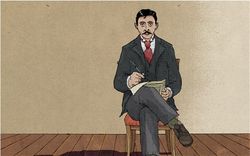
Marcelproust_2737624bIn autumn 1912, a writer best known for pastiches and society columns took a manuscript to the Nouvelle Revue Française, recently founded by Gaston Gallimard. It was passed to a reader who opened it randomly at page 62 and found what he decided was a boring and overwritten description of a cup of herbal tea. The manuscript was politely declined.

The novelist was Marcel Proust, the novel was Swann’s Way, the first volume of A la recherche du temps perdu, and the reader was André Gide. Proust took the book to Grasset, a few streets away in the septième arrondissement, who published it at the author’s expense 100 years ago this week. The following year Proust received one of the best-known apologies in literary history: “Turning down your book,” wrote Gide, “remains one of the greatest regrets of my life.” After some knotty negotiations with Bernard Grasset, Gallimard managed to win Proust back, buying up the last 200 unsold copies of Swann’s Way. Proust won the Prix Goncourt in 1919, and from then the novel became what we now think it to be: a book so famous that we don’t need to have read it to talk about it. Do we expect our classics to be misunderstood? Is that how we measure their path-breaking greatness? Ten years after Swann’s Way, Gallimard received a long Irish novel which one of their most distinguished writers dismissed as “obscene” and “blighted by a diabolical lack of talent”. The Irish novelist was James Joyce, and disgusted of the septième was Paul Claudel. Even geniuses can misunderstand one another: when Proust met Joyce, his most radical successor, the two men barely spoke except to compare ailments. If we really want to understand how art works, how books and paintings and symphonies and buildings get made, survive and become part of our lives, we need to understand the role misunderstanding plays in culture.

More here.

Quantum world record smashed

From KurzweilAI:

AtomA normally fragile quantum state has been shown to survive at room temperature for a world record 39 minutes, overcoming a key barrier towards building ultrafast quantum computers, the researchers say. An international team including Stephanie Simmons of Oxford University‘s Department of Materials report in this week’s Science a test performed by Mike Thewalt of Simon Fraser University, Canada and colleagues.

In the experiment, the team raised the temperature of a system — in which information is encoded in the nuclei of phosphorus atoms in silicon — from -269 °C to 25 °C and demonstrated that the superposition states survived at this balmy temperature for 39 minutes — outside of silicon, the previous record for such a state’s survival at room temperature was around two seconds. The team even found that they could manipulate the qubits as the temperature of the system rose, and that they were robust enough for this information to survive being “refrozen” (the optical technique used to read the qubits, which only works at very low temperatures). According to Simmons, an author of the paper, “39 minutes may not seem very long but as it only takes one-hundred-thousandth of a second to flip the nuclear spin of a phosphorus ion — the type of operation used to run quantum calculations — in theory over 20 million operations could be applied in the time it takes for the superposition to naturally decay by one percent. Having such robust, as well as long-lived, qubits could prove very helpful for anyone trying to build a quantum computer.” “This opens up the possibility of truly long-term coherent information storage at room temperature,” said Thewalt.

More here.

Wednesday, November 20, 2013

The real program to sabotage Iran’s nuclear facilities was far more sophisticated than anyone realized

Ralph Langner in Foreign Policy:

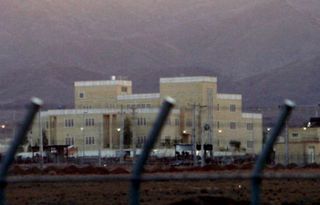
Natanz_1Three years after it was discovered, Stuxnet, the first publicly disclosed cyberweapon, continues to baffle military strategists, computer security experts, political decision-makers, and the general public. A comfortable narrative has formed around the weapon: how it attacked the Iranian nuclear facility at Natanz, how it was designed to be undiscoverable, how it escaped from Natanz against its creators' wishes. Major elements of that story are either incorrect or incomplete.

That's because Stuxnet is not really one weapon, but two. The vast majority of the attention has been paid to Stuxnet's smaller and simpler attack routine — the one that changes the speeds of the rotors in a centrifuge, which is used to enrich uranium. But the second and “forgotten” routine is about an order of magnitude more complex and stealthy. It qualifies as a nightmare for those who understand industrial control system security. And strangely, this more sophisticated attack came first. The simpler, more familiar routine followed only years later — and was discovered in comparatively short order.

With Iran's nuclear program back at the center of world debate, it's helpful to understand with more clarity the attempts to digitally sabotage that program. Stuxnet's actual impact on the Iranian nuclear program is unclear, if only for the fact that no information is available on how many controllers were actually infected. Nevertheless, forensic analysis can tell us what the attackers intended to achieve, and how.

More here.

Nixon and Kissinger: LOOKING AWAY FROM GENOCIDE

Gary Bass in The New Yorker:

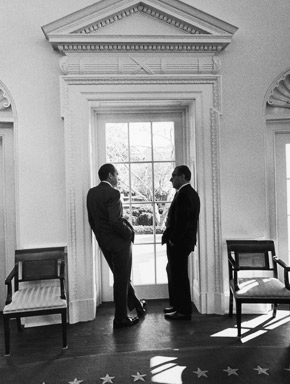
Nixon-tapes-postOn March 25, 1971, the Pakistani Army launched a devastating military crackdown on restive Bengalis in what was then East Pakistan. While the slaughter in what would soon become an independent Bangladesh was underway, the C.I.A. and State Department conservatively estimated that roughly two hundred thousand people had died (the official Bangladeshi death toll is three million). Some ten million Bengali refugees fled to India, where untold numbers died in miserable conditions in refugee camps. Pakistan was a Cold War ally of the United States, and Richard Nixon and his national-security advisor, Henry Kissinger, resolutely supported its military dictatorship; they refused to impose pressure on Pakistan’s generals to forestall further atrocities.

My new book, “The Blood Telegram: Nixon, Kissinger, and a Forgotten Genocide,” tries to reconstruct this dark chapter of the Cold War, using declassified documents, investigative reporting, and countless hours of White House tapes, including about a hundred newly transcribed conversations. Thanks to the secret taping system that he installed to record his own blunt conversations, Nixon inadvertently left behind the most transparent Administration in American history. The tapes offer the most revealing account of Nixon and Kissinger’s raw thinking. Staffers at the White House and the State Department were often more pragmatic than their principals, so the documents they produced make the Administration appear more moderate than it was. It’s only on the audio tapes that Nixon and Kissinger’s full radicalism is on display.

More here. [Thanks to Tunku Varadarajan.]

Leonardo Da Vinci’s wacky piano is heard for the first time, after 500 years

From The Age:

NG_Vinciwide4-20131118132723799848-620x349A bizarre instrument combining a piano and cello has finally been played to an audience more than 500 years after it was dreamt up Leonardo da Vinci.

Da Vinci, the Italian Renaissance genius who painted the Mona Lisa, invented the ‘‘viola organista’’ – which looks like a baby grand piano – but never built it, experts say.

The viola organista has now come to life, thanks to a Polish concert pianist with a flair for instrument-making and the patience and passion to interpret da Vinci’s plans.

Full of steel strings and spinning wheels, Slawomir Zubrzycki’s creation is a musical and mechanical work of art.

More here. And check out this video: