How Doctor Who Survived 50 Years

Ddcfc841e

Nicholas Slayton in The Atlantic:

[P]art of that appeal, not just for viewers but also writers, is its limitlessness. Doctor Who can be anything. If you strip it down to its core concept, it's the platform for every genre and plot imaginable.

“It's a perfect story engine in many ways. The lead can change, you can go anywhere in space and time, the box itself is kind of weird, so we can have an excuse as to why it suddenly disappears at any moment,” said Rudy Jahchan, who along with Liz Shannon Miller hosts the time-travel and Doctor Who-themed podcast Timey Wimey TV. “They can always make it be whatever it needs to be for the years it's in.”

Early on, the show stepped away from its educational nature and started playing with more fantastic ideas, and also genres. There were seasons that played homage to the '60s spy craze, Hammer Horror, and the existential science-fiction stories that filled the '70s. And now the show has fully embraced its genre-busting nature. Recent seasons have mixed pirate adventures, government conspiracy thrillers, and ghost stories, sometimes back to back.

“The appeal of Doctor Who is that you can do anything, any when, you can have him meet anyone,” Handcock said. “That's irresistible as a writer. You're given a completely blank slate, but you're given one of the best characters ever devised in fiction to have an adventure there. You present someone with those two factors, and they're going to leap at it.”

And Doctor Who is uplifting. As dark as the show can get, and as high as the body count can rise (which is very high), there's always a sense of joy and discovery there.

More here.
Aldous Huxley: the prophet of our brave new digital dystopia

John Naughton in The Guardian:

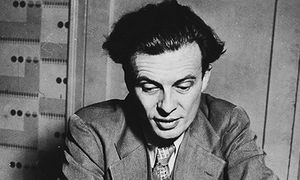
Aldous-Huxley-008Huxley was a child of England's intellectual aristocracy. His grandfather was Thomas Henry Huxley, the Victorian biologist who was the most effective evangelist for Darwin's theory of evolution. (He was colloquially known as “Darwin's Bulldog”.) His mother was Matthew Arnold's niece. His brother, Julian and half-brother Andrew both became distinguished biologists. In the circumstances it's not surprising that Aldous turned out to be a writer who ranged far beyond the usual preoccupations of literary folk – into history, philosophy, science, politics, mysticism and psychic exploration. His biographer wrote: “He offered as his personal motto the legend hung around the neck of a ragged scarecrow of a man in a painting by Goya: Aún aprendo. I am still learning.” He was, in that sense, a modern Voltaire.

Brave New World was published in 1932. The title comes from Miranda's speech in Shakespeare's The Tempest: “Oh, wonder! / How many goodly creatures are there here! / How beauteous mankind is! Oh brave new world, / That has such people in't.” It is set in the London of the distant future – AD 2540 – and describes a fictional society inspired by two things: Huxley's imaginative extrapolation of scientific and social trends; and his first visit to the US, in which he was struck by how a population could apparently be rendered docile by advertising and retail therapy. As an intellectual who was fascinated by science, he guessed (correctly, as it turned out) that scientific advances would eventually give humans powers that had hitherto been regarded as the exclusive preserve of the gods. And his encounters with industrialists like Alfred Mond led him to think that societies would eventually be run on lines inspired by the managerial rationalism of mass production (“Fordism”) – which is why the year 2540 AD in the novel is “the Year of Our Ford 632”.

More here.

Meaningful Misery: negative emotions are essential for mental health

Toni Rodriguez in Scientific American:

Taking-the-bad-with-the-good_1A client sits before me, seeking help untangling his relationship problems. As a psychotherapist, I strive to be warm, nonjudgmental and encouraging. I am a bit unsettled, then, when in the midst of describing his painful experiences, he says, “I'm sorry for being so negative.” A crucial goal of therapy is to learn to acknowledge and express a full range of emotions, and here was a client apologizing for doing just that. In my psychotherapy practice, many of my clients struggle with highly distressing emotions, such as extreme anger, or with suicidal thoughts. In recent years I have noticed an increase in the number of people who also feel guilty or ashamed about what they perceive to be negativity. Such reactions undoubtedly stem from our culture's overriding bias toward positive thinking. Although positive emotions are worth cultivating, problems arise when people start believing they must be upbeat all the time. In fact, anger and sadness are an important part of life, and new research shows that experiencing and accepting such emotions are vital to our mental health. Attempting to suppress thoughts can backfire and even diminish our sense of contentment. “Acknowledging the complexity of life may be an especially fruitful path to psychological well-being,” says psychologist Jonathan M. Adler of the Franklin W. Olin College of Engineering.

Positive thoughts and emotions can, of course, benefit mental health. Hedonic theories define well-being as the presence of positive emotion, the relative absence of negative emotion and a sense of life satisfaction. Taken to an extreme, however, that definition is not congruent with the messiness of real life. In addition, people's outlook can become so rosy that they ignore dangers or become complacent [see “Can Positive Thinking Be Negative?” by Scott O. Lilienfeld and Hal Arkowitz; Scientific American Mind, May/June 2011]. Eudaemonic approaches, on the other hand, emphasize a sense of meaning, personal growth and understanding of the self—goals that require confronting life's adversities. Unpleasant feelings are just as crucial as the enjoyable ones in helping you make sense of life's ups and downs. “Remember, one of the primary reasons we have emotions in the first place is to help us evaluate our experiences,” Adler says.

More here.

Saturday, November 23, 2013

Sudden Progress on Prime Number Problem Has Mathematicians Buzzing

Erica Klarreich in Wired:

ScreenHunter_413 Nov. 23 16.25On May 13, an obscure mathematician — one whose talents had gone so unrecognized that he had worked at a Subway restaurant to make ends meet — garnered worldwide attention and accolades from the mathematics community for settling a long-standing open question about prime numbers, those numbers divisible by only one and themselves. Yitang Zhang, a lecturer at the University of New Hampshire, showed that even though primes get increasingly rare as you go further out along the number line, you will never stop finding pairs of primes separated by at most 70 million. His finding was the first time anyone had managed to put a finite bound on the gaps between prime numbers, representing a major leap toward proving the centuries-old twin primes conjecture, which posits that there are infinitely many pairs of primes separated by only two (such as 11 and 13).

In the months that followed, Zhang found himself caught up in a whirlwind of activity and excitement: He has lectured on his work at many of the nation’s preeminent universities, has received offers of jobs from top institutions in China and Taiwan and a visiting position at the Institute for Advanced Study in Princeton, N.J., and has been told that he will be promoted to full professor at the University of New Hampshire.

Meanwhile, Zhang’s work raised a question: Why 70 million? There is nothing magical about that number — it served Zhang’s purposes and simplified his proof. Other mathematicians quickly realized that it should be possible to push this separation bound quite a bit lower, although not all the way down to two.

More here.

The U.S. Health Care System Is Terrible, In 1 Enraging Chart

Mark Gongloff in the Huffington Post:

Hello, did you know the American health-care system is terrible? It is. Don't let John Boehner tell you otherwise.

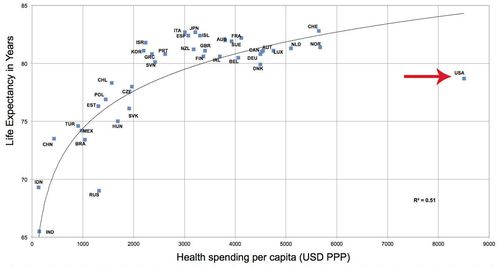
If you're unconvinced, here is a chart that demonstrates its terribleness. It shows, using OECD data, how much money different countries spend on health care per person, charted against life expectancy in each of those countries. As you can see, there is a pretty close relationship between health-care spending and life expectancy. Except for one very, very terrible country. Can you spot it?

Original

Click graph to enlarge.

Yes, among this group of big countries, the U.S. spends far and away more on health care than any other. And yet it has among the lowest life expectancies of any developed country. People live longer in pretty much every country in Europe, including Greece, where the economy has been wracked by austerity for years.

More here.

Twenty tips for interpreting scientific claims

William J. Sutherland, David Spiegelhalter& Mark Burgman in Nature:

ScreenHunter_412 Nov. 23 16.11We are fully aware that scientific judgement itself is value-laden, and that bias and context are integral to how data are collected and interpreted. What we offer is a simple list of ideas that could help decision-makers to parse how evidence can contribute to a decision, and potentially to avoid undue influence by those with vested interests. The harder part — the social acceptability of different policies — remains in the hands of politicians and the broader political process.

Of course, others will have slightly different lists. Our point is that a wider understanding of these 20 concepts by society would be a marked step forward.

Differences and chance cause variation. The real world varies unpredictably. Science is mostly about discovering what causes the patterns we see. Why is it hotter this decade than last? Why are there more birds in some areas than others? There are many explanations for such trends, so the main challenge of research is teasing apart the importance of the process of interest (for example, the effect of climate change on bird populations) from the innumerable other sources of variation (from widespread changes, such as agricultural intensification and spread of invasive species, to local-scale processes, such as the chance events that determine births and deaths).

No measurement is exact. Practically all measurements have some error. If the measurement process were repeated, one might record a different result. In some cases, the measurement error might be large compared with real differences. Thus, if you are told that the economy grew by 0.13% last month, there is a moderate chance that it may actually have shrunk. Results should be presented with a precision that is appropriate for the associated error, to avoid implying an unjustified degree of accuracy.

More here.

Sigizmund Krzhizhanovsky’s ‘Autobiography of a Corpse’

1124-bks-Kalfus-articleInlineKen Kalfus at The New York Times:

The stories in this collection by the early Soviet writer Sigizmund Krzhizhanovsky are nearly as fantastic as the crashing combination of consonants at the beginning of his surname. In one, the reflection of a man in his girlfriend’s eye vanishes down the dark corridors of her pupil and falls into a deep well, where it joins the lonely, miserable reflections of her previous lovers. There the reflections debate their mistress’s charms and caprices, as well as their own deficiencies of character. And they plot their escape. The hero of another story, a writer, composes a tale about a hermit whose prayers temporarily close all the cracks in the world — potholes, mountain gorges, facial wrinkles, even “the cranial seams hidden under the skin on people’s heads.” After reading the yarn to some indifferent friends, the writer is visited by an enthusiastic scientist, a reincarnation of the German philosopher Gottfried Wilhelm Leibniz, who claims that reality itself, the entire space-time continuum, is no less cracked than our everyday world, riddled with gaps and intermittencies.

Krzhizhanovsky (1887-1950) was from the generation of Soviet writers who came to Moscow in the 1920s, a time of explosive literary ferment. Mikhail Bulgakov, Yuri Olesha, Andrei Platonov and others, while working on revolutionary newspapers and in avant-garde theaters, were often appalled by the headlong modernization, mechanization and collectivization of the society they saw around them. Their best work, much of it satirically fabulous, expressed their disquiet without putting themselves in opposition.

more here.

Emily Dickinson’s ‘envelope poems’

La-la-ca-1115-emily-dickinson-34-jpg-20131121Brenda Shaughnessy at the LA Times:

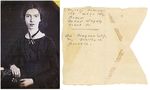
In 2012, a daguerreotype surfaced that was thought to be of a midlife Emily Dickinson, causing an Internet frenzy. As far as we (the frenzied) knew, there was only one known photographic image of the poet. That 1847 picture, taken when she was 16, is enigmatic, extraordinary and a little unsatisfying. Her single expression is dual: both deep and blank, both innocent and knowing. Dickinson readers recognize this intoxicating, paradoxical doubleness well: It is so very Emily. What wouldn't we give for more of her? Just one more glimpse?

Perhaps we'd contented ourselves with that single image, but suddenly there was a chance that we could behold her mature face. We squinted and cocked our heads, trying hard to divine whether this woman in the “new” photo was truly Our Emily. I thought, reluctantly, that it wasn't. But now that the possibility had been presented, I was eager for another view, another angle of her.

The stunning art book “The Gorgeous Nothings” offers us this view — slant, as Emily liked things. In 52 color reproductions of the writings on envelopes, we still never see her face. But she shows us her hand.

more here.

Norman Mailer: A Double Life

Fe8ad720-5332-11e3-b425-00144feabdc0Randy Boyagoda at the Financial Times:

Obviously, Norman Mailer should be reviewing the authorised biography of Norman Mailer. Were he not six years in the grave, he would certainly accept the assignment. And based on the evidence in J Michael Lennon’s impressive effort to recount Mailer’s multitudinous and combustible life story, here’s how that scenario would likely play out: asked for 1,500 words, Mailer submits 150,000. Upon learning that this newspaper is unwilling to devote its entire Saturday edition to his writing about himself, he is shocked and outraged and demands (successfully) that his agent secure a six-figure book deal so his work could be published in its rightful fullness. He uses most of that money to pay down his latest overdue tax bill; the rest goes in alimony instalments for his ex-wives.

He then flies from New York to London with a documentary film crew in tow. Cameras rolling, he pushes his way into the editorial offices, roaring for an explanation as to why his piece was rejected. The meeting leads to some combination of the following: a fist-fight, a drunken reconciliation, a drunken fist-fight, a one-night stand, a press conference. Then Mailer returns to the US to work on the documentary of his trip to London, and on the manu­script of his 150,000-word autobiographical impressions of his authorised biography. When these matters and a few dozen others are dealt with, he at last returns to the latest million-word novel he’s writing. This one concerns a barrel-chested, curly-haired Paleolithic warrior-fertility god’s endless battles against the legions of cowards and prudes arrayed against him.

more here.

Saturday Poem

Last night, as I was sleeping,
I dreamt—marvelous error!—
that a spring was breaking
out in my heart.
I said: Along which secret aqueduct,
Oh water, are you coming to me,
water of a new life
that I have never drunk?

Last night, as I was sleeping,
I dreamt—marvelous error!—
that I have a beehive
here inside my heart.
And the golden bees
were making white combs
and sweet honey
from my old failures.

Last night, as I was sleeping,
I dreamt—marvelous error!—
that a fiery sun was giving
light inside my heart.
It was fiery because I felt
warmth as from a hearth,
and sun because it gave light
and brought tears to my eyes.

Last night, as I was sleeping,
I dreamt—marvelous error!—
that it was God I had
here in my heart.
.

by Antonio Machado
from Times Alone, Selected Poems of Antonio Machado
Wesleyan University Press, 1983

The Price of the Ticket: My Literary Hero

M.J.Moore in The Paris Reviw:

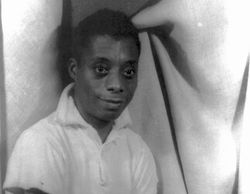
James-Baldwin-Portrait-Paris-ReviewBack in 1985, on the morning of November 23 (a cold, wet, gray autumn Saturday), I woke up happy. At that time in my life, nothing could have been more unusual. But I knew that before that day’s sun had set, I was going to meet James Baldwin, whose body of work (the novels and short stories, his plays and all those exquisite essays) had inspired my own burning desire to write.

…For three years Baldwin’s books had meant the world to me. Back in the summer of ’82, when I transferred from a small college in Chicago to the flagship University of Illinois at Urbana-Champaign, I brought my interest in the 1960s downstate. And shortly before leaving to enroll in two summertime classes, a PBS documentary called I Heard It Through the Grapevine was aired; James Baldwin was all over it. Throughout the program, Mr. B. pored over photographs of America and varied Americans in the late 1950s and early 1960s—from the mayhem at Little Rock in 1957 to the burning buses that carried Freedom Riders in 1961 and myriad other images; as one iconic photo after another was re-examined, Baldwin commented on camera, or quotations from his past essays were articulated in voice-overs. The sound of James Baldwin’s voice captured me with its splendid variety of tonal colors, its musically percussive rhetorical rhythms, and its soaring narrative power. His voice was the instrument that created what I’d later learn to see on the page as his unique brand of “spoken prose.” And at length, Baldwin reflected on the bloodshed, the torment, and the suffering that characterized the 1960s for him; I tried to do him justice now.

More here.

The State of Israel

Leon Wieseltier in The New York Times:

Cover-articleLargeToo much of the discourse on Israel is a doubting discourse. I do not mean that it is too critical: Sometimes it is, sometimes it isn’t. I mean that the state is too often judged for its viability or its validity, as if some fundamental acceptance of its reality is pending upon the resolution of its many problems with itself and with others. About the severity of those problems there is no question, and some of them broach primary issues of politics and morality; but Israel’s problems are too often combined and promoted into a Problem, which has the effect of emptying the Jewish state of its actuality and consigning it to a historical provisionality, a permanent condition of controversy, from which it can be released only by furnishing various justifications and explanations.

In its early years Israel liked to think of itself as an experiment in the realization of various ideals and hopes, but really all societies, including Arab ones, are, in the matter of justice, experiments; and existence itself must never be regarded as an experiment, as if anybody has the authority to declare that the experiment has failed, and to try and do something about it. Israel is not a proposition, it is a country. Its facticity is one of the great accomplishments of the Jews’ history and one of the great accomplishments of liberalism’s and socialism’s and nationalism’s histories, and it is not complacent or apologetic to say so. The problems are not going away. I cannot say the same about the sense of greatness.

More here.

Friday, November 22, 2013

What makes for a beautiful visage, and why, may have been discovered accidentally on a Russian fur farm

From The Economist:

20131116_STP002_5Until now, experiments to try to determine the biological basis of beauty have been of the please-look-at-these-photographs-and-answer-some-questions variety. Some useful and not necessarily obvious results have emerged, such as that one determinant of beauty is facial symmetry.

But what would really help is a breeding experiment which allowed the shapes of faces to be followed across the generations to see how those shapes relate to variations in things that might be desirable in a mate. These might include fertility, fecundity, social status, present health, and likely resistance to future infection and infestation. Correlations between many of these phenomena and attributes of the body-beautiful have, indeed, been established. But in a pair-forming, highly social species such as Homo sapiens, you also have to live with your co-child-raiser or, at least, collaborate with him or her. So other things may be important in a mate, too, such as an even temper and a friendly outlook.

It would be impossible to do such a breeding experiment on people, of course. But as Irene Elia, a biological anthropologist at Cambridge, realised, it has in fact been done, for the past five decades, on a different species of animal. Dr Elia has published her analysis of this experiment in the Quarterly Review of Biology. The animals in question are foxes.

More here.

Social Democracy’s Incomplete Legacy

Ackerman_2

Chris Maisano in Jacobin:

While it may be premature to sound the death knell for social democracy, it is clear that the current crisis has accelerated the long-term decline of social-democratic politics in Europe. Social-democratic parties may still be able to win elections and form governments, but they’ve shown little inclination to break decisively from neoliberal policy prescriptions when in power. From Greece to Spain to Ireland to France to Germany, the principles of solidarity and social welfare that have underpinned the kinder, gentler form of capitalism embodied in the phrase “social Europe” are under attack. They may not hold up under the combined pressures of the European Union, the International Monetary Fund, and European Central Bank as they pursue neoliberal structural adjustment. Citizens across the continent have protested against the dismantling of their social protections, sometimes ferociously, but to date they have not been able to turn the tide. At the moment, at least, an “asocial Europe” appears to be the continent’s future.

In the recently published book What’s Left of the Left, a group of prominent political scientists, sociologists, and policy experts attempt to make sense of social democracy’s long transition from left to center-left, from opposition to capitalism to its humane and rational administration. This is not a neutral or objective piece of scholarship. All of the volume’s contributors can be counted among the partisans of social democracy and accept the putative wisdom of the center-left’s rejection of socialist visions in favor of capitalism with a human face. Edited by James Cronin, George Ross, and James Schoch, and including contributions from such luminaries of the academic center-left as Sheri Berman, Gerassimos Moschonas, and Jonas Pontusson, it attempts to provide an intellectual framework to advance the project of “progressive politics in tough times.” The book is far too long and detailed to permit comprehensive treatment here, so I will focus primarily on those contributions that are most relevant to our purposes. While valuable for anyone seeking to attain an introduction to the contemporary European center-left, it reflects the profound limitations of the political tradition it seeks to defend.

More here.

Two Recumbant Male Figures Wrestling on a Sidewalk

Images

An old piece by John Berger on Eqbal Ahmad, over at The Transnational Institute:

He has fought alongside guerrillas in the mountains many times in at least two continents. He's also an excellent cook. He will happily spend an entire day preparing an evening meal for friends. His name is Eqbal Ahmad. Once when he and I were cutting up vegetables for a curry, he told me a story.

It began in 1947. Eqbal was thirteen years old. His voice had begun to break. Sometimes he spoke as gruffly as a man, at other times he spoke in a boy's falsetto. He couldn't control it. But he already had a man's decisiveness, he was already at risk like a man. I imagine the knowledge of that risk was in his eyes but I didn't know him then.

With independence, India was being partitioned. Twelve million people were on the roads, going in both directions, seeking safety. Eqbal's family had lived as Muslims for generations in India but now his elder brother decided to take the family to the newly created Pakistan.

The boy's mother refused to leave. Only mothers who are widows can become as immovable as she did. The rest of the family took the train for Lahore. In Delhi they learnt that the train would go no further: the fighting of the civil war was too dangerous. Everybody was lodged in a refugee camp. Eqbal's brother, who was a senior civil servant, telegraphed for a plane to come and rescue them. A whining man, begging for opium in the camp, caught Eqbal's attention. Misery importuning misery, he thought. Some youngsters pushed the man aside. Ay! Charsi! they mocked. Ay! Charsi! Opium-eater who lives in a cloud of smoke!

Finally the plane from Pakistan arrived. It was an ex-RAF Fokker. At the airport the two brothers were the last to embark. Every place was already taken.

You can fly in the cockpit with me, sir, the pilot shouted to his brother.

No, we're two, there's also Eqbal.

Then would you like me to tell somebody to get down, sir?

No, take Eqbal.

It was then that the thirteen year old revolted. He ran across the tarmac away from the plane.

Go, he shouted, go! I'm going to walk.

His brother, perhaps because he wanted to accompany his wife and small children, perhaps because he knew how obstinate and bone-headed Eqbal could be, climbed up into the plane and, standing by the still open door, said: All right, but take these! Whereupon he handed down a .22 single-barrel hunting gun, an ammunition belt and a 100-rupee note. Stay here and wait for the next plane, he added. Finally the Fokker took off.

More here.