Vote now for one of the nominees for the 3QD Arts & Literature Prize 2014

Alphabetical list of nominated blog names followed by the blog post title:

(Please report any problems with links in the comments section below.)

For prize details, click here.

  1. 3:AM Magazine: Honest work: an experimental review of an experimental translation
  2. 3 Quarks Daily: Ahsan Akbar talks to K. Anis Ahmed
  3. 3 Quarks Daily: Digging Up Bones or, The Labyrinths beneath Our Feet
  4. 3 Quarks Daily: European Crime Fiction – Mini Reviews
  5. 3 Quarks Daily: Every Genuine Encounter Destroys Our Existing World: On Things
  6. 3 Quarks Daily: Ghazal, Sufism, and the Birth of a Language
  7. 3 Quarks Daily: Haiku and Landays in Science
  8. 3 Quarks Daily: Industrial Township-ness or How I learnt to be Bourgeois
  9. 3 Quarks Daily: Jake and Dinos Chapman: Come and See
  10. 3 Quarks Daily: Landings
  11. 3 Quarks Daily: Mental Illness, the Identity Thief
  12. 3 Quarks Daily: My Pakistan Television Show
  13. 3 Quarks Daily: On Reading Emerson as a Fourteen-Year-Old Girl
  14. 3 Quarks Daily: San Francisco and the Storm of Progress
  15. 3 Quarks Daily: The Short Bus
  16. 3 Quarks Daily: The Terrain of Indignities
  17. 3 Quarks Daily: Three Seconds: Poems, Cubes and the Brain
  18. Book Haven: An interview with Philip Roth
  19. Campus Diaries: An Encounter with Lady Luck
  20. Gilded Birds: Kwame Anthony Appiah
  21. Gilded Birds: Michael Rosen
  22. Guernica: Poetry as Life, Life as Poetry
  23. Industrial Revelation: The Boiling Frog
  24. Kuppuswami: Looking and Seeing
  25. Los Angeles Review of Books: How Auden Was Modified in the Guts of the Living
  26. Los Angeles Review of Books: On Mario Bellatin’s “Mishima’s Illustrated Biography”
  27. Medium: The Death of the Urdu Script
  28. Meta-Metaphoricity: Is Poetry Universal? -a gristly verse of Mir
  29. n + 1: Everywhere and Nowhere
  30. n + 1: Fear and Agression in Florida
  31. n + 1: Kunicki, Water (I)
  32. New Savanna: What's Photography About Anyhow?
  33. Nobody Expects The Spanish Inquisition: I am Philip Seymour Hoffman . . . Minus the Heroin
  34. Northeast Review: Mofussil Junction
  35. Open Letters Monthly: It Might Have Been
  36. Orienteringsforsok: Dreaded analogy…not so fast
  37. Paris Review: Drinking in the Golden Age
  38. St. Orberose: José Saramago: The Year of the Death of Ricardo Reis
  39. Strange Violin Music: Some Things a Former Soldier of the Third Reich Told Me
  40. The Bombay Column: A Republic of Regret
  41. The GetHigh Files: A Room With a View
  42. The Mercenary Researcher: A Friend and a Feast
  43. The Millions: The Fictional Lives of High School Teachers
  44. The Nation: Breaking the Cycle of Anger
  45. The Smart Set: Under the Influence
  46. View from Elephant Hills: Trophies 101: a year of books and bookstores
  47. Vissi d'Arte: Elegy for Jon
  48. World Literature Today: World Literature Isn’t Foreign Food
  49. Writing Without Paper: Metastatic ~ A Cento (Poem)
  50. Writing Without Paper: Monday Muse Reads “Concertina”

If you are new to 3 Quarks Daily, we welcome you and invite you to look around the site after you vote. Learn more about who we are and what we do here, and do check out the full site here. Bookmark us and come back regularly, or sign up for the RSS feed. If you have a blog or website, and like what you see here, we would very much appreciate being added to your blogroll. Please don't forget!

Voting ends on June 9th at 11:59 pm NYC time.

Results of the voting round (the top twenty most-voted-for posts) will be posted on the main page on June 10th. The finalists will be announced on June 16 and winners of the contest will be announced on June 23rd, 2014.

PLEASE BE AWARE: We have multiple ways of detecting fraud such as multiple votes being cast by the same person. We will disqualify anyone attempting to cheat.

Now click here to vote.

Thank you.
Monday, June 2, 2014

Sunday, June 1, 2014

A Dangerous Method: Syria, Sy Hersh, and the Art of Mass-crime Revisionism

Muhammad Idrees Ahmad in the Los Angeles Review of Books:

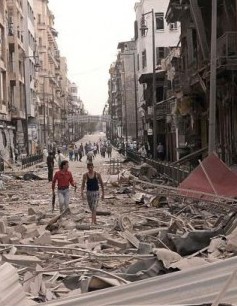
SyriaOn the day the London Review of Books published a widely circulated article by veteran journalist Seymour Hersh exonerating the Syrian regime for last year’s chemical attack, 118 Syrians, including 19 children, died in aerial bombing and artillery fire. Only the regime has planes and heavy ordnance.

Since last November, Aleppo has been targeted by helicopters dropping explosives-filled barrels from high altitudes. Between last November and the end of March, Human Rights Watch recorded 2,321 civilian deaths by this indiscriminate weapon. Only the regime has helicopters.

For many months after the chemical massacre, the targeted neighborhoods and the Yarmouk refugee camp were kept under a starvation siege. Aid agencies were denied entry. Only the regime controls access.

The regime’s ruthlessness has never been in doubt. Reports by Human Rights Watch, Amnesty International, the UN’s Independent International Commission of Inquiry, and myriad journalists and on-the-ground witnesses have repeatedly confirmed it. The regime has demonstrated the intent and capability to inflict mass violence. The repression is ongoing.

So when an attack occurred last August, employing a weapon that the regime was known to possess, using a delivery mechanism peculiar to its arsenal, in a place the regime was known to target, and against people the regime was known to loathe, it was not unreasonable to assume regime responsibility. This conclusion was corroborated by first responders, UN investigators, human rights organizations, and independent analysts.

When a Pulitzer Prize–winning journalist and a respectable literary publication undertake to challenge this consensus, one reasonably expects due diligence.

More here.

Does Big Data Threaten Political Inequality?

Voting

Andrew Mayersohn in Boston Review:

Few Americans claim to follow “very closely” stories that are not above-the-fold headlines, even ones with a strong partisan valence and widespread coverage such as the Keystone XL pipeline (16 percent of Americans as of March, per Gallup) or last year’s IRS scandal (20 percent as of May 2013). That small population of news junkies likely overlaps the minority of Americans who are devotees of Fox News or MSNBC, further diminishing the number of citizens engaging in actual political dialogue. For better or worse, our politics are already fragmented.

The extent of the gap between the politically engaged and disengaged is what makes Anthony Fowler’s findings troubling. He and his coauthors report that get-out-the-vote operations “increase representational inequality” by bringing “more rich, white, educated, churchgoing citizens to the polls.”­ Knowing that their efforts are more likely to affect some than others, campaigns assign “propensity scores” to prospective voters in order to zero in on those who just need a nudge to vote.

This is where big data is most valuable. The Obama campaign’s major analytical accomplishment was to improve propensity scores by combining traditional voter rolls with consumer data and huge numbers of voter contacts, but even before Obama’s 2012 campaign, political operatives were getting much better at honing in on the best prospects among potential voters. For example, political scientist David Nickerson, who served as Director of Experiments for the Obama re-election campaign, has demonstrated that voter contact in Ohio was vastly more concentrated among high-propensity voters in 2008 and 2012 than in 2004—a triumph of intelligence-gathering from a campaign’s perspective, but one that reinforces political inequality. The better campaigns get at concentrating resources on prospective voters, the more they can focus on turning out their base and the less they need to worry about broad mobilization. Senate Democrats have apparently already adopted this strategy to some extent, according to Sasha Issenberg, who says that candidates’ strategy for this November is to “mobilize their way into contention, then persuade their way across the finish line.” In short, even if big data doesn’t inaugurate an era of personalized campaign messaging, it’s already fragmenting our democracy in another way by widening the gap between the engaged and the disengaged.

More here.

Britain Lurches

Nigel-farage-42-58776405_jpg_600x467_q85

Mary Beard in NY Review of Books (Facundo Arrizabalaga/epa/Corbis):

The UK Independence Party, it seems, has drawn its support from across the political spectrum. It attracts—in addition to the xenophobic—the socially conservative (against same-sex marriage and in favor of “traditional British values”), and those who are deeply suspicious of the European Union (“Why be run by Brussels?”). Certainly it includes among its supporters and party candidates some people of extreme right-wing inclinations. But most of all, UKIP appeals to those who feel distanced from modern politics and politicians. They hate the sense of a political class, which consists of those who have never worked in anything other than professional politics, who speak only in carefully controlled, on-message sound bites, and never really engage with “us voters.”

This explains the extraordinary popularity of the party leader, Nigel Farage—a privately-educated, ex-city financial trader who left the Tory party in 1992 to set up UKIP, and who since 1999 has been a Member of the European Parliament, an institution which he is committed to undermining. Farage appears to speak his mind without concern for political correctness (and it is, of course, largely appearance). He relishes nothing more than being photographed outside a pub, with a pint of beer in one hand and a cigarette in the other. There’s hardly another British politician who would be seen dead in public within ten yards of a packet of Marlboro Lights, whatever their secret smoking habits. This looks like a breath of fresh air.

And Farage is not averse to offering his German wife as a defense against the suggestion that there is any personal hatred of “foreigners” in the UKIP campaign – whether on his own part or that of his followers. The party’s official message (and it is, I have no doubt, sincerely believed by some members) is that they are personally a pretty tolerant bunch; they simply want to end the dominance of the EU over British politics, and they want to stop the inflow of EU migrants, particularly from Eastern Europe, who are taking British jobs.

This is troubling enough. But the real danger of UKIP’s success is not its own policies, but the reaction it draws from politicians and supporters of the other parties.

More here.

Animal Magnetism

RTR39BYZ

David P Barash in Aeon (Photo by Lisi Niesner/Reuters):

I like zoos. Really I do. I applaud today’s zoological parks for their increasing emphasis on naturalistic exhibits, their breeding programmes for endangered species, and their efforts to educate the public about wildlife conservation. But the truth is, I mainly like zoos for the same reason that other people do: because I love watching animals.

Animals in captivity might satisfy our desire to cross the existential barrier that separates us from other creatures. Yet the sad reality is that, for the most part, zoo animals have become, as the art critic John Berger put it in 1977, ‘a living monument to their own disappearance’. The greatest pleasure of animal-watching still comes from observing free-living creatures in their natural environment. With enough disposable income, you can go to India, South America or Antarctica on animal-watching trips, ‘bag’ a view of the African ‘Big Five’ (elephant, rhino, lion, leopard, and buffalo), or take a boat to admire great whales exhaling geysers of salty breath.

The wild animals of the world have long inhabited the depths of the human imagination no less than they have occupied the natural habitats of our shared planet. There isn’t a human society on Earth, however primitive or high-tech, that doesn’t concern itself with animal imagery, whether the critters are domesticated or free-living. Indeed, the human fascination with animals is so ancient and so widespread that it seems to be a cross-cultural human universal.

More here.

How the West Embraced Chairman Mao’s Little Red Book

Maoamo

John Gray in The New Statesman:

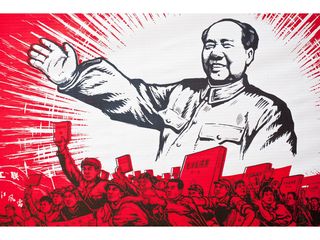
The editor of Mao’s Little Red Book writes in the preface that this is “the first scholarly effort to understand Quotations from Chairman Mao as a global historical phenomenon”. It is an accurate description, but the collection has the shortcomings that are to be expected in a book of essays by academic authors. The prose style is mostly stodgy and convoluted, and the contributors seem anxious to avoid anything that might smack of a negative attitude towards the ideas and events they describe. “As a group,” the editor continues, “we are diverse with respect to age, gender, ethnicity and political sympathies.” He is right that, judged by prevailing standards, it is a well-balanced group. All of the relevant disciplines are represented – history, area studies, literature, political science and sociology – and although ten of the 13 contributors teach in the US, the collection is representative of the range of views of China that you will find in universities in much of the world. However, the fact that it reflects the present state of academic opinion is also the book’s most important limitation.

Reading the essays brought together here, you would hardly realise that Mao was responsible for one of the biggest human catastrophes in recorded history. Launched by him in 1958, the Great Leap Forward cost upwards of 45 million human lives. “When there is not enough to eat, people starve to death,” Mao observed laconically. “It is better to let half of the people die so that the other half can eat their fill.” He did not specify how those condemned to perish would be made to accept their fate. Ensuing events provided the answer: mass executions and torture, beatings and sexual violence against women were an integral part of a politically induced famine that reduced sections of the population to eating roots, mud and insects, and others to cannibalism. When Mao ordered an end to the horrific experiment in 1961, it was in order to launch another. The Cultural Revolution was nothing like as costly in fatalities, but it left a trail of broken lives and cultural devastation, the memory of which is one of the chief sources of the post-Mao regime’s legitimacy.

More here.

Sunday Poem

Private Parts

The first love of my life never saw me naked.
There was always a parent coming home in a half hour,
always a little brother in the next room, always too much
body and not enough time for me to show him.

Instead, I gave him a shoulder, an elbow, the bend
of my knee. I lent him my corners, my edges:
the parts of me I could afford to offer, the parts of me
I had long since given up trying to hide.

He never asked for more. He gave me back his eyelashes,
the back of his neck, his palms. We held each piece we were given
like it was a nectarine—might bruise if we weren’t careful—
we collected them like we were trying to build an orchard.

And the spaces that he never saw: the ones my parents
had labeled “Private Parts” when I was still small enough
to fit all of my self and worries inside a bathtub,
I made up for them by handing over all the private parts of me.

There was no secret I did not tell him,
there was no moment we did not share.
We did not grow up, we grew in: like ivy wrapping,
molding each other into perfect yings and yangs.

We kissed with mouths open, breathing his exhale
into my inhale and back. We could have survived
underwater or in outer space, living only off the breath
we traded. We spelled “love” G-I-V-E.

I never wanted to hide my body from him.
If I could have, I am sure I would have given it all away
with the rest of me. I did not know it was possible
to keep some things for myself.

Some nights, I wake up knowing he is anxious.
He is across the world in another woman’s arms
and the years have spread us like dandelion seeds,
sanding down the edges of our jigsaw parts that used to only fit each other.

He drinks from the pitcher on the night stand, checks
the digital clock, it is five AM. He tosses in sheets and
tries to settle. I wait for him to sleep, before tucking myself
into elbows and knees; reaching for things I have long since given away.
.

by Sarah Kay

I Hate Everyone… Starting With Me

Natalie Hope McDonald in PhillyMag:

JoanGay Pride month may be the perfect time to buy a copy of Joan Rivers’ latest book – I Hate Everyone… Starting With Me. Not only is she one of our favorite comedians, but she provides a hilarious summer read for anyone who may be hitting the beach or enjoying a mental health day after a jam-packed Philly Pride weekend.

Don’t believe us? Here are some of our favorite lines:

On growing up:

“My earliest childhood memory was watching my parents loosen the wheels on my stoller.”

On celebrities and their babies:

“Everyone thinks Angelina Jolie was the first celebrity baby hoarder, but she wasn’t. Before Angelina there was Mia Farrow. Mia had an entire farm full of children. I think she got them at Costco.”

On gay and lesbian parents:

“I love gay and lesbian parents. But I think we need a law that says lesbians and gay men have to raise their children together. This way, the kids would not only know how to build bookshelves, but they’d also instinctively know how to decorate them.”

On Tom Cruise:

“I hate Tom Cruise… In TV interviews Tom laughs inappropriately and much too vociferously at non-humorous declarative statements, which is ironic because in real life he can’t take a f – – – ing joke at all. All you have to do is make one simple, little, harmless, innocuous aside like, ‘The Scientology spaceship was late today; it had to stop by Fire Island to pick up Tom Cruise,” and he has a pack of lawyers at your door faster than Katie Holmes can say, ‘No, really, he loves me in that way, I swear.’”

More here.

‘The Scorpion’s Sting: antislavery before Civil War’

Ira Berlin in The Washington Post:

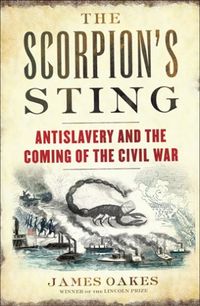
BookIn 1856, as the matter of African American enslavement heated to a boil in the cauldron of American politics, Abraham Lincoln freely admitted that “if all the earthly powers were given to me, I should not know what to do, as to the existing institution.” Here Honest Abe fudged a bit of the truth. He, like most Republicans, had devised a solution to end slavery peaceably over time. James Oakes, a professor of history at the Graduate Center of the City University of New York, who recently received the Abraham Lincoln prize for his book “Freedom National: The Destruction of Slavery in the United States,” argues that Lincoln and other Republicans not only had a plan but had even given it a name: the Scorpion’s Sting. In his new book of the same name, Oakes places the history of this powerful image in the context of antislavery politics.

The Scorpion’s Sting refers to the fearsome arthropod that, when in mortal danger — for example, “surrounded by fire” — stings itself to death. Republican politicos believed that this striking image showed how Southern slavery would eventually self-destruct. Southern leaders took note. Sen. Robert Toombs, a leading secessionist, characterized the Republican strategy as “to pen up slavery within its present limits — surround it with a border of free States, and like the scorpion surrounded by fire, they will make it sting itself to death.”

More here.

Saturday, May 31, 2014

The Art Hitler Hated

Michael Kimmelman in the New York Review of Books:

Kimmelman_1-061814_jpg_250x1304_q85As he had lived, Cornelius Gurlitt died at eighty-one early in May, in thrall to a trove of inherited art he kept hidden for decades mostly at a modest apartment in Munich. The announcement last year of the collection’s discovery by German authorities yanked the reclusive Gurlitt from the shadows. Stories about him busied the front pages of newspapers for weeks.

He seemed a figure out of Sebald or Kafka. He had never held a job, kept no bank accounts, was not listed in the Munich phone book. Aside from sporadic visits to a sister, who lived in Würzburg and died two years ago, he had had little contact with anyone for half a century. Der Spiegel reported that he had not watched television since 1963 or seen a movie since 1967, and that he had never been in love, except with his collection.

The art, nearly 1,300 works, some of which belatedly turned up in a second home in Salzburg, was mostly nineteenth- and early-twentieth-century European pictures, a good deal of it what the Nazis called Entartete Kunst, or degenerate art, who knows how much of it seized from museums and Jews. Cornelius’s father, Hildebrand Gurlitt, accumulated the collection.

More here.

From Womb to Womb

Carl Zimmer in his excellent blog, The Loom:

ScreenHunter_665 Jun. 01 12.33Worldwide, women suffer an estimated 2.65 million stillbirths each year. Despite those huge numbers, we only understand some of the factors that are responsible. In low- and middle-income countries (where most of the world’s stillbirths occur), diseases like malaria can put pregnant women at risk of stillbirths. In wealthier countries, the biggest risks include smoking and obesity. But these factors only go partway to explaining why some women have stillbirths, leaving many cases unaccounted for. The benefits that would come from that knowledge could be enormous.

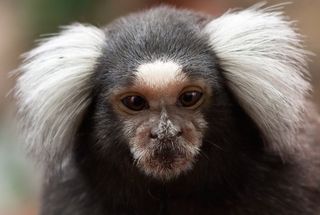
One way to learn about reproductive health is to observe how our primate cousins have babies. And a new study on marmosets offers some hints about the causes of stillbirth. It suggests that a mother’s health during pregnant may not be the whole story. In fact, some of the risk factors may arise before mothers are even born.

The first thing that one notices about the white-tufted ear marmoset (Callithrix jacchus) is its wildly adorable face–a tiny visage framed by shocks of white fur. Marmosets are interesting to scientists not because they’re cute, but because of theirintriguing way of having kids. While most primate females have a single offspring at a time, marmoset typically have twins. Some marmoset mothers even have triplets.

This is a tricky strategy for passing on marmoset genes. Marmoset babies can weigh between a fifth and a quarter of their mother’s weight. Imagine a 135-pound woman giving birth to two 16 pound babies–and then nursing them.

More here.

SHUT UP AND EAT

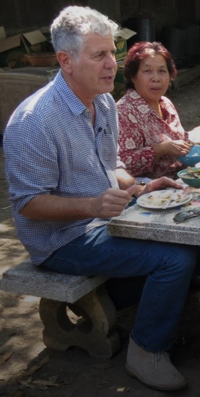
Anthony Bourdain in Medium:

ScreenHunter_664 Jun. 01 12.28A frequent comment on food websites is that I should avoid discussion of politics or social conditions and concentrate on the food. My host, serving me a humble but tasty Lao style laarb could be missing three out of four of his limbs but God forbid I ask the question: “Hey there, fella…what happened to your arm and legs?” The answer might intrude on someone’s vicarious eating experience.

In the Congo, the bucket of water used to boil my pounded cassava might well have been transported the 2 miles from the nearest river on top of a small child’s head. Some very unpleasant militias have been known to interrupt such journeys. This, it would seem, is also worth mentioning.

There is, of course, nothing more political than food. Food itself. Who’s got it, who doesn’t. “What’s” cooking is usually the end of a long, often violent story. That can be a bummer for some—who’d rather be fondling themselves while perusing recipes for bundt cake than thinking about what Burroughs called the “frozen moment when everyone sees what is on the end of every fork.”

More here.

Mirages of the Mind

Sepoy in Chapati Mystery:

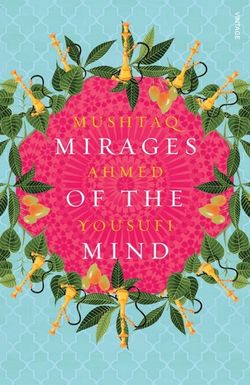
BookThe early books of famed Urdu satirist Mustaq Ahmed Yousufi (b. 1922), Chiragh Talay (1961) and Khakam-e Badhan (1969), functioned in the college space for us in Lahore as cigarettes function in a prison camp – a currency, a momentary respite, a surge, and a day dream. We used to crack jokes from his oeuvre claiming them as they were uttered. He was not very well liked by my elders, however. They found him a poor replacement for the other satirists at play, Pitras Bukhari or Mustanssar Hussain Tarad or often Ibn-e Insha. Yet he was beloved by us near-adults as a rock star. Now a new translation from Urdu of Yousufi’s Aab-e Gum is coming out (by end May). Matt Reeck and Aftab Ahmad, the co-translators, have excerpted their translation earlier in Caravan India and Asymptote. They were both recipients of the 2012 PEN Translation grant for this project. At the occasion of this publication, I asked a few questions from Reeck & Ahmad. Enjoy:

Q. Who was Mushtaq Ahmed Yousufi?

Mushtaq Ahmed Yousufi is a humor and satire writer and a resident of Karachi, where he has lived since immigrating to Pakistan soon after Partition. How he will be remembered is still up for debate: while he was the top official at many major Pakistani banks, he is also one of the greatest living Pakistani writers. With more publicity for his works, he may last in the collective memory of literary audiences in South Asia and abroad for this latter skill—that of a writer.

Q. Why is it important to translate him into English?

His work is good. It deserves to be read by more people. That’s the simple answer. The more complicated answer involves how world literature operates, and how its restrictive canon needs to admit more writers from unrepresented areas and literatures, like Pakistan and Urdu, respectively. For inclusion in world literature canons, texts must be available in English, or another major European language, for these are the languages of arbitration in these canon formation processes.

More here.

The migrant has no face, status or story

Hanif Kureishi in The Guardian:

A-supporter-of-a-National-011The immigrant has become a contemporary passion in Europe, the vacant point around which ideals clash. Easily available as a token, existing everywhere and nowhere, he is talked about constantly. But in the current public conversation, this figure has not only migrated from one country to another, he has migrated from reality to the collective imagination where he has been transformed into a terrible fiction. Whether he or she – and I will call the immigrant he, while being aware that he is stripped of colour, gender and character – the immigrant has been made into something resembling an alien. He is an example of the undead, who will invade, colonise and contaminate, a figure we can never quite digest or vomit. If the 20th century was replete with uncanny, semi-fictional figures who invaded the lives of the decent, upright and hard-working – the pure – this character is rehaunting us in the guise of the immigrant. He is both a familiar, insidious figure, and a new edition of an old idea expressed with refreshed and forceful rhetoric.

Unlike other monsters, the foreign body of the immigrant is unslayable. Resembling a zombie in a video game, he is impossible to kill or finally eliminate not only because he is already silent and dead, but also because there are waves of other similar immigrants just over the border coming right at you. Forgetting that it is unworkable notions of the “normal” – the fascist normal – which make the usual seem weird, we like to believe that there was a better time when the world didn't shift so much and everything appeared more permanent. We were all alike and comprehensible to one another, and these spectres didn't forever seethe at the windows.

More here.

The Insolence of Architecture

Martin Filler in the New York Review of Books:

ScreenHunter_664 May. 31 14.21Rarely do architecture writers convey a sense of place with the observational acuity, physical immediacy, and (on occasion) moral outrage of the British journalist Rowan Moore. Since the turn of the millennium, Moore—a Cambridge University—trained architect and younger brother of Charles Moore, the newspaper and Spectator editor and Margaret Thatcher’s authorized biographer—has been the architecture correspondent for The Evening Standard, then the director of the London-based Architecture Foundation, and is now the architecture critic of The Observer. Michael Sorkin burned up the pages of New York’s Village Voice in the 1980s with his tirades against Philip Johnson, Paul Goldberger, and other voices of the architecture establishment. Since then no other newspaper architecture critic has been as sharp an assessor of the built environment as Moore and as rueful an evaluator of the ever-increasing commercialism and pointless exhibitionism that dominate contemporary construction.

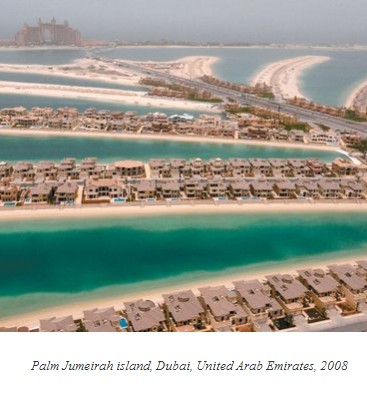
Moore begins his lively, wide-ranging, and thought-provoking new book, Why We Build: Power and Desire in Architecture, with a devastatingly funny if deeply disturbing set piece that finds him in a helicopter hovering over the architectural theme park that is Dubai, the oil-poor Arab emirate determined to use flamboyant urban development to “brand” itself as a desirable destination for investors and tourists, and thereby to become a global economic powerhouse on the order of Singapore. Although Moore invokes Francis Ford Coppola’s famous “Ride of the Valkyries” sequence fromApocalypse Now, his eye for the grotesque detail reminds me more of the opening of Federico Fellini’s La Dolce Vita, in which a statue of Christ suspended from a chopper hovers over the Vatican, with arms outstretched in seeming benediction.

More here.