A man with amnesia taught us how memories become personal

Sam Kean in Slate:

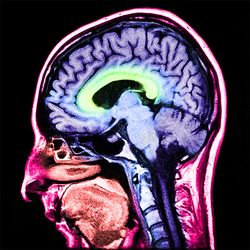
SCI_KC.jpg.CROP.original-originalKent Cochrane, the amnesiac known throughout the world of neuroscience and psychology as K.C., died last week at age 62 in his nursing home in Toronto, probably of a stroke or heart attack. Although not as celebrated as the late American amnesiac H.M., for my money K.C. taught us more important and poignant things about how memory works. He showed how we make memories personal and personally meaningful. He also had a heck of a life story.

During a wild and extended adolescence, K.C. jammed in rock bands, partied at Mardi Gras, played cards till all hours, and got into fights in bars; he was also knocked unconscious twice, once in a dune-buggy accident, once when a bale of hay conked him on the head. In October 1981, at age 30, he skidded off an exit ramp on his motorcycle. He spent a month in intensive care and lost, among other brain structures, both his hippocampuses.

As H.M.’s case demonstrated in the early 1950s, the hippocampus—you have one in each hemisphere of your brain—helps form and store new memories and retrieve old ones. Without a functioning hippocampus, names, dates, and other information falls straight through the mind like a sieve. At least that’s what supposed to happen. K.C. proved that that’s not quite true—memories can sometimes bypass the hippocampus.

More here.

A Life Beyond ‘Do What You Love’

Gordon Marino in the New York Times:

Love-what-you-do.-Screenprints-diptych-8.3-x-11-1Student advisees often come to my office, rubbing their hands together, furrowing their brows and asking me to walk along with them as they ponder life after graduation. Just the other day, a sophomore made an appointment because he was worrying about whether he should become a doctor or a philosophy professor. A few minutes later, he nervously confessed that he had also thought of giving stand-up comedy a whirl.

As an occupational counselor, my kneejerk reaction has always been, “What are you most passionate about?” Sometimes I‘d even go into a sermonette about how it is important to distinguish between what we think we are supposed to love and what we really love.

But is “do what you love” wisdom or malarkey?

In a much discussed article in Jacobin magazine early this year, the writer Miya Tokumitsu argued that the “do what you love” ethos so ubiquitous in our culture is in fact elitist because it degrades work that is not done from love. It also ignores the idea that work itself possesses an inherent value, and most importantly, severs the traditional connection between work, talent and duty.

More here.

Saturday Poem

This Neruda Earth

Sitting against a treetrunk in Delores Park
amid the Chilean solidarity gathering,
my eyes beheld three tiny daisies
in the grass, their little pollen hearts
attacked by flies. Nearby, yellowjackets
were flying over a jungle of blades
of grass and brilliantly green-backed
horseflies were making merry on
a flute of dogshit. I had lowered
my eyes from the speeches, and even
the People's Tribune was stacked at
my side. So much movement
in nature. A butterfly alighted on
the front page and walked along
the headline as if reading it. The
flies went on eating the hearts out.
The horseflies were absolutely drunken
on the excrement. The yellowjackets
were strafing and landing and
taking off again. It was the guerilla
war, it was mir, it was peace. So much
movement, so much space in an inch. This
Neruda Earth.

by Jack Hirschman
from Poetry Like Bread
Curbstone press, 1994

Friday, May 30, 2014

Piketty’s Fair-Weather Friends

Piketty_seth

Seth Ackerman in Jacobin:

If you’ve read far enough into the reviews of Piketty’s book, you’ve probably already come across references to a mysterious academic debate of the 1950s and 1960s called the Cambridge Capital Controversies, which pitted MIT neoclassicals like Paul Samuelson and Robert Solow against a group of Cambridge University economists, including Joan Robinson and Piero Sraffa, who sought to revive and perfect aspects of the earlier classical approach of David Ricardo and Marx.

Popular attempts to recount that debate tend to get needlessly bogged down in the abstract. They typically focus on the brain-teaser question of whether it’s possible to quantify the “amount” of capital in the economy, given that this capital stock is made up of a vast number of heterogeneous goods, from jackhammers to hard drives. And that was, in fact, the issue that first got the debate started.

But what the argument was fundamentally about was whether the marginal productivity theory of income distribution — marginalism — is a logically coherent theory. Although carried out in technical terms, the debate had strong political overtones. (Note that Solow served in the Kennedy White House, whereas Sraffa had smuggled in the paper for Gramsci to write thePrison Notebooks).

At its heart, the controversy opposed two visions of the capitalist economy. In the neoclassical vision, the most fundamental forces shaping the division of society’s produce are the supply and demand for labor and capital, and behind them, the technical facts of technology, scarcity, and consumer tastes. In this vision, the income distribution can be explained by the old platitudes “when the price goes up, less is bought,” and “when more is supplied, the price goes down.”

In the Cambridge vision, social, historical, and political forces — class struggle — are the essential factors in setting the income distribution. Once that distribution is fixed, the rest of the economy adjusts around it.

More here.

The Ghosts of Tiananmen Square

I.Johnson_1-060514_jpg_250x1402_q85

Ian Johnson in the NY Review of Books (image Ken Jarecke/Contact Press Images):

Eight-nine-six-four: June 4, 1989.

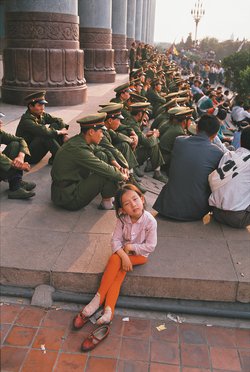
This is a date that the Communist Party has tried hard to expunge from public memory. On the night of June 3–4, China’s paramount ruler, Deng Xiaoping, and a group of senior leaders unleashed the People’s Liberation Army on Beijing. Ostensibly meant to clear Tiananmen Square of student protesters, it was actually a bloody show of force, a warning that the government would not tolerate outright opposition to its rule. By then, protests had spread to more than eighty cities across China, with many thousands of demonstrators calling for some sort of more open, democratic political system that would end the corruption, privilege, and brutality of Communist rule.1 The massacre in Beijing and government-led violence in many other cities were also a reminder that the Communist Party’s power grew out of the barrel of a gun. Over the coming decades the Chinese economy grew at a remarkable rate, bringing real prosperity and better lives to hundreds of millions. But behind it was this stick, the message that the government was prepared to massacre parts of the population if they got out of line.

When I returned to China as a journalist in the early 1990s, the Tiananmen events had become a theater played out every spring. As the date approached, dissidents across China would be rounded up, security in Beijing doubled, and censorship tightened. It was one of the many sensitive dates on the Communist calendar, quasi-taboo days that reflected a primal fear by the bureaucracy running the country. It was as if June 4, or liu si (six-four) in Chinese, had become a new Qingming, but one the government was embarrassed to admit existed. Now the crackdowns in May and June have lessened in intensity but are still part of daily life for hundreds of people throughout China, such as Xu Jue, the mother of a Tiananmen victim.

What remains? The author Christa Wolf used this phrase as the title of a novella set in late-1970s East Berlin. A woman notices that she is under surveillance and tries to imprint one day of her life in her memory so she can recall it sometime in the future when things can be discussed more freely. It is a story of intimidation and suppressed longing. Is this the right way to think of Tiananmen, as an act frozen in time, awaiting its true recognition and denouement in some vague future?

More here.

Multiverses and Sleeping Beauty

Panel5

Richard Marshall interviews Alastair Wilson in 3:AM Magazine:

3:AM: One of the things you’ve dedicated yourself to contemplating is the Everettian multiverse. Before we go further into your thoughts can you sketch out what this is , how it solves Schrodinger’s cat puzzle and other issues? Is it science? And why do you thinkscientists like it more than philosophers?

AW: The Everettian multiverse is one of the most beautiful ideas in the history of science. If its wrong, at least it’s gloriously, elegantly, ambitiously wrong. My approach to Everettian quantum mechanics (EQM) builds directly upon that of the ‘Oxford Everettians’ – David Deutsch, Simon Saunders, David Wallace, and Hilary Greaves. Wallace’s presentation of the view has become canonical, and any seriously interested readers should start by ignoring me and reading his lovely book The Emergent Multiverse.

EQM involves a straightforward scientific realist attitude to the quantum-mechanical formalism. The best explanation of the empirical success of quantum mechanics is that it’s tracking some real structure in the world; and if the theory seems to describe superpositions of macroscopic states, we should at least explore the possibility that there are superpositions of macroscopic states. Everett’s remarkable idea was to reconcile macroscopic superpositions with the ‘manifest image’ by interpreting superpositions not as indeterminacy but as multiplicity. Instead of a single cat in an indeterminate state – half-alive-half-dead – we have two cats each in a determinate state – one alive and one dead.

Is it science? I don’t see why not, at least if our theories about quarks and gluons and about gravitational waves and about galaxies beyond the visible universe count as science. Such things are all posited on the basis that they allow for theories with superempirical theoretical virtues; they’re testable indirectly through the empirical generalizations that they help to elegantly explain.

There are lots of reasons to worry about EQM, some of them worth taking seriously. Amongst the interesting objections are the various aspects of the probability problem (on which more below) and concerns about emergent ontology and lack of determinate identity conditions for worlds. Technical difficulties (the ‘preferred basis problem’) which loomed large in older discussions have largely been resolved by decoherence theory, though this remains pretty controversial. To my mind the less interesting objections include ontological extravagance and departure from common sense. If we can solve the probability and ontology problems in satisfactory ways, then objections based on intuition or aesthetics aren’t going to carry much weight.

More here.

On the biology of race

Massimo Pigliucci Scientia Salon:

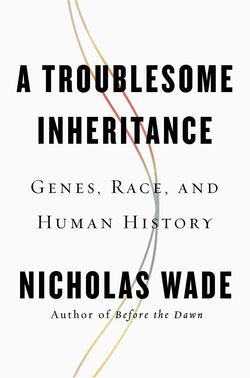
L9781594204463The biology of human races is back in the news, big time. This is because of a new book by former New York Times journalist Nicholas Wade, A Troublesome Inheritance: Genes, Race and Human History [1].

The basic thesis of the book is that human races are real, and that their genetic differences — which according to Wade evolved rapidly after the invention of agriculture — account for much of the behavioral differences among human groups, as well as for the success of some and the failure of others.

Here is a sample of quotes from Wade himself, to give you an idea of what he is up to [2]:

[Trying to explain why Western societies have been capable of developing advanced democracies while others haven't] “Conventionally, these social differences are attributed solely to culture. But if that’s so, why is it apparently so hard for tribal societies like Iraq or Afghanistan to change their culture and operate like modern states? The explanation could be that tribal behavior has a genetic basis.” (Indeed, but what explains the difference between the cultures of North and South Korea, which — as Allen Orr notes in his review of the book (see below) — are certainly genetically very close to each other?)

More here.

Akeel Bilgrami on the results of the Indian elections

Akeel Bilgrami in The Hindu:

ScreenHunter_663 May. 30 18.32One pundit in the aftermath of the Indian elections has described the Prime Minister-elect as seeking to “reshape the entire political universe of India” (Ashutosh Varshney in The Guardian ). It is in the nature of public life in the modern period that even just the rhetoric and pretence of “change” can bestow upon a politician an ersatz glamour. In the drumbeat of electioneering over several recent months that rhetoric and pretence on the lips of Mr. Narendra Modi was flamboyantly yet carefully cultivated and, above all, purchased at obscene expense. The media, funded and controlled by the same corporate sources that paid for this public relations achievement, acquiesced with conviction in the pretence and repeated the rhetoric each day both in print and on screen.

The strategy has paid off; the man now has the added glamour of the nation’s most exalted office which, suppressing his natural swagger, he has approached with an affectation of humility and express concern for the poor and working people of the country, the very people that the policies and politics he stands for will sink into ever-increasing poverty and insecurity.

These unstintingly negative remarks I have made are intended to recoil from the charitable and hopeful responses that even some of those made anxious by Mr. Modi’s election have resigned themselves to. A belief in democracy requires two things: an acceptance of the upshot of an election and a refusal to blame the electorate if the upshot fills one with dread. Beyond this no graciousness is required, least of all a slackening of the critical powers one brings to assessing the upshot.

More here.

The Erasure of Maya Angelou’s Sex Work History

Peechington Marie in Tits and Sass:

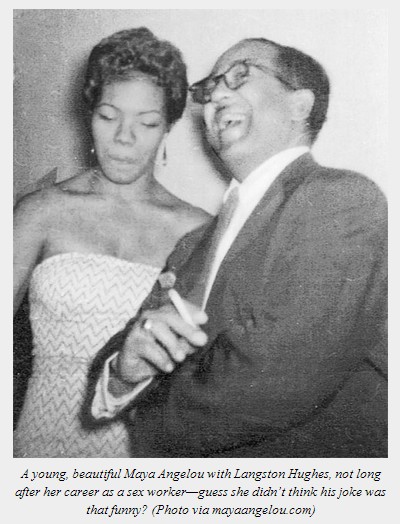
ScreenHunter_662 May. 30 12.58Dr. Maya Angelou, American Poet Laureate, most famous for authoring I Know Why The Caged Bird Sings, passed away at age 86 on May 28th, 2014. Her literary agent Helen Brann confirmed the news to press, and thus began a worldwide outpouring of grief. The top trending tag on Twitter was “RIP Maya Angelou” and, at the time of this writing, it is one of four Maya Angelou-related trending hashtags. She is hailed as a national best selling author, a genius, a spiritual God-, Grand-, and mother. She is lauded as everything Black women should aspire to emulate in life. So why is it very few of us know she was a sex worker? Why is it, even in her death, as in her life, it’s such a guarded secret? Why was this secret kept by seemingly everyone except Dr. Angelou herself?

We can, once again, boil it down to respectability politics and stigma. I am angry about it. I find myself ruminating, considering, wondering: If her work had been talked about as much as her dancing with James Baldwin or even her considerable, commanding and lovely height of six feet, what would the sex work community look like today? If we had talked about her wonderful compassion for sex workers, how she never looked down on them, and her refusal to be intimidated by invasive and obnoxious questioning about her sex working past, what would sex workers around the world be saying today in memory of her life?

More here.

Rite of Passage: A father and son explore a changing landscape

Mike Tidwell in Orion Magazine:

JourneysHeader2He’s fifteen years old. Not quite a man, but almost. We’ll be visiting colleges this time next year. He’s not a boy, either, although he looks consummately boyish in the innocence of slumber. I see the Little Leaguer in his face, and the kindergartener. In sleep we catch the last youthful poses of our children.

And at this moment, I wonder yet again why I brought Sasha to this wilderness place. Part of the answer is simple. I’ve traveled the world—the Amazon, the Serengeti, the Alps—and for me this is the most haunting and beautiful landscape on earth. We are in absolute backcountry: the Chihuahuan Desert canyons of “Big Bend Country,” literally that giant bend of the Rio Grande that separates west Texas from northern Mexico. The same sun washing over Sasha’s closed eyes is rousing the cliff swallows into song two hundred feet away. Around us, a million desert flowers go all electric in late-March bloom—red ocotillo, purple verbena, the magenta blossoms of cholla cacti. In the riverbank shallows, a longnose gar sloshes though the willow grass, hunting frogs.

More here.

The Next Wave of Cancer Cures Could Come From Nasty Viruses

Matt Safford in Smithsonian:

VirusThe notion of using viruses to attack cancer has been around nearly as long as we’ve known about viruses themselves. But several roadblocks– viruses attacking patients’ immune systems, or, not effectively targeting tumors–have led to slow growth in this area of research. Until now.
Earlier this month, a team led by Dr. Stephen Russell at Minnesota’s Mayo Clinic announced that a patient with previously unresponsive, blood-borne cancer (multiple myeloma) had gone into complete remission after being treated with a massive dose of a modified measles virus. A second patient given a similar dose (10 million times the amount in the common measles vaccine) didn’t respond as dramatically to the treatment, but the patient’s tumors did shrink, indicating the virus was at least attacking the targeted areas.

In a separate study that hasn’t yet made it to human trials, a team led by Dr. Khalid Shah at the Harvard Stem Cell Institute (HSCI) at Massachusetts General Hospital has made progress in attacking brain tumor cells in mice using the herpes virus. Shah’s team packed the virus inside a type of human stem cell which, unlike some previous vehicles, is amenable to carrying modified viruses and doesn’t trigger a significant immune response. The team’s second trick: They wrapped the herpes-loaded stem cells inside a biocompatible gel to help keep the virus in place and attacking tumor cells for a longer period of time. According to the team, mice treated in this way had significantly improved survival.

More here.

Friday Poem

Oceans

I have a feeling that my boat
has struck, down there in the depths,
against a great thing.
And nothing
happens! Nothing . . . Silence . . . Waves . . .

—Nothing happens? Or has everything happened,
and we are standing now, quietly, in the new life?
.

by Juan Ramón Jiménez
from News of the Universe
Sierra Club Books, 1995
translated by Robert Bly

Thursday, May 29, 2014

Patricia Lockwood: The Smutty-Metaphor Queen of Lawrence, Kansas

Jesse Lichtenstein in the New York Times:

ScreenHunter_661 May. 29 21.38Just before she took the microphone one soggy night in Portland, Ore., the poet Patricia Lockwood downed a shot of cheap bourbon. She had never had a drink right before a reading, but she often enacts some private joke when she speaks in public. It might be slurping her water loudly into the microphone, or rolling (instead of stepping) onto a stage, or, in this case, ingesting something that tasted to her like a puddle in a forest — anything to erase what she calls the “anxiety kegels” leading up to a performance.

That evening, more than a hundred poetry fans — most of them in their 20s, most of them clutching cans of bargain beer — crowded into a corner of a 12,000-square-foot wood-and-metal shop as Lockwood began a 12-minute romp of a poem called “The Father and Mother of American Tit-Pics.”

Lockwood is all large eyes, apple cheeks and pixie haircut — like an early Disney creation, perhaps a woodland creature; one of her fans recently rendered her as a My Little Pony. The contrast between how she presents and what she writes is something Lockwood delights in.

“Emily Dickinson was the father of American poetry and Walt Whitman was the mother,” she read. “Walt Whitman nude, in the forest, staring deep into a still pool — the only means of taking tit-pics available at that time.”

I laughed, like everyone else in the audience, and then settled in for a poem that re-envisioned two 19th-century pillars of American poetry through a kaleidoscope of contemporary obsessions. Occasionally, the sound of arc welding filled the silences between stanzas. It was, she later said, “the butchest I have ever felt.”

More here.

Why Godzilla matters

John Mecklin in Bulletin of the Atomic Scientists:

ScreenHunter_660 May. 29 21.31Godzilla is on the fire-breathing march again, its latest silver screen appearance bringing Warner Bros. and Legendary Pictures some $93 million in US opening-weekend revenue. The 2014 version of the monster sagaputs its nuclear connections front-and-center (although it does seem to suggest that rather than merely awakening the monster, a nuclear test at the Bikini atoll was actually a failed attempt to kill him). A couple of Mosura—flying, nuclear-material-ingesting monsters that create technology-zapping electromagnetic pulses by pounding the ground—emerge from something similar to cocoons underneath a Japanese nuclear power plant and inside a Yucca Mountain nuclear storage facility. They then rampage toward San Francisco to mate, in the process ravaging Las Vegas and Honolulu. For some reason, Godzilla steams across the Pacific to stop them. Once the monsters are all in San Francisco, the almost magical use of special effects allows them to fight in captivating ways across the city, to make amazing noises, and to kill many tiny humans the movie doesn't care about. Godzilla wins, swimming back out to sea, a scary hero who has restored the natural order.

What does it all mean? Don't ask this film.

More here.

On Necessary and Contingent Truths, With Special Reference to Mt. Kilimanjaro

Justin E. H. Smith in his own blog:

ScreenHunter_659 May. 29 21.22There is a familiar distinction in philosophy between contingent and necessary truths. Truths of the latter sort are those the negation of which implies a contradiction, or those that are true simply in virtue of the meaning of the words involved. For example, “A triangle has three sides” is true simply in virtue of the meanings of the words 'triangle', 'three' and 'side'. If you encounter a figure with four sides, then necessarily you have not encountered a very unusual triangle, but rather a non-triangle.

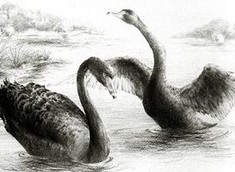
Contingent truths are those the negation of which implies no contradiction, or, to put this somewhat differently, those that could have been false (whatever that might mean!). Some contingently true statements involve particular cases, e.g., “This swan is white.” A special class of contingent truths are those expressed by empirical claims about how one expects all entities or phenomena of a certain kind to be. These are the sort of truths established by inductive reasoning, and it is characteristic of them that they can always turn out to be falsified by any given case. Thus, “All swans are white” was held to be true for a long time, as the instances of observed swans grew and grew, and in each case, each swan observed turned out, in fact, to be white. This contingent truth however, turned out to be false, as European travelers to Australia, home of the Cygnus atratus, realized toward the end of the 18th century.

Now, any member of the genus Cygnus is a swan, and there was a prior fact of the matter, prior that is to Captain Cook's expedition, about the color-independent features of an entity that determine whether it is a member of this genus or not. This is what makes “All swans are white” a mere empirical claim rather than an analytic truth, or a truth that can be established simply in virtue of the analysis of a proposition into the meanings of its component parts.

More here.

The Ill-Fated Mission To spread the good word

ObookiahT.H. Breen at The American Scholar:

Cornwall, a small community in northwestern Connecticut, would seem to have been an unlikely place to launch a campaign to save the world. But as John Demos recounts in this wonderfully crafted, deeply disturbing narrative, that is precisely what happened during the early decades of the 19th century. A group of highly educated Protestant ministers, energized by the evangelical fervor of the Second Great Awakening, devised a bold plan to bring true religion to millions of people who had not yet heard the word of Christ. Such ambition had a long and depressing history. The first Europeans who landed in the New World strove to convert the Native Americans, and even though these efforts seldom fulfilled the missionary dream, generation after generation insisted on trying to rescue the heathens from ignorance and evil.

Converting native peoples always turned out to be harder than the evangelicals anticipated. Before the heathens could become proper Christians, they had to learn the ways of civilized society, which in practice meant adopting European customs. The ministers reasoned that if they could just persuade the heathens to speak English, dress in English clothes, and live in English-style houses, they would be more receptive to Christianity.

more here.

vollmann on O’Hara

Vollmann_ciardiello_b24.5_630William T. Vollmann at The Baffler:

John O’Hara’s themes are alcoholism, infidelity, rape, perversion, child molestation, the yearning for power and financial security (many who knew the author believed this to be his own basic preoccupation), the instability of love and passion, the effects of economic substructures on the superstructures of private life (in method, if certainly not in ideology, he resembles a Marxist), boardroom and statehouse politics, and the secret corruptions of families. In many respects he is a cruel writer; not only does he portray quotidian cruelty unblinkingly and intimately, but his portrayals themselves can be cruel. While critics often prefer his short stories to his novels, my preference is the reverse of theirs. For me, a writer’s highest business is the creation of some kind of empathy, and O’Hara’s short stories rarely permit him to do more than cast his contemptuously bloodshot gaze on a situation, evoking revulsion or pity, perhaps, but nothing more.

To be sure, in the stories you will find any number of strange types, such as the sprightly, obese, sexually deviant, not unsympathetic dancer-actor-clown of “The Portly Gentleman,” or the vicious, stupid, smalltime gangsters of “The Sun-Dodgers,” usually encountered at some revealing and decisive moment. A few of these tales—I’m thinking of the bitter brilliance of “It’s Mental Work” or the cheap perversions and double-crosses of “A Phase of Life”—are as effective as the best of Ernest Hemingway or Raymond Carver.

more here.