Our Apples, Ourselves

Our own Morgan Meis in The Smart Set:

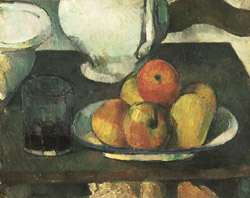
IC_MEIS_APPLES_AP_001Long has the fate of mankind been tied to apples. They got Adam and Eve banished from Paradise. With the apple, Johnny Appleseed tamed the New World. And then, in the late 19th century, Paul Cézanne declared he would paint the otherwise unremarkable fruit and “astonish Paris with an apple.”

Cézanne did just that. His paintings of apples confused critics and art enthusiasts alike. People were astonished that apples could look so ugly, and be so poorly painted. Some thought Cézanne’s still lifes were actually a joke, or an insult. It is difficult, looking at Cézanne’s paintings today, to feel the full force of that outrage. But there were certain artistic standards in the late 19th century. Painting that came out of the official Academy of Art (Écoles des Beaux-Arts) was expected to look a certain way. Brushstrokes, for instance, were supposed to be smoothed out and worked, more or less, into the finish of the painting. A glossy and well-varnished surface was expected. One look at the paintings currently on display at The Barnes Foundation’s Cézanne exhibit (The World Is an Apple: The Still Lifes of Paul Cézanne) is enough to see that Cézanne was not an Academy painter. He was making a point of being rough and crude.

There is a helpful juxtaposition of paintings in the catalogue to the Barnes Foundation exhibit. Curator Benedict Leca presents a picture by Henri Fantin-Latour called Still Life with Vase of Hawthorn, Bowl of Cherries, Japanese Bowl, and Cup and Saucer (1872). Fantin-Latour was a successful and well-respected Academic painter in his time. His still life is skillfully done. His rendering of the Japanese bowl and the cup and saucer is, in particular, masterful in its photographic details. The reflections on the bowl are perfect. Turning to Cézanne’s 1873-77 painting, Apples and Cakes, the contrast really is incredible.

More here.

What was Alan Turing really like?

Vincent Dowd at the BBC:

ScreenHunter_709 Jun. 26 19.44When Alan Turing died of cyanide poisoning in June 1954 his death was not huge news. The story of how he and colleagues at Bletchley Park had cracked the German Enigma codes was still secret and the Turing name was not yet public property.

In a two-paragraph story reporting his death, the Times described how he had “helped to develop a mechanical brain which he said had solved in a few weeks a problem in higher mathematics that had been a puzzle since the 18th Century”. It also noted his work on the Ace “automatic computing machine”. A short obituary followed a few days later.

Turing had contributed to a couple of radio programmes on the BBC Third Programme (sadly now lost) but otherwise his wide-ranging work on artificial intelligence and morphology seemed the stuff of specialist journals.

His name emerged from the shadows in 1983 when Andrew Hodges published a well-received biography which inspired the play Breaking the Code. It played in London and on Broadway and was later adapted for TV. The public image of Turing as tortured gay genius was taking shape.

Yet long before the icon, the Greenbaums knew the man. The memories of Barbara and Maria Greenbaum (now Barbara Maher and Maria Summerscale) remain vivid.

More here.

Don’t Trouble Yourself

Philip N. Cohen in the Boston Review:

ScreenHunter_708 Jun. 26 19.40In his latest book, Nicholas Wade, a longtime science journalist, argues that evolution by natural selection created human races with different genetic predispositions for social behavior. As races evolved following divergent migrations out of Africa, their social behavior diverged and became written in their genes. This divergence fueled the development of disparate societal institutions, leading to contemporary inequalities between rich and poor countries according to their adaptability to modern economic imperatives. In Wade’s telling, the Caucasian and East Asian races comprise the richest and most powerful nations in the world because they are genetically better adapted to success in modern capitalist systems than are Africans and the other racial groups, who remain steeped in tribalism, the “default” human condition.

We might know all this already, Wade claims, if it were not for politically correct gatekeepers who are afraid to discuss the realities of genetic forces underlying racial differences. Of course, Wade says, no one wants to reignite the racism that gave us social Darwinism, eugenics, and the Holocaust, but enough with taboos. It is time to move on to a scientific examination of how genes explain racial differences.

The book has nothing to do with racial superiority, Wade assures us. Unless you consider economic, political, and cultural success—thanks to your genes—an indicator of superiority. It is a hard assurance to accept from a needlessly defensive book riddled with scientific errors, deaf to better-supported theories, and willfully blind to its own implications.

More here.

george herbert, voice of eros

XChapelle_sixtine_x448.jpg.pagespeed.ic.mikhfNHg6GAdam Plunkett at Poetry Magazine:

George Herbert, the 17th-century poet and parson, is notable for having written almost only sacred poems, about his experience of God rather than that of other people. His single and singular masterpiece, The Temple, written throughout his adulthood and published shortly after his death in 1633, is “a record of spiritual struggles,” as T. S. Eliot wrote, struggles inspired “only in the Faith, in hunger and thirst after godliness.” A good churchman, Herbert wrote poems to draw his readers, like his parishioners, toward the love of God. This meant that he evoked the range of human love, from sacred to profane. But it also made him, perhaps unwittingly, a master of erotic poetry. This is not something of which the churchman is often accused. But erotic love is everywhere in The Temple, the unspoken drive behind many other loves in the poems and, in the end, their impossible fulfillment.

Herbert’s God was that of the flourishing moderate and humanist Anglicanism in the early 17th century, set against what the Anglicans saw as the ritual austerity of Puritanism, the ideological austerity of Calvinism, and the elaborate hierarchies and rituals of Roman Catholic popery. In 1611, when Herbert was 18, the King James Bible was first published, the translation that reproduced the majesty of biblical language in the vernacular.

more here.

kunkel on piketty

Capital--621x414Benjamin Kunkel at the London Review of Books:

In the background to Piketty’s wide and admiring reception lie two crises. One is disciplinary. Economists, endowed until a few years ago with more authority than other scholars, now appear in the eyes of many to have produced models of efficiency and harmony whose perfection was won at the cost of reality. The mathematised dream of some future catallaxy – Hayek’s lovely word for the spontaneous peaceful order that would result from maximum liberation of the market – bore little resemblance to actually existing capitalism. Since the crash, behavioural economics has generated much of the excitement in the field, but it too is better equipped to make sense of individual economic actors than of the mutually determining trajectories of social classes and national economies. The second crisis is not of economics but the economy: the maldistribution of wealth and incomes visible in every facet of societies today. Piketty’s searching investigation of this phenomenon has been met with understandable gratitude. Branko Milanovic, in a symposium titled ‘Piketty’s Triumph’ in the American Prospect, hailed ‘a monumental book that will influence economic analysis (and perhaps policymaking) in the years to come’, and restores economics to its ‘roots where it seeks to understand’ – in Marx’s phrase – ‘the “laws of motion” of capitalism’. Martin Wolf in the Financial Times wrote that ‘in its scale and sweep’ Capital in the 21st Century‘brings us back to the founders of political economy’. The inadequacy of mainstream economics in the face of the capitalist economy today has clearly produced a hunger for such a book. But the hungry are apt to praise any substantial meal as a feast.

more here.

The Near-Death of Grand Central Terminal

DetroitPublishingCo-LoC-GrandCentral-630Kevin Baker at Harper's Magazine:

Many consider the destruction of New York’s original Pennsylvania Station in 1963 to have been the architectural crime of the twentieth century. But few know how close we came to also losing its counterpart, Grand Central Terminal, a hub every bit as irreplaceable. Grand Central’s salvation has generally been told as a tale of aroused civic virtue, which it was. Yet it was, as well, an affirming episode for those of us convinced that our political culture has become an endless clown-car act with the same fools always leaping out.

“In New York then, I learn to appreciate the Italian Renaissance,” said Le Corbusier of Grand Central. “It is so well done that you could believe it to be genuine. It even has a strange, new firmness which is not Italian, but American.” It was not seen as such by its owner, New York Central Railroad, which viewed it mostly as a cash cow. As early as 1954, the Central proposed replacing the terminal with something called The Hyberboloid — an I. M. Pei monstrosity that, at 108 stories and 1,600 feet, would have become the world’s tallest building at the time. There was enough public outcry that a scaled-down Hyberboloid was built instead just north of Grand Central, where it was retitled the Pan Am (later the Met Life) Building. Even at a lesser height, it proved every bit as grotesque as promised.

more here.

Top 10 books about Indian families

Sandra Hunter in The Guardian:

Family-on-a-motorbike-013Let's face it: the Indian family is irresistible to readers. Will the grandmother reveal the secret about mad Uncle Arun? Will Preeti go through with the arranged marriage? And what are they going to cook next and where can we get some? But I'm less interested in the sequins and spices than the family tensions that occur due to immigration, an accident or disease, the introduction of a new element or person, or that sense of displacement we've all come across in arriving in a new place and not knowing how time works. I'm always drawn to writers who explore similar themes. So, here are 10 stories about Indian families.

Rich Like Us by Nayantara Saghal

When Ram Surya marries cockney girl Rose and brings her back to India, his first wife Mona and the family are dumped into chaos. Ram doesn't appear to be affected by the conflicts caused by his decision to have two wives. Saghal shows how male selfishness is trumped by the adaptability and strength of women, regardless of tragic outcomes (no spoilers!)

Life Isn't All Ha Ha Hee Hee by Meera Syal

I'm a big fan of Syal's work as a comedian, so, I devoured her novel about British-born Indian women with successful working lives who then “morph into obedient wives and self-abnegating mothers the moment they come home”. The story jumps off the page and drags you in so that you feel like you're running around London with Sunita, Chila and Tania.

More here.

Love in the lab: Close collaborators

Kerri Smith in Nature:

THINKSTOCK-VECTOR-498647733When physicists Claudia Felser and Stuart Parkin were introduced at a conference on applied magnetics, they felt an immediate attraction. But then, standing outside the Amsterdam conference centre, they started talking shop. It did not go well. Parkin was interested in finding materials he could use to make miniature data-storage devices. Felser espoused the benefits of her pet topic: Heusler compounds, alloys with modifiable magnetic properties. “But he was not interested!” she laughs. Parkin thought that the compounds sounded as though they would be too difficult to interface with other materials. “So this was not a successful introduction,” Felser says. But the two kept in touch. And as Felser shared her growing knowledge about the semiconductor and quantum properties of Heusler compounds, Parkin grew more curious about the molecules — and about Felser. At the end of 2009, she decided to take a sabbatical from Johannes Gutenberg University in Mainz, Germany, to work at the headquarters of IBM in San Jose, California, where Parkin worked. “I invited her to stay with me,” Parkin says. They were a couple from then on. “So this was more or less how it started and we're still working together,” he says.

Felser and Parkin are one of thousands of couples who met through science. According to a 2010 survey by the US National Science Foundation, just over one-quarter of married people with doctorates had a spouse working in science or engineering1. Such partnerships are on the rise: in 1993, the proportion was one-fifth. More and more institutions are hiring couples. A 2008 survey2 of around 9,000 US researchers found that the proportion of hires that went to couples rose from 3% in the 1970s to 13% in the 2000s. And data from the online dating service PlentyOfFish reveal that users with a graduate degree are three times more likely than the average user to form a couple with someone with a similar level of education. Collaboration is key to the scientific process, but when collaborators are romantic partners, that relationship offers some unique advantages — a deep understanding of each other's personality and motivations — as well as the risk that work will dominate conversation at the dinner table.

More here.

Thursday Poem

The Pride of Life

McGarvey and I were young and male and speaking
of the concupiscence of eyes, of flesh,
of the pride of life; our God, old Taskmaster,
demanded of us perfection, suffering and Latin.

McGarvey and I were dressing boards
of flesh-coloured deal, dovetailing them
into library shelves when the chisel,
curved like the quarter moon, slipped, and sliced

into my index finger; maladroit, I watched
blood spurt until the pain scalded me
and I sat down, stunned, amongst wood-shavings
and white dust; in illo tempore seminarians,

McGarvey and I (like Christ himself) were in otherwhere
on carpentry assignment, though I was more
for the study of Aquinas and the Four Last Things, more
apt with pen and paper and the ancient texts;

my finger-flesh had lifted and I tied it, tight,
with my seminarian’s white handkerchief – you’re
pale as a ghost
, McGarvey said, that ghost
still with me now, pen in hand, wandering the world,

a fine-curved scar on my index finger;
a solitary gladiolus, elegant and tall,
of a cardinal brightness, beckons to me
from outside the window, and that young seminarian –

misfit and eager, trenchant and melancholy
in the pursuit of love – haunts me still, his God
and McGarvey’s God, displaced, replaced, my God
untonsured now, and feminine, and here.

by Tom Sheehan
from Poetry International, 2012

Wednesday, June 25, 2014

A Brief History of Glass and How It Planted the Seed for the Innovation Gap Between the East and West

Maria Popova in Brain Pickings:

In Stuff Matters: Exploring the Marvelous Materials that Shape Our Man-Made World(public library), British materials scientist, engineer and educator Mark Miodownik sets out to “decipher the material world we have constructed and find out where these materials came from, how they work, and what they say about us,” stripping them down to the elemental human desire that brought each of them into being and exploring how the material science that produced them affects the broader context of our lives. Miodownik paints the backdrop:

This stuff is important. Take away the concrete, the glass, the textiles, the metal, and the other materials from the scene, and I am left naked, shivering in midair. We may like to think of ourselves as civilized, but that civilization is in large part bestowed by material wealth… The material world is not just a display of our technology and culture, it is part of us. We invented it, we made it, and in turn it makes us who we are.

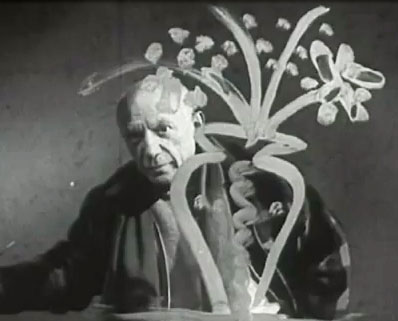
Picasso paints on glass, 1950. Click image for more.

One of the most interesting, and unexpectedly so, materials he examines is glass — a substance so ubiquitous in modern life and yet, at its best, so invisible. Duality and paradox, in fact, seem to be baked into the very nature of glass — quite literally. Before he plunges into the meaty interestingness of this singular material and its cultural history, Miodownik explains the no less interesting basic science of how sand becomes glass — one of the most remarkable transmutations in the observable physical universe:

Sand is a mixture of tiny bits of stone that have fallen off larger bits of rock as a result of the wind and the waves and other wear and tear that stones have to put up with. If you take a close look at a handful of sand you will find that a lot of these bits of stone are made of quartz, a crystal form of silicon dioxide. There is a lot of quartz in the world because the two most abundant chemical elements in the Earth’s crust are oxygen and silicon, which react together to form silicon dioxide molecules (SiO2). A quartz crystal is just a regular arrangement of these SiO2 molecules, in the same way that an ice crystal is a regular arrangement of H2O molecules or iron is a regular arrangement of iron atoms. Heating up quartz gives the SiO2 molecules energy and they vibrate, but until they reach a certain temperature they won’t have enough energy to break the bonds that hold them to their neighbors. This is the essence of being a solid. If you keep heating them, though, their vibrations will eventually reach a critical value — their melting point — at which they have enough energy to break those bonds and jump around quite chaotically, becoming liquid SiO2. H2O molecules do the same thing when ice crystals are melted, becoming liquid water.

But here’s the rub — when you put that liquid water into the freezer, it has no trouble refreezing into ice crystals.

More here.

Why Germany Wants to Look Like Its Soccer Team

German-flags

Brian Blickenstaff in Pacific Standard (Photo: 360b/Shutterstock):

FOOTBALL IN GERMANY IS influential in a way that is difficult to overstate—and, in the United States, difficult to find a comparison for. The DFB, Germany’s Football Association, the sport’s governing body, is the world’s largest. “[It] has almost 7 million members now,” says Uli Hesse, a German football historian and author of Tor! The Story of German Football. (Seven million is about 8.7 percent of the German population.) “You know the saying over here is that the three biggest sports in Germany are football, football, and football.”

Only the top four or five divisions overseen by the DFB are professional or semi-professional and therefore subject to the meritocratic integration of that world. The rest—about 25,000 clubs—are amateur. In Germany’s largest cities, according to Gerd Dembowski, a German researcher who has specialized in football culture for 20 years, almost 50 percent of those amateur teams at the junior and senior levels are composed of players coming “from the roots of the Guestarbeiter.”

“If [those players] stopped playing football,” Dembrowski says, “football would not be here anymore.”

One of the DFB’s jobs is to cast a wide net in search of the country’s best players. At the amateur level, teams are sometimes segregated or set up by specific ethnic groups—like Turks or Poles—which can create tension on the soccer field that goes beyond a desire to win or lose. For the DFB to properly carry out its mission, the organizations must run a league system that’s inclusive, and that means addressing ethnic tensions and other integration issues at the grassroots level.

“[The DFB] are investing in long-term development right now,” Dembowski says. “They’re not investing any more in the easy ways of saying no to racism. They do this, of course … but they also invest in the lower leagues, more and more. They invest money and they invest in giving the privileges to the people. For a long time, it was the Germans saying, ‘Oh, they have to adapt. They have to become like us. They have to change. They have to approach us.’ But now the German Football Association and the other players who are involved in football as institutions, they show openly that, ‘We have to change, too.’ People coming from [elsewhere] change the whole.”

The idea that ethnic Germans have a responsibility to adapt to immigrants has taken hold in other parts of German society too. In this way, the DFB, and the symbolism of the national team, have a real impact on German culture as a whole.

More here.

Stefan Zweig and the Long Night’s Dawn

ImpossibleCover-243x366

Morten Høi Jensen reviews George Prochnik's The Impossible Exile : Stefan Zweig at the End of the World, in the LA Review of Books:

WRITING from his American exile in the late 1940s, the Austrian novelist Hermann Broch composed a bitter indictment of the Viennese society in which he grew up, and whose exalted golden age he now viewed as little more than a dubious facade. Vienna, he wrote in his book-length essay Hugo von Hofmannsthal and His Time, was the center of a kind of post-1848 European value vacuum. “It was really far less a city of art than a city of decoration par excellence […] A minimum of ethical values was to be masked by a maximum of aesthetic values.” Broch, who narrowly escaped the concentration camps thanks to a campaign led by James Joyce, had witnessed firsthand a decline of civilized society so steep that it forced him to question whether that society had ever really existed in the first place. Or if it did, why it had been so easily disfigured? What good were all the books and paintings and scientific advances, the sculptures and symphonies and psychiatric paradigms, when it could be toppled so easily by the same society that had nourished it? How could 200,000 residents of a city whose shining stars included names like Mahler, Freud, Schnitzler, and Zweig, converge on Heldenplatz to applaud their invasion by Nazi Germany?

Few writers pondered these questions more intimately, and with greater personal consequence than Stefan Zweig, the Austrian writer currently enjoying a wave of popularity in England and America. In the opening pages of his celebrated memoir The World of Yesterday (1941), which describes his own experience of leaving the world he had loved, Zweig considered the rationalistic faith in progress that characterized his parents’ generation — the same generation Broch now held in such scorn. It was, Zweig wrote, “[an] idealistically blinded generation,” duped by the notion that great advances in science and technology necessarily spelled great moral advancement. He credited Freud with having anticipated what the First World War brutally affirmed: that culture and civilization “were merely a thin layer liable at any moment to be pierced by the destructive forces of the ‘underworld.’”

But where Hermann Broch ultimately saw “one of the most wretched” facades in human history, Zweig recognized “a wonderful and noble delusion.”

More here.

The phantom women who changed American music and then vanished without a trace

Record-factory-and-recording-studio-building-1280

John Jeremiah Sullivan's interactive piece in the NYT Magazine (photo: Alex van der Tuuk Archives) [h/t: Todd Weeks]:

IN THE WORLD of early-20th-century African-American music and people obsessed by it, who can appear from one angle like a clique of pale and misanthropic scholar-gatherers and from another like a sizable chunk of the human population, there exist no ghosts more vexing than a couple of women identified on three ultrarare records made in 1930 and ’31 as Elvie Thomas and Geeshie Wiley. There are musicians as obscure as Wiley and Thomas, and musicians as great, but in none does the Venn diagram of greatness and lostness reveal such vast and bewildering co-extent. In the spring of 1930, in a damp and dimly lit studio, in a small Wisconsin village on the western shore of Lake Michigan, the duo recorded a batch of songs that for more than half a century have been numbered among the masterpieces of prewar American music, in particular two, Elvie’s “Motherless Child Blues” and Geeshie’s “Last Kind Words Blues,” twin Alps of their tiny oeuvre, inspiring essays and novels and films and cover versions, a classical arrangement.

Yet despite more than 50 years of researchers’ efforts to learn who the two women were or where they came from, we have remained ignorant of even their legal names. The sketchy memories of one or two ancient Mississippians, gathered many decades ago, seemed to point to the southern half of that state, yet none led to anything solid. A few people thought they heard hints of Louisiana or Texas in the guitar playing or in the pronunciation of a lyric. We know that the word “Geechee,” with a c, can refer to a person born into the heavily African-inflected Gullah culture centered on the coastal islands off Georgia and the Carolinas. But nothing turned up there either. Or anywhere. No grave site, no photograph. Forget that — no anecdotes. This is what set Geeshie and Elvie apart even from the rest of an innermost group of phantom geniuses of the ’20s and ’30s. Their myth was they didn’t have anything you could so much as hang a myth on. The objects themselves — the fewer than 10 surviving copies, total, of their three known Paramount releases, a handful of heavy, black, scratch-riven shellac platters, all in private hands — these were the whole of the file on Geeshie and Elvie, and even these had come within a second thought of vanishing, within, say, a woman’s decision in cleaning her parents’ attic to go against some idle advice that she throw out a box of old records and instead to find out what the junk shop gives. When she decides otherwise, when the shop isn’t on the way home, there goes the music, there go the souls, ash flakes up the flue, to flutter about with the Edison cylinder of Buddy Bolden’s band and the phonautograph of Lincoln’s voice.

I have been fascinated by this music since first experiencing it, like a lot of other people in my generation, in Terry Zwigoff’s 1994 documentary “Crumb,” on the life of the artist Robert Crumb, which used “Last Kind Words” for a particularly vivid montage sequence. And I have closely followed the search for them over the years; drawn along in part by the sheer History Channel mysteriousness of it, but mainly — the reason it never got boring — by their music.

Outside any bullyingly hyperbolical attempts to describe the technical beauty of the songs themselves, there’s another facet to them, one that deepens their fascination, namely a certain time-capsule dimension.

More here.

Schelling, Adorno and All that Jazz

Photo-3-768x1024

Richard Marshall interviews Andrew Bowie in 3:AM Magazine:

3:AM: You find Daniel Barenboim and Edward Said’s East-West Divan orchestra an illustration of one of the key reasons why you think music important. Can you say something about this and how it illustrates your approach to music that it is only through our activities that the world can be disclosed to us and we can enter into it?

AB: The Barenboim-Said Orchestra offers an example of communication between people whose political views are often totally opposed. Barenboim cites two musicians from the orchestra on opposed sides of the Arab-Israeli disputes who cannot agree at all on issues of justice and politics, but who can agree on the importance of getting the phrasing in a Beethoven symphony right. Philosophers also hardly ever agree on anything, but they have to coexist, so finding modes of communication and interaction which circumvent inevitable differences should be crucial. The point of something like music, where participation is essential, is that what happens in successful participation cannot be fully cashed out in discursive terms. Our political judgements, on the other hand, should have to be publicly cashed out, and this means we often arrive at irreconcilable conflicts, where both sides’ judgements may, of course, anyway be mistaken.

The existence of a practice where a different kind of agreement is possible can help suggest how theoretical differences can be overcome by involvement in a practice. That does not mean that the world of music is devoid of antagonism and disagreement – it is actually notorious for being riven by conflict – but it does also offer examples of cooperation and communication beyond everyday antagonisms in other domains. That is one of the things I love about the jazz scene, where people from wildly different backgrounds, with very different levels of experience and skill, and very different musical conceptions, can play together successfully. People invest in music because it always already makes some kind of sense: establishing what that sense is by a philosophical theory is unlikely to intensify the investment, because the theory is at a different level of sense from the sense that makes people invest in the practice of music in the first place. The objectifying tendency of much philosophy can easily obscure essential dimensions of sense, of the kind generated in participatory cultural activities. That is not to say, as Adorno, not always wholly successfully, reminds us, that music cannot become ideological and open to misuse, but without an adequate prior awareness of the primary level of sense in music, that concern would be baseless.

More here.

Wednesday Poem

Dear Loretta, Mistress Mine

I am the jackal that lurks in your halls of freedom
I am the snake that slithers in your garden
I am the lion that roars in your neighboring hills

I have heard you singing as you went about your
daily tasks
I have watched you basking, browsing in the sun
I have watched your goings-in and goings-out

How I have longed for you, Loretta, Mistress mine
How my heart has ached for you
morning, afternoon and evening
But my desire is only to rob you of your innocence.

Unsuspecting,
I have seen you lavish me with your smile
and I will lure you, Loretta, with my riches and guile
and leave you, Loretta, when I’ve
had my fill
and the jackal has picked the bones.
.

by Cosmas Mairosi
from Poetry International, 2006

The Ancient Egyptian invention that made everything else possible

John Gaudet in Salon:

SphinxThe history of Egypt boggles the mind. By any standard the scale of achievement was enormous, but through it all, it seems clear that the economy remained rooted in agriculture. It was the everyday business of the ancient Egyptians to produce food. This they did using a system that was the envy of all. Sandra Postel, Director of the Global Water Policy Project, said that overall, Egypt’s system of basin irrigation proved inherently more stable from an ecological, political, social, and institutional perspective than that of any other irrigation-based society in human history, including the Fertile Crescent of Mesopotamia where a fallow year had to be interposed to rest the land between harvests on land that was also subject to salinization, something that did not happen along the Nile. “Fundamentally … the system sustained an advanced civilization through numerous political upheavals and other destabilizing events over some 5,000 years. No other place on Earth has been in continuous cultivation for so long.”

According to Dr. Butzer, during late Paleolithic times the great bulk of early settlements were concentrated in the floodplains on the levees and the immediate riverbanks of the Nile. From 5000 BC, well before the first wooden boats, it probably occurred to most Egyptians that travel by water was a must. Today from satellite images, arable land in the Nile Valley is seen as a long green swath running the length of Egypt, with a bright blue river running down its center reminding everyone that if they intended to travel from one end of the country to the other, the message was clear: use a boat. Since boats made of wood were costly, everyday vessels—the thousands, even millions of small craft that were the work boats of ordinary souls—had to be made of cheap, reliable stuff. And that was as true in prehistoric times as it is in the 21st century. Today it is plastic and fiberglass. Then, it was papyrus.

More here.

Still Exerting a Hold on Science: Defying Gravity

George Johnson in The New York Times:

GravityNot long after the bombings of Hiroshima and Nagasaki, while the world was reckoning with the specter of nuclear energy, a businessman named Roger Babson was worrying about another of nature’s forces: gravity. It had been 55 years since his sister Edith drowned in the Annisquam River, in Gloucester, Mass., when gravity, as Babson later described it, “came up and seized her like a dragon and brought her to the bottom.” Later on, the dragon took his grandson, too, as he tried to save a friend during a boating mishap. Something had to be done. “It seems as if there must be discovered some partial insulator of gravity which could be used to save millions of lives and prevent accidents,” Babson wrote in a manifesto, “Gravity — Our Enemy Number One.” In 1949, drawing on his considerable wealth, he started the Gravity Research Foundation and began awarding annual cash prizes for the best new ideas for furthering his cause. It turned out to be a hopeless one. By the time the 2014 awards were announced last month, the foundation was no longer hoping to counteract gravity — it forms the very architecture of space-time — but to better understand it. What began as a crank endeavor has become mainstream. Over the years, winners of the prizes have included the likes of Stephen Hawking, Freeman Dyson, Roger Penrose and Martin Rees.

With his theory of general relativity, Einstein described gravity with an elegance that has not been surpassed. A mass like the sun makes the universe bend, causing smaller masses like planets to move toward it. The problem is that nature’s other three forces are described in an entirely different way, by quantum mechanics. In this system forces are conveyed by particles. Photons, the most familiar example, are the carriers of light. For many scientists, the ultimate prize would be proof that gravity is carried by gravitons, allowing it to mesh neatly with the rest of the machine.

More here.

Tuesday, June 24, 2014

ILLEGAL MARIJUANA IN HUMBOLDT COUNTY, CALIFORNIA,

Article_ellisLee Ellis at The Believer:

Since 1996, Californians with the right doctors’ notes have had legal clearance to grow and possess pot. That year, Proposition 215, a voter initiative granting limited immunity from prosecution to “seriously ill” residents whose health conditions might be improved by the use of the drug, passed on a statewide ballot. In 2003, Senate Bill 420 upheld the law, and added a handy medical marijuana ID card program (to date, nearly seventy-two thousand cards have been issued). Neither the proposition nor the senate bill superseded federal law, however; as such, raids on growers and dispensaries carried out by federal agents were frequent from 1996 until March 2009, when Attorney General Eric Holder announced that marijuana grows and storefronts complying with state law would not be a priority for the Obama administration.

In the wake of the proposition, twenty states and the District of Columbia passed medical marijuana legislation. Colorado and Washington recently went a step further by permitting recreational use. While traditionally conservative states have been slow to relax harsh punishments for possession (in Kansas, holding any amount of marijuana—even a single gram—can earn the offender up to a year in prison), it’s clear that blue America is trending toward legalization.

more here.

How profit trumped passion in the beautiful game

71177424Shougat Dasgupta at Caravan:

Being a football fan used to be about being local, about sublimated parochialism, about pride in your team and, synecdochically, your neighbourhood, your city, your country. Supporting a football team was an expression of solidarity, an assertion of community. Football culture was by its nature insular, and this was as true in India as, say, in Britain. Take Celtic and Rangers in Glasgow, Al Ahly and Zamalek in Cairo, East Bengal and Mohun Bagan in Kolkata: all local rivalries with attendant histories of identity, immigration, belonging, class, even food; rivalries made piquant by proximity. It was a culture built on shared experience, on being at the stadium with your people, on active partisan support. There is no need to gloss over the violence such insularity can breed—the deaths of sixteen fans in Kolkata in 1980, for instance, when a derby unravelled into a riot—to acknowledge how intrinsic football once was to fans’ understanding of their place in the world.

Early in Dev Dutta Roy’s An Incredible Tale from the Beautiful Game—an awful novel made endearing by the author’s affection and enthusiasm for Kolkata football—is a throwaway sentence that encapsulates what it once meant to be a football fan. “It was a Sunday morning of September,” he writes. “All the newspapers of Calcutta, of which Dadu used to buy three—Anandabazar and Juganter in Bengali and The Statesman in English—were talking about a great match that was going to be played four fifteen that afternoon … I and Kakka never missed such a big match. We were morally bound to be there.”

Morally bound to be there.

more here.