
Category: Recommended Reading
Review of Paul Scheerbart, Lesabéndio: An Asteroid Novel

For admirers of the work of Walter Benjamin, a translation of Paul Scheerbart’s Lesabéndio: An Asteroid Novel is a major event. Benjamin continually lauded Lesabéndio throughout his life, most decisively in his famous vision of architectural politics, “Experience and Poverty” of 1933. Benjamin’s interest in Scheerbart spans the whole of his career, from Gershom Scholem’s gifting him the book at his wedding to an essay on Scheerbart written near the end of his life. Most significantly, Benjamin intended to write an extensive essay on the book that was meant as a fulfillment of the claims set out in “The Destructive Character” and was to be provocatively entitled “The True Politician.” As the Benjamin literature grows, so does Scheerbart’s reputation. Since 2007 there has been a dramatic rise in the stature of Scheerbart’s writings, including the translation of four books and a range of essays and artistic projects related to his work. At the center of Scheerbart’s current reputation is the identification of technology (glass and steel) and politics. As Josiah McElheny, the artist whose work has revolved around Scheerbart’s example in recent years, recently put it, the “most important aspect of Scheerbart’s thinking” is to see how his “world of fantasy was in fact his attempt to discuss politics by other means.”
Scheerbart’s 1913 sci-fi novel—undoubtedly his most significant literary achievement—provides another in a series of wildly ambitious architecturally-based explorations of utopia.
more here.
The working life of Brian Eno

In January, 1975, the musician Brian Eno and the painter Peter Schmidt released a set of flash cards they called “Oblique Strategies.” Friends since meeting at art school, in the late sixties, they had long shared guidelines that could pry apart an intellectual logjam, providing options when they couldn’t figure out how to move forward. The first edition consisted of a hundred and fifteen cards. They were black on one side with an aphorism or an instruction printed on the reverse. Eno’s first rule was “Honour thy error as a hidden intention.” Others included “Use non-musicians” and “Tape your mouth.” In “Brian Eno: Visual Music,” a monograph of his musical projects and visual art, Eno, who still uses the rules, says, “ ‘Oblique Strategies’ evolved from me being in a number of working situations when the panic of the situation—particularly in studios—tended to make me quickly forget that there were other ways of working and that there were tangential ways of attacking problems that were in many senses more interesting than the direct head-on approach.”
Eno is widely known for coining the term “ambient music,” and he produced a clutch of critically revered albums in the nineteen-seventies and eighties—by the Talking Heads, David Bowie, and U2, among others—but if I had to choose his greatest contribution to popular music it would be the idea that musicians do their best work when they have no idea what they’re doing.
more here.
Restoring the World in the Climate Change Century

It is difficult for anybody who looks dispassionately at the statistics that echo our depletion of the Earth’s resources, and illustrate how wounded is the world of nature, not to be profoundly disheartened at times. The human population has increased four-fold over the last hundred years, and doubled in our lifetime, but our use of water resources has grown nine-fold in that time, climate emissions have increased seventeen-fold, overfishing by a multiple of thirty-five. The rainforests that harbour most terrestrial biodiversity have dwindled: Madagascar has lost ninety-three per cent of its forest, ninety-nine per cent of the Atlantic coast forest of Brazil is gone, the island forests of Polynesia and the Caribbean have disappeared altogether. At the current rate of extinction, thirty per cent of species will be gone by 2050.
The growing concern among ecologists about the rate of species extinction, and the urgent need to do something more focused about halting or reversing it, resulted in the formation of the Society for Ecological Restoration in 1987 and the establishment of the journal Restoration Ecology. There is now a flood of scientific papers in this and other publications documenting the theory and practice of our attempts to try to patch a few of the holes in the unravelling fabric of biological and ecological diversity in every quarter of the Earth.
more here.
The Pleasure of the Text: Hervé Guibert’s unbridled eroticism
Wayne Koestenbaum in Bookforum:

I might as well mention some impediments. I can’t write about Guibert without mentioning his beautiful face: His literary greatness is tied, Laocoön style, to his attractiveness. I can’t write about Guibert without noting the historical coincidence that he’s dead and I’m not: He was born only three years before me. And I can’t objectively evaluate the work of a writer I take personally and envy, though I can’t entirely wish to trade places with a man—however much he qualifies as an idealizable hyacinth—who died so young.
More here.
Ash Forests After Emerald Ash Borers Destroy Them
Maggie Koreth-Baker in The New York Times:

Emerald ash borers do their damage as larvae, eating into the bark and burrowing deep into the trunk to insulate themselves against the cold. In the process, they cut off access to the nutrients and water that the tree needs to survive; it is like severing a human’s network of veins and arteries. After surviving the unusually cold winter, the beetles emerged in spring as adults. Now they are mating and laying eggs, leaving the next generation of larvae to tunnel through the trees’ internal organs. They can kill an ash tree in as little as two years.
More here.
Tuesday Poem
You Are the Penultimate Love of My Life
.
.
I want to spend a lot but not all of my years with you.
We’ll talk about kids
but make plans to travel.
I will remember your eyes
as green when they were gray.
Our dogs will be named For Now and Mostly.
Sex will be good but next door’s will sound better.
There will be small things.
I will pick up your damp towel from the bed,
and then I won’t.
I won’t be as hot as I was
when I wasn’t yours
and your hairline now so
untrustworthy.
When we pull up alongside a cattle car
and hear the frightened lows,
I will silently judge you
for not immediately renouncing meat.
You will bring me wine
and notice how much I drink.
The garden you plant and I plant
is tunneled through by voles,
the vowels
we speak aren’t vows,
but there’s something
holding me here, for now,
like your eyes, which I suppose
are brown, after all.
.
.
by Rebecca Hazelton
from Vow
Cleveland State University Press Poetry Center.
Monday, June 30, 2014
Perceptions

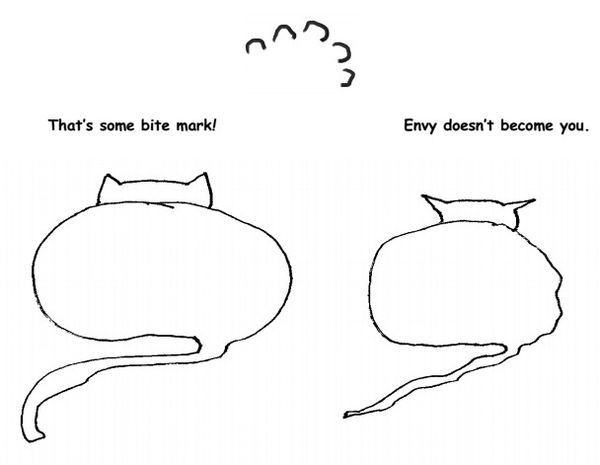
CATSPEAK
by Brooks Riley
Sunday, June 29, 2014
A Case of Mohammad Hanif
From The Daily Star:

In this interview with the SLR editor, Mohammed Hanif talks about the mystery of babies, an occasional need to shout from rooftops and reminds Dhakaites how important it is not to take even a bit of freedom for granted.
SLR: How has your writing sensibilities been shaped by your earliest reading?
MH: There were about two and a half books in the village where I grew up. Colonel Mohammed Khan's Bajang Amad – the memoir of a Punjabi officer in Second World War – was very funny, very exotic. The second one was a collection of miracles performed by Muslim saints; fantastic. We also used to get a free government-published magazine by the Family Planning Ministry. It was quite mysterious because you never learnt how babies are made. And then there was China Pictorial everywhere. I am sure every little bit that I read influenced me.
SLR: You are both a writer and a journalist. We all know the responsibility a journalist has. Do you think you have a responsibility as a writer from Pakistan?
MH: I hope not. I mean I should try not to bore my readers or lecture them because that I can do as a journalist.
More here.
ultra violet (1935 – 2014)
Tinker: John Forshee
Gavrilo Princip, Conspiracy Theories and the Fragility of Cause and Effect
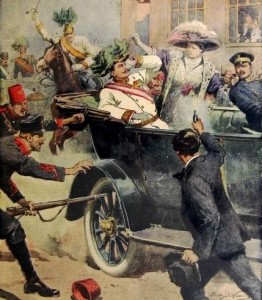
Ashutosh Jogalekar in Scientfic American (Achille Beltrame's illustration of the June 28, 1914 assassination of the Archduke Franz Ferdinand by Gavrilo Princip (Image: Wikipedia)):
When you read the story of the shots that led to World War 1, what strikes you is how staggering the gulf between cause and effect was, how little it takes for history to change, how utterly subject to accidental and unlikely events the fickle fortunes of men are. Reading the story of Princip and the Archduke, one sometimes gets the feeling of being no more than wood chips being cast adrift on the roaring river of history.
The dark comedy of the assassination of the Archduke and his wife is succinctly narrated in skeptic and writer Michael Shermer’s highly readable book “The Believing Brain“, and the story is as good an example of the roots of conspiracy theories as any other. It sheds light on human psychology and illuminates conspiracy theorizing in all scientific quarters, ranging from creationism to climate change denial.
Shermer recounts how, on that fateful day, six conspirators waited in the shadows to carry out their deed. When the Archduke’s motorcade passed close by, the first two conspirators failed to take any shots because of the crowds and an inadequate line of sight. The next conspirator managed to throw a bomb at the Archduke’s car but it simply bounced off and fell into the car behind. The two conspirators quietly disappeared while the third tried to commit suicide by ingesting cyanide but simply vomited and was captured by the police. Unlucky Princip and the other two insurgents gave up and sauntered away. Meanwhile the Archduke made it all the way to the city hall and gave a speech, expressing outrage to the mayor that he had just been subjected to an assassination attempt.
Since the Archduke had just expressed outrage at an attempted assassination, he should have known better than to drive back the same way he came. However it seems that only one of the generals in his entourage suggested taking an alternative route back. But in the heat of the moment, for some reason this timely advice was not communicated to the driver who decided to again drive back through the city center. While this was happening Princip had purportedly given up and was hanging around a bakery, maybe enjoying a pastry. However when he saw the car return on the same route the opportunity was too good to pass; more so since the transmission seemed to be jammed and the driver could not back up. The rest is very much history.
More here.
St Paul, Caravaggio and the agonised Catholicism of Pasolini
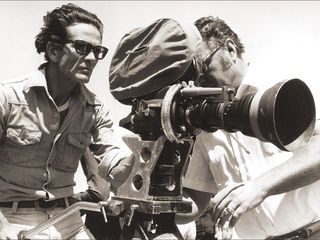
Ian Thomson on Pier Paolo Pasolini's St Paul: a Screenplay; translated by Elizabeth A Castelli, in The New Statesman (Photo: Mondadori via Getty):
San Paolo, published posthumously in 1977 and presented here for the first time in English as St Paul, is Pasolini’s screenplay for the life of the apostle. Drafted in 1966 and subsequently rewritten, it was intended to be a sequel toThe Gospel According to Matthew (1964), shot in the lunar landscape of Italy’s Basilicata region. The screenplay, with its New Testament voice-over, typically mingles an intellectual leftism with a Franciscan Catholicism: blessed are the poor, for they are exempt from the unholy trinity of materialism, money and property. The film was never made, for lack of funds.
Pasolini’s solidarity with the poor was at heart romantic. La ricotta, his 35-minute episode in the collaborative film RoGoPaG (1963), features Orson Welles as an American director shooting a film in Rome about Christ’s Passion. Stracci (the name means “rags”), the sub-proletarian actor who plays the part of the good thief, dies on set from a case of real-life starvation. For all its manifest compassion, the film led to a suspended prison sentence for Pasolini on blasphemy charges. Over a tableau vivant inspired by a Caravaggio-like painting of the Deposition, Welles cries out sacrilegiously: “Get those crucified bastards out of here!”
Like La ricotta, St Paul champions those who have been disinherited by capitalism and the “scourge of money”. Pasolini believed that the consumerist “miracle” of 1960s Italy had undermined the semi-rural peasant values of l’Italietta (Italy’s little homelands). In the director’s retelling of the Bible, Paul stands as a bulwark against the “corruption” brought to Italy by Coca-Cola, chewing gum, jeans and other trappings of American-style consumerism.
Nevertheless, as the former Saul, a Pharisee and persecutor of Christians, Paul was an ambivalent figure for Pasolini.
More here.
In Conversation with “House of Cards” Creator Beau Willimon
“The Skeleton Crew”: How a motley band of amateurs solves cold cases online

Laura Miller in Salon:
The idealistic notion of an army of smart volunteers taking to the Internet to help solve crimes suffered a serious knock last year. That’s when cocky amateur detectives at Reddit.com took it upon themselves to scrutinize photos snapped just before the Boston Marathon bombing in search of likely “suspects.” Crowd shots were posted to the Web, complete with incriminating circles and arrows pointing to innocent spectators, many of whom just happened to have brown skin. When the FBI released closed-circuit camera images of the actual perpetrators (neither of whom had been fingered by the Redditors), some site members then went on to argue that one of the suspects was Sunil Tripathi, a missing college student later found drowned in Rhode Island. It was a clueless, hurtful and potentially dangerous performance that did not bode well for the future of crowdsourced law enforcement.
Let Deborah Halber’s “The Skeleton Crew: How Amateur Sleuths Are Solving America’s Coldest Cases” stand as a partial corrective to the hubris of the Redditors. Halber, a science writer, recounts how a motley band of committed hobbyists have devoted countless unpaid hours to linking unidentified human remains with missing-person reports. The case that serves as her framing device — “Tent Girl,” a young woman whose body was discovered wrapped in a striped tarpaulin off Route 25 in Scott County, Kentucky — was 30 years cold when a factory worker named Todd Matthews matched her to a listing posted by a woman in search of her long-lost sister.
Matthews solved that one all the way back in 1998, when the Web was young. As Halber reveals, listings of missing persons and unidentified bodies were among the first things average citizens wanted to put on the Internet. It turns out there are a lot of unidentified bodies out there. No one can say for sure how many because real-life law enforcement organizations are much less proficient at collecting and sharing information than the ones on TV.
More here.
jimmy c. newman (1927 – 2014)
Sunday Poem
The Buried Rib Cage
Eve slipped from its arced ridge-
the only body part
you don't
……do evil with:
the eye, the hand,
might beg
….. corruption;
the ribs are modest
shy crests, ticklish,
………. an open fan,
not quite sexual, yet not putitan:
delicate accordion
……………… -yawn, moan-
Soul breathes through its comb.
.
by Eve Grubin
from Morning Prayer
Sheep Meadow Press, 2005
Bad Chompers & Bum Tickers
Rebecca Kreston in Discover:

When the severity of periodontal disease was directly measured in a 2006 Swedish study by counting existing pockets of infection and decay, it was found to be associated with hypertension in a dose-dependent manner (7). In other words, the lack of oral maintenance that allows build-up of bacteria on our chompers allows a similar build-up in less visible but far more life-threatening locales as well.
More here.
Boyhood is a battlefield: The dangerous expectations of early masculinity
Judy Y. Chu in Salon:

While this popular discourse on boys has been helpful in drawing attention to possible problems pertaining to boys’ gender socialization, it has been limited by its tendency to pathologize boys and problematize boys’ development. For example, most of these books are based on clinical populations of boys and adopt a diagnostic approach to understanding boys’ development. Starting from the assumption that there is something wrong with boys, these books emphasize their alleged emotional and relational deficiencies (as compared to girls) and aim to identify what is wrong and who or what is to blame. Boys’ emotional capacities and relational strengths are rarely mentioned, much less addressed. Furthermore, these books do not account for group and individual differences in boys’ socialization experiences and outcomes, including how some boys manage to thrive, and not merely survive, within the same contexts that can be debilitating for other boys.
More here.