THE FIRST GREAT FEMALE ARCHITECT

From More Intelligent Life:

Zaha%20face2_0When Tokyo won the bid for the 2020 Olympics, it was more good news for Zaha Hadid, who is designing the new national stadium. Six years ago, we published a profile by Jonathan Meades saying, “The world is waking up to her”

ZAHA HADID'S PRACTICE occupies a former school in Clerkenwell, an area of London that still bears the scent of Dickens. It's an 1870s building designed by the London School Board architect E.R. Robson, who, typically of his profession, was unquestionably formulaic. Still, his was a sound enough formula. Today the high, plain, light rooms are crammed to bursting with Hadid's 200 or so employees. Though they are of every conceivable race, they are linked by their youth, their sombre clothes, their intense concentration. They gaze at their screens, astonishingly silently. There is little sound other than the click of keyboards and a low murmur from earphones. They don't talk to each other. It is as though they are engaged in a particularly exigent exam. It feels more like a school than a former school. And it feels more like a factory than a school. If there is such a thing as a physical manifestation of the dubious concept called the knowledge economy, this is it. This is a site of digital industry.

“What is exciting,” says Zaha, “is the link between computing and fabrication. The computer doesn't do the work. There is a similar thing to doing it by hand…”

“The computer is a tool,” I agree.

“No. No, it's not…”

What then? The workers on the factory floor–my way of putting it, not hers–are, she says “connected by digital knowledge…They have very different interests from 20 years ago.” Sure. But this does not make immediate sense. It is a matter to return to, that will become clear(ish) in time.

TEN MINUTES' WALK from the practice is Hadid's apartment—austerely elegant, a sort of gallery of her painting and spectacularly lissom furniture. It's a monument to Zaha the public architect rather than Zaha the private woman. It occupies a chunk of an otherwise forgettable block. Her route from home to work might almost have been confected as an illustration of the abruptness of urban mutation. Here is ur-London: stock bricks and red terracotta, pompous warehouses, run-down factories, Victorian philanthropists' prison-like tenements, grim toytown cottages, high mute walls, a labyrinth of alleys, off-the-peg late-Georgian terraces, neglected pockets of mid-20th-century Utopianism, apologetic infills, ambiguous plots of wasteground. It is neither rough nor pretty, but it has sinewy character. It may be ordinary, but it is undeniably diverse. The daily stroll through this canyon of variety is surely attractive to an artist whose aesthetic is doggedly catholic, each of whose buildings seems unsatisfied with being just one building.

More here.

‘Game of Thrones’ scenario seen in Neandertal ancestors

Kerry Sheridan in PhysOrg:

SkullThe vicious fight for survival and power among disparate kingdoms and clans may have led some ancient people to evolve facial traits more quickly than others, a study said Thursday. New research on 17 skulls from a collection of 430,000-year-old remains found at the base of an underground shaft in Spain suggests that big jaws were the first prominent feature of these pre-Neandertals. Their large mandibles could gnash meat, open wide and be used like a tool or a third hand, helping them adapt to their eating needs in a harsh, cold environment. The fact that their skulls were compact, suggesting a small brain, indicates that the development of the larger brain seen in Neandertals came later in the evolutionary process, according to the study in the US journal Science. The group is the largest known discovery of early human remains, including 28 individuals, of whom nearly 7,000 bone fragments have been excavated since the Sima de los Huesos site in the Atapuerca Mountains was uncovered in 1984. They were young adults when they died, raising a host of questions that have yet to be answered by science: How did they die? How did they get to their resting place at the base of the shaft? Scientists say they may have been pitched—ceremoniously or not—into a pit by their conquerors.

Lead researcher Juan-Luis Arsuaga from the Complutense University of Madrid described their story in terms of “Game of Thrones,” a popular fantasy television series based on novels by George R.R. Martin. We think that a 'Game of Thrones' scenario probably describes hominin evolution in Eurasia and Africa in the Middle Pleistocene period,” he told reporters. “As in the famous serial, there was never a unified and uniform European Middle Pleistocene kingdom but a number of 'houses,' living in different regions and often competing for land,” he added. Some groupings were closely related, including members of the same extended family, but others were not.

More here.

Thursday, June 19, 2014

The 3 Quarks Daily 10th Anniversary Meetup in New York City

ScreenHunter_698 Jun. 19 16.24

Dear Reader,

Next month it will be a full ten years since that evening in Manhattan in 2004 when, with my friend Marko Ahtisaari's encouragement, I signed up for a Typepad account, thought of the name 3 Quarks Daily, designed a temporary logo (above), and put up my first posts.

ScreenHunter_700 Jun. 19 17.07

Me and Robin (at his wedding)

We've come a long way since that day: we have done almost 35,000 posts, published several thousand original essays, and we have received around 30 million page views. In these ten years, we have had exactly and only one day when we did not post anything (long story), otherwise we have taken no holiday. Ever. Sometimes 3QD seems like an overwhelming and relentless duty to me from which there is never any escape, not even for just a week out of the year, but for the most part I enjoy it. Well, obviously. Why else would I do it?

I would like to thank all of the many, many people who have joined me and contributed in some way or other to the evolution and progress of the website by name but there are just too many. You know who you are and you also know that I am grateful. I will take this opportunity to personally thank Morgan Meis, Robin Varghese, Azra Raza, Sughra Raza, Jim Culleny, and Zujaja Tauqeer, for all that they have done and continue to do to make this site one worth coming to for so many intelligent and highly educated readers, and to say this to them: guys and gals, I am in your debt!

KBH_high_resolution-29Now, to the important thing: I will be in New York City on July 3rd and would like to invite all of you to join me here. They have a beautiful space, Robin assures me, and some fine drinks and food are available for purchase. Most of the editors of 3QD will be there as well as quite a few of our writers (well, those who happen to live in NYC). So come and hang out with us, won't you?

PLACE: Die Kölner Bierhalle

TIME: 6 pm to 10 pm

DATE: Thursday, July 3, 2014

RSVP: In the comments section of this post.

I am looking forward to meeting you, so see you there!

Yours,

Abbas

The Fathers of Philosophy

John Kaag in the Chronicle of Higher Education:

Photo_51339_portrait_large“Do you want to cut it?”

No. I wanted to run and hide. To find some quiet corner of the hospital that had nothing to do with pregnancy, labor, or children. Like the psychiatric ward. It didn’t even look like something that was meant to be cut—it looked like something between a vital artery and the nylon rope you buy at the hardware store. So cutting it was the last thing I wanted to do.

Instead, I wanted to point out to our lovely midwife that my father hadn’t even been in the delivery room when I was born. (In that moment, for the first time ever, I found myself not entirely blaming him.) I also wanted to tell her that I’d only very recently stopped calling her “the Wiccan Priestess,” but that her question had once again convinced me that she clearly was one. Didn’t she know that I was a philosopher, not a surgeon, and therefore not schooled in this sort of occult ritual? More than anything, I wanted to state the obvious: that one end of that cord was attached to the only woman I’d ever really loved, and the other end was affixed to a total stranger. And that once I cut it, that little stranger would become its own person, and would be irreparably ours to take care of.

So, no. I definitely did not want to cut it.

More here.

The sectarian myth of Iraq

Sami Ramadani in The Guardian:

ScreenHunter_697 Jun. 19 16.05Tony Blair has been widely derided for his attempted justification of the 2003 Iraq invasion, and his claim last weekend that he's blameless over the current turmoil. Unfortunately, though, many of his critics have also bought into a central plank of his argument: that Iraqi society is no more than a motley collection of religions and ethnicities which have been waiting for decades, if not centuries, to slaughter each other and plunge the place into a bloodbath.

The main difference between the two sides seems to be that Blair believes western intervention is the answer; some of his critics say Iraq needed a dictator like Saddam to hold the nation together. Neither side, though, has yet produced historical evidence of significant communal fighting between Iraq's religions, sects, ethnicities or nationalities. Prior to the 2003 US-led occupation, the only incident was the 1941 violent looting of Jewish neighbourhoods – which is still shrouded in mystery as to who planned it. Documents relating to that criminal incident are still kept secret at the Public Records Office by orders of successive British governments. The bombing of synagogues in Baghdad in 1950-51 turned out to be the work of Zionists to frighten Iraq's Jews – one of the oldest Jewish communities in the world – into emigrating to Israel following their refusal to do so.

Until the 1970s nearly all Iraq's political organisations were secular, attracting people from all religions and none. The dividing lines were sharply political, mostly based on social class and political orientation. The growth of religious parties followed Saddam's ruthless elimination of all political entities other than the Ba'ath party. Places of worship became centres of political agitation and organisation.

Despite popular myths, the majority of Ba'ath party founders were Shia.

More here.

The DNA of the extinct passenger pigeon reveals a complicated history

Carl Zimmer in his excellent blog, The Loom:

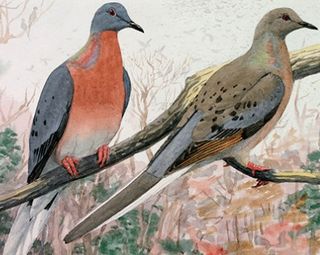
ScreenHunter_696 Jun. 19 15.50In the early 1800s, a naturalist named Alexander Wilson was traveling in Kentucky when the sky suddenly became dark. Wilson believed, he later wrote, that it was “a tornado, about to overwhelm the house and everything round in destruction.”

When Wilson got his wits back, he realized the sun had been blotted out by passenger pigeons.

The journals of many early explorers contain similar passages. The passenger pigeon would sweep across the eastern United States in vast flocks, feeding on chestnuts and acorns as they traveled. As Wilson gazed at his passenger pigeon flock, he tried to figure out how many birds it contained. From one side to the other, it was a mile wide. It streamed overhead like a feathered river for more than four hours. Based on that information, Wilson guessed that it contained over 2.2 billion birds–”an almost inconceivable multitude,” he wrote, “and yet probably far below the actual amount.”

In 1914, the passenger pigeon became extinct, likely thanks to industrial-scale hunting. In his book Nature’s Ghosts, Mark Barrow notes that our eradication of such a populous species came as a tremendous shock–one that helped the world appreciate nature’s true fragility.

More here.

Massimo Vignelli (1931-2014)

Design_vignelli_clothing_drawings_Ellen Lupton at Smithsonian Magazine:

From the moment Massimo Vignelli started his career in Italy in the mid-1950s, he forged a rigorous philosophy that transformed the international language of design for print, products, and environments. Over the decades, debates about design’s cultural function bubbled and boiled around him. Confronting the upheavals of Pop, post-modernism, deconstruction, and the digital age, Massimo didn’t change his methodology so much as polish it into an ever sharper, more refined instrument. His ability to stay modern in a post-modern world sealed his reputation as one of the great designers of our time. As his career advanced, Massimo’s work and ideas became more relevant, not less. He remains a towering and untarnished design hero, not only to his peers and to the generation who started their own careers in his offices in the 1960s, 70s, and 80s, but to designers just entering the field now, who view the elegant man in the modernist menswear with almost mystical reverence.

Massimo Vignelli’s career is inseparable from that of his equally gifted wife, Lella Vignelli. The couple married in 1957 and opened their first firm together in Milan in 1960. While both were trained as architects, Lella continued to focus on three-dimensional design, while Massimo focused on graphics. Together, they could move across disciplines with astonishing grace.

more here.

Football’s offer of hope against experience

P14_Cummings2_1076088kBrian Cummings at the Times Literary Supplement:

Sitting in a drab hotel room with an old journalist friend after the latest alarm about his liver, watching an old video of his playing days, George Best suddenly jumped up from his armchair. “Jesus Christ!”, he shouted at the screen. “I’d forgotten I was that fucking good!”

Best probably was not thinking about Pindar at the time, but this stifled eulogy on himself raises the question asked with most acuteness by Pindar, of why we praise athletes, and indeed, why we watch them. The epinikion was the Greek lyric genre of the victory ode: Ibycus (sixth century BCE), Simonides and Bacchylides all are known to have composed them, and in the case of Pindar (c.518–438 BCE) there are forty-four complete odes, composed for winners in all four of the panhellenic games, the Olympic, the Pythian, the Nemean, and the Isthmian. If modern sportswriting has tended to concentrate on direct reportage (what happened next?), or else interviews with participants (how did it feel?), Pindar only occasionally offers details of the events themselves.

Pindar understood that we do not respond to sport only at the literal level. He mixes prayers to the gods with address to the muses and haunting retelling of topical myths, which he relates to the sportsman in action (for they are all men), whether it is a sprinter or a charioteer or a wrestler.

more here.

Local Color: Paint the Pavement

Peter Brewitt in Orion Magazine:

Paint-the-Pavement-by-MJI-PhotosPEOPLE HAVE TRIED TO CONTROL traffic and speeding since the invention of the car—maybe since the domestication of the horse. And for good reason: research has shown that when America got a nationwide fifty-five-mile-per-hour speed limit in 1974, driving fatality rates plummeted, and when it was lifted in 1987, deaths increased. The good news is, in more and more places, art is coming to the rescue. Over the past decade, communities across the nation have taken to beautifying their roads and intersections with hand-painted murals, slowing drivers as they go. Murals like these come at minimal cost—just buy some street-grade paint, get whatever permits your city requires, and figure out how to reroute traffic for a few hours. As people motor through the neighborhood, murals catch the eye, situate the mind, and lighten the right foot.

Many of these creations did not begin as traffic-control devices—the goal was often to engage the neighborhood with itself, to display its spirits and hopes for the future, and to embrace the spaces that bind people together. But art touches drivers as well as neighbors: when a motorist sees a sunburst on the roadway, it draws her mind to the surroundings, focusing her on where she is, not just where she’s heading. More and more communities, seeing the kaleidoscopic benefits of street painting, are making these expressions part of their physical and cultural infrastructure. Of course, many of them are in big cities—New York, Baltimore, Portland—but every place has cars, and communities in smaller towns from New Jersey to Mississippi are also getting together and coloring the asphalt. Some of the images you see here come courtesy of Paint the Pavement, a street-art program in Saint Paul, Minnesota.

More here.

This Time It’s Personal: Tailoring cancer treatment to individual and evolving tumours

Lauren Gravitz in Scientific American:

CancerEvery cancer has a weak spot — a genetic vulnerability that could be exploited by the right drug — and many envision a day when the genome of every cancer will be sequenced, in full or in part, and then paired with an appropriate therapy. Researchers point to the effectiveness of imatinib (marketed as Gleevec and Glivec) against chronic myelogenous leukaemia (CML) — a rare blood cancer — as perhaps the greatest success in the personalized cancer field so far. CML is most often caused by an abnormal gene rearrangement in which pieces of two chromosomes switch places with each other. Assessing whether a patient is a candidate for the drug requires the analysis of a small group of genes in what is referred to as a gene panel. “In the 1980s, unless you got a bone-marrow transplant, the disease was an absolute death sentence in four to six years,” says Razelle Kurzrock, director of the Center for Personalized Cancer Therapy at the University of California, San Diego. “Today, average survival is more than 20 years. And because the average age at diagnosis is 60, it's almost a normal life expectancy.” That success comes at a price: in 2012, a year's worth of the therapy cost US$92,000. Imatinib's success has not been easy to duplicate. Every tumour has a unique set of genetic mutations — tumours are commonly likened to snowflakes, each is slightly different from the next. And this heterogeneity, which is found even between cells in a single tumour, means that matching a patient with the appropriate therapy can be a complex proposition.

Vulnerabilities such as the one that imatinib capitalizes on are known as driver oncogenes, genetic changes that generate the proteins driving a cancer's growth. Disabling these proteins should, at least in theory, beat back the disease. The number of driver oncogenes seems to be limited — perhaps as few as 200–300 common ones, says Robert Nussbaum, a medical geneticist at the University of California, San Francisco. Understanding how to disable the common driver oncogenes should therefore enable the treatment of a large number of cancers. “First, we have to know what the genes are and how are they mutating. Then, the second challenge is developing drugs that target these abnormally activated proteins,”

More here.

Wednesday, June 18, 2014

The Fetish of Staring at Iran’s Women

17anvari-articleLarge

Haleh Anvari in The New York Times (image by Tom Jay):

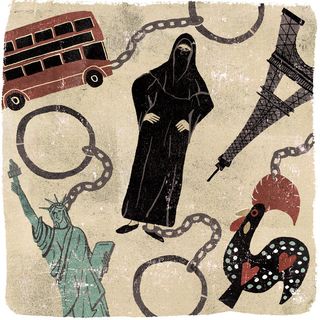
Ever since the hijab, a generic term for every Islamic modesty covering, became mandatory after the 1979 revolution, Iranian women have been used to represent the country visually. For the new Islamic republic, the all-covering cloak called a chador became a badge of honor, a trademark of fundamental change. To Western visitors, it dropped a pin on their travel maps, where the bodies of Iranian women became a stand-in for the character of Iranian society. When I worked with foreign journalists for six years, I helped produce reports that were illustrated invariably with a woman in a black chador. I once asked a photojournalist why. He said, “How else can we show where we are?”

How wonderful. We had become Iran’s Eiffel Tower or Big Ben.

Next came the manteau-and-head scarf combo — less traditional, and more relaxed, but keeping the lens on the women. Serious reports about elections used a “hair poking out of scarf” standard as an exit poll, or images of scarf-clad women lounging in coffee shops, to register change. One London newspaper illustrated a report on the rise of gasoline prices with a woman in a head scarf, photographed in a gas station, holding a pump nozzle with gasoline suggestively dripping from its tip. A visitor from Mars or a senior editor from New York might have been forgiven for imagining Iran as a strange land devoid of men, where fundamentalist chador-clad harridans vie for space with heathen babes guzzling cappuccinos. (Incidentally, women hardly ever step out of the car to pump gas here; attendants do it for us.)

More here.

Stone Age Sex

LON3041

Neil McArthur in Aeon (French actor Alain Delon and Italian actress Claudia Cardinale during a scene from The Centurions 1965. Photo by George Rodger/Magnum):

The roots of evolutionary psychology can be traced back to Charles Darwin himself, who says in On the Origin of Species (1859) that, armed with the theory of natural selection, ‘psychology will be based on a new foundation’. But it truly came into its own in the 1970s, thanks to Robert Trivers, then a Harvard postgraduate, who wrote a series of papers that helped to define evolutionary psychology as a field. One of these, ‘Parental Investment and Sexual Selection’ (1972), laid out the basic elements of an evolutionary explanation for sexual behaviour. Trivers looked at data from a variety of animal species, and concluded: ‘The relative parental investment of the sexes in their young is the key variable controlling the operation of sexual selection. Where one sex in­vests considerably more than the other, members of the latter will compete among themselves to mate with members of the former.’

Trivers’s paper looked only glancingly at human behaviour, though it was rich in suggestions for further research. In his book, The Evolution of Human Sexuality (1979), the anthropologist Donald Symons used Trivers’s basic ideas to explain how people make sexual choices. Symons wanted to know what women and men were after when they went looking for sex, and he arrived at a relatively simple answer: ‘Men like sex with strangers … and women generally don’t.’

Symons was a powerful theoriser, but he had been unable to offer much in the way of actual data. In 1981, an ambitious young Harvard professor, David Buss, read Symons’s book, and decided to look for hard evidence to test its key claims. Though he started with a survey of a few middle-class white people, he was not content, as many of his followers would later be, to stop there. He assembled a group of international collaborators into what he called the International Mate Selection Project, which asked people from 37 different cultures what they looked for in a sexual partner. His collaborators risked their lives to survey Zulu women in remote South African villages and to smuggle information, carefully coded to avoid government censors, out of Communist China. The results, first published in 1990, provided data from close to 10,000 respondents in 33 countries and they revealed some strikingly consistent patterns across a variety of cultures, all more or less in line with Symons’s predictions. Buss used this data as the basis for what he called ‘sexual strategies theory’.

Though the data from Buss’s surveys confirmed the basic hypotheses of Trivers and Symons, the resulting theory introduced some important refinements. Notably, sexual strategies theory pays attention to an obvious fact that earlier evolutionary psychologists had left largely unanalysed: women sometimes want casual flings, too.

More here.

Shaka, When the Walls Fell

Ian Bogost on the episode of Star Trek: The Next Generation “Darmok” and the limits of human communication, in The Atlantic [h/t: Jennifer Ouellette]:

On stardate 45047.2, Jean-Luc Picard leads the crew of the Enterprise in pursuit of a transmission beacon from the El-Adrel system, where a Tamarian vessel has been broadcasting a mathematical signal for weeks. The aliens, also known as the Children of Tama, are an apparently peaceable and technologically advanced race with which the Federation nevertheless has failed to forge diplomatic relations. The obstacle, as Commander Data puts it: “communication was not possible.”

Picard exudes optimism as his starship courses through subspace. “In my experience communication is a matter of patience, imagination,” he beams to his senior staff. “I would like to believe that these are qualities which we have in sufficient measure.” But after hailing the alien ship upon arrival, contact with Children of Tama proves more difficult than Picard imagined:

DATHON, the Tamarian captain: Rai and Jiri at Lungha. Rai of Lowani. Lowani under two moons. Jiri of Umbaya. Umbaya of crossed roads. At Lungha. Lungha, her sky gray.

(no response from Enterprise, looks at First Officer in frustration)

(slowly, deliberately) Rai and Jiri. At Lungha.

In the Star Trek universe, a “universal translator” automatically interprets between any alien language instantly and fluently. Unlike today’s machine translation methods, the universal translator requires no previous experience with another language in order to make sense of it. Such is the case with Tamarian, at least on the surface, as the Enterprise crew is able to comprehend the basic syntax and semantics of Tamarian utterances. “The Tamarian seems to be stating the proper names of individuals and locations,” offers Data, stating the obvious. But Picard quickly sums up the problem, “Yes, but what does it all mean?”

Picard’s reply to the Tamarians sounds especially staid to the viewer’s ears after having heard the aliens’ exotic prose: “Would you be prepared to consider the creation of a mutual non-aggression pact between our two peoples? Possibly leading to a trade agreement and cultural interchange. Does this sound like a reasonable course of action to you?” His questions cause the Tamarians as much befuddlement as their litany of names and places does the Federation crew.

More here.

Known Unknowns of the Class War

Zia-haider-rahman-books

Naeem Mohaiemen review of Zia Haider Rahman’s In the Light of What We Know over at the Asian American Writers' Workshop (photo by Naeem Mohaiemen):

When you turn to page 186 of In the Light of What We Know, you encounter an illustration. The novel’s two main characters have by this point discussed many things, and readers may have already been craving visual aids. But this is the first time the text is interrupted by a diagram. You sense, therefore, the arrival of a crucial digression.

The illustration is of a diagonal line that runs from the top left corner of the diagram to the bottom right, interrupted mid-way by a vertical rectangle. On the other side of the rectangle, two diagonals slope downward in the same direction as the first, one atop the other. If you are not particular about the condition of your books (as I am not), you will have the urge to fold the page to better work out the optical illusion. It appears as if the descending diagonal line continues, after interruption, along the upper diagonal on the right. But folding would reveal the opposite—that it is actually the second, lower diagonal that it is joined with.

Named “Poggendorff’s illusion,” after the nineteenth-century German physicist Johann Poggendorff who discovered it in a drawing, the illusion is something Zafar, the novel’s British-Bangladeshi protagonist, starts explaining to our unnamed narrator. But as with many other incomplete yet meticulously plotted diversions within Zia Haider Rahman’s debut novel, Zafar does not finish the story. It is up to the narrator to fill in the gaps, after “consulting pages on the Internet,” as one of the novel’s many Infinite Jest-like footnotes inform us.

Yet, even after the optical dislocation has been explained—in dialogue, in footnote, and in an expansive reference to the similar Müller-Lyer illusion—the reader will be drawn back to page 186. The illusion stubbornly refuses to budge. As Zafar underscores, “Knowing doesn’t fix things.” We might add, too, that knowing doesn’t overcome the desire to have faith in the unknown, the unverifiable. Why have faith in God, for example? Some expected science to free people from faith, but of course it did not work out that way. Immanuel Kant’s idea of the sublime affirmed the capacity of human reason to comprehend and size up that which cannot be perceived by the faculties. Kant described three kinds of emotions evoked by this comprehension: wonder, beauty, and terror. Some volatile combination of all three forms of the sublime permeate the pages of this acidic, inventive novel.

More here.

Are you sure you have hands?

Massimo Pigliucci in Scientia Salon:

Leonardo_aSkepticism is a venerable word with a panoply of meanings. When I refer to myself as “a skeptic,” I mean someone inspired by David Hume’s famous dictum: “In our reasonings concerning matter of fact, there are all imaginable degrees of assurance, from the highest certainty to the lowest species of moral evidence. A wise man, therefore, proportions his belief to the evidence” [1]. Or, as Carl Sagan famously phrased it, “Extraordinary claims require extraordinary evidence” [2]. Oh, and if there is one thing I resent it is being mislabelled as a “cynic,” meaning a naysayer with no sense of humor…

But skepticism (and cynicism, for that matter!) in philosophy is much, much older than that, and has at the least a couple of additional meanings [3]. According to so-called (by Sextus Empiricus, second or third century CE, [4]) “academic skeptics” (because they belonged to Plato’s academy, post-Plato), such as Carneades (214-129 BCE) [5], we cannot have any epistemically interesting knowledge. A different type of skeptic, the Pyrrhonian (named after Pyrrho, 365–ca 275 BCE) denied even that we can deny the possibility of knowledge, a meta-skepticism, if you will. Few modern philosophers are interested in Pyrrhonism, while academic skepticism has a long and venerable tradition, including perhaps most famously Descartes’ “radical doubt” thought experiment, in which he imagined a Machiavellian demon determined to trick him about what he thought he knew. Descartes then asked whether it would be possible, under those circumstances, to actually know anything at all. His answer, of course, was in the affirmative, and took the form of his famous cogito, ergo sum (I think, therefore I am) [6].

There is, of course, a much more fun way to think about the problem of skepticism in epistemology, and that is by using the 1999 scifi move The Matrix as a philosophical thought experiment [7].

More here.

Why Audiences Hate Hard News—And Love Pretending Otherwise

Derek Thompson in The Atlantic:

ScreenHunter_695 Jun. 18 17.52The most important story in the world, according to every major American newspaper this morning, is the violent splintering of Iraq. It was the front-page and top-of-the-homepage story in the Washington Post, the Wall Street Journal, the New York Times, and more.

Surely, there are millions of people who are reading about Iraq, because they're fascinated in the Middle East, in foreign policy, or in the general news cycle. But despite Iraq's prominent location on every major newspaper, the mostreadstories on those papers' websites aren't about Iraq, at all.

In the Post, the top stories included an op-ed about Benghazi, and updates about the World Cup and a midwest tornado. WSJ's most-read box led off with two stories about YouTube games and taxes. The Times' most-emailed stories included two pieces about gluten and postpartum depression. Not one of the most-read or most-emailed boxes on three papers' websites included the wordsIraq, Sunni, or Maliki when I looked this morning.

Iraq is a uniquely difficult news story. But there's nothing unique about U.S. readers side-stepping the news cycle.

More here.

The Palestinians: A kidnapped society

Avraham Burg in Haaretz:

ScreenHunter_694 Jun. 18 17.48Our hearts are in pain over those three teenage boys whose identities we did not even know a moment ago, but who now belong to all of us. Each of them looks like my own son, the son of every one of my friends and their friends.

Like many people, I hope with all my heart that the moment will come when we see them alive among us, and that all this tension dissipates into blissful relief. I hope, with real trembling, but I cannot and do not want to ignore the silenced truth that surrounds their kidnapping.

Those three boys are truly unfortunate. They are unfortunate because of the trap of fear in which they have been captured, the uncertainty and the fact that their lives are in great danger. Our hearts are in pain, and go out to them and their families because of how, in a single moment, they had to step into the glare of publicity. And these teenagers are unfortunate because of the lie in which they have lived their lives — lives of supposed normalcy that were built upon the foundations of that greatest of Israeli injustices: the occupation.

Now let us turn from their wretchedness to our own. For us, a dramatic or traumatic event is always a very clear, refined and transparent moment. All the plans and failures, the fears and hopes, burst out.

More here.

The Teaching Class: everyone paying tuition should care

Rachel Riederer in Guernica:

Prof When Mary Margaret Vojtko died last September—penniless and virtually homeless and eighty-three years old, having been referred to Adult Protective Services because the effects of living in poverty made it seem to some that she was incapable of caring for herself—it made the news because she was a professor. That a French professor of twenty-five years would be let go from her job without retirement benefits, without even severance, sounded like some tragic mistake. In the Pittsburgh Post-Gazette op-ed that broke the story, Vojtko’s friend and attorney Daniel Kovalik describes an exchange he had with a caseworker from Adult Protective Services: “The caseworker paused and asked with incredulity, ‘She was a professor?’ I said yes. The caseworker was shocked; this was not the usual type of person for whom she was called in to help.” A professor belongs to the professional class, a professor earns a salary and owns a home, probably with a leafy yard, and has good health insurance and a retirement account. In the American imagination, a professor is perhaps disheveled, but as a product of brainy eccentricity, not of penury. In the American university, this is not the case.

Most university-level instructors are, like Vojtko, contingent employees, working on a contract basis year to year or semester to semester. Some of these contingent employees are full-time lecturers, and many are adjunct instructors: part-time employees, paid per class, often without health insurance or retirement benefits. This is a relatively new phenomenon: in 1969, 78 percent of professors held tenure-track positions. By 2009 this percentage had shrunk to 33.5. The rest of the professors holding jobs—whether part time or full time—do so without any job security. These are the conditions that left Vojtko in such a vulnerable position after twenty-five years at Duquesne University. Vojtko was earning between $3,000 and $3,500 per three-credit course. During years when she taught three courses per semester, and an additional two over the summer, she made less than $25,000, and received no health benefits through her employer. Though many universities limit the number of hours that adjunct professors can work each semester, keeping them nominally “part-time” employees, teaching three three-credit courses is certainly a full-time job. These circumstances are now the norm for university instructors, as the number of tenured and tenure-track positions shrinks and the ranks of contingent laborers swell.

More here. (Thanks to Anjuli Kolb)