Why John Oliver’s Last Week Tonight Is Better Than The Daily Show and Colbert

Matt Zoller Seitz in Slate:

Over the past few weeks he’s shown us, with evidence, that while our national legislature is unproductive and tedious, our local legislatures are incredibly prolific and often demented; that the rules governing drone strikes are so filled with slippery language as to be almost meaningless; that the death penalty and our preferred defense of the need for the death penalty are holdovers from medieval Europe’s golden age of religious-based torture; that the increasing income inequality in the United States is inextricably tied to its historical belief in optimism, a cover for money-grubbing that turns exploited people into enablers (“I can clearly see that this game is rigged,” Oliver proclaimed, in the voice of a typical American citizen, “which is gonna make it really sweet when I win this thing!”); that former U.S. troops are working harder to get translators to the states than our own government is; that “nutritional supplements” are the new snake oil; and that President Warren G. Harding was a smooth mofo who wrote “smutty fuck-notes” to his mistress. And his interviews, while tinged with agreeable but by-now-cliché Daily Show–style goofiness, are excellent: particularly his sit-downs with Stephen Hawking, Australian prime minister Tony Abbott, and General Keith Alexander, former head of the National Security Agency, where the motto was, to quote Oliver, “Collect everything … the motto of a hoarder, that’s the fundamental principle that ends up with somebody living alongside 1,500 copies of newspapers from the 1950s and ‘60s and six mummified cats.” (It helps tremendously that most of these interviews are conducted off-site, away from a studio audience that might encourage the guest to “perform” too much or the host to overdo the chumminess.)


More here.

Gut–brain link grabs neuroscientists

Sara Reardon in Nature:

MicrobiomeCompanies selling ‘probiotic’ foods have long claimed that cultivating the right gut bacteria can benefit mental well-being, but neuroscientists have generally been sceptical. Now there is hard evidence linking conditions such as autism and depression to the gut’s microbial residents, known as the microbiome. And neuroscientists are taking notice — not just of the clinical implications but also of what the link could mean for experimental design. “The field is going to another level of sophistication,” says Sarkis Mazmanian, a microbiologist at the California Institute of Technology in Pasadena. “Hopefully this will shift this image that there’s too much commercial interest and data from too few labs.” This year, the US National Institute of Mental Health spent more than US$1 million on a new research programme aimed at the microbiome–brain connection. And on 19 November, neuroscientists will present evidence for the link in a symposium at the annual Society for Neuroscience meeting in Washington DC called ‘Gut Microbes and the Brain: Paradigm Shift in Neuroscience’.

Although correlations have been noted between the composition of the gut microbiome and behavioural conditions, especially autism1, neuroscientists are only now starting to understand how gut bacteria may influence the brain. The immune system almost certainly plays a part, Mazmanian says, as does the vagus nerve, which connects the brain to the digestive tract. Bacterial waste products can also influence the brain — for example, at least two types of intestinal bacterium produce the neurotransmitter γ-aminobutyric acid (GABA)2. The microbiome is likely to have its greatest impact on the brain early in life, says pharmacologist John Cryan at University College Cork in Ireland. In a study to be presented at the neuroscience meeting, his group found that mice born by caesarean section, which hosted different microbes from mice born vaginally, were significantly more anxious and had symptoms of depression. The animals’ inability to pick up their mothers’ vaginal microbes during birth — the first bacteria that they would normally encounter — may cause lifelong changes in mental health, he says.

More here.

the berlin wall

PI_GOLBE_BERLIN_AP_002Stefany Anne Golberg at The Smart Set:

In the beginning, the Wall was made of barbed wire and soldiers. On some streets, cinder blocks had been stacked. In the Neukölln borough, on Harzer Straße, the Wall was about neck-high. East and West Berliners could look at each other over the Wall but they were not allowed to touch. In a photograph taken on the first day, August 13, 1961, two mothers stand on either side of a coil of wire that reaches to their knees. The babies they hold stretch out to each other, inches of air between their fingers. There seems to be a magnetic repulsion preventing them from holding hands. In another picture from that day, a young man in a crowd stands across from two border guards; a chest-high stack of cement is separating them. The young man appears to be asking one guard a question — both lay their hands on the Wall. Their hands are almost touching. The second guard smiles and leans upon the Wall as if he were socializing at a pub.

We will build the Wall in summer, declared GDR leader Walter Ulbricht, a summer day will be best. A Sunday in summer, when Berliners will be on holiday, having picnics at the lake. We will begin quietly, at night, when Berliners are sleeping, and work mostly in the dark. We will tear up the roads to make them impassable, and seal the border crossings. Railway lines will be cut off and train stations will be turned into deserts. Never again will East Berliners be able to leave of their own accord. And when the people of Berlin arise in the morning, our work will be complete.

more here.

Martha C. Nussbaum: There are limits to what the law can do to police cyberabuse

Martha C. Nussbaum in The Nation:

ScreenHunter_887 Nov. 12 13.29Like a surprisingly large proportion of Americans, I have a cyberstalker, whom I shall call S. “You know I hate you more than Aphrodite hates Helen,” S announced in his most recent e-mail. “If anyone hates you, it’s me.” A gifted, disturbed and drug-abusing former student, S slipped into paranoia almost three years ago, one fall night in 2011—I remember the shock of receiving about twenty obscene messages in a single hour. He has bombarded me with abusive, lewd and often threatening messages ever since—punctuated by periods in residential rehab, and by all-too-brief periods of lucidity thereafter. S is a gay Latino man, and the special nature of his paranoia is extreme hatred for the dominant white heterosexual academic world, which, he believes, has caused his drug addiction so that he won’t succeed. He has also created a kind of paranoia porn about the fantasized sexual organs of putative lovers or ex-lovers of mine, enraged that they have allegedly preferred a white woman to him (while glorifying those body parts, he includes denigration of female body parts, especially mine, in his rants). I have not replied to his messages since shortly after the break, when I advised him to seek psychiatric help, but I do read them to know how he is doing. He is not doing well. S used to be gifted, sweet and funny. (You can almost glimpse the old S, with his joke about Aphrodite.) Now he is not sweet and rarely funny.

Because the threats might be real, and because in any case S would very likely attend any public lecture I would give in his home city, C (he comments on my whereabouts in his e-mails and seems well informed), and probably cause a disturbance, I do not give public lectures in that city. (I don’t mind this. It is pleasing to have a clear excuse to say no to some invitations.) I have given all of his e-mails and his photo to officials at the University of Chicago, where I am a professor, but I have not involved the police, feeling that the Chicago police would not be interested in a perpetrator far away in C, and that the police in C would not be interested in protecting me here in Chicago. Besides, I feel safe, as S has no money and thus cannot travel. But also, I think S is suicidal, and I do not want to precipitate a tragedy. His e-mails do not alarm me (after the initial shock); they do make me very sad.

More here.

Srsly.

Sarah Mesle in the Los Angeles Review of Books:

Ortberg-Cover-243x366You’re not supposed to say that. Being categorically angry with men is unattractive, and it isn’t (given the basic human decency of most men) really fair. What’s worse, being angry isn’t effective. If you’re in the midst of dealing with a sucky man situation, expressing anger about sexism or structural inequality is the surest way to get yourself and your point of view relegated to the “crazy angry lady” category where your tone will be labeled shrill and your opinions summarily dismissed.

This is the conundrum many women find themselves navigating: we regularly experience an anger we can only partially credit and only in certain contexts safely or successfully articulate. That anger needs to go somewhere. It needs different modes. It needs, often, satire.

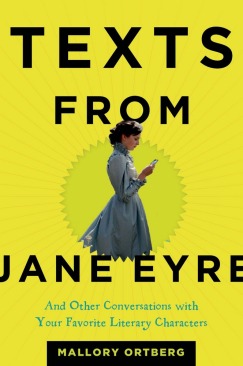
Into this emotional context enters a new book: Mallory Ortberg’s Texts from Jane Eyre. It’s a splendid and wry work of humor writing, but that is not its only merit. Comprised entirely of imagined text conversations with or between literary figures, Texts from Jane Eyre employs a clever conceit. But “the phones,” as Ortberg has said, “aren’t really the point.” Texts from Jane Eyre isn’t really another book in the mode of Pride and Prejudice and Zombies— a book I enjoy, but which stages the collision between high literature and mass culture as a joke for its own sake. Texts from Jane Eyre, by contrast, uses that collision to pointed satiric effect.

Read the rest here.

Wednesday Poem

Glacier
.

One might have been born for such sharp alignment:
The white curve of an arch quietly concentric

To the bowl of my skull, my knees midway
Between a pair of columns, the feet of a chair

In line with my palms, as walls and bookshelves,
Window, ceiling, lampshade and guitar

Converge silently round the axis of my spine.
Now couched on straw matting and niched in wide spaces,

The body might even be a hub of strong forces,
A pivot or a nucleus but for which

These walls might give way, these rafters cave in.
The stone Buddha on the shelf no longer

Asks me to probe myself; nor does the jug on the table
Urge the eye, to forage for any meaning

Beneath its jet black. The smooth curves
Of its sides would have me stay as I am,

Wide-eyed and becalmed by the surfaces of things
Willfully arranged to centre me;

And it might be wise, if I could, to stay true to their will;
But I have only to shut my eyes to know at once

That I am a vast frozen mountain thawing in the sun,
Huge, heaving chunks of me breaking off at random,

Crashing with a thud into the river below;
The strong, single-minded river,

That is always letting go of itself,
That may possess no single centre of gravity,

And knows no direction but downhill and seaward.
.

by Anand Thakore
from Elephant Bathing
publisher: Poetrywala, Mumbai, 2012

Scientists Figured Out How to Make People “Feel” an Otherworldly Presence

Rachel Nuwer in Smithsonian Magazine:

ScreenHunter_886 Nov. 12 12.55A tickle on the back of your neck, a sudden feeling that you are not alone: some believers in the paranormal attribute these sensations to the presence of a ghost, angel or otherworldly being.

Now, a team of Swiss neuroscientists have figured out how to conjure those spirits—or at least the perception of them—in the lab. The sensation of an otherworldly presence, they found, actually derives from garbled sensorimotor brain signals, in which a person's self awareness of their own body is projected into a seemingly disconnected space. In such cases, the researchers explained in a release, the brain mis-assigns its own life signals as belonging to someone or something else.

The team first studied the brains of a dozen patients who all suffered from such apparitions—a common symptom for people with some forms of epilepsy, schizophrenia or other neurological disorders. MRI analyses showed that they all had abnormal activity in three regions of the brain involved in self-awareness, movement and proprioception (the sense of one's position in space), the researchers reported.

Next, they attempted to recreate this neurological experience in healthy volunteers.

More here.

Sweden’s Prostitution Solution: Why Hasn’t Anyone Tried This Before?

Marie De Santis in Esnoticia:

ScreenHunter_885 Nov. 12 12.46In a centuries deep sea of clichés despairing that 'prostitution will always be with us', one country's success stands out as a solitary beacon lighting the way. In just five years Sweden has dramatically reduced the number of its women in prostitution. In the capital city of Stockholm the number of women in street prostitution has been reduced by two thirds, and the number of johns has been reduced by 80%. There are other major Swedish cities where street prostitution has all but disappeared. Gone too, for the most part, are the renowned Swedish brothels and massage parlors which proliferated during the last three decades of the twentieth century when prostitution in Sweden was legal.

In addition, the number of foreign women now being trafficked into Sweden for sex is nil. The Swedish government estimates that in the last few years only 200 to 400 women and girls have been annually sex trafficked into Sweden, a figure that's negligible compared to the 15,000 to 17,000 females yearly sex trafficked into neighboring Finland. No other country, nor any other social experiment, has come anywhere near Sweden's promising results.

By what complex formula has Sweden managed this feat? Amazingly, Sweden's strategy isn't complex at all. It's tenets, in fact, seem so simple and so firmly anchored in common sense as to immediately spark the question, “Why hasn't anyone tried this before?”

In 1999, after years of research and study, Sweden passed legislation that a) criminalizes the buying of sex, and b) decriminalizes the selling of sex. The novel rationale behind this legislation is clearly stated in the government's literature on the law:

“In Sweden prostitution is regarded as an aspect of male violence against women and children. It is officially acknowledged as a form of exploitation of women and children and constitutes a significant social problem… gender equality will remain unattainable so long as men buy, sell and exploit women and children by prostituting them.”

In addition to the two pronged legal strategy, a third and essential element of Sweden's prostitution legislation provides for ample and comprehensive social service funds aimed at helping any prostitute who wants to get out, and additional funds to educate the public.

More here.

Tuesday, November 11, 2014

new translations of Italo Calvino

Thier_calculatorsandbutterflies_ba_imgAaron Thier at The Nation:

Positive or negative, these letters reflect an intense belief in the importance of discussion. “Dear Silvio,” he writes in 1948, “I’m pleased we’re arguing. It’s a healthy symptom, for goodness’ sake! It means there’s life and movement and dialectic.” Ten years later, he tells a critic that “our job [as fiction writers] is basically to raise problems for you to solve.” Throughout his life, an article that forces him to reconsider his ideas is cause for celebration: “Rarely (not to say never) does one come across a critical article which stirs up so many ideas, all of them different from the usual rehashed notions, and forces us to rethink everything from scratch.” He keeps up with developments in literary theory and admires Northrop Frye, Claude Lévi-Strauss and Roland Barthes. He wants to chart “lines of continuity” between the fiction of his youth (“Hemingwayism, spare stories, with a final shoot-out”), his early “fantasy-moral novels or lyrical-philosophical novels,” his cosmicomic stories and the “preciosity, Alexandrinism, the prose poem” of Invisible Cities. Calvino wants himself explained to himself. He wants to understand what his writing means, and he believes that criticism can tell him.

As for what he actually says about his work, there are plenty of interesting claims. Early in his career, he says that he is “in favor of a clown-like mimesis of contemporary reality.” Writing to his French publisher about The Nonexistent Knight, he says, “I never say that the knight is unreal. I say that he does not exist. That is very different.”

more here.

Steven Pinker’s Bad Grammar

Masters-degree-jordan-awan-320Nathan Heller at The New Yorker:

Some skimmings from the final part of Pinker’s book ran in the Guardian last month, under the provocative headline “10 ‘Grammar Rules’ It’s OK To Break (Sometimes).” It is a brazen document. Armed with examples from pop culture and from the literary canon, Pinker tries to shoot down some basic principles of English grammar (such as the distinction between “who” and “whom”), some looser stylistic preferences (such as the recommendation against splitting infinitives), and some wholly permissible things widely rumored to be wrong (such as beginning sentences with “but” or “and”). He even takes aim at conventions enforced only in American English (introducing restrictive clauses with “that” and nonrestrictive clauses with “which”), which must have left someGuardian readers even more perplexed than they thought they were.

When it comes to language, many people distinguish between “prescriptivism” (the idea that correct usage should be defined by authorities) and “descriptivism” (the idea that any way a lot of people use the language is correct). Pinker, who has felt unfairly dismissed as a descriptivist, says that his new usage does not reflect either camp. It’s better. “Standards of usage are desirable in many arenas of communication,” he writes, and yet “many prescriptive rules originated for screwball reasons.” The cause is noble, and Pinker approaches it gamely.

more here.

The rise of unreason

Pervez Hoodbhoy in Dawn:

PervezSome 300 years ago the age of reason lifted Europe from darkness, ushering in modern science together with modern scientific attitudes. These soon spread across the world. But now, running hot on its heels is the age of unreason. Reliance upon evidence, patient investigation, and careful logic is giving way to bald assertions, hyperbole, and blind faith. Listen to India’s superstar prime minister, the man who recently enthralled 20,000 of his countrymen in New York City with his promises to change India’s future using science and technology. Inaugurating the Reliance Foundation Hospital in Mumbai two Saturdays ago, he proclaimed that the people of ancient India had known all about cosmetic surgery and reproductive genetics for thousands of years. Here’s his proof:

“We all read about Karna in the Mahabharata. If we think a little more, we realise that the Mahabharata says Karna was not born from his mother’s womb. This means that genetic science was present at that time. That is why Karna could be born outside his mother’s womb.” Referring to the elephant-headed Lord Ganesha, Modi asserted that, “there must have been some plastic surgeon at that time who put an elephant’s head on the body of a human being and began the practice of plastic surgery”. Whether or not he actually believed his words, Modi knew it would go down well. In 1995, parts of India had gone hysterical after someone found Lord Ganesha would drink the milk if a spoon was held to his trunk. Until the cause was discovered to be straightforward capillary action (the natural tendency of liquids to buck gravity), the rush towards temples was so great that a traffic gridlock resulted in New Delhi and sales of milk jumped up by 30pc.

More here.

Multiverse Collisions May Dot the Sky

-nas-wp-www-cluster-1275-quanta-wp-content-files_mf-cache-915f3d84ec89f011f4c64ec05e66d59a_ReachingForTheMultiverse_996

Jennifer Ouellette in Quanta (image Olena Shmahalo/Quanta Magazine):

Like many of her colleagues, Hiranya Peiris, a cosmologist at University College London, once largely dismissed the notion that our universe might be only one of many in a vast multiverse. It was scientifically intriguing, she thought, but also fundamentally untestable. She preferred to focus her research on more concrete questions, like how galaxies evolve.

Then one summer at the Aspen Center for Physics, Peiris found herself chatting with the Perimeter Institute’s Matt Johnson, who mentioned his interest in developing tools to study the idea. He suggested that they collaborate.

At first, Peiris was skeptical. “I think as an observer that any theory, however interesting and elegant, is seriously lacking if it doesn’t have testable consequences,” she said. But Johnson convinced her that there might be a way to test the concept. If the universe that we inhabit had long ago collided with another universe, the crash would have left an imprint on the cosmic microwave background (CMB), the faint afterglow from the Big Bang. And if physicists could detect such a signature, it would provide a window into the multiverse.

Erick Weinberg, a physicist at Columbia University, explains this multiverse by comparing it to a boiling cauldron, with the bubbles representing individual universes — isolated pockets of space-time. As the pot boils, the bubbles expand and sometimes collide. A similar process may have occurred in the first moments of the cosmos.

In the years since their initial meeting, Peiris and Johnson have studied how a collision with another universe in the earliest moments of time would have sent something similar to a shock wave across our universe. They think they may be able to find evidence of such a collision in data from the Planck space telescope, which maps the CMB.

The project might not work, Peiris concedes. It requires not only that we live in a multiverse but also that our universe collided with another in our primal cosmic history. But if physicists succeed, they will have the first improbable evidence of a cosmos beyond our own.

More here.

The Story of How The New Republic Invented Modern Liberalism

ARTICLE_INSET_FOER1_625-624x496 (1)

Franklin Foer in The New Republic (photo of Walter Lippman, Alfred Eisenstaedt/The Life Picture Collection/Getty Images):

On a fall night in 1914, Theodore Roosevelt summoned the young editors of a yet-unpublished magazine to the seat of his ex-presidency, his estate on the north shore of Long Island. The old Bull Moose had caught wind of the new project and wanted to make sure that the editors had the full benefit of his extensive wisdom. In T.R.’s social set—Harvard and Yale men with an intellectual proclivity and a progressive bent—the impending debut of The Republic, as it was called in its nascent days, was much anticipated. It was grist for gossipy letters and dinnertime chatter.

The magazine’s proposed title would have appealed to Roosevelt because it conjured both Plato and Rome. And the classic reference was merited, since America was in the thick of a Renaissance of sorts. A new artistic fervor occupied the narrow streets of Greenwich Village, thanks to the early arrival of European modernism and bootleg editions of Freud. Even more importantly, there was a proliferation of political reform movements, budding seemingly everywhere and pushing a mélange of causes—temperance, suffrage, antitrust, trade unionism. The presidential campaign two years earlier, which Roosevelt lost, had amounted to a competition to capture the hearts and minds of these reformers.

All this energy needed a home and deeper thinking. That might have been the primary point that Roosevelt had hoped to impress upon his protégés over dinner. But he could never quite contain his conversational agendas, and he piled argument upon argument, so persistently and so deep into the night that the editor of the magazine, Herbert Croly, closed his eyes and drifted into an embarrassingly deep sleep.

The Republic, however, was doomed—or at least its name was. A partisan organ with the very same title already existed, owned by John F. Kennedy’s gregarious grandfather John F. “Honey Fitz” Fitzgerald. When the genteel editors politely inquired about the possibility of sharing the moniker, the old Boston pol refused. In truth, he probably hadn’t intended to turn them away, only to get a little compensation for his troubles. But the editors missed the hint and renamed their magazine.

It would be The New Republic, which better represented the spirit of the enterprise anyway. The magazine was born wearing an idealistic face. It soon gathered all the enthusiasm for reform and gave it coherence and intellectual heft. The editors would help craft a new notion of American government, one that now goes by a very familiar name: liberalism.

More here.

Using Grammar as a Tool, Not as a Weapon

Steven_pinker_by_max_s_gerber_srgb_profile_0

Lindsay Beyerstein interviews Steven Pinker, over at CFI's Point of Inquiry:

The English language is often treated as delicate and precious, and disagreements about what is “proper English” go back as far as the 18th century. Then as now, style manuals and grammar books placed innumerable restrictions on what is and isn’t “correct,” as “Language Mavens” continue to delight in pointing out the unforgivable errors of others. To bring some fresh perspective to this remarkably heated topic (and to let some of us who are less than perfect, grammatically speaking, off the hook), Point of Inquiry welcomes Harvard psychology professor Steven Pinker, author of the new book The Sense of Style: The Thinking Person’s Guide to Writing in the 21st Century.
Pinker’s previous works include such award-winning books as The Language Instinct, How the Mind Works, The Blank Slate, The Stuff of Thought, and The Better Angels of Our Nature. He’s been honored by such institutions as the National Academy of Sciences, the Royal Institution of Great Britain, and the American Psychological Association, as well as having been named named Humanist of the Year and one of Time magazine’s “The 100 Most Influential People in the World Today.”
And most appropriate to this episode, he is currently the chair of the Usage Panel of the American Heritage dictionary.

Listen here.

The Map Makers: Learning How Little We Know About the Brain

James Gorman in The New York Times:

Brain-seattle-videoSixteenByNine1050So many large and small questions remain unanswered. How is information encoded and transferred from cell to cell or from network to network of cells? Science found a genetic code but there is no brain-wide neural code; no electrical or chemical alphabet exists that can be recombined to say “red” or “fear” or “wink” or “run.” And no one knows whether information is encoded differently in various parts of the brain. Brain scientists may speculate on a grand scale, but they work on a small scale. Sebastian Seung at Princeton, author of “Connectome: How the Brain’s Wiring Makes Us Who We Are,” speaks in sweeping terms of how identity, personality, memory — all the things that define a human being — grow out of the way brain cells and regions are connected to each other. But in the lab, his most recent work involves the connections and structure of motion-detecting neurons in the retinas of mice. Larry Abbott, 64, a former theoretical physicist who is now co-director, with Kenneth Miller, of the Center for Theoretical Neuroscience at Columbia University, is one of the field’s most prominent theorists, and the person whose name invariably comes up when discussions turn to brain theory.

…The question now on his mind, and that of many neuroscientists, is how larger groups, thousands of neurons, work together — whether to produce an action, like reaching for a cup, or to perceive something, like a flower. There are ways to record the electrical activity of neurons in a brain, and those methods are improving fast. But, he said, “If I give you a picture of a thousand neurons firing, it’s not going to tell you anything.” Computer analysis helps to reduce and simplify such a picture but, he says, the goal is to discover the physiological mechanism in the data. For example, he asks why does one pattern of neurons firing “make you jump off the couch and run out the door and others make you just sit there and do nothing?” It could be, Dr. Abbott says, that simultaneous firing of all the neurons causes you to take action. Or it could be that it is the number of neurons firing that prompts an action. His tools are computers and equations, but he collaborates on all kinds of experimental work on neuroscientific problems in animals and humans.

More here.

The $9 Billion Witness: Meet JPMorgan Chase’s Worst Nightmare

Matt Taibbi in Rolling Stone:

ScreenHunter_884 Nov. 11 11.18She tried to stay quiet, she really did. But after eight years of keeping a heavy secret, the day came when Alayne Fleischmann couldn't take it anymore.

“It was like watching an old lady get mugged on the street,” she says. “I thought, 'I can't sit by any longer.'”

Fleischmann is a tall, thin, quick-witted securities lawyer in her late thirties, with long blond hair, pale-blue eyes and an infectious sense of humor that has survived some very tough times. She's had to struggle to find work despite some striking skills and qualifications, a common symptom of a not-so-common condition called being a whistle-blower.

Fleischmann is the central witness in one of the biggest cases of white-collar crime in American history, possessing secrets that JPMorgan Chase CEO Jamie Dimon late last year paid $9 billion (not $13 billion as regularly reported – more on that later) to keep the public from hearing.

Back in 2006, as a deal manager at the gigantic bank, Fleischmann first witnessed, then tried to stop, what she describes as “massive criminal securities fraud” in the bank's mortgage operations.

More here.

Selling Fast: Public Goods, Profits, and State Legitimacy

Konczal---Hales-web

Mike Konczal in Boston Review (image by Jason Hales):

Adam Smith was not the first, but he was certainly one of the most eloquent defenders of justice delivered according to the profit motive. In The Wealth of Nations, he wrote that since courts could charge fees for conducting a trial, each court would endeavor, “by superior dispatch and impartiality, to draw to itself as many causes as it could.” Competition meant a judge would try “to give, in his own court, the speediest and most effectual remedy which the law would admit, for every sort of injustice.” Left unsaid is what this system does to those who can’t afford to pay up.

Our government is being remade in this mold—the mold of a business. The past thirty years have seen massive, outright privatization of government services. Meanwhile the logic of business, competition, and the profit motive has been introduced into what remains.

But for those with a long enough historical memory, this is nothing new. Through the first half of our country’s history, public officials were paid according to the profit motive, and it was only through the failures of that system that a fragile accountability was put into place during the Progressive Era. One of the key sources of this accountability was the establishment of salaries for public officials who previously had been paid on commission.

As this professionalized system is dismantled, once-antique notions are becoming relevant again. Consider merit pay schemes whereby teachers are now meant to compete with each other for bonuses. This mirrors the 1770 Maryland assembly’s argument that public officials “would not perform their duties with as much diligence when paid a fixed salary as when paid for each particular service.” And note that the criminal justice system now profits from forfeiture of property and court fees levied on offenders, recalling Thomas Brackett Reed, the House Republican leader who, in 1887, argued, “In order to bring your criminals against the United States laws to detection” you “need to have the officials stimulated by a similar self-interest to that which excites and supports and sustains the criminal.”

The dissolution of the old system, and its return with a vengeance, are the subjects of three recent books on the everyday lives of our front-line public employees.

More here.

Monday, November 10, 2014