
by Brooks Riley
Category: Recommended Reading
Sunday, November 9, 2014
Ordinary Iranians are losing interest in the mosque
From The Economist:

Iran is the modern world’s first and only constitutional theocracy. It is also one of the least religious countries in the Middle East. Islam plays a smaller role in public life today than it did a decade ago. The daughter of a high cleric contends that “religious belief is mostly gone. Faith has been replaced by disgust.” Whereas secular Arab leaders suppressed Islam for decades and thus created a rallying point for political grievances, in Iran the opposite happened.
More here.
The new atheist commandments: Science, philosophy and principles to replace religion
Bayer and Figdor in Salon:
“Begin at the beginning,” the King said, very gravely, “and go on till you come to the end: then stop.” — Lewis Carroll, Alice in Wonderland
There seems to be no end. It’s like the old story of a learned man giving a public lecture in which he mentions that the earth orbits the sun. At the end of the lecture an elderly lady approaches the lectern and sternly informs him that he is wrong: The world, she says, is actually resting on the back of a giant turtle. The learned man smiles and asks, “What is the turtle standing on?” The old lady doesn’t even blink and replies, “Another turtle, of course!” When the learned man starts to respond, “And what is that turtle—” she interrupts him: “You’re very clever, young man . . . but it’s turtles all the way down!” Just like that cosmic stack of turtles, the process of justifying beliefs based on other beliefs never ends—unless at some point we manage to arrive at a belief that doesn’t rely on justification from any prior belief. That would be a foundational source of belief.
More here.
The Creepy New Wave of the Internet

Sue Halpern in the NYRB (Penelope Umbrico/Mark Moore Gallery, Los Angeles):
Every day a piece of computer code is sent to me by e-mail from a website to which I subscribe called IFTTT. Those letters stand for the phrase “if this then that,” and the code is in the form of a “recipe” that has the power to animate it. Recently, for instance, I chose to enable an IFTTT recipe that read, “if the temperature in my house falls below 45 degrees Fahrenheit, then send me a text message.” It’s a simple command that heralds a significant change in how we will be living our lives when much of the material world is connected—like my thermostat—to the Internet.
It is already possible to buy Internet-enabled light bulbs that turn on when your car signals your home that you are a certain distance away and coffeemakers that sync to the alarm on your phone, as well as WiFi washer-dryers that know you are away and periodically fluff your clothes until you return, and Internet-connected slow cookers, vacuums, and refrigerators. “Check the morning weather, browse the web for recipes, explore your social networks or leave notes for your family—all from the refrigerator door,” reads the ad for one.
Welcome to the beginning of what is being touted as the Internet’s next wave by technologists, investment bankers, research organizations, and the companies that stand to rake in some of an estimated $14.4 trillion by 2022—what they call the Internet of Things (IoT). Cisco Systems, which is one of those companies, and whose CEO came up with that multitrillion-dollar figure, takes it a step further and calls this wave “the Internet of Everything,” which is both aspirational and telling.
More here.
Sergei Dovlatov, Dissident Sans Idea
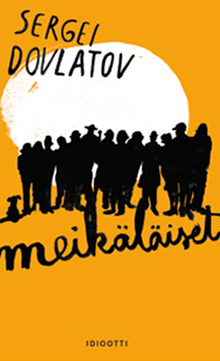
Vladimir Yermakov in Eurozine:
In the Soviet Union I was not a dissident. (Being a drunk doesn't count.) All I did was write stories that were ideological strangers. And I had to leave. It was in America that I became a dissident.
Sergei Dovlatov
Central to the primary meaning of a work of art is the person of the artist, especially if the work contains autobiographical material. Sergei Dovlatov (1941-1990) is a special case in this respect. The writer Dovlatov, and his character Dovlatov, are as dependent on one another as the two hands simultaneously drawing one another in Maurits Cornelis Escher's mysterious drawing. This interdependence doesn't imply anything definite about their identity, however. Those who knew Dovlatov from his works merely imagined they knew the man. Those who knew him personally realized they didn't know him very well. The facts of his biography are all blurred, ambiguous, vague. This should be kept in mind when reading his books. Almost confessionary in form, their content is largely invented. As a great mystifier, he was able to unsettle his surroundings. In the field of gravitation surrounding Dovlatov, reality is distorted and loses its plausibility.
But before focusing on the man himself, we should decide on our criteria. The pathos typical of world literature can be seen as a defence of the human being. How do we evaluate a person? Every one of us has a scale according to which we weigh the social significance of a person. This scale runs between two generalizing definitions, namely “the great man” and “the small man”. The megalomania inherent in Russian autocratic rule would acknowledge only statesmen-heroes as great men. Therefore Tsarist censorship was nettled by the entirely inappropriate respect shown for the person of Pushkin in his obituary: what value could there be in a poet, let alone one who, instead of praising absolute power, endorsed mercy toward the fallen? As for the place of the human being in Russian reality, government and society were far from seeing eye-to-eye. Russian literature turned its face from the mighty of this world and gave its heart to the poor, the luckless, penniless outsiders, whom it saw through the magic crystal of art. They were seen as true, genuine people, whereas the lords of life proved to be the charlatans of existence.
The central character in Sergei Dovlatov's prose, the author's alter ego, is a small person. A small man in a great country built by dwarfs. Here is the first confusing point: a great small person.
More here.
Liberalism and Its Critics
From the Heyman Center:
In his recent book “The Revolt Against the Masses,” Fred Siegel indicts modern American liberalism for elitism toward ordinary Americans, their values and culture, and blames liberals for many of the problems plaguing American Society today. Taking off from Siegel's book, the panelists will respond to his critique, discuss liberalism's history, and evaluate its future prospects.
Panelists include Fred Siegel, Scholar in Residence at St. Francis College in Brooklyn; Eric Foner, DeWitt Clinton Professor of History at Columbia University; Ira Katznelson, Ruggles Professor of Political Science and History at Columbia University; Anne Kornhauser, Assistant Professor of History at City College of New York, City University of New York; and Judith Stein, Distinguished Professor of History, The Graduate Center, City University of New York.
Liberalism and Its Critics from Heyman Center/Society of Fellows on Vimeo.
Negro Prison Songs / “Black Woman-Murder’s Home-Jumpin’Judy”
Bon Iver – Skinny Love
I Was a Bustle Maker Once, Girls by Patrick Barrington
A Secular History of Islam
Tariq Ali in Counterpunch:
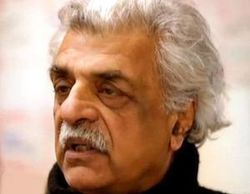
…The military successes of the first Muslim armies were remarkable. The speed of their advance startled the Mediterranean world, and the contrast with early Christianity could not have been more pronounced. Within twenty years of Muhammad’s death in 632, his followers had laid the foundations of the first Islamic empire in the Fertile Crescent. Impressed by these successes, whole tribes embraced the new religion. Mosques began to appear in the desert, and the army expanded. Its swift triumphs were seen as a sign that Allah was both omnipotent and on the side of the Believers. These victories were no doubt possible only because the Persian and Byzantine Empires had been engaged for almost a hundred years in a war that had enfeebled both sides, alienated their populations and created an opening for the new conquerors. Syria and Egypt were part of the Byzantine Empire; Iraq was ruled by Sassanid Persia. All three now fell to the might and fervour of a unified tribal force.
More here.
Sunday Poem
Written for Old Friends in Yang-jou City While
Spending the Night on the Tung-lu River
.
I hear the apes howl sadly
In dark mountains.
The blue river
Flows swiftly through the night.
The wind cries
In the leaves on either bank.
The moon shines
On a solitary boat.
These wild hills
are not my country.
I think of past ramblings
in the city with you.
I will take
These two lines of tears
And send them to you
Far away
At the western reach of the sea.
.
by Meng Hua-Ran
Tang Dynasty
Early 730s A.D.
from The Heart of Chinese Poetry
Edited and translated by Greg Whincup
Anchor Books, 1987
.
.
Saturday, November 8, 2014
Farzana: The Woman who Saved an Empire
Arif Akbar in The Independent:
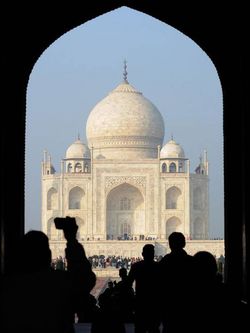
Her story is as large as any multiplex-worthy biopic and in Julia Keay’s hands, it is brought alive both in its sensational biographic detail – the stormy love life and marriages, the conversion from Islam to Catholicism, the rag-to-riches ascendancy of a “nautch” girl (dancer-cum-prostitute) – and in the power-play between the East India Company’s imperial expansion across India and a tottering Mughal Court struggling to maintain its footing as a ruling power. In almost every aspect of her life, Farzana managed to defy the social conventions that would have written her off as victim of her social class, her gender, her illegitimate birth. She was sold to the “nautch” trade by her destitute mother when her father died and his wife – not Farzana’s mother –inherited his wealth. Farzana’s beauty gave her a natural advantage in this environment but the trade also seemed to finesse her powers of beguilement in other, far more powerful ways. It was her ability to gain the trust of the men she entertained and to soothe but also to become their companion and confidante, which gave her the knee-up.
More here.
‘The Laughing Monsters,’ by Denis Johnson
Denis Johnson is closest in sensibility to the great Robert Stone, though he lacks that writer’s command of plot and structure. Yet we don’t read Johnson for methodology but for troubled effect and bright astonishments. A writer should write in such a way that nobody can be ignorant of the world and that nobody may say that he is innocent of what it is all about. Sartre says this, more or less, in “What Is Literature?” Johnson writes in just such a way. Life is ludicrous and full of cruel and selfish distractions. Honor is elusive and many find the copious ingestion of drugs necessary. Our ignorance is infinite and our sorrows fearful. We have made an unutterable waste of this world, and our passage through it is bitter and unheroic. Still, the horror can at times be illuminating, and it is necessary that the impossible be addressed. Here is the hapless murderer Bill Houston at the end of Johnson’s first novel, “Angels,” strapped down in the gas chamber, listening to the sound of his heart:
“Boom. . . . Boom! Was there ever anything as pretty as that one? Another coming . . . boom! Beautiful! They just don’t come any better than that. He was in the middle of taking the last breath of his life before he realized he was taking it. But it was all right. Boom! Unbelievable! And anothercoming? How many of these things do you mean to give away? He got right in the dark between heartbeats, and rested there. And then he saw that another one wasn’t going to come.”
Writing, like old age and Wyoming, is not for sissies.
more here.
AN ISM OF ONE’S OWN: ON VOLODINE’S WRITERS
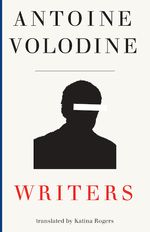
However much the Formalists and New Critics insisted on maintaining an analytic gap between the work of literary interpretation and the life circumstances of authors, readers and reviewers generally expect a modicum of information about the author to come along with a book. Where such information is counterfactual, as in the case of pseudonymity or heteronymity, the situation is a little different, but fundamentally the same. The impulse toward biographical candor is not wholly dodged, as one might first think, but rather reinforced through a teasing gesture that only appears to oppose it. Pseudonymity calls attention to authorship and identity in ways that more conventional forms of attribution do not, and it generally has the effect of intensifying the curiosity and mystique which sometimes surrounds literary authorship.
In other words, textual signification is never only intrinsic to the text, but on the contrary always also framed by what information is known about its composition and provenance. A famous Borges story, “Pierre Menard, Author of the Quixote,” pivots on this interplay between authorship/attribution and signification. The central character, a writer called Pierre Menard, develops an ambition to “produce a number of pages which coincided—word for word and line for line—with those of Miguel de Cervantes.” When the narrator of the story compares Menard’s fragments with the corresponding passages from Cervantes, he is awestruck by the differences of style that arise from attributing the text to either Cervantes or Menard.
more here.
‘A Brief Stop on the Road from Auschwitz’

In August 1947 a young Jewish man named David Rosenberg descended alone from a train at the small town of Södertälje, a few kilometres to the west of Stockholm. A “pitiful remnant of his almost extinguished family”, David was in his twenties, on a journey that began in the Polish city of Lodz, took him to the selection ramp at Auschwitz-Birkenau – the point of separation from his beloved Halinka – and thence on to numerous labour and death camps in Germany. Somehow he ended up in Sweden, on a train. “My dearest Halinka,” he writes hopefully to the woman who eventually became his wife, “I got to Södertälje at seven in the evening.” Has he chosen the right place to disembark?
That question threads its way through A Brief Stop on the Road from Auschwitz. David and Halinka are soon reunited; it is a time for “bright dreams and big projects” in a new country. They produce a son who is given a local name, Göran. He will become one of Sweden’s most distinguished journalists, a success story for a child of immigrants, and years later will write this fine, captivating account of his father’s journey, his own journey of discovery, and the nature of Sweden in the years after the war.
more here.
The War of the Words
Keith Gessen in Vanity Fair:
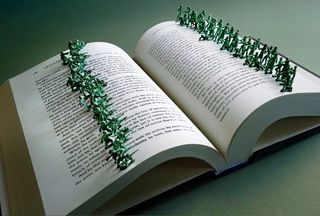
This past year has seen hostilities between Amazon and the publishers, which had been simmering for years, come out into the open, filling many column inches in The New York Times and The Wall Street Journal, not to mention numerous online forums. The focal point of the dispute has been a tough negotiation between Amazon and the publisher Hachette, with some public sniping between the companies’ executives (who have otherwise kept out of view). Hachette, it should be said, is no slouch: it is owned by the large French media conglomerate Lagardère. The other big publishers are similarly well backed. HarperCollins is owned by Rupert Murdoch’s News Corp. Simon & Schuster is a part of CBS. Macmillan and Penguin Random House are owned, or co-owned, by hefty German corporations. Nonetheless, all the publishers feel bullied by Amazon, and Amazon, in turn, feels misunderstood.
It wasn’t always this way. When Amazon first appeared, in the mid-90s, mailing books out of the Seattle garage of its founder, Jeff Bezos, it was greeted with enthusiasm. The company seemed like a useful counterweight to the big bookstore chains that had come to dominate the book-retailing landscape. In the late 1990s, the large chains, led by Borders and Barnes & Noble, controlled about a quarter of the adult-book market. Their stores were good. They may have lacked individuality, but they made up for it in inventory—a typical Barnes & Noble superstore carried 150,000 titles, making it as alluring, in its way, as the biggest and most famous independent bookstores in America, like Tattered Cover, in Denver, or City Lights, in San Francisco. Now a person on a desolate highway in upstate New York could access all those books, too.
The big chains were good for publishers because they sold so many books, but they were bad for publishers because they used their market power to dictate tough terms and also because they sometimes returned a lot of stock. People also worried about the power of the chains to determine whether a book did well or badly. Barnes & Noble’s lone literary-fiction buyer, Sessalee Hensley, could make (or break) a book with a large order (or a disappointingly small one). If you talked to a publisher in the early 2000s, chances are they would complain to you about the tyranny of Sessalee. No one used her last name; the most influential woman in the book trade did not need one.
More here.
Automation and us
Daniel Menaker in The New York Times:
Exhibit A: Electronic medical records. In 2005, the RAND Corporation predicted that electronic medical records “could save more than $81 billion annually and improve the quality of care.” But as it turns out, Carr shows us, along with the usefulness of these records has arrived a plague of problems — above all, the interposition of the computer screen between doctors and their patients. Studies have proved that checking records, possible diagnoses and drug interactions on a computer during a medical examination can interfere with what should be not only a fact-based investigation but a deeply human, partly intuitive and empathetic process. One tiny but telling detail: Handwritten records allow physicians to pick out and attend to the comments of individual colleagues. How? Penmanship. In computerized records, one font fits all.
More here.
Saturday Poem
Is it Time to Go to Sleep Yet?
.
I just want
to go to sleep
and wake up
not to a brighter day
but to one less
until I see you again.
.
by Sassan Tabatabai
from Uzunburun
Pen and Anvil Press, 2011
How the Chemical Age Spun Evolution Out of Control
Lindsay Abrams in AlterNet:

And despite the opinions of those who don’t like to think that human activity can have a significant, detrimental effect on our planet, they’re proof of just the opposite. We may temporarily gain the upper hand over pests and diseases through our use of chemicals, but eventually they’re all but guaranteed to bounce back, stronger than before. Less intentional still, says Monosson, are the impacts we’re having on larger species: where industrial pollution meets wildlife, frogs, fish and salamanders evolve to survive in their newly toxic environments.
In “ Unnatural Selection,” Monosson discusses the myriad ways in which the chemical age is changing life, and, most importantly, what we can do to slow things down. Part of the challenge, she told Salon, is just understanding that this is evolution we’re seeing — something that not everyone seems to grasp. ”Maybe if we did,” she mused, “we’d realize how important it is to reduce our chemical influence on life.”
More here.