John Craske’s embroidered life

Alexandra Harris in TLS:

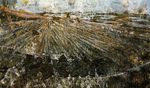
BoatJohn who? Craske’s obscurity is part of the subject of this book, but surely his name will be remembered now that his paintings and astonishing embroideries are available to us in the abundant reproductions that fill these pages, and now that Julia Blackburn has empathetically filled out a possible life story from the sparse but striking threads of evidence that remain. Craske was a Norfolk fisherman too ill to fish. As a young man he worked with his brothers, crabbing and longshore cod fishing, until 1905 when he started a fish shop in Dereham. When the war came, his efforts to enlist were rejected on unknown medical grounds – until he at last received a commission in 1917, promptly suffered what his wife Laura called “a relapse”, fell into a “stuporous state”, and was sent to Norwich Asylum rather than to the war. The remaining twenty-six years of his life might have been spent in one asylum or another, had it not been for the determination of Laura, who found a small house where they could live on almost nothing, with daylight coming into the cramped room where Craske lay month after month in bed.

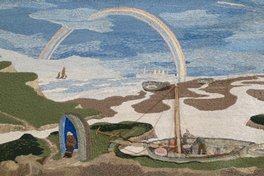
In that bed he became an artist. In the periods of lucidity between “stupors” (“have I been away again?”, he would ask), he carved and painted model boats, made oil paintings of tossed vessels at sea, and, from 1929, made some of the most ambitious embroideries of the twentieth century. In his “Panorama of the Norfolk Coast”, a rainbow arcs over the muds flats where channels of water glint between moored boats, and a pink haul is unloaded from a vessel named in tiny stitches THE PRAWN. There is a stiff breeze blowing. We gauge the precise speed and motion of the breakers in the distance; a waiting fisherman, bundled up in waterproofs, sits with his back to the sea in the little sheltering alcove of an upturned boat. Every detail is honoured, and there is pleasure, too, in the abstract design of it.

More here.

Can Islamic scholars change thinking on climate change?

Davide Castelvecchi, Quirin Schiermeier & Richard Hodson in Nature:

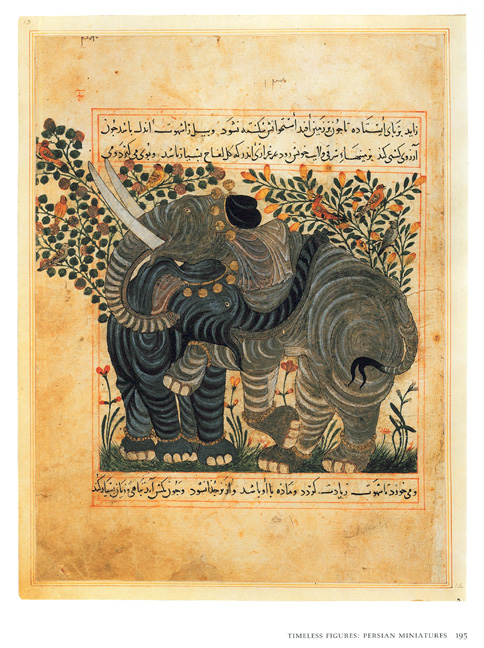
IslamFewer than four months before politicians gather in Paris to try to hammer out an international climate agreement, Islamic scholars have underscored the urgency of halting climate change. The Islamic Declaration on Global Climate Change, drawn up by a group of academics, Muslim scholars and international environment policy experts, was announced this week at a symposium on Islam and climate change in Istanbul. It calls on the 1.6 billion Muslims around the world to phase out greenhouse-gas emissions from fossil fuels and switch instead to energy from renewable sources. Unlike Catholicism, for example, there is no central religious authority in Islam, but the declaration suggests Muslims have a religious duty to tackle climate change. Nature explains the intent of the declaration and what it might achieve.

What does the statement say?

In a nutshell, it says that climate change resulting from fossil-fuel burning must urgently be halted, lest ecosystems and human civilization undergo severe disruptions. “This current rate of climate change cannot be sustained, and the earth’s fine equilibrium (mīzān) may soon be lost,” it reads. “Excessive pollution from fossil fuels threatens to destroy the gifts bestowed on us by God, whom we know as Allah — gifts such as a functioning climate, healthy air to breathe, regular seasons, and living oceans.” Citing a 2014 report by the Intergovernmental Panel on Climate Change (IPCC), it warns that components of Earth's system are at risk of experiencing abrupt and irreversible change.

More here.

Wednesday Poem

The Fall of Rome
.

The piers are pummeled by the waves;
In a lonely field the rain
Lashes an abandoned train;
Outlaws fill the mountain caves.

Fantastic grow the evening gowns;
Agents of the Fisc pursue
Absconding tax-defaulters through
The sewers of provincial towns.

Private rites of magic send
The temple prostitutes to sleep;
All the literati keep
An imaginary friend.

Cerebrotonic Cato may
Extol the Ancient Disciplines,
But the muscle-bound marines
Mutiny for food and pay.

Caesar’s double bed is warm
As an unimportant clerk
Writes I DO NOT LIKE MY WORK
On a pink official form.

Unendowed with wealth or pity,
Little birds with scarlet legs,
Sitting on their speckled eggs,
Eye each flu-infected city.

Altogether elsewhere, vast
Herds of reindeer move across
Miles and miles of golden moss,
Silently and very fast

by. W.H. Auden
from The Collected Poems
Farber & Farber, 1976

Tuesday, August 18, 2015

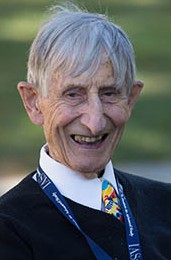
What does the Freeman J. Dyson think about the Pluto flyby, the Iran nuclear deal, and how his scientific legacy might be affected by his contrarian climate-change views?

Jermey N. A. Matthews in Physics Today:

ScreenHunter_1321 Aug. 18 18.23Now 91 years old, mathematical physicist Freeman Dyson continues to churn out fresh opinions and original ideas. He is well known for his contributions to quantum electrodynamics and random matrix theory, among other things. However, he also expresses broad views and visions in book reviews and essays, including on topics as varied as space exploration, genetic engineering, and nuclear weapons.

Two collections of Dyson’s writings were released earlier this year, within a month of each other: Dreams of Earth and Sky (New York Review of Books, 2015) and Birds and Frogs: Selected Papers, 1990–2014 (World Scientific, 2015). “One of the joys of both books is the pleasure of getting to know Dyson better,” writes theoretical physicist Frank Wilczek in his review for this month’s issue of Physics Today. Dreams of Earth and Sky, geared for the general reader, is a selection of Dyson’s reviews for the New York Review of Books. The second offering, Birds and Frogs “is more varied and on the whole more technical,” writes Wilczek.

Physics Today caught up with Dyson recently to talk about his new books and about his views on current issues.

PT: What prompted you to assemble these two collections around the same time? And what's new or different about them?

DYSON: The simultaneous publication of the two books was unexpected and unplanned.Dreams of Earth and Sky is a collection of book reviews published by the New York Review of Books. It is a sequel to The Scientist as Rebel (New York Review Collections, 2006). Birds and Frogs is a collection of writings—everything except for book reviews—published by World Scientific. It is a sequel to an earlier volume of selected papers published by the American Mathematical Society.

PT: The reviewer highlights your appreciation for the virtues of blunders and of wrong theories. At what point in your career did you begin developing these appreciations?

DYSON: I did not think much about blunders and wrong theories until I read the books by Mario Livio (Brilliant Blunders, Simon & Schuster, 2013) and Margaret Wertheim (Physics on the Fringe, Walker Books, 2011) and wrote reviews of them. Writing reviews gives me a chance to think new thoughts and express new opinions. Sometimes the opinions are sincere and sometimes not. Reviews are intended to entertain as well as educate.

More here.

Why We Need to Resurrect Our Souls

Illustrations_to_Robert_Blair's_The_Grave_,_object_9_The_Soul_Hovering_over_the_BodyMark Edmundson at The Chronicle Review:

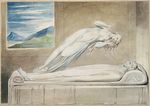
Maybe we are best off without ideals. Perhaps there can be something bleakly noble in affirming ourselves as fundamentally Darwinian creatures who live to sustain our existences with as little pain and as much pleasure as possible. But is that all there is to life? The question of the great states of being, self and soul, is in danger of dropping off the map of human inquiry. In its place there opens up an expanse of mere existence based on desire, without hope, fullness, or ultimate meaning. We can do better.

Critics have often identified Western culture as a culture of the image. We live, it’s been said, in a culture of simulation. But simulation of what?

Popular culture (as adored now by the elite as it is by the general populace) simulates soul. An enormous, complex, and stunning technological force, which might be used to feed the world or to rid it of disease, is instead devoted to entertainment — to delivering experiences that fabricate states of soul. These fabrications testify to both our fear of soul states — they are ways of holding dangerous ideals at arm’s length — and our hunger for ideals. They mean and have meant too much. We cannot quite let them go.

more here.

The Strange Comics And Equally Strange Legacy Of ‘The Far Side’ And Gary Larson

ScreenHunter_1320 Aug. 18 18.09

Chris Sims in Comics Alliance:

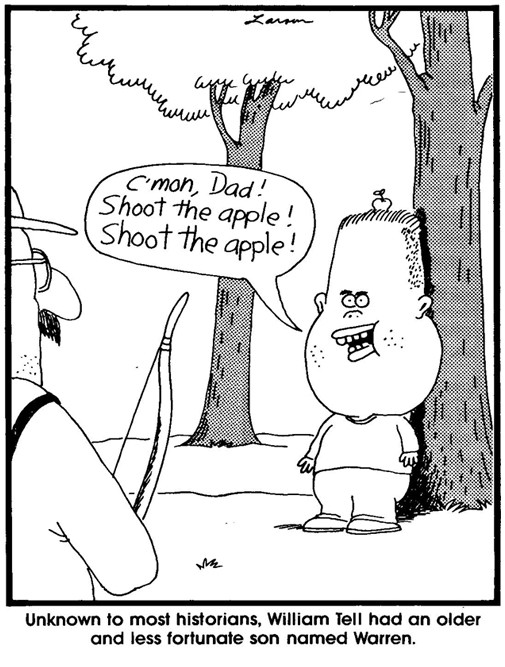
When you look back at pop culture, you can occasionally follow the threads back to these points that change everything. They’re the projects that paved the way for so much that came after, the ones that introduced their audiences to a strange new way of thinking that eventually becomes the new standard, these massive influences that vast sections of the things we love almost certainly wouldn’t exist without. And for my generation, Gary Larson’s The Far Side is one of those points.

Through a daily strip that ran for fifteen years in over 1,900 newspapers — and got dropped from a handful for being too weird in the process — Larson introduced an entire generation to the surreal, random, and occasionally very dark humor that would become part of the language that we all speak. And today, August 14, as Larson celebrates his birthday, it’s a pretty great time to look back on his work.

More here.

Robot Weapons: What’s the Harm?

Jerry Kaplan in the New York Times:

Kaplan-master675Last month over a thousand scientists and tech-world luminaries, including Elon Musk, Stephen Hawking and Steve Wozniak, released an open letter calling for a global ban on offensive “autonomous” weapons like drones, which can identify and attack targets without having to rely on a human to make a decision.

The letter, which warned that such weapons could set off a destabilizing global arms race, taps into a growing fear among experts and the public that artificial intelligence could easily slip out of humanity’s control — much of the subsequent coverage online was illustrated with screen shots from the “Terminator” films.

The specter of autonomous weapons may evoke images of killer robots, but most applications are likely to be decidedly more pedestrian. Indeed, while there are certainly risks involved, the potential benefits of artificial intelligence on the battlefield — to soldiers, civilians and global stability — are also significant.

The authors of the letter liken A.I.-based weapons to chemical and biological munitions, space-based nuclear missiles and blinding lasers. But this comparison doesn’t stand up under scrutiny.

More here.

The radicalization of Joan Didion

150824_r26853-690Louis Menand at The New Yorker:

Didion came from a family of Republicans. She was born in Sacramento in 1934, a fifth-generation Californian. Her father started out in insurance, speculated in real estate, and ended up spending most of his career in the military, a very California trifecta. Turned down by Stanford, Didion attended Berkeley, in an era when campus life was socially conventional and politically dormant. In 1955, she won a guest editorship at Mademoiselleand spent a few months in New York City. A year later, she won a similar contest at Vogue, and she moved to New York in the fall of 1956 and began her magazine career there. Leaving home, she later said, “just seems part of your duty in life.”

Didion worked at Vogue for ten years. She continued to write for Mademoiselle, and, in 1960, she began contributing to The National Review, William F. Buckley’s conservative weekly. She wrote pieces about John Wayne, her favorite movie star, and, in the 1964 Presidential election, she voted for Barry Goldwater. She adored Goldwater. It was hardly a surprise that she found Haight-Ashbury repugnant. Her editors at the Post understood perfectly how she would react. They designed the cover before she handed in the piece.

Didion’s transformation as a writer did not involve a conversion to the counterculture or to the New Left. She genuinely loathed the hippies, whom she associated with characters like Charles Manson, and she thought that the Black Panthers and the student radicals were both frightening and ridiculous.

more here.

Finding Our Bearings with Art

NigredoJohn Lysaker at nonsite:

We have come some way from the days when a stone torso fixed a poet and lead him to speak of its gaze, one that saw, even read him head to toe. For many if not most, it is now the reader or viewer or listener that sets the terms of such encounters, attenuated as they are. That is, it is no longer simply beauty that is in the eye of the beholder, but everything there is to say about a work and whatever might be found there. Not that “reader response criticism,” whether based in affect, cultural identity, and/or the neuro-Kantian turn, is the principal variable in this turn away from the sensibility that enabled Rainer Maria Rilke to write “Archaic Torso of Apollo.” But even without exploring the art market and museum culture, one has a firm sense that the basics of aesthetic engagement have changed in our age of digital reproduction.

Permit me an anecdote. I asked my “What is Art?” class: “How often do you listen to music?” “All the time,” I was told, each reporting that he or she listened for at least an hour a day. “But what do you mean by listen,” I asked. “Do you play the music just to listen to it, to follow it, to see where it goes and where it takes you? And then again, maybe a day or two later, listen again, armed with a few anticipations that, if you’re lucky, will cede to more intriguing discoveries? And might all that then ask of you something, something dear?” No. Music accompanied some other activity: studying, working-out, walking to class. For these students, and I do not believe they are unique, though they certainly were talented and a pleasure to engage, music had become ambient, what Brian Eno glosses as “an atmosphere, or a surrounding influence: a tint.”

more here.

The Slaughter

Stewart Sinclair in The Morning News:

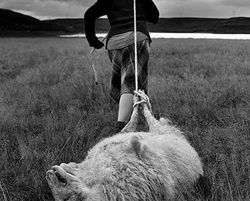
SheepA sheep that is born and bred at a major US slaughterhouse has a much different experience. After a life in a small pen, she is one day led into a large room with four or five other sheep and a worker wielding what looks like a pair of oversized Walkman headphones, only they’re connected to a high-voltage cable descending from the ceiling. The worker then positions the pads on the sheep’s temples, subjecting her to electronarcosis, a shock that according to the Humane Slaughter Association instigates “a gran mal epileptic fit, during which the brain is stimulated, the body exhibits tonic/clonic activity, and the result is complete loss of consciousness.” The sheep collapses and stops breathing. Her front legs extend rigidly while her hind legs contract, pulling them inward like child’s pose in yoga. Then her body relaxes, her legs involuntarily kick, her body shakes in spasmodic fits, eyes dipping in their sockets as if she were experiencing a spiritual awakening. She might urinate or defecate, but there is still no pain. Then the worker straps her hind legs to a line that raises her through an entrance in the ceiling leading to the killing floor, where another worker “sticks” her, slicing her throat with a sharp knife until she bleeds. In a kind and considerate world, this happens within 15 seconds of electronarcosis, and the sheep doesn’t feel a thing. But this isn’t always the case.

The typical slaughterhouse worker is a Latino who nets $12.50 an hour and quits within a year, leaving employers little incentive to invest any time or money into training, which makes operator error—to say nothing of outright disregard and cruelty—a frequent occurrence. If the pads are misplaced on the sheep’s temples, she might not be fully unconscious. And even if they are placed correctly, the operator might take too long to attach her to the conveyor belt, and the poor sheep begins to recover, to breathe rhythmically and regain awareness of her surroundings—and to be able to respond to painful stimuli—just as the worker’s knife sticks her in the throat, leaving her wide-eyed, panicked, writhing, and struggling to breathe for up to a minute as the conveyor belt transports her soon-to-be carcass down the line.

More here.

The Butterfly, the Ant and the Oregano

Nicholas Wade in The New York Times:

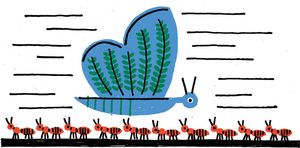
ButterIt may be hard to imagine a ménage à trois, satisfactory to all parties, in which one member tries to dislodge another with a toxic gas and a third eats the offspring of the other two. But such an arrangement exists, and one of its members may even be sitting quietly in your kitchen’s spice rack. The story begins with the Large Blue, a butterfly that lays its eggs on the wild oregano plant. The caterpillar munches on the plant’s flower buds for two weeks and then one night drops to the ground. Most ants forage at noon, but by timing its descent at dusk, the infant caterpillar gets adopted by a red ant known as Myrmica that forages only at day’s end. The caterpillar deceives an ant into thinking it is a stray grub from the ant’s own nest. It does so by adopting the grub’s posture and by exuding a scent that mimics that of the ant’s own species. Taken underground to the Myrmica nest, the adopted caterpillar doesn’t remain a helpless foundling for long. It starts to acquire influence in the ant society by imitating the little clucking sounds made by the ants’ queen. And having gained high status in the nest, it can fulfill the purpose of its visit: to feast on the ants’ larvae. The ants themselves use their larvae as a food source when times are tough, so for their queenly guest to behave like a cannibal may not strike them as all that abhorrent.

The caterpillar gorges on the ant grubs for 10 months, increasing its weight nearly 50 times until it is time to turn into a pupa and then a butterfly. The Large Blue’s association with ants has been known for more than a century. Only recently have researchers started to explore how the butterfly pulls off the feat of detecting the underground nests of a single species of ant to which its caterpillars are adapted. (The butterfly, widespread in Europe, seeks out a single species of the Myrmica family of ants, but the particular species varies from one region to another in the Large Blue’s territory.) Considerable puzzlement ensued when experiments to test the butterfly’s ability to sense the presence of Myrmica came up blank. “It was a huge mystery that none of the experiments seemed to work,” said Naomi E. Pierce, an expert on butterfly-ant interactions at Harvard University. A surprising solution has been proposed by researchers led by Dario Patricelli and Emilio Balletto at the University of Turin in Italy and Jeremy A. Thomas of the University of Oxford. They have developed evidence that the oregano plant is the crucial mediator between the ants and the Large Blue butterfly.

More here.

Tuesday Poem

Recursive

More neurons in the brain  than stars in the Milky Way—  some structure, however tentative—  and the fact of other forms  doesn’t fail to astound me  so much as it renders me  speechless, the lawful world  incomprehensible, the arbitrary world  consumed by lapses— coffee and oranges  in an office lonely as a picture occurs—  your hand on a book— and in this body  more transactional than animal  the day goes by— quite by—

.

by Shannon Tharp
from Echotheo Review, January 2015

Monday, August 17, 2015

Sunday, August 16, 2015

Gorgeous Examples of the Lost Art of Blackboard Sketching

Blackboardsketch00whit_0012

Emily Becker in Mental Floss:

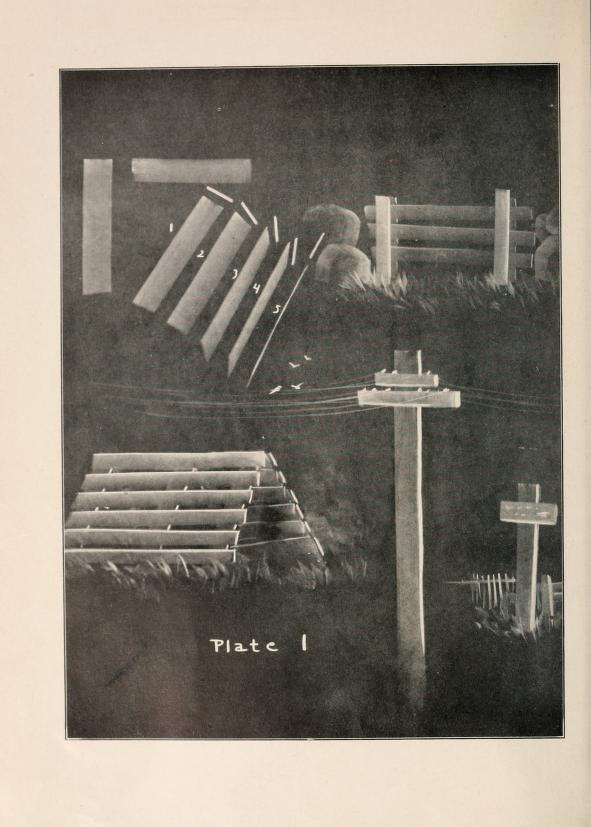
Sometimes, the act of teaching is a work of art. In the days before clip art and Google image search, artistically-challenged teachers had few alternatives to the chalkboard for their visual-based lessons. Enter Frederik Whitney, author of Blackboard Sketching, who wrote his guide in 1909 with the promise that, with a few basic strokes and some practice, anybody could turn a chalkboard into a canvas. Check out the virtual art gallery below of chalk art that’s too good for the sidewalk.

More here.

Bethe, Teller, Trinity and the End of Earth

John Horgan in Scientific American:

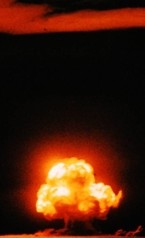
ScreenHunter_1317 Aug. 17 01.37The 70th anniversary of the bombings of Hiroshima and Nagasaki has reminded me of an extraordinary incident that occurred during the Manhattan Project, when Edward Teller and other physicists feared the fission bomb they were building might incinerate the planet. I heard about the incident in 1991 while preparing for an interview with Hans Bethe, who headed the Manhattan Project’s theoretical division. Teller reportedly did calculations suggesting that a fission explosion might generate heat so intense that it would trigger runaway fusion in the atmosphere. (Ironically, Teller later helped create thermonuclear bombs, in which fission catalyzes a vastly more powerful fusion explosion.) Teller brought his concerns to other physicists, including Bethe, an authority on fusion (and pretty much everything else in nuclear physics). After considering Teller’s concerns, Bethe and others concluded… Well, I’ll let Bethe tell the story in his own words. Here is an exact transcript of my interview with him, which took place at his home in Ithaca, New York.

Horgan: I wonder if you could tell me a little bit about the story of Teller's suggestion that the atomic bomb might ignite the atmosphere around the Earth.

Bethe: It is such absolute nonsense [laughter], and the public has been interested in it… And possibly it would be good to kill it once more. So one day at Berkeley — we were a very small group, maybe eight physicists or so — one day Teller came to the office and said, “Well, what would happen to the air if an atomic bomb were exploded in the air?” The original idea about the hydrogen bomb was that one would explode an atomic bomb and then simply the heat from the atomic bomb would ignite a large vessel of deuterium… and make it react. So Teller said, “Well, how about the air? There's nitrogen in the air, and you can have a nuclear reaction in which two nitrogen nuclei collide and become oxygen plus carbon, and in this process you set free a lot of energy. Couldn't that happen?” And that caused great excitement.

More here.

ISIS Enshrines a Theology of Rape

Rukmini Callimachi in the New York Times:

ScreenHunter_1315 Aug. 17 01.32In the moments before he raped the 12-year-old girl, the Islamic State fighter took the time to explain that what he was about to do was not a sin. Because the preteen girl practiced a religion other than Islam, the Quran not only gave him the right to rape her — it condoned and encouraged it, he insisted.

He bound her hands and gagged her. Then he knelt beside the bed and prostrated himself in prayer before getting on top of her.

When it was over, he knelt to pray again, bookending the rape with acts of religious devotion.

“I kept telling him it hurts — please stop,” said the girl, whose body is so small an adult could circle her waist with two hands. “He told me that according to Islam he is allowed to rape an unbeliever. He said that by raping me, he is drawing closer to God,” she said in an interview alongside her family in a refugee camp here, to which she escaped after 11 months of captivity.

The systematic rape of women and girls from the Yazidi religious minority has become deeply enmeshed in the organization and the radical theology of the Islamic State in the year since the group announced it was reviving slavery as an institution. Interviews with 21 women and girls who recently escaped the Islamic State, as well as an examination of the group’s official communications, illuminate how the practice has been enshrined in the group’s core tenets.

More here.

The Ethics of Bloodless Medicine

Amanda Schaffer in The New Yorker:

Schaffer-Medicine-without-Blood-3-690Pennsylvania Hospital, in downtown Philadelphia, was Colonial America’s first hospital, founded in 1751 by Benjamin Franklin and the physician Thomas Bond. For much of its history, the hospital’s staff treated conditions from pneumonia to gangrene and headaches with aggressive bloodletting, a practice that may have originated in ancient Egypt, and that persisted for millennia, despite the scarcity of evidence that it cured patients of disease. Benjamin Rush, who was a co-signer of the Declaration of Independence and practiced at Penn Hospital in the late eighteenth and early nineteenth centuries, was known by colleagues as the Prince of Bleeders. His enthusiasm arose from the belief that “all disease arose from excitation of blood vessels, which copious bleeding would relieve,” according to the author Douglas Starr. “If the patient fainted, so much the better, for it meant that the harsh measures were taking effect.” During the yellow-fever outbreak of 1793 in Philadelphia, Rush reportedly treated more than a hundred patients a day with bloodletting; years later, the provost of the University of Pennsylvania recalled that “his house was filled with the poor whose blood, from want of a sufficient number of bowls, was often allowed to flow upon the ground.”

Widespread blood transfusion, by contrast, is less than a century old. Yet it, too, was popularly adopted without rigorous testing of when, exactly, it benefitted patients. Just as early practitioners accepted the virtues of draining blood away, most mid-twentieth-century doctors took it on faith that infusing more was better. On a warm Saturday in April, however, more than a hundred Jehovah’s Witnesses gathered in the auditorium at Penn Hospital to learn about a program in bloodless medicine, in which patients choose to forego transfusion under all circumstances, and instead receive, in the course of their care, a range of treatments designed to build up their own red-blood-cell counts and painstakingly conserve as much of their blood as possible. Jehovah’s Witnesses object to transfusion because they believe that scriptural passages forbid it. But the attendant reasoning—that an individual’s singular qualities, life and soul, are carried in blood—does not fall so far outside of the mainstream imagination. When we get hurt as kids, the first thing we notice is whether it’s bleeding. Blood rushing down an arm or a leg is a badge of honor. But blood also gives us away, revealing embarrassment when it rushes to the face, or lust when it rushes elsewhere. If we are sick or pregnant or dying, the proof is in our blood, more often than in our sweat or tears or spit. If we don’t know what’s wrong with us, we expect our blood to provide an answer. Blood symbolizes murder, birth, passion, danger, and conquest, as when hunters drink from a slain animal. Martian blood is never red like ours. Vampires can’t survive without sucking the lifeblood from people. In movies, when a drop of blood trickles from a wounded hero’s nose we know he is about to keel over. Blood is how we learn what our bodies can and cannot take. Patricia Ford has led the bloodless-medicine program at Penn since 1998.

More here.

THE EMBRYOLOGIST FULL OF LIFE

Samantha Weinberg in More Intelligent Life:

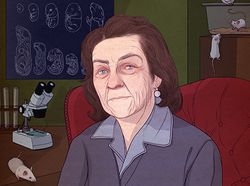
McLarenThe first time I met Anne McLaren, I was quite daunted. I knew she was a genius and I was in my very early days as a scientist. I went to see her with a problem: I couldn’t get my eggs to fertilise. She was then at University College London. She looked at me rather quizzically and said: “When my mouse embryos don’t grow, I think it’s something to do with sun spots.” And then she laughed. Anne was born in London and read zoology at Oxford, where she got her PhD before moving to UCL in 1952. It was there that she started work on mouse genetics with Donald Michie. They married the same year and went on to have three children before divorcing seven years later. She brought up the children as a single mother and always campaigned for government help with child care. She and Michie remained friends, though, and got back together when they were both in their 70s. They died together, in a car accident on the M11 on the way back from Cambridge in 2007. It was a tragedy—she was still in full possession of her faculties, still full of life.

She was a remarkable woman and a brilliant scientist. Anne’s work became very important to mine: in my view she was more important in the development of IVF than Robert Edwards, who won the Nobel prize for his work on IVF. But she doesn’t get the plaudits she deserves. She wasn’t a doctor, she didn’t treat humans, and she wouldn’t have said that IVF was her key subject; she was an embryologist who was interested in how fertilisation worked. But she developed many of the techniques now used in human IVF by working on mice—which is very difficult. She discovered how to fertilise an embryo and transfer it back into the animal, and how to cut an embryo in half to make twins. It was highly significant—her long record of published papers and books is testament to the importance of her work.

More here.