
Category: Recommended Reading
You eat what you read
Rebecca Tucker in National Post:

I think of tragedy too, and of the deceptively straightforward prose that characterized Plath’s short career as a novelist. But for one reason or another, the passage in The Bell Jar that has the most staying power is the one in which Plath details a ladies’ luncheon that gave everyone food poisoning: “When I finished the first plate of cold chicken and caviar, I laid out another,” Plath’s protagonist, Esther, recalls. “Then I tackled the avocado and crabmeat salad.” Food is a powerful narrative device, even (or, sometimes, especially) when it’s not being used to directly propel a story forward. The literary use of a meal, a snack, or a table setting can serve to provide, with great depth, the most context: in The Bell Jar, for instance, Plath could’ve described a poet Esther once met as deliberate, pretentious or effete; instead, she merely observed that he ate salad with his hands, making it seem like “the only natural and sensible thing to do.”
Cara Nicoletti’s new book, Voracious, is both a collection of such literary references to food and a psuedo-memoir, where recipes are used as a compelling narrative backbone. Nicoletti places memorable passages about food and eating within the context of her own life: Voracious is split into three sections — childhood, adolescence and college years, and adulthood — within which Nicoletti has catalogued a series of short essays about the importance of certain books, followed by a recipe she’s written based on a reference to food from each one. Her reflection on The Silence of the Lambs, for instance, has a recipe for crostini with fava beans and chicken liver mousse; a passage on Charlotte’s Web is accompanied, somewhat morbidly, by one for pea and bacon soup. Nicoletti’s recipe for The Bell Jar’s Crab-Stuffed Avocado appears mid-adolescence.
More here.
Sex does matter: Key molecular process in brain is different in males and females
From ScienceDaily:

Among their findings, the scientists found that a drug called URB-597, which regulates a molecule important in neurotransmitter release, had an effect in females that it did not have in males. While the study was done in rats, it has broad implications for humans because this drug and others like it are currently being tested in clinical trials in humans.
More here.
Thursday, August 13, 2015
Can we reverse the ageing process by putting young blood into older people?
A series of experiments has produced incredible results by giving young blood to old mice. Now the findings are being tested on humans.
Ian Sample in The Guardian:

Behind that statistic lies a serious problem. People are living longer, but they are not necessarily living better. The old struggle with chronic conditions, often many at once: cancer, respiratory disease, heart disease, diabetes, arthritis, osteoporosis, dementia.
Medical researchers tend to tackle these diseases separately. After all, the illnesses are distinct: cancer arises from mutated DNA; heart disease from clogged up blood vessels; dementia from damaged brain cells. The biological processes that underpin the pathologies vary enormously. Each, then, needs its own treatment. Yet some researchers take another view: the greatest driver of disease in old age is old age itself. So why not invent treatments for ageing?
More here.
The Buckley Myth
Garry Wills in the New York Review of Books Daily (ABC Photo Archives/Getty Images):
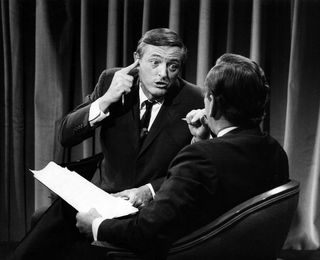
William F. Buckley, Jr., important in conservative circles during the Nixon and Reagan eras, was not central to the time of Dick Cheney and George W. Bush (he called their Iraq war a failure). But there is some renewed interest in him now, in particular in his serial sparring with intellectuals and institutions on the left: a new documentary, Best of Enemies, recalls Buckley’s televised clashes with Gore Vidal at the 1968 political conventions; while a book by Kevin M. Schultz, Buckley and Mailer: The Difficult Friendship That Shaped the Sixties, presents its subjects as friend-foes with an outsize impact on their time.
Put these together with the fact that a major biography of Buckley is being written by Sam Tanenhaus, the former editor of The New York Times Book Review—and that another biography has been backed by the Buckley Program at Yale, itself a recent addition to the Buckley legacy—and it is a lot of attention being paid to a man who died seven years ago. The interest may, in fact, be fueled by overstatement.
I am sorry to see Morgan Neville and Robert Gordon’s Best of Enemies being hailed for remembering a golden age when intellectuals fought out profound issues in public. There is more intellectual insight and incisive commentary on a single night of Stephen Colbert’s The Colbert Report or Jon Stewart’s The Daily Show than in all of the mean broadcasts of Buckley and Vidal. One of the broadcasts, which the documentary makes much light of, took place while police and protesters were battling in the streets of Chicago—and things were not going so well inside the TV studio either, since at one point Buckley said to Vidal, “Now listen, you queer, stop calling me a crypto-Nazi or I’ll sock you in the goddam face and you’ll stay plastered.”
Buckley certainly hated Vidal, but not, I think, for being gay. He hated him for ridiculing his supreme values—Catholicism and the Market.
More here.
a recently found, previously unpublished essay by T. S. Eliot

In his little book on Nathaniel Hawthorne, published many years ago, Henry James has the following significant sentences:
“The charm [of Hawthorne’s slighter pieces of fiction] is that they are glimpses of a great field, of the whole deep mystery of man’s soul and conscience. They are moral, and their interest is moral; they deal with something more than the mere accidents and conventionalities, the surface occurrences of life. The fine thing in Hawthorne is that he cared for the deeper psychology, and that, in his way, he tried to become familiar with it.”
The interest of this passage lies in its double application: it is true of Hawthorne, it is as true or truer of James himself. “They are moral, and their interest is moral”; this is the truth about all of James’s long series of novels and stories; a series of novels and stories which fell, accordingly, exactly upon the generations least qualified to appreciate the “moral interest”. Note the term “deeper psychology”. James’s book on Hawthorne was published in 1879. “Psychology” had not then reached the meaning of to-day, or if it had the meaning had not reached Henry James. One could not use the phrase now without surrounding it with a whole commentary of exposition and defence. But one feels that it is right; and that our contemporary novelists, under the influence of the shallower psychology by which we are all now affected, have missed that deeper psychology which was the subject of Henry James’s study.
more here.
The day I stood up alone
An absurdist Israeli writer confronts the serious business of family life
There’s a shorthand phrase in Israel for describing the politics of war and peace that permeates everything: ha matzav, “the situation.” You might come upon a conversation between two people and ask, “What are you talking about?” And the response would simply be “the situation.”
This can mean whatever happened that morning—a café blown up, olive trees vandalized in the occupied territories, or the latest proclamation of “Death to Israel” from Tehran. But it can also capture the particular flavor of a collective existence that finds itself, on a regular basis, trounced by History—an unrelenting, never-forgotten force, as much a part of everyday life as whether the buses are running or it’s rainy outside.
Etgar Keret, the most internationally celebrated and widely read of his generation of Israeli writers, has been notably uninterested in “the situation.” His microstories are no longer than a couple pages each and don’t concern themselves much with Hezbollah or Netanyahu. The best of them are fantastical and arrive, very economically, at some strange wisdom about the inner life of the human animal.
more here.
evil but stupid

IS HERSH PARANOID? In some ways, the label seems appropriate. He has written about the private lives of the Kennedys and claimed that high-ranking military officials are members of the Knights of Malta and Opus Dei (although, as Greg Grandin pointed out in the Nation, a number of current and former high-ranking military officials really have been members of extreme right-wing Christian sects such as the Knights of Malta). In its unending accumulation of detail after disastrous detail, Hersh’s reporting often has the screwball plotting of a Pynchon novel. If the subject matter weren’t so upsetting, his reports would be funny.
But in other respects, the term doesn’t fit. Hersh’s stories break down complex events into chains of isolated, largely reactive individual decisions. His reporting never points back, as Pynchon’s novels do, to shadowy conspiracies; there is no titanic clash between impersonal forces, no central organizing principle, only human action churning away. Near the beginning of Hersh’s book on the Iraq war, an intelligence official complaining about the “enhanced interrogation” tactics at Guantánamo says, “It was wrong and also dysfunctional.” A few pages later, this refrain is repeated by another source: “It’s evil, but it’s also stupid.”
more here.
Anatomy of a murder
Ali and Zaman in The Herald:

Sitting in a sparsely furnished room within Karachi Police’s Crime Investigation Department (CID), Aziz appears at ease even in blindfold. Recounting the events of that evening, he never sounds hurried or under duress. After shooting Mahmud, he says he and Tony turned left from the signal towards Punjab Chowrangi and reached Sharae-e-Faisal, crossing Teen Talwar in Clifton on their way. While still on the motorcycle, he messaged others to get back to Tariq Road. Once there, he just picked up his motorcycle and they all dispersed. “We only got confirmation of her death later from the news,” he says. “At that moment [of shooting], there is no way of confirming if the person is dead. You just do it and get out of there.” It was on February 13, 2015, when he says he decided that Mahmud had to die. That evening, he was at T2F, attending an event, The Karachi “Situation”: Exploring Responses. “It was something she said during the talk,” he recalls. “That we shouldn’t be afraid of the Taliban, we should stand up to them, demonstrate against them, something like that. That is when we made up our minds.” Later in the conversation, though, he adds, “There wasn’t one particular reason to target her: she was generally promoting liberal, secular values. There were those campaigns of hers, the demonstration outside Lal Masjid [in Islamabad], Pyaar ho jaane do (let there be love) on Valentine’s Day and so on.” He laughs softly, almost bashfully, as he mentions the last.
More here. (Via Dr. Fahad Qazi)
Wednesday, August 12, 2015
Brain imaging research is often wrong. This researcher wants to change that.
Julia Belluz in Vox (Semnic/Shutterstock):
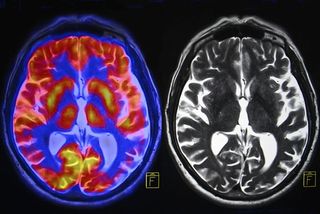
When neuroscientists stuck a dead salmon in an fMRI machine and watched its brain light up, they knew they had a problem. It wasn't that there was a dead fish in their expensive imaging machine; they'd put it there on purpose, after all. It was that the medical device seemed to be giving these researchers impossible results. Dead fish should not have active brains.
The researchers shared their findings in 2009 as a cautionary tale: If you don't run the proper statistical tests on your neuroscience data, you can come up with any number of implausible conclusions — even emotional reactions from a dead fish.
In the 1990s, neuroscientists started using the massive, round fMRI (or functional magnetic resonance imaging) machines to peer into their subjects' brains. But since then, the field has suffered from a rash of false positive results and studies that lack enough statistical power — the likelihood of finding a real result when it exists — to deliver insights about the brain.
When other scientists try to reproduce the results of original studies, they too often fail. Without better methods, it'll be difficult to develop new treatments for brain disorders and diseases like Alzheimer's and depression — let alone learn anything useful about our most mysterious organ.
To address the problem, the Laura and John Arnold Foundation just announced a $3.8 million grant to Stanford University to establish the Center for Reproducible Neuroscience. The aim of the center is to clean up the house of neuroscience and improve transparency and the reliability of research. On the occasion, we spoke to Russ Poldrack, director of the center, about what he thinks are neuroscience's biggest problems and how the center will tackle them.
More here.
Don’t Believe the Hype: David Foster Wallace and the End of the Tour

Christopher Schaberg in 3:AM Magazine:
1. There is a clever scene in the closing minutes of James Ponsoldt’s The End of the Tour, when David Foster Wallace (Jason Segel) is out in his driveway scraping snow and ice off his Honda Civic, and David Lipsky (Jesse Eisenberg) furtively takes last-minute notes as he makes his final observations around Wallace’s frumpy home. At one point Lipsky enters a nearly pitch black room, and we see a dim ray of light wash over Wallace’s writing desk: we get a glimpse of a well-used personal computer, a notepad and pen, bookshelves against the wall…. It is the wish image of a writer’s sacred den, a domestic shrine that emanates the residual aura of the Author at work. It strikes me that this is one of the things some viewers want from this movie, and maybe from David Foster Wallace in general: the architectural plans, the supply list and tools, for writing—for really being a certain kind of writer. Of course it’s just a fleeting glimpse, and we know the movie is wrapping up at this point, soon to fade out.
2. I saw the film on a Saturday morning in New York City the day after it opened. The theater wasn’t crowded at all; the vibe was mellow and subdued. I chuckled several times throughout the film, but I didn’t hear anyone else laughing. The experience was like sipping warm Earl Grey tea while someone tells you a long and sometimes unintentionally funny story in a comfortable if awkward living room. I watched the movie with a former student of mine who now lives in the city. This student is working hard to become a writer—I mean to really be a full-time writer, and I sincerely believe he has what it takes. Just two nights before, we had workshopped one of his new essays, apiece that overtly grapples with—and extends—David Foster Wallace’s classic essay “Consider the Lobster.” This student was in my David Foster Wallace seminar at Loyola University New Orleans the first time I taught that class, in 2011; Wallace is one of the writers who inspired my student to want to write, and to think critically about the world. So it made sense that we should go to The End of the Tour together. I had also considered seeing the film the night before, with a few friends, as Wallace kept coming up in conversation over dinner. (In the end, we were all too tired, and we dispersed to continue our individual, ordinary lives.) But so Wallace is in the air, and there are a lot of opinions, attitudes, and emotions swirling around The End of the Tour.
More here.
The Brussels Diktat
Étienne Balibar, Sandro Mezzadra, and Frieder Otto Wolf in Eurozine:
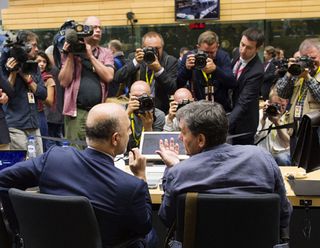
Does the unjust and forced “agreement” between the Greek government and the other states in the European Union (not all of whom feel the necessity for such a sanction) mark the end of one era and the beginning of another? In many ways yes, but almost certainly not in the sense indicated to us by the “Euro-Summit” statement of 12 July 2015. In reality, the agreement is fundamentally unenforceable in economic, social and political terms, though it will be “forced through” by a process that promises to be at least as brutal and even more divisive than the extremities we have seen over the last five years.
It is therefore necessary to try to understand the implications of the agreement and to discuss its consequences, avoiding all use of rhetoric but not of engagement or passion.
In order to do so we must first look at how the negotiations unfolded (those opened by Alexis Tsipras's return to Brussels on the back of his “triumph” in the 5 July referendum – which, for good reason, has not ceased to fuel incomprehension and criticism among his supporters in Greece and abroad), and secondly we must look at what these negotiations tell us about the positioning of the various European forces.
We must define the stage that the crisis in the EU has reached (a crisis of which Greece is both the symptom and the victim) in terms of three strategic domains: firstly the debt situation and the effects of the austerity measures; secondly the division of Europe into unequal zones of prosperity and sovereignty; and finally the collapse of democratic systems and the resulting rise in populist nationalism.
But first, it is vital that we include an “assessment” of the Euro-Summit agreement: “as seen from Athens” (from the Greek people's point of view) and “as seen from Europe” (which does not mean as seen from Brussels, whose institutions clearly have no awareness whatsoever of the current European climate).
More here.
Norman Mailer Loved Getting Punched In the Face
Jonathan Gottschall in The Daily Beast:
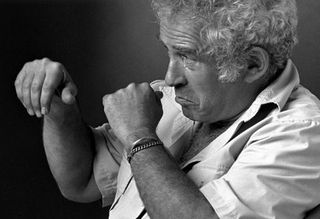
There was the time he head-butted Gore Vidal in the green room of The Dick Cavett Show and then—swaggering on stage truculent with drink—got himself verbally mauled by Vidal, Cavett, Janet Flanner, and a hooting studio audience (video below). Or maybe my favorite Mailer fight was his 100 percent vérité tussle with Rip Torn in his experimental film Maidstone (capsule play-by-play: Torn taps Mailer twice on the head with a hammer; Mailer tries to bite off Torn’s ear; they go to the ground; getting the worst of it, Mailer negotiates a fake truce; Torn relents, Mailer attacks; again getting the worst of it, Mailer is saved by his ferocious wife; Torn and Mailer exchange verbal haymakers; Mailer whiffs; Torn lands). Or there was the time Mailer drunkenly fought—or tried to fight—nearly every man he invited to a party, arguing with many and stepping outside at least three times to throw dukes on the sidewalk. Later that same night he stabbed his wife twice with a pen knife after she called him a “little faggot” with no cojones (not one of my favorite Mailer fights; she almost died).
This is going to take too long. Suffice it to say that, going by J. Michael Lennon’s biography, Norman Mailer: A Double Life, Mailer seems to have mixed it up—verbally or physically, playfully or in dead earnest—with most of the men he ever met. The book alludes to around 20 punch-ups, the last of which occurred when, at 74, he slugged the publisher of Esquire over a review he didn’t like.
More here.
Steven Pinker: The moral imperative for bioethics
Steven Pinker in The Boston Globe:

Some say that it’s simple prudence to pause and consider the long-term implications of research before it rushes headlong into changing the human condition. But this is an illusion.
First, slowing down research has a massive human cost. Even a one-year delay in implementing an effective treatment could spell death, suffering, or disability for millions of people.
Second, technological prediction beyond a horizon of a few years is so futile that any policy based on it is almost certain to do more harm than good.
More here.
The Myth of a Better Iran Deal
Stephen M. Walt in Foreign Policy:

Never mind that while the United States ramped up sanctions, Iran went from zero centrifuges to 19,000. Never mind that there was no international support for harsher sanctions and that unilateral U.S. sanctions wouldn’t increase the pressure in any meaningful way. Never mind that attacking Iran with military force would not end its nuclear program and only increase Iran’s interest in having an actual weapon. Never mind that the deal blocks every path to a bomb for at least a decade. And never mind that the myth of a “better deal” ignores Diplomacy 101: To get any sort of lasting agreement, it has to provide something for all of the parties.
More here.
The mathematics of history
What Gives Robert Frost’s “The Road Not Taken” Its Power?
David C. Ward in Smithsonian:

The years in England were crucial to Frost, but they have also caused confusion in straightening out his publishing history – the books appeared in reverse order in America and the poems that appeared in the magazines had in fact already appeared in print, albeit in England. What mattered to Frost was that his English trip had worked. 1915 became the year in which he became recognized as America’s quintessential poet; in August, the Atlantic Monthly published what is perhaps Frost’s most well-known work, “The Road Not Taken.”
More here.
The coddling of the american mind
Lukianoff and Haidt in The Atlantic:

Two terms have risen quickly from obscurity into common campus parlance. Microaggressions are small actions or word choices that seem on their face to have no malicious intent but that are thought of as a kind of violence nonetheless. For example, by some campus guidelines, it is a microaggression to ask an Asian American or Latino American “Where were you born?,” because this implies that he or she is not a real American. Trigger warnings are alerts that professors are expected to issue if something in a course might cause a strong emotional response. For example, some students have called for warnings that Chinua Achebe’s Things Fall Apart describes racial violence and that F. Scott Fitzgerald’s The Great Gatsby portrays misogyny and physical abuse, so that students who have been previously victimized by racism or domestic violence can choose to avoid these works, which they believe might “trigger” a recurrence of past trauma. Some recent campus actions border on the surreal. In April, at Brandeis University, the Asian American student association sought to raise awareness of microaggressions against Asians through an installation on the steps of an academic hall. The installation gave examples of microaggressions such as “Aren’t you supposed to be good at math?”
More here.
Wednesday Poem
We'll Always have CGI Paris
.
Open on the galaxy, dolly zoom
through Doppler shifting stars, leave the local planets
in our wake, brush off the Moon
and rummage through the clouds to find
the crouching continent where Paris piggybacks.
Pinpoint the pyramid, dogleg along the Seine
until the camera starts to weave between the struts
of youknowwhat and youknowwhere
to finish on us kissing in the festive, fireworky air.
But we were never there. My sitcom kept me
in LA, your slasher movie debut
saw you junketing in hotel rooms out east.
We shot green screen on different days: my face
a balloon taped to a broom, your waist a tailor’s dummy;
our foggy breath was lifted from Titanic;
the cutaways to clasping hands were cut in
from a jewellery ad as all of Paris waited
to be pixellated, cut and pasted.
But we’ll always have Paris,
although our eye lines never matched
and everything we tried to hold onto
our phantom fingers passed clean through.
.
by Simon Barraclough
from Neptune Blue
Salt Publishing, Cromer, 2011