The Making of a President

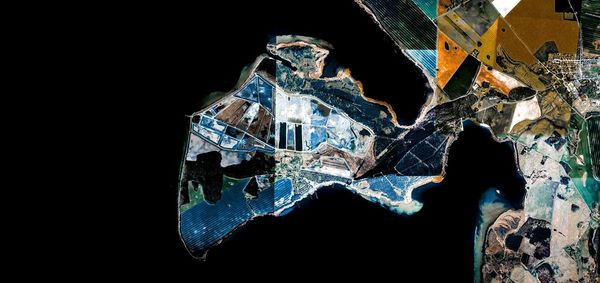
16liberland_map-master315

Gideon Lewis-Kraus in The New York Times:

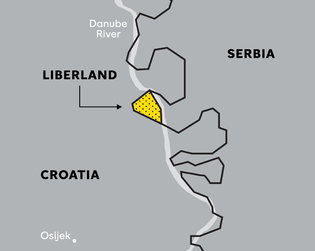
Along the western bank of the Danube, more or less halfway between Zagreb and Belgrade, there rests in historic obscurity a three-square-mile teardrop of no man’s land. It is an artifact of a border dispute of long standing, and neither Serbia nor Croatia expresses a desire to rule over this unprepossessing Gibraltar-size property. The land, marshy and prone to seasonal inundation, is choked with unregulated scrub, with here and there the lone tongue of a poplar or the gentle shag of a willow. The only road is a rutted single-lane dirt track, the only existing dwelling a flimsy hunting hovel, its provenance unknown.

The absence of governmental authority on this land is due to the manipulated course of the Danube itself. By the late 19th century, the Danube was accepted as the natural border between the regions — at that point still under Austro-Hungarian control — that would become Croatia and Serbia. There, however, the river’s path was tortuous and difficult for larger boats to navigate, so engineering work was undertaken to smooth the snaking flow. The straightened Danube was a vast improvement for international riverine transport, but in the process, four large uncontiguous bulges of Croatia became stranded alone on the Serbian side, and one small pocket of Serbia, on what was now the far bank, became attached to the Croatian mass.

This latter pocket, which local residents call Gornja Siga, is the no man’s land in question. When the two countries were neighboring republics of Yugoslavia, these orphaned riverbank plots were of little concern, but since the 1990s they have presented an intractable problem. The stranded pieces of Croatia now contiguous with Serbia are some 10 times larger, in aggregate, than the rather trifling portion of Serbia now joined to Croatia; Serbia has been all too glad to assume ownership of its expanded territory, but Croatia sees the situation as unacceptable. In light of this ongoing disagreement, for Croatia to accept Gornja Siga would constitute a de facto recognition of the Serbian view of the border and a relinquishing of Croatia’s claim to the more considerable, though equally mosquito-infested and uninspiring, portions of Serbian bank.

And yet Gornja Siga has come, over the last few months, to assume an outsize role in the imagination of many — not only in Europe, but also in the Middle East and in the United States. Its mere existence as a land unburdened by deed or ruler has become cause for great jubilation.

More here.
A psychologist’s lifelong search to understand the brain

Barbara Moran at the website of Boston University:

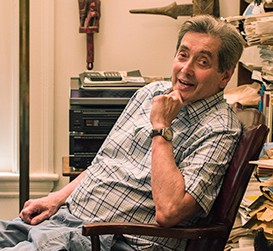
ScreenHunter_1306 Aug. 11 21.06Steve Grossberg has a habit he calls “taking a think walk.” When a person spends his life applying the rigor of math to the mysteries of the mind, as Grossberg has, sometimes he gets stuck. On these occasions, with the answer to a problem just out of reach, Grossberg walks. As a younger man, he strode through Boston’s Back Bay, sometimes stopping at a cafe to write down new ideas; but mostly he walked, enjoying the sparkling city at night, coaxing along the insights that always, finally, came. “Many scientists see or feel things before they fully know them,” says Grossberg, Boston University’s Wang Professor of Cognitive and Neural Systems. “Eventually things become luminous, glistening; everything becomes clear.”

Grossberg’s insights, spanning decades, have changed the way we understand the brain. One of the principal founders and current leaders in the field of neural networks, Grossberg has tried to answer two major questions: how does the brain control behavior, and how can technology emulate biological intelligence? His mathematical models touch almost every area of psychology and neuroscience, including learning, memory, vision, development, speech, language, attention, cognition, navigation, and even consciousness. The applications of his work have been equally vast, in fields from image processing to pattern recognition, manufacturing to medicine.

Grossberg’s scientific quest is also a spiritual one, sparked by early tragedy and propelled by a pursuit of transcendence. When accepting the 2015 Lifetime Achievement Award from the Society of Experimental Psychologists, he spoke movingly of his need “to grow toward something more enduring.” What Grossberg wants, simply, is to understand how the lump of gray tissue we call our brain gives rise to the creative, soulful presence we call our mind. “For me, science is a spiritual calling,” he says, “not just a profession.”

More here. [Thanks to Yohan John.]

A new book traces a century of legislative prudery

Jacob Brogan in Slate:

150805_BOOKS_BoundariesIllo.jpg.CROP.promo-xlarge2When the proprietor of a Florida-based pornographic website was put on trial in 2008, he was accused of violating community standards. To prove that the operator had done nothing of the kind, his lawyer exhibited Google search data for the region, showing that residents were more likely to go online looking for “sex” than for “apple pie.” Pornography, this lawyer implied,was central to community standards, whether or not the community members were willing to admit it. In the process, he suggested that the pleasures we deny ourselves—like those that we would refuse to others—can reveal a great deal about the forces that move us. Maybe that’s why the easiest way to tell a story about sex is to tell a story about repression.

This, at any rate, is the premise of author and attorney Eric Berkowitz’s new book, The Boundaries of Desire. Over the course of seven chapters, Berkowitz sets out to explore the last century of sex law, focusing most of all on the ways that our civilization restrains the needs of some while punishing the passions of others. Attentive to changing norms but rarely content with present pieties, he surveys attitudes toward prostitution, homosexuality, pornography, and more. Throughout, he treats desire as a force that has “always carried outsize significance” because it “burns at the intersection of existence, identity, and power.”

Indeed, sex is the most personal of passions, but it is also the one in which the personal becomes interpersonal. Intercourse, as philosophers of sex have known for years, is never far from discourse, and pillow talk may be just as important as everything that precedes it. Speaking about sex by narrating the many attempts to silence it is therefore an almost deliberately paradoxical project.

More here.

Why do so many corpses found in Europe’s peat bogs show signs of violent death?

Kristen C. French in Nautilus:

ScreenHunter_1305 Aug. 11 19.06One Saturday in the spring of 1950, brothers Viggo and Emil Højgaard from the small village of Tollund, in Denmark, were cutting peat in a local bog when they uncovered a dead man. He looked as though he had only just passed away. His eyelashes, chin stubble, and the wrinkles in his skin were visible; his leather cap was intact. Suspecting murder, the brothers called the police in nearby Silkeborg, but the body wasn’t what it seemed.

Cracking the case required a special breed of forensic analysis. Famed Danish archaeologist Peter V. Glob, from the University of Aarhus, arranged for the body, along with its bed of peat, to be excavated and transferred to the Silkeborg Museum in a giant wooden box. An examination of the contents of the dead man’s stomach suggested—and radiocarbon dating later confirmed—that he had lived during the third century B.C., in the pre-Roman Iron Age. For more than 2,000 years, Tollund Man, as the corpse became known, had lain at the bottom of the bog, nearly untouched by time, as all of recorded history marched forward over his head.1

Since the 18th century, the peat bogs of Northern Europe have yielded hundreds of human corpses dating from as far back as 8,000 B.C. Like Tollund Man, many of these so-called bog bodies are exquisitely preserved—their skin, intestines, internal organs, nails, hair, and even the contents of their stomachs and some of their clothes left in remarkable condition.

More here.

Deeper Than Quantum Mechanics—David Deutsch’s New Theory of Reality

From the Physics arXiv Blog:

1--MLUU1H9BmcZgblmOZhheQOne of the unsung heroes of 20th century science is the mathematician and electronics engineer, Claude Shannon, who worked at the famous Bell laboratories during the 1940s, 50s and 60s. Shannon’s greatest work is the theory of information which he published in 1948 and has since had a profound influence on our world.

This theory is the basis for all digital communication. So mobile phones, digital television and radio, computers and the Internet all depend on Shannon’s theory of information. For that reason, it’s possible to argue that Shannon has had a bigger influence on 21st century technology than anybody in history.

But there’s a problem his theory of information which has stumped physicists and mathematicians in recent years. This is that it only applies to classical information, the kind of 0s and 1s that make up ordinary digital code.

But physicists have become increasingly interested in quantum information and its potential in cryptography and in quantum computing. Quantum information can be both a 1 and 0 at the same time. This among other exotic properties is what allows quantum computers to be so powerful and quantum cryptography to be perfectly secure.

More here.

The Ethics of Testing on Animals

Miriam Wells in Vice News:

ImagesSubjecting a small number of highly sentient beings to a horrible life and death is necessary to reduce the suffering and death of huge numbers of others. Some “survival of the fittest” also comes into it — given that human beings are the most sentient of all, and highest up on the food chain — we experiment on those below us. Over 70,000 non-human primates were used for research in the United States in 2010, according to the US Department of Agriculture. They include macaques, baboons, marmosets, and other monkeys, as well as some chimpanzees. Around 65,000 dogs, 21,000 cats, and 53,000 pigs were used, as well as hundreds of thousands of rabbits, guinea pigs, and hamsters. Around the world, dogs, cats, and primates together account for less than 0.2 percent of research animals, according to scientific lobby group Understanding Animal Research, which also points out the number of animals used for medical testing is miniscule compared to the number of animals bred and slaughtered for meat consumption. Mice, rats, fish, and birds account for the majority, with around 25 million used in US laboratories a year, while estimates for the number of animals used annually around the world vary from 60 to 115 million.

After speaking to people on either side of the debate, it was interesting how much they had in common — everyone agrees that testing on animals is deeply unpleasant, that it would be better if animals were not used, and that phasing out the use of animals in medical research is the ultimate goal. What the animal rights advocates and the scientists disagree on is how much benefit medical animal testing has brought, how fast animals should be phased out, and how they should be treated in the meantime. “People automatically assume that primates are a better model [for medical research] because they're so similar to us,” Kathleen Conlee, vice president of the US-based NGO Humane Society, told VICE News. “But the differences are enormous when you come to their biology. When it comes to the immune system that's where the greatest differences are and that's often what we're studying.” Nearly 90 vaccines that had promising results in primates have failed in clinical trials in humans, said Conlee, adding that very few detailed scientific studies on the scientific value of primate use had ever been conducted. One of the only major US studies, the Institute of Medicine and National Research Council's landmark 2011 report, Chimpanzees in Biomedical and Behavioral Research: Assessing the Necessity, concluded that “chimpanzees are not necessary for most biomedical research,” and that there were very few cases where chimpanzee research offered valuable enough insights to “offset the moral costs” of the experiments. The Humane Society is now pushing for a similar study to be done on research involving other primates. “Animals models are always very crude and aren't giving us the answers we need,” said Conlee. “They are always going to have limitations, whereas non-animal models will only continue to improve. So why do we continue to put such a huge investment in these animal models, and very little in alternatives?”

More here.

How aging cripples the immune system

From KurzweilAI:

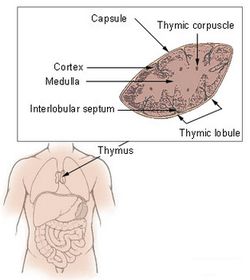
Thymus1Aging cripples the production of new immune cells, decreasing the immune system’s response to vaccines and putting the elderly at risk of infection, but antioxidants in the diet may slow this damaging process. That’s a new finding by scientists from the Florida campus of The Scripps Research Institute (TSRI), published in an open-access paper in the journal Cell Reports. The problem is focused on an organ called the thymus, which produces T lymphocytes (a type of white blood cell) — critical immune cells that must be continuously replenished so they can respond to new infections. “The thymus begins to atrophy rapidly in very early adulthood, simultaneously losing its function,” said TSRI Professor Howard Petrie. “This new study shows for the first time a mechanism for the long-suspected connection between normal immune function and antioxidants.”

How antioxidant enzyme deficiency leads to metabolic damage

Scientists have been hampered in their efforts to develop specific immune therapies for the elderly by a lack of knowledge of the underlying mechanisms of this process. To explore these mechanisms, Petrie and his team developed a computational approach for analyzing the activity of genes in two major cell types in the thymus — stromal cells and lymphoid cells — in mouse tissues, which are similar to human tissues in terms of function and age-related atrophy. The team found that stromal cells were specifically deficient in an antioxidant enzyme called catalase. That resulted in elevated levels of the reactive oxygen byproducts of metabolism, which cause accelerated metabolic damage.*

More here.

Tuesday Poem

Late August

cloud shreds
skid across
sandstone cliff face
dimmed red
to red
in an invisible rain
. . .
mosquito
becoming
language
. . .
scratched-off
scratch-off ticket
moldering in
a mound of
whacked
dandelions
. . .
to walk
a word
from one
weather
into another
. . .
on the window screen
a patch of beetles
peristaltic under
porch light
.

by Joseph Massey

Joseph Massey is the author of Areas of Fog (Shearsman Books, 2009), At the Point (Shearsman Books, 2011), To Keep Time (Omnidawn, 2014) and Illocality (Wave Books, forthcoming in 2015). He lives in the Pioneer Valley of Massachusetts.

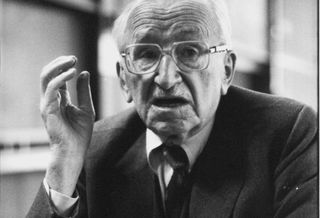
The Friedrich Hayek I knew, and what he got right – and wrong

Hayek_hcrop

John Gray in The New Statesman:

My interest in Hayek, which began in the early 1970s, was as much to do with intellectual life in the Vienna of his youth as with the condition of British politics at the time. One of the first questions I asked after we had met through one of the right-wing think tanks that were proliferating around the end of that decade was whether he had known Karl Kraus, the incomparable Viennese satirist, who in 1909 had written, with some prescience: “Progress celebrates victories over nature. Progress makes purses out of human skin.” Hayek replied that he had not talked with Kraus, though he remembered seeing him crossing the road to enter a coffee house some time during the First World War. Hayek had little in common with Kraus. Cool and reserved, he had nothing of Kraus’s wit. Although he was academic in his manner, Hayek’s most striking intellectual trait was one that is uncommon in academic life – independence of mind, which enabled him to swim against some of the most powerful currents of the age.

I was also keen to learn something of Hayek’s connection with Wittgenstein, a relative of his about whom he had written a biographical fragment, “Remembering My Cousin, Ludwig Wittgenstein”, published in Encounter in 1977. Hayek met Wittgenstein by chance, on a railway station in August 1918, when they were both in the uniform of the Austro-Hungarian army. Travelling on together, they talked throughout the journey – a conversation Hayek told me had influenced him deeply, though not because of any philosophical exchange that he could remember. The two would never become close and their paths crossed only occasionally; but there seems to have been a meeting of minds between the two artillery ensigns on their way back to war. At the time both were ardent socialists who attributed the disaster that had befallen Europe to the malign impact of capitalism.

More here.

Listen to John Rawls’ Course on “Modern Political Philosophy” (Recorded at Harvard, 1984)

Over at Open Culture:

Some of the most-referenced Western political thinkers—like Thomas Hobbes, John Locke, and Thomas Jefferson—have taken hierarchies of class, race, or both, for granted. Not so some of their more radical contemporaries, like Jean-Jacques Rousseau and Thomas Paine, who made forceful arguments against inequality. A strain of utopianism runs through more egalitarian positions, and a calculating pragmatism through more libertarian. Rarely have these two threads woven neatly together.

In the work of 20th century political philosopher John Rawls, they do, with maybe a knot or a kink here and there, in a unique philosophy first articulated in his 1971 book A Theory of Justice, a novel attempt at reconciling abstract principles of liberty and equality (recently turned into a musical.)

More here.

Monday, August 10, 2015

Sunday, August 9, 2015

Edwidge Danticat on Mass Deportation of Haitian Families

A transcript of Amy Goodman and Juan González's interview with Edwidge Dandicat, over at truth-out:

AMY GOODMAN: Talk about the significance of what’s happening right now in the Dominican Republic, the other half of the island, Hispaniola, from where you were born, in Haiti.

EDWIDGE DANTICAT: Well, I think this—we’ve often had deportations from the Dominican Republic to Haiti, but this is the first time that they will be done with a law behind them that actually, since the law—this constitutional court decided to strip citizenship from that large number of people, has really made life much harder for Dominicans of Haitian descent, but also migrants who are on the island. So, this law not only now gives the Dominican government the power to deport mass amounts of people, but also creates an environment, a civil environment, that’s really hard for people, because, you know, others might feel now that we’ve had an increase of violence against Haitians and Dominicans of Haitian descent, because it seems like a state-sponsored open season on people who are not only—who are considered Haitians by the way they look, primarily, or by their Haitian-sounding name.

JUAN GONZÁLEZ: And most people here in the United States are not aware of this long, troubled history between the Dominican Republic and Haiti, occupying the same island. There are ultranationalists and conservatives among the Dominican Republic who still—who talk about, hearken back to what they claim was the Haitian occupation of their country, and they see a line running through historically on this issue. Could you fill us in on some of that history that’s led to what we are facing today?

EDWIDGE DANTICAT: Well, Hispaniola is shared by—the island—by Haiti and the Dominican Republic. And we share a history of colonialism and occupations, and at some point it was split between the French and the Spanish. And after the Haitian independence, there was a shift, where Haiti—and there was a—the whole island was under one rule, post-independence. And then, Dominican Republic, in 1822, there was a separation. But there are all these historical scars, where, you know, we, on the Haitian side, remember the massacre of Haitian cane workers in 1937. And then these things are brought up. But there’s also, for Americans, a common occupation of both Haiti and the Dominican Republic at the turn of the century, and both sides of the island have been marred, really, by the corporate—this other kind of occupation of the sugar industry that goes back to the beginning of the 20th century.

More here.

Strunk and White’s Macho Grammar Club

Mark Dery in The Daily Beast:

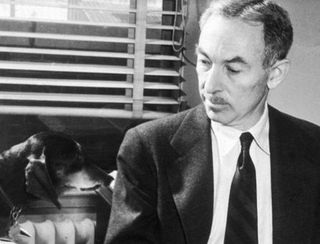
ScreenHunter_1301 Aug. 09 22.07“Be clear.” “Omit needless words.” “Do not overwrite.” “Avoid fancy words.” “Use the active voice.” Who can argue with such common sense commandments, especially when they’re delivered with Voice-of-God authority? Certainly not the generations of students, secretaries, working writers, and wannabe Hemingways who’ve feared and revered Strunk and White’s Elements of Style as the Bible of “plain English style,” as E.B. White calls it in his introduction. (Since 1959, when White revised and substantially expanded the brief guide to prose style self-published in 1918 by William Strunk Jr., a professor of English literature at Cornell, Strunk & White, as most of us know it, has sold more than 10 million copies.)

Can it really be coincidence that, smack on the first page, in a note about exceptions to one of his Elementary Rules Of Usage (“Form the possessive singular of nouns by adding ‘s…, whatever the final consonant”), Strunk gives as an example, “Moses’ laws”? The Elements of Style, more than another book, has set in stone American ideas about proper usage and, more profoundly, good style. Professor Strunk wrote his little tract as a stout defense of “the rules of usage and principles of composition most commonly violated,” the red-flag word in that sentence being “violated.”

Usage absolutists are the Scalia-esque Originalists of the language-maven set. Their emphasis on “timeless” grammatical truths, in opposition to most linguists’ view of language as a living, changing thing, is at heart conservative; their fulminations about the grammatical violations perpetrated by the masses mask deeper anxieties about moral relativism and social turbulence.

More here.

What drives our urge to explore?

Veronique Greenwood in Aeon:

ScreenHunter_1300 Aug. 09 22.00First, there is nothing. From all appearances, the fast ferry, whipping through the water in the early morning sun, is headed out into the cold wastes of the Atlantic. But then a shimmering line appears on the horizon. As minutes and miles pass, it grows no taller but, eventually, the black profile of a row of loblolly pines, tossed by the wind, comes into focus.

There is land out here after all; flat, low land, its highest point only 28 feet above the waves. This fragment of coral shelf is the northernmost of the British Virgin Islands, the last before the open ocean, and it has a completely different character from its gaggle of southern sisters. While they are steep green mountains rising from the sea, this place is so low that its Spanish name, Anegada, means ‘covered in water’ or ‘shipwrecked’. The other islands tend to be home to thousands of people and are serviced by commercial flights and ferries. Anegada has a boat every two days or so, and a scant few hundred inhabitants, most of them in the lone settlement called The Settlement.

Looking around at the other people on the ferry, it seems that some might be headed to jobs on the island, in its scattering of restaurants and businesses. A few are tourists come to stay in the handful of basic guesthouses and eat the sweet lobster that is a local speciality. My husband and I came out here because it was the edge of the map. He suggested it after seeing it way out on the rim of things, and I, not totally sure why we were going, made the plans.

More here.

Artificial Intelligence Is Already Weirdly Inhuman

David Berreby in Nautilus:

Edebc543333dfbf7c5933af792c9c4Artificial intelligence has been conquering hard problems at a relentless pace lately. In the past few years, an especially effective kind of artificial intelligence known as a neural network has equaled or even surpassed human beings at tasks like discovering new drugs, finding the best candidates for a job, and even driving a car. Neural nets, whose architecture copies that of the human brain, can now—usually—tell good writing from bad, and—usually—tell you with great precision what objects are in a photograph. Such nets are used more and more with each passing month in ubiquitous jobs like Google searches, Amazon recommendations, Facebook news feeds, and spam filtering—and in critical missions like military security, finance, scientific research, and those cars that drive themselves better than a person could.

Neural nets sometimes make mistakes, which people can understand. (Yes, those desks look quite real; it’s hard for me, too, to see they are a reflection.) But some hard problems make neural nets respond in ways that aren’t understandable. Neural nets execute algorithms—a set of instructions for completing a task. Algorithms, of course, are written by human beings. Yet neural nets sometimes come out with answers that are downright weird: not right, but also not wrong in a way that people can grasp. Instead, the answers sound like something an extraterrestrial might come up with.

More here.

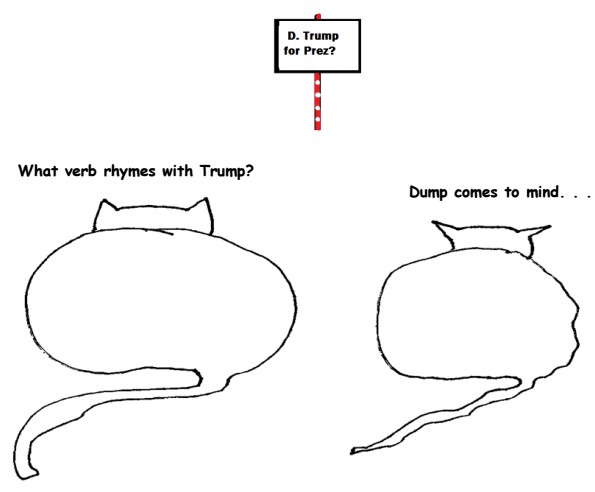
The republican Party Created Donald Trump

Molly Ball in The Atlantic:

Lead_960ATLANTA—Donald Trump was supposed to be the keynote speaker at the RedState Gathering here, a convocation of the hard-core conservative activists who read the influential blog edited by Erick Erickson. But when Trump said on CNN late Friday that debate moderator and Fox News host Megyn Kelly had “blood coming out of her eyes, blood coming out of her wherever,” Erickson, who is a Fox News contributor, announced he had disinvited Trump from the conference. “There are just real lines of decency a person running for President should not cross,” Erickson wrote.

As the linchpin of a GOP counter-establishment of Tea Party-oriented media and PACs, Erickson may be the most powerful conservative in America. A knowledgeable source confirmed to me last week’s report that he will soon announce his departure from RedState—Erickson’s heart is in his work as a radio host, and he will continue to write commentaries on his personal website. Trump was one of 10 presidential candidates who had accepted the invitation to speak at this year’s RedState Gathering, including Jeb Bush, Scott Walker, Marco Rubio,Ted Cruz, Mike Huckabee, Chris Christie, Bobby Jindal, Rick Perry, and Carly Fiorina.

More here.