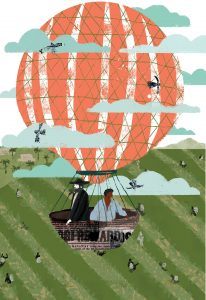
The UN’s human rights chief has had enough

Tom Fletcher in Prospect:

The Hague, September 2016. The speech from the UN high commissioner for human rights was not expected to ruffle feathers. A mild appeal to our better angels and then back to the canapés—traditionally, as one UN speechwriter puts it, “we don’t use adjectives, we don’t name names.”

But instead of platitudes, Zeid Ra’ad Al Hussein called out a parade of “xenophobes, populists and racists”: Wilders, Farage, Orbán, Le Pen, Trump and—in the same breath—Islamic State (IS). He shook with rage. The room was stunned into silence, then burst into a standing ovation. One ambassador present calls it “a moment of pure authenticity, emotion and reason.” A friend calls it Zeid’s “quantum leap.” But this was not simply a frustrated UN chief shooting from the hip. “He knew exactly what he was doing,” says his wife, Sarah.

There is an air of battered decency to the UN’s top official on human rights. Partly jet lag and the debilitating wade through undrained swamps of bureaucratic treacle. Partly bearing witness to the worst of humanity. As a junior UN official in Bosnia, he was profoundly marked by the sight of the skull of a child as a trophy on a warlord’s car. In a recent statement on Myanmar, he asked: “What kind of hatred could make a man stab a baby crying out for his mother’s milk. And for the mother to witness this murder while she is being gang-raped by security forces who should be protecting her?”

But the weariness is also something deeper. This is a man watching his worldview come under relentless assault. Zeid was a global citizen before the idea went in and then out of fashion.

More here.

He’s One of Brazil’s Greatest Writers. Why Isn’t Machado de Assis More Widely Read?

Benjamin Moser in The New Yorker:

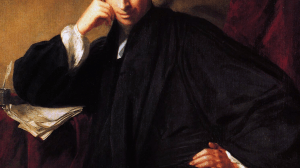
Joaquim Maria Machado de Assis, Knight of the Imperial Order of the Rose, founder of the Brazilian Academy of Letters, has long been Brazil’s ambassador to the international society of official writers. He seemed to be preparing for the role for most of his adult life, which was so colorless and conventional it might have been taunting future biographers.

An outstanding employee of the Ministry of Agriculture, Commerce, and Public Works, Machado, like Kafka (of the Worker’s Accident Insurance Institute) and Cavafy (of the Third Circle of Irrigation), wore prim suits, lived in nondescript neighborhoods, worked bureaucratic jobs, and rarely stirred from the city where he was born.

These authors looked like emblems of the petit bourgeois, and the gap between their appearance and their writing made them emblems of something else, too—of the inner life pulsing behind the mask that the modern person dons. That gap allowed such writers to take on an electric symbolism. By presenting no outward challenge to their epochs, they could move freely through them—and eventually define them.

Machado “had a half dozen gestures, habits, and pat phrases,” an early biographer, Lúcia Miguel Pereira, wrote, in 1936. He avoided politics. He was an ideal husband. He spent his free time at the bookshop. And, in founding the Academy of Letters, he brought an administrative structure to literature.

Yet to place this image beside his books is to wonder whether such diligence was a carefully calibrated act—and to see why, despite more than a century’s veneration, the vestment of national spokesman will never quite fit. Machado was too ironic, too mischievous, for the pretentions that the official homages imply.

More here.

Western Europeans vary in their nationalist, anti-immigrant and anti-religious minority attitudes

Swedes score lowest on scale of nationalist, anti-immigrant, anti-religious minority attitudes (NIM); Italians the highestJeff Diamant and Kelset Jo Starr over at the Pew Research Center:

To better examine the prevalence of these attitudes, the Center developed a scale to measure the extent of Nationalist, anti-Immigrant and anti-religious Minority (NIM) sentiment. The NIM scale combines answers to 22 survey questions on a wide range of issues including views on Muslims, Jews and immigrants, as well as immigration policy.

Respondents’ scores increased if they said that immigration to their country should be reduced; that they were unwilling to be neighbors or relatives with Muslims or Jews; that immigrants from certain regions are not honest or hardworking; that Islam is fundamentally incompatible with their national culture and values; that being born in their country is important to being “truly French,” “truly German,” etc.; and for expressing a host of other sentiments on related topics. The higher the score, the more likely a respondent had expressed nationalist, anti-immigrant and anti-religious minority sentiments during the survey. Scores on the scale range from 0 to 10.

Relatively few adults in every country surveyed score above 5 on the scale. But there is considerable variation across countries. In Sweden, just 8% of those surveyed scored higher than 5, the lowest amount in any country, while in Italy, 38% did, the highest share in any country. In most countries, the share scoring 5.01 or higher was between 15% and 25%. For example, in both Norway and France, 19% of respondents scored 5.01 or higher.

The NIM scale also provides an opportunity to explore whether factors such as age, political ideology or religious affiliation are associated with these kinds of attitudes.

More here.

How Indigenous Filmmakers Are Changing Contemporary Cinema

Alexander Tesar at The Walrus:

When the acclaimed Inuk film director Zacharias Kunuk attended his first Toronto International Film Festival reception seventeen years ago, he noticed the noise—the deep, resonant mumble of well-dressed partygoers talking over one another, the staccato clink of glasses. In the past, Kunuk had often been the only Inuk at these kinds of parties, which had few analogues in his home of Igloolik, Nunavut. This time, he spotted a few tawny patches of hide amongst the cotton and polyester: some members of his cast who were invited to attend were wearing traditional clothing. Suddenly, he realized what was familiar about the sound: the glamorous party sounded like a herd of walruses.

Kunuk no longer feels out of place at these sorts of events. The film he premiered at that festival, Atanarjuat (The Fast Runner), won the Caméra d’Or at the 2001 Cannes film festival and has been called the best Canadian movie ever made.

more here.

Tuesday Poem

Death is Smaller Than I Thought

My Mother and Father died some years ago
I loved them very much.
When they died my love for them
Did not vanish or fade away.
It stayed just about the same,
Only a sadder colour.
And I can feel their love for me,
Same as it ever was.

Nowadays, in good times or bad,
I sometimes ask my Mother and Father
To walk beside me or to sit with me
So we can talk together
Or be silent.

They always come to me.
I talk to them and listen to them
And think I hear them talk to me.
It’s very simple –
Nothing to do with spiritualism
Or religion or mumbo jumbo.

It is imaginary.
It is real.
It is love.

by Adrian Mitchell
from: In Person: 30 Poets
Bloodaxe Books, Tarset, 2008
ISBN: 9781852248000


The Fate of Self-Taught Art

Valérie Rousseau at The Brooklyn Rail:

By conceiving the notion of art brutin a Europe devastated by the Second World War, French artist Jean Dubuffet questioned the underlying pretense behind the processes of artistic legitimization, dispossessing those authorities empowered to legislate in the art world. He also insisted on the flexible nature of definitions, maintaining that art brutcould incessantly evolve depending on the context of its emergence, knowing that the norm and the margins are perpetually reassessed. Without an art movement or identifiable style, art brut is not a category, but an evolving critical concept. Above all, as observed Céline Delavaux, Dubuffet likely proposed a singular, even poetic and literary way of thinking about art, “It is in the absence of the voice of the madman, the excluded, the uneducated, that his radically subjective art discourse was invented.”

more here.

The Staffordshire Hoard and the Distance of the Past

Samuel Collins at Marginalia:

Herein lies the difference between the popular reception of a discovery like the Gospel of Jesus’s Wife and the war-gear of the Staffordshire Hoard. Never in the coverage of the hoard and its discovery was there any serious suggestion that there is a political or ethnic community anywhere that is, in any Jeffersonian sense, the lineal descendants of the makers of the hoard. Past politics, in this reading, is just that: the stuff of the past. No one raised the idea that the understanding of modern politics or political identities might be somehow altered by the hoard, or that that those who used and buried the hoard share any important connection to the political communities of modern Britain or elsewhere. All the popular writing that was done about the hoard, still only a small fraction of the ink spilled over the Gospel of Jesus’s Wife, keep the hoard firmly situated in a remote and unfamiliar past, one where it makes sense to summon up as points of comparison either unrelated but spectacular treasures (“Staffordshire’s Tutankhamen”as a the BBC’s Antiques Roadshow put it) or Middle Earth or Westeros.

more here.

Artificial Intelligence Shows Why Atheism Is Unpopular

Sigal Samuel in The Atlantic:

Imagine you’re the president of a European country. You’re slated to take in 50,000 refugees from the Middle East this year. Most of them are very religious, while most of your population is very secular. You want to integrate the newcomers seamlessly, minimizing the risk of economic malaise or violence, but you have limited resources. One of your advisers tells you to invest in the refugees’ education; another says providing jobs is the key; yet another insists the most important thing is giving the youth opportunities to socialize with local kids. What do you do? Well, you make your best guess and hope the policy you chose works out. But it might not. Even a policy that yielded great results in another place or time may fail miserably in your particular country under its present circumstances. If that happens, you might find yourself wishing you could hit a giant reset button and run the whole experiment over again, this time choosing a different policy. But of course, you can’t experiment like that, not with real people.

You can, however, experiment like that with virtual people. And that’s exactly what the Modeling Religion Project does. An international team of computer scientists, philosophers, religion scholars, and others are collaborating to build computer models that they populate with thousands of virtual people, or “agents.” As the agents interact with each other and with shifting conditions in their artificial environment, their attributes and beliefs—levels of economic security, of education, of religiosity, and so on—can change. At the outset, the researchers program the agents to mimic the attributes and beliefs of a real country’s population using survey data from that country. They also “train” the model on a set of empirically validated social-science rules about how humans tend to interact under various pressures.  And then they experiment: Add in 50,000 newcomers, say, and invest heavily in education. How does the artificial society change? The model tells you. Don’t like it? Just hit that reset button and try a different policy.  The goal of the project is to give politicians an empirical tool that will help them assess competing policy options so they can choose the most effective one. It’s a noble idea: If leaders can use artificial intelligence to predict which policy will produce the best outcome, maybe we’ll end up with a healthier and happier world. But it’s also a dangerous idea: What’s “best” is in the eye of the beholder, after all.

More here.

Many Genes Play a Role in Educational Attainment, Enormous Genetic Study Finds

Carl Zimmer in The New York Times:

In the largest genetics study ever published in a scientific journal, an international team of scientists on Monday identified more than a thousand variations in human genes that influence how long people stay in school. Educational attainment has attracted great interest from researchers in recent years, because it is linked to many other aspects of people’s lives, including their income as adults, overall health and even life span. The newly discovered gene variants account for just a fraction of the differences in education observed between groups of people. Environmental influences, which may include family wealth or parental education, together play a bigger role. Still, scientists have long known that genetic makeup explains some of the differences in time spent in school. Their hope is that the data can be used to gain a better understanding of what educators must do to keep children in school longer. With a fuller understanding of the influences exerted by genes, scientists think they will be able to better measure what happens when they try to improve a child’s learning environment. The new study, published in the journal Nature Genetics, finds that many of the genetic variations implicated in educational attainment are involved in how neurons communicate in the brain. A striking number are involved in relaying signals out of neurons and into neighboring ones through connections called synapses. The findings are based on genetic sequencing of more than 1.1 million people. But the subjects were all white people of European descent. In order to maximize the odds of discovering genetic links, the scientists say they needed a very large, homogeneous sample.

When the team tried to use these genetic variants to explain differences in schooling time among African-Americans, the predictions failed. The researchers also found that genes don’t have a uniform effect: The influences of the genes varied from country to country. The researchers could not pinpoint the cause of these differences. But if educators in one country emphasize memory over problem-solving in math classes, for example, then some gene variants may provide a bigger benefit to some students than others, the scientists speculated. A truly global understanding of these genetic influences will require similarly huge studies of people of other ancestries, the researchers said.

More here.

Monday, July 23, 2018

3 Quarks Daily Welcomes Our New Monday Columnists

Hello Readers and Writers,

We received a large number of submissions of sample essays in our search for new columnists. Most of them were excellent and it was hard deciding whom to accept and whom not to. If you did not get selected, it does not at all mean that we didn’t like what you sent; we just have a limited number of slots and also sometimes we have too many people who want to write about the same subject (for example, a lot of philosophers applied this year). Today we welcome to 3QD the following persons, in alphabetical order by last name:

  1. Fountain-pens-530Abigail Akavia
  2. Samia Altaf
  3. Pranab Bardhan
  4. Jeroen Bouterse
  5. Nickolas Calabrese
  6. Niall Chithelen
  7. Shawn Crawford
  8. Timothy Don
  9. Robert Fay
  10. Joan Harvey
  11. Mary Hrovat
  12. Lexi Lerner
  13. Bill Murray
  14. Thomas  O’Dwyer
  15. Anitra Pavlico
  16. Ahmad Saidullah
  17. Andrea Scrima
  18. Joseph Shieber
  19. Tim Sommers
  20. Adele Stanislaus
  21. Joshua  Wilbur

I will be in touch with all of you in the next days to schedule a start date. The “About Us” page will be updated with short bios and photographs of the new writers no later than the day they start.

Thanks to all of the people who sent samples of writing to us. It was a pleasure to read them all. Congratulations to the new columnists!

Best wishes,

Abbas

The paradox of polemic and related interpretive phenomena

by Dave Maier

Recently I’ve been reading a couple of books attacking postmodernism and/or leftist politics, which the authors – not surprisingly – tie together as closely as they can, albeit from rather different perspectives, for maximum polemical effect. Maybe we’ll get into the gory details some other time (haven’t got very far into them yet), but for now let’s just examine a few things that struck me about the very idea of polemical interpretations. 

For example: I can never figure out whether I’m supposed to be the audience, invited to join the authors in combating these worthless and dangerous ideas, or instead whether I am the target, such that these books intend to smash my own position(s) to conceptual smithereens. If I picture myself beside the author as he fires bolts at his target, I find myself alarmed at the way he’s swinging that crossbow around: watch where you’re aiming that thing! But maybe I myself am really the target – in which case I watch in puzzlement as the bolts sail harmlessly off to one side (was that really aimed at me?). If it were consistently one rather than the other, I would simply toss the book aside as incompetent; but when the two flip back and forth like the duck and the rabbit, it makes me wonder about polemics in general. How exactly are they supposed to work? Read more »

Your Rights, If You Can Keep Them, Part II

by Michael Liss

The other shoe dropped.  

Anthony Kennedy’s idiosyncratic role as a Justice of the United State Supreme Court will come to an end a mere week from now. A lot of things are going to change.

Let’s start with the politics. Kennedy’s leaving cinches the conservative revolution (or counter-revolution) for at least a generation. For the first time in living memory, a conservative Supreme Court will be in position to review and bless the acts of a like-minded Congress and President.

This will occur regardless of who is confirmed (Trump’s list is one to which moderates need not apply), but, unless a bolt of lightning strikes, it’s going to be Brett Kavanaugh. Yes, there will be plenty of Kabuki before he gets measured for a new robe, but Kavanaugh is the one who rings every bell for both Republicans and Trump. He’s a Federalist Society member, reliably conservative on all the big issues, not afraid to advance his interpretation of the law even when it conflicts with precedent, and has a past history of partisan politics. His nomination even offers a prize in the Cracker Jack box—the unique, magnificent straddle of having worked aggressively for Ken Starr, but now being deeply committed to the idea that sitting Presidents should be immune from prosecution. Read more »

Understanding America’s Hyper Partisanship

by Akim Reinhardt

Spectator sports can reflect a society’s worst inclinations by promoting pure partisanship.

Pure partisanship is profoundly anti-intellectual. Pure partisanship can disable a person’s moral compass. Anyone who follows sports, even tangentially, witnesses this frequently. This team’s victory or that team’s loss have led to countless riots. Here in Baltimore a few years ago, I listened to fans make excuses for football player Ray Rice after footage surfaced of him knocking his fiancee unconscious. And just this past weekend, Milwaukee Brewers baseball fans gave star pitcher Josh Hader a standing ovation after it was revealed that he had published racist and homophobic tweets. My team, wrong or right.

In the world of spectator sports, unchecked partisanship reveals human beings’ self-limiting intellects and ugly moral shortcomings. But when pure partisanship runs amok in politics, the possible ramifications are truly dire. A my party (or candidate, or politician) wrong or right attitude facilitates political repression and the rise of totalitarianism. That is the threat facing the United States and several other democratic nations today.

It is a recent development. For most of the post-WWII period, American political partisanship was moderated by tremendous pressure to conform. While conformist pressures certainly present their own set of problems worthy of critique, we must acknowledge that they also helped preclude the type of hyper political partisanship we now see in the Age of Trump. Read more »

What is God? What is atheism?

by Jamie Elsey

Although some may be heralding the end of free speech, 2018 has been a year of far-reaching debate and discussion. In the coming months, we can anticipate attending or streaming discussions ranging from such topics as the role of race in American politics to the nature of truth, from existential threats posed by artificial intelligence to the value of religion.

As sure as I am that many readers will share my enthusiasm for these events, I’m also certain I’m not the only one frustrated by the sense that many such talks end up with the participants merely talking past one another. It’s as if the speakers have agreed to play chess, but change the rules to drafts whenever they’re put in check. I at least find myself in the good company of Stephen Fry who, well over an hour into the recent Munk debate on political correctness, expressed his bemusement that “people will look back on this debate and wonder why political correctness wasn’t discussed”.[1]

Failure to properly define the topic of discussion is, I believe, a primary cause of this frustration. Changing the format from one of debate to one of open conversation is less conducive to the kind of evasiveness and rhetorical point scoring that characterizes purely combative interactions. However, even in open-ended conversation, we want to see opposing viewpoints properly challenged, and the problem of poor definition stands even when all participants are in apparent agreement. How do we know that we are in agreement if we don’t really know what we’re agreeing to?

There is nowhere this issue of definition looms larger than in recent discussions of religion, God, and morality. Grappling with these topics is as vital as it is difficult. We can’t expect to make any progress if we do not have a shared or at least mutually understood language with which to tackle them. Read more »

Sunday, July 22, 2018

Can Economists and Humanists Ever Be Friends?

John Lanchester in The New Yorker:

What are you doing? I don’t mean what are you doing with your life, or in general, but what are you doing right now? The answer, in one respect, is simple enough: you’re reading this magazine. Obviously. From a certain economic perspective, however, you’re doing something else, something you don’t realize, something with a sneaky motive that you aren’t admitting to yourself: you are signalling. You are sending signals about the kind of person you are, or want to be. What’s that you say—you’re reading this in the bath, or on your phone in bed, or otherwise in private? Well, the same argument applies. You are acquiring the tools for a “fitness display.” This, the economist Robin Hanson and the writer-programmer Kevin Simler argue in their new book, “The Elephant in the Brain: Hidden Motives in Everyday Life” (Oxford), is an advertisement of “health, energy, vigor, coordination, and overall fitness.” Fitness displays “can be used to woo mates, of course, but they also serve other purposes like attracting allies or intimidating rivals.” So there you go: that’s what you’re doing, there in the bath with the magazine. Your rivals are right to feel intimidated.

Wait, though—surely signalling doesn’t account for everything? Hanson, in a recent podcast interview with Tyler Cowen, a colleague at George Mason University, was asked to give a “short, quick and dirty” answer to the question of how much human behavior “ultimately can be traced back to some kind of signalling.” His answer: “In a rich society like ours, well over ninety per cent.” He was then asked to cite a few voluntary human activities that “have the least amount to do with signalling.” The example Hanson came up with was “scratching your butt.”

That made me laugh, and also shake my head. Economists often do. I started reading up on economics twelve years ago. I was in the early stages of writing a novel about contemporary London, and had come to the realization that frequently hits you when you are writing fiction, which is that there is a story behind the apparent story.

More here.

Hundreds of skulls reveal massive scale of human sacrifice in Aztec capital

Lizzie Wade in Science:

The priest quickly sliced into the captive’s torso and removed his still-beating heart. That sacrifice, one among thousands performed in the sacred city of Tenochtitlan, would feed the gods and ensure the continued existence of the world.

Death, however, was just the start of the victim’s role in the sacrificial ritual, key to the spiritual world of the Mexica people in the 14th to the 16th centuries.

Priests carried the body to another ritual space, where they laid it face-up. Armed with years of practice, detailed anatomical knowledge, and obsidian blades sharper than today’s surgical steel, they made an incision in the thin space between two vertebrae in the neck, expertly decapitating the body. Using their sharp blades, the priests deftly cut away the skin and muscles of the face, reducing it to a skull. Then, they carved large holes in both sides of the skull and slipped it onto a thick wooden post that held other skulls prepared in precisely the same way. The skulls were bound for Tenochtitlan’s tzompantli, an enormous rack of skulls built in front of the Templo Mayor—a pyramid with two temples on top. One was dedicated to the war god, Huitzilopochtli, and the other to the rain god, Tlaloc.

More here.

Palaeontology and the Photographic Trace

Justin E. H. Smith at his own blog:

Some time back I took a group of students to the Galerie d’Anatomie Comparée at the Jardin des Plantes. This is the famous collection of skeletons laid out according to one version of the order of nature by Georges Cuvier at the turn of the 19th century. We were looking at a display case (added long after Cuvier’s death) that consisted in four rows, one above the other, with five skulls in each row representing five developmental stages of three species of great ape –gorillas, chimpanzees, and orangutans–, plus Homo sapiens. 

I had asked the students to pay attention to the way in which the different species, particularly the human species, seem to develop away from each other as they move from their more or less similar infant stage through adolescence to adulthood, and how the gorilla in particular develops a huge cranial crest, while the human simply develops a freakishly huge cranium (at least by comparison).

At this point a student interrupted to ask me whether each skull of the same species was from the same individual.

Pardon? I said. The student explained again that she wanted to know whether the baby gorilla skull, for example, was from the same animal as the adolescent gorilla skull and the gorilla skulls at the other three stages of development. How on earth would that be possible? I asked, still confused as to whether I had understood.

Yet, intuitively, I understood, and what she was asking was not at all strange.

More here.

How the Diderot Effect explains why you buy things you don’t need

Scotty Hendricks in Big Think:

In 1765, Russian Empress Catherine the Great heard that the philosopher Dennis Diderot was in dire need of money. As a well-known patron of the arts, sciences, and Enlightenment philosophers, she immediately purchased his entire library. She directed him to keep it at his home and hired him as her librarian with 25 years of salary upfront.

Diderot, whose finances had never been sound, proceeded to use some of the money to buy a very lovely scarlet robe.

This is where his troubles began. After he got used to the splendor of his new garment, he noticed that his apartment wasn’t quite as nice as it should be now that he was wearing beautiful clothes.

To fix this, he replaced his old prints with new ones. Then he noticed his armchair was no longer suitable and replaced it with a new leather one. His desk was then suddenly out of place and needed to be updated as well.

Before long, he had replaced nearly every item in his home with a shiny upgrade. In the end, he was in debt and still hungry for more material goods.

More here.