The Pulitzer, and what classical music needs to do

Colin Eatock in his own blog:

Kendrick-lamar-damn_origAmong the many “breakthroughs” that have followed in the wake of Kendrick Lamar’s 2018 Pulitzer Prize for the album Damn is the fact that a hip-hop artist is now being discussed in classical music circles. “What are we to make of this development?”, various classical-music commentators, practitioners and enthusiasts are asking. Is this a good thing? Or a bad thing? Or what?

I’ve noticed that some classical types have been careful to sound respectful and inclusive when discussing this issue. Perhaps fearful of being labelled “elitist,” or hoping that just a little bit of hip-hop’s coolness might rub off on them, they praise Damn for its musical craft, sophistication and cultural authenticity, and say supportive things about Lamar’s prize-win. (See here, here or here.)

On the other hand, the permanently outraged Norman Lebrecht called the decision, “an almighty kick in the teeth of contemporary composition.” And, predictably, the decision has also coaxed some downright racist reactions out of the woodwork. I suspect that some of these outraged folks, bravely defending good taste and high standards, didn’t even know there was a Pulitzer Prize for music until Lamar won it.

As a classical guy myself (living in Toronto, Canada, by the way), I must admit that I didn’t know much about Lamar until a couple of days ago.

More here.

How to lengthen your Life

Alain de Botton in School of Life:

ScreenHunter_3051 Apr. 19 17.23The normal way we set about trying to extend our lives is by striving to add more years to them – usually by eating more couscous and broccoli, going to bed early and running in the rain. But this approach may turn out to be quixotic, not only because Death can’t reliably be warded off with kale, but at a deeper level, because the best way to lengthen a life is not by attempting to stick more years on to its tail.

One of the most basic facts about time is that, even though we insist on measuring it as if it were an objective unit, it doesn’t, in all conditions, feel as if it were moving at the same pace. Five minutes can feel like an hour; ten hours can feel like five minutes. A decade may pass like two years; two years may acquire the weight of half a century. And so on.

In other words, our subjective experience of time bears precious little relation to the way we like to measure it on a clock. Time moves more or less slowly according to the vagaries of the human mind: it may fly or it may drag. It may evaporate into airy nothing or achieve enduring density.

If the goal is to have a longer life, whatever the dieticians may urge, it seems like the priority should not be to add raw increments of time but to ensure that whatever years remain feel appropriately substantial. The aim should be to densify time rather than to try to extract one or two more years from the fickle grip of Death.

More here.

Thursday Poem

I Invite My Parents to a Dinner Party
.

In the invitation, I tell them for the seventeenth time
(the fourth in writing), that I am gay.

In the invitation, I include a picture of my boyfriend
& write, You’ve met him two times. But this time,

you will ask him things other than can you pass the
whatever. You will ask him

about him. You will enjoy dinner. You will be
enjoyable. Please RSVP.

They RSVP. They come.
They sit at the table & ask my boyfriend

the first of the conversation starters I slip them
upon arrival: How is work going?

I’m like the kid in Home Alone, orchestrating
every movement of a proper family, as if a pair

of scary yet deeply incompetent burglars
is watching from the outside.

My boyfriend responds in his chipper way.
I pass my father a bowl of fish ball soup—So comforting,

isn’t it? My mother smiles her best
Sitting with Her Son’s Boyfriend

Who Is a Boy Smile. I smile my Hurray for Doing
a Little Better Smile.

Read more »

Monet’s eye for architecture

Martin Oldham in 1843 Magazine:

Header-Monet-X9385-A5Claude Monet is known and loved as a painter of light and mist, rivers and sea and water-lily ponds. It is doubtful whether he would have recognised himself as a painter of architecture. “Other painters paint a bridge, a house, a boat,” Monet said in 1895. “I want to paint the air that surrounds the bridge, the house, the boat – the beauty of the light in which they exist.” He was reasserting the Impressionist creed: it was subjective experience that mattered, not objective description. Inconsequential corners of nature were as worthy of his attention as any of humanity’s grand designs. And yet the National Gallery has launched an exhibition called “Monet & Architecture”, which argues that buildings in his paintings are an “overlooked aspect of Monet’s work.”

The gallery has assembled an impressive array of works, some famous, others rarely seen pieces from private collections. “Architecture” is perhaps too weighty a word; the exhibition considers the man-made environment in its broadest sense – there are humble shacks here alongside cathedrals – and distils what buildings meant to Monet and what purposes they served in his paintings. The argument the curators weave is subtle rather than a radical revision; it teases out some of the contradictions in Monet’s art, but without fully addressing the implications of these insights. We learn, for example, that Monet maintained a lingering allegiance to the Picturesque tradition, a romantic, conventional genre of landscape painting which Impressionism ostensibly rejected as unnatural artifice. We also find that, though the Impressionists famously embraced modernity, Monet’s preoccupation with contemporary urban and suburban subjects proved relatively short-lived. But when he did paint buildings, he did so in order to evoke history and the human presence in the landscape (so much for those inconsequential corners of nature). We might reach the conclusion that here is an artist who, in terms of his subjects, looked to the past as much as to the future.

But if we consider how he painted, rather than what he painted, a more familiar Monet emerges: an artist radically redefining painting, using colour and brushwork to capture an increasingly personal vision. Buildings played a valuable role in his compositions, providing structural frameworks which he played off against the irregularities of nature. In some of his great “series” paintings, such as those of the Houses of Parliament or Rouen Cathedral, the details of the building are dispensed with. They become a silhouette or screen on which he explored the effects of changing light and weather. Seen this way, the theme of architecture proves to be a surprisingly effective lens through which to appreciate Monet’s distinctive technique, and his mastery of light and colour.

More here.

Wednesday, April 18, 2018

Why lolling about is a worthwhile pursuit

Charlotte Salley in The American Scholar:

9780525429647Patricia Hampl’s new book, The Art of the Wasted Day, is so delightfully nebulous—dangling somewhere between travelogue, literary criticism, memoir, and love letter, with a couple of philosophical deadlifts thrown in—that it’s worth summarizing her argument right from the get-go: reveries and daydreams are not throwaway instances that we should shrug off or snap out of. Times when we are lost in thought, far away from quotidian woes, are moments to seek out and cultivate. The central concern of her book is to show us how to do just that—how to live a life of the mind in a humdrum world.

We begin with Sarah Ponsonby and Eleanor Butler, known as the Ladies of Llangollen, who in 1778 abandoned their duties, routines, and familes in Ireland for a long life of what they called “delicious seclusion” in the Welsh countryside. For the next 50 years, they lived in solitude, savoring each other’s quiet company. Well, almost.

Having become “famous for wishing to be left alone,” as Hampl puts it, they were soon visited by the whole literary kingdom. Wordsworth, Southey, Shelley, and Byron all stopped by, as did Sir Walter Scott and Caroline Lamb. All were enchanted by the two “chatelaines of serenity” who had voluntarily rusticated themselves, eschewing the pleasures and vices of urban society. Instead, the Ladies organized their days around self-improvement activities, clocking everything by what they termed “our System”: hours for language studies, transcription, sketching, long walks, and letter writing. Reading was the centerpiece of each day. A full life, but “so still,” as Eleanor records in her journal. “So silent.”

More here.

Antonio Damasio, Feeling, and the Evolution of Consciousness: Siri Hustvedt on “The Strange Order of Things”

Siri Hustvedt in the Los Angeles Review of Books:

Strange-orderAntonio Damasio has been an influential and highly regarded neuroscientist for decades, not only in his field but beyond it. As a person who roams among disciplines, I have seen his and his frequent co-author Hanna Damasio’s work referenced by scholars from anthropology to psychology to literary studies. Damasio’s lucid and genial prose style as well as his willingness to push beyond the narrow strictures of neuroscience set his work apart from the countless other scientists who have published books on their research for the general public. Damasio has never been parochial, and he has never condescended to his audience. He writes that hard-to-write book directed at both his peers and uninitiated lay people.

In The Strange Order of Things, he sets out to do nothing less than tell the story of the evolution of mind and culture through his central, organizing theory of homeostasis. Damasio revises the classical conception of homeostasis as an organism’s internal striving for a “neutral” or “balanced” state, a kind of thermostat, for a more dynamic, optimal form of self-regulation that ensures survival. He demonstrates that the simplest life forms, such as bacteria, act under the imperative of homeostasis in self-preserving but also cooperative ways with their own kind. Bacteria are social, and their elaborate, if mindless, social existence is antecedent to (in evolutionary time) but not irrelevant to our own. Homeostasis is present in the simplest creatures, but feeling requires a more recent development in evolution: the arrival of a nervous system that allows an animal to internally map its own bodily structures and experiences.

More here.

Peak Bullshit?

Richard King in the Sydney Review of Books:

ScreenHunter_3050 Apr. 18 19.41In 2017 the British Parliament established an official inquiry into fake news, or ‘the growing phenomenon of widespread dissemination, through social media and the internet, and acceptance as fact of stories of uncertain provenance or accuracy’ (it has recently returned from Washington, where it took evidence from tech and media bigwigs), while in January if this year the Italian government encouraged voters to report false stories through a dedicated internet portal set up ahead of last month’s elections. Facebook is now so worried about fake news – ostensibly, at any rate – that earlier this year it announced a plan to rank news sources for credibility based on feedback from users. Even the Vatican is getting in on the act, with Pope Francis using his 2018 World Communications Day address to compare fake news to the snake in the Garden of Eden – an odd choice, given that that slippery customer urged Eve to eat the fruit of the Tree of Knowledge. Indeed, a cynic, or at least a sceptic, might question why the Catholic Church feels qualified to comment on fake news at all, given its record on issues ranging from the movement of the planets to creationism, not to mention its history of denial and cover-up regarding abuses of those in its charge. But these are ironies for another time …

The point is that we have now reached the stage where post-truth and fake news are so central to the political conversation that groupthink is almost bound to occur and assumptions that may indeed contain some kernel of truth become mere platitudes. One doesn’t have to employ Edenic imagery à la the current Bishop of Rome in order to lapse into ‘Golden Age’ thinking, and for journalists of a certain vintage the temptation to mistake the state of the world for the state of their own bank accounts is a standing one. (Steven Spielberg’s recent film, The Post, which your reporter took a look at here, is a fine example of this dynamic in action.) None of this is to say that we are not in different territory; it is simply to question whether the map of that territory we’ve been offered is an accurate one, and whether certain of its features remain unchartered. Are we really in a ‘post-truth era’? Is fake news a threat to democracy? What responsibility might the very people who complain loudest about these phenomena bear for their prominence in the current environment? We need, I think, to take a step back and consider these, and other, questions, before declaring an emergency. An emergency it may be; but who should we call?

More here.

How Assad’s War Crimes Bring Far Left and Right Together – Under Putin’s Benevolent Gaze

Alexander Reid Ross in Haaretz:

1018316866Compare and contrast:

"We lost. War machine bombs syria. No evidence Assad did it. Sad warmongers hijacking our nation."

"Congratulations to all the war hawks and pundits and regime change propagandists who encouraged [Trump]. There is still no evidence that the [Syrian] government carried out last week’s alleged attack."

Little distinguishes these two tweets' content.

But the first is from conservative talk-radio host Michael Savage, and the second, from regular RT contributor and pro-Assad leftist Rania Khalek.

In recent months, the crossover between leftists and the far-right in defense of Syria's tyrant and Russian geopolitics has become increasingly obvious. Its implications are potentially disastrous for the course of the international left and political society in general.

More here.

The Darker Side of Leonard Cohen

WEB_cohen_bloom_artMyra Bloom at The Walrus:

Such is the aura of sacredness that attaches to the High Priest of Pathos that dissident views are treated as heresy. Writer and critic Anakana Schofield said it best in an essay published a month before Cohen’s death: “Be very careful challenging opinion on Leonard Cohen, it’s like bringing up someone’s ex-partner with a mistaken warm smile on your face.” Full disclosure: as the child of two Montreal-raised Jews (one of whom is, incidentally, a Leonard), I’ve been steeped in Cohen’s music/legend since I was a zygote, and my love for him abides. Still, I think it worth considering how the posthumous focus on the “later” Cohen—whose grandfatherly, fedora-clad image towers benevolently (in duplicate!) over Montreal—obscures a more complex understanding of a man who, before he became divine, was obsessed with the flesh, and not always in ways that are palatable today.

Given that our threshold for bad male behaviour is currently sitting at an all-time low, we can surmise that Cohen’s “ladies’ man” persona—cultivated in an era when the term still connoted “romantic artist” rather than “pickup artist”—would get less traction now. By his own admission, Cohen was never “very good” at relationships: “I had a great appetite for the company of women,” he said in a 2005 interview. “[But] I wasn’t very good at the things that a woman wanted” (read: fidelity).

more here.

Searching for closure in Veracruz

3c_mnJesse Alejandro Cottrell at Harper's Magazine:

Since the turn of the decade, the state of Veracruz has suffered some of Mexico’s worst violence, as several drug cartels, including Los Zetas and Jalisco Nueva Generación, have fought to control the state’s lucrative smuggling routes north to the United States. The most reliable estimates put the number of people murdered in Mexico due to organized crime at 80,000 since 2006, and the number of people disappeared at over 30,000, though many deaths and disappearances stay off the record. In 2013, it was reported that police were not notified of as many as 98 percent of disappearances over the previous year. Even when they are notified, government investigations lag far behind. Jorge Winckler, the state prosecutor, found that agents in Veracruz were only looking into about two-thirds of disappearance cases.

The men and women gathered in Córdoba for the forensics workshop were members of a group called Solecito that was formed on WhatsApp in 2014 by a Veracruz mother who had lost her son. She selected a sun to be the icon for the text thread—a bright spot in the darkness—and invited other parents of missing children to share emotional support.

more here.

translating The Odyssey

Download (29)Colin Burrow at the LRB:

All of this makes The Odyssey much harder to translate than The Iliad. One person’s interpolation or historical curiosity will be another person’s moment of deep psychological insight. That problem is compounded by the subject matter and social world of the poem. It is full of travellers and strangers who might be gods, or con men, or, like much enduring godly Odysseus of the many wiles himself, a little bit of both. So no one ever quite knows what’s going on. A swineherd might turn out to be an abducted prince. A Cyclops might greet a stranger who addresses it politely by bashing the brains out of one of his companions as if he were a puppy. A good king might politely offer a wary welcome and food, listen to a stranger’s story, and then after a tactful delay ask who he is and where he is from. And then the guest might lie. People in their conversations in this poem often proceed cagily in order to allow for what they do not yet know. Telemachus doesn’t quite know whether his mother is planning to remarry. We don’t know either.

Throughout the magically poised final books of the poem it’s never clear whether or not Penelope suspects that the disguised travelling beggar who has come to her house is Odysseus. The delicacy with which Odysseus checks that his wife remains loyal, while she holds off acknowledging him in case he is even more of a trickster than he appears to be, makes Book 19 of The Odyssey one of the first and greatest pieces of psychological drama, in which no one – readers, characters, and perhaps even the author(s) – knows exactly where they stand.

more here.

Wednesday Poem

Sci-Fi

There will be no edges, but curves.
Clean lines pointing only forward.

History, with its hard spine & dog-eared
Corners, will be replaced with nuance,

Just like the dinosaurs gave way
To mounds and mounds of ice.

Women will still be women, but
The distinction will be empty. Sex,

Having outlived every threat, will gratify
Only the mind, which is where it will exist.

For kicks, we’ll dance for ourselves
Before mirrors studded with golden bulbs.

The oldest among us will recognize that glow—
But the word sun will have been re-assigned

To a Standard Uranium-Neutralizing device
Found in households and nursing homes.

And yes, we’ll live to be much older, thanks
To popular consensus. Weightless, unhinged,

Eons from even our own moon, we’ll drift
In the haze of space, which will be, once
And for all, scrutable and safe.
.

by Tracy K. Smith
from Life on Mars
Graywolf Press.

Why Is the Human Brain So Efficient?

Liqun Luo in Nautilus:

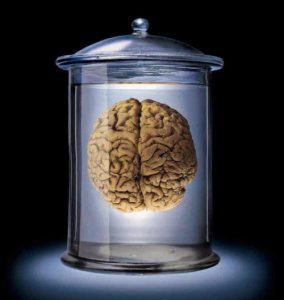
BrainThe brain is complex; in humans it consists of about 100 billion neurons, making on the order of 100 trillion connections. It is often compared with another complex system that has enormous problem-solving power: the digital computer. Both the brain and the computer contain a large number of elementary units—neurons and transistors, respectively—that are wired into complex circuits to process information conveyed by electrical signals. At a global level, the architectures of the brain and the computer resemble each other, consisting of largely separate circuits for input, output, central processing, and memory.1 Which has more problem-solving power—the brain or the computer? Given the rapid advances in computer technology in the past decades, you might think that the computer has the edge. Indeed, computers have been built and programmed to defeat human masters in complex games, such as chess in the 1990s and recently Go, as well as encyclopedic knowledge contests, such as the TV show Jeopardy! As of this writing, however, humans triumph over computers in numerous real-world tasks—ranging from identifying a bicycle or a particular pedestrian on a crowded city street to reaching for a cup of tea and moving it smoothly to one’s lips—let alone conceptualization and creativity. So why is the computer good at certain tasks whereas the brain is better at others? Comparing the computer and the brain has been instructive to both computer engineers and neuroscientists. This comparison started at the dawn of the modern computer era, in a small but profound book entitled The Computer and the Brain, by John von Neumann, a polymath who in the 1940s pioneered the design of a computer architecture that is still the basis of most modern computers today.2 Let’s look at some of these comparisons in numbers (Table 1).

The computer has huge advantages over the brain in the speed of basic operations.3 Personal computers nowadays can perform elementary arithmetic operations, such as addition, at a speed of 10 billion operations per second.

More here.

Tuesday, April 17, 2018

Are religious people more moral?

Dimitris Xygalatas in RNS:

File-20171023-1748-1d0uxthA recent study we conducted, led by psychologist Will Gervais, found widespread and extreme moral prejudice against atheists around the world. Across all continents, people assumed that those who committed immoral acts, even extreme ones such as serial murder, were more likely to be atheists.

Although this was the first demonstration of such bias at a global scale, its existence is hardly surprising.

Survey data show that Americans are less trusting of atheists than of any other social group. For most politicians, going to church is often the best way to garner votes, and coming out as an unbeliever could well be political suicide. After all, there are no open atheists in the U.S. Congress. The only known religiously unaffiliated representative describes herself as “none,” but still denies being an atheist.

So, where does such extreme prejudice come from? And what is the actual evidence on the relationship between religion and morality?

More here.

When a Bigger Penis Means Swifter Extinction

Ed Yong in The Atlantic:

Lead_960_540 (2)The oldest penis ever found is 425 million years old, and belongs to an animal whose scientific name—Colymbosathon ecplecticos—means “astounding swimmer with a large penis.” Large is relative, though. The entire creature is just a fifth of an inch long, but for its size, its penis is still “large and stout,” according to its discoverers.

That’s not unusual for the ostracods—the ancient group of crustaceans to which Colymbosathon belongs. From their origins almost half a billion years ago, these animals have diversified into some 70,000 species. At first glance, they look like little seeds. Look closer, and you’ll see what appear to be distorted shrimps, encased in hard, clam-like shells. Male shells tend to be longer than female ones, because they have to accommodate a pair of large penises, and outrageously big sperm that, when uncoiled, can be six times as long as the ostracod itself. In some species, all of this reproductive gear can take up a third of the male’s shell.

This anatomical extravagance is the result of intense sexual selection, where organisms evolve traits that give them an edge in the competition for mates. That competition leads to excessive body parts, like peacock tails or deer antlers. It leads to colorful plumage and flashy courtship displays. In many groups—ostracods, flies, ducks, dolphins—it sculpts genitals and sperm into an extraordinary diversity of shapes and sizes. And in the ostracods, it can lead to oblivion.

More here.

Israel and Annexation by Lawfare

Michael Sfard in the New York Review of Books:

GettyImages-905946178I always thought that if Israel were to unilaterally annex the occupied Palestinian territories, it would come under an international spotlight, with denunciations and protests around the world. I was wrong. Annexation is underway, but out of the spotlight, away from international attention. In the dismal offices of the fortified Justice Ministry in East Jerusalem, in the cramped meeting rooms of the Knesset, and in the august chambers of the Supreme Court, Israel’s finest lawyers are working around the clock to shape the biggest paradigm shift since the West Bank was conquered in 1967. The government’s lawyers are busy giving their counsel, drafting laws, and defending Israel’s efforts to expand the jurisdiction of its law and administration beyond the 1949 ceasefire lines to serve the interests of Jewish settlers at the expense of the occupied Palestinians, whose civil rights are suspended. Knesset committees are drawing up legislation to expand and entrench the dual legal system that already exists in the West Bank: one code for settlers, another for Palestinians. These new laws are to be applied in a setting in which the colonized are dominated by the colonizers, with a clear intention of maintaining that domination. Even the Israeli judiciary is joined to the task, allowing the exploitation of Palestinian property for the benefit of Israeli settlers.

This epic transformation is taking place after close to fifty years of occupation. During that time, Israel made profound changes to both the landscape and the demography of the territory it conquered. Palestinians were subjected to a military government that denied them participation in the political process that shaped the rules applied to them and determined their future. Israel used the authoritarian powers that international law gives an occupying force to exploit the territory in a way never envisaged by the framers of those laws. It unilaterally annexed East Jerusalem, a move that was widely condemned abroad. The international community does not recognize the unified city as Israel’s capital; even Trump’s declaration on moving the US embassy to Jerusalem stops short of acknowledging the annexation of the city’s eastern parts.

More here.

Scientists accidentally create mutant enzyme that eats plastic bottles

Damian Carrington in The Guardian:

4500Scientists have created a mutant enzyme that breaks down plastic drinks bottles – by accident. The breakthrough could help solve the global plastic pollution crisis by enabling for the first time the full recycling of bottles.

The new research was spurred by the discovery in 2016 of the first bacterium that had naturally evolved to eat plastic, at a waste dump in Japan. Scientists have now revealed the detailed structure of the crucial enzyme produced by the bug.

The international team then tweaked the enzyme to see how it had evolved, but tests showed they had inadvertently made the molecule even better at breaking down the PET (polyethylene terephthalate) plastic used for soft drink bottles. “What actually turned out was we improved the enzyme, which was a bit of a shock,” said Prof John McGeehan, at the University of Portsmouth, UK, who led the research. “It’s great and a real finding.”

The mutant enzyme takes a few days to start breaking down the plastic – far faster than the centuries it takes in the oceans. But the researchers are optimistic this can be speeded up even further and become a viable large-scale process.

More here. [Thanks to Eric Chaffee.]