Brian Gallaghar in Nautilus:
 In the Netflix anime series Knights of Sidonia, humankind is marooned in a spaceship 500,000-strong, refugees constantly on the run from shapeshifting aliens who destroyed Earth over 1,000 years ago. Both the patriarchy and poverty have been smashed. Advances in genetic engineering have allowed androgynous individuals to proliferate and asexual reproduction to become commonplace. Everybody (except the protagonist, a clone of his grandfather) can photosynthesize, drastically reducing the need to eat. A plot twist near the end of the first season, released in 2014, revealed the existence of a shadow government called the Immortal Ship Committee which, in the last several centuries, had grown in number, from less than 10 members to just under 30, becoming more and more corrupt and self-serving. One of them, a 600-year-old woman named Kobayashi, captains the ship behind a mask, concealing her unaging, youthful complexion. She helps orchestrate fake news of alien encounters to justify the emergency powers of the committee’s undemocratic puppet government front.
The potential for undying tyrants or tyrannical bodies is one reason Leonard Hayflick, one of the world’s preeminent experts on aging (he was a founder of the Council of the National Institute on Aging), is against slowing down or eliminating the aging process. He has other reasons, too, like avoiding the father-daughter situation in Interstellar, where, due to the time-dilation effects of traveling in different gravitational fields, the daughter caught up to her father in years, and eventually died of old age first. “To slow, or even arrest, the aging process in humans is fraught with serious problems in the relationships of humans to each other and to all of our institutions,” he told Jordana Cepelewicz, a former editorial intern at Nautilus. “By allowing antisocial people—tyrants, dictators, mass murderers, and people who cause wars—to have their longevity increased should be undesirable…I would rather experience the aging process as it occurs, and death when it occurs, in order to avoid allowing the people who I just described to live longer.”
Despite his reservations about radical life-extension, Hayflick is a big proponent of studying aging at a more fundamental level, he said. “Most studies are either descriptive, studies on longevity determinants, or studies on age-associated diseases. None of this research will reveal information about the fundamental biology of aging. Less than 3 percent of the budget of the National Institute on Aging in the past decade or more has been spent on research on the fundamental biology of aging.” He’s a bit annoyed, for instance, that about a half of the National Institute on Aging’s budget goes toward researching Alzheimer’s disease.
More here.

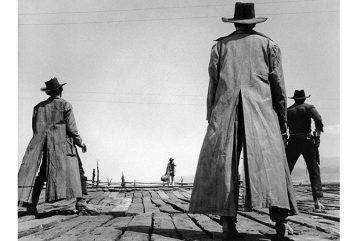 The movie that made me consider filmmaking, the movie that showed me how a director does what he does, how a director can control a movie through his camera, is Once Upon a Time in the West. It was almost like a film school in a movie. It really illustrated how to make an impact as a filmmaker. How to give your work a signature. I found myself completely fascinated, thinking: ‘That’s how you do it.’ It ended up creating an aesthetic in my mind.
 The press photographer’s task is to obtain a likeness of the person who is at the center of the news. This proves difficult when the subject, who is either accused of crimes or tied, however flimsily, to someone who is, wants to avoid being photographed at all costs. Hounded at every step, unable to escape, even in shackles, the subject resorts to makeshift concealments—hat, sleeve, lapel, handkerchief, newspaper—in order to prevent facial capture. The photographer can only pursue, shadow, perhaps verbally goad the subject, waiting for a slip or a stumble that will cause the mask to drop. When that fails to happen, the photographer’s sole option is to photograph the mask. The public, inflamed by press coverage of the case, wants a face it can charge with blame (and, often enough, spread the blame to faces that bear it a superficial resemblance), but is instead offered a metonym: hat, handkerchief, newspaper. The photographer, in quest of a portrait, has delivered in its place an event: the defeat of portraiture by the subject.
 There is intense debate as to what the outcome tells us about voter support for Brexit, with both Leavers and Remainers claiming vindication. The most striking feature of the results, however, is the polarisation they reveal. The result of a botched Brexit has been the Europeanisation of British politics, with the old centre ground falling away.
 As a literary scholar and authority on African American history, Henry Louis Gates Jr. has written or co-written 24 books and serves on the faculty of Harvard University. But he didn’t achieve broad public attention until he began hosting “Finding Your Roots,” a popular PBS series in which celebrities explore their ancestry, often with surprising results. During an episode of a related program, “African American Lives 2,” comedian Chris Rock discovers that his great-great-grandfather, Julius Caesar Tingman, had fought for the Union with the United States Colored Troops during the Civil War, then served in the South Carolina legislature under its Reconstruction government. The revelation brought the typically glib Rock to tears. “How in the world could I not know this?” Rock asked Gates.
 Trying to get a point across in public writing, whether established or clickbait media (a distinction of vanishing significance), with just the nuance, force, and connotations you intend, is like trying to perform a violin solo underwater. You can be as virtuosic as you like, but the medium you’re playing in is going to distort the signal to the point that your effort becomes a vain expenditure, and the result of it comes across as a dull, warped, and muted sound wave to which silence would have been preferable.
 Critics are often maligned.
  What year is it? It’s 2019, obviously. An easy question. Last year was 2018. Next year will be 2020. We are confident that a century ago it was 1919, and in 1,000 years it will be 3019, if there is anyone left to name it. All of us are fluent with these years; we, and most of the world, use them without thinking. They are ubiquitous. As a child I used to line up my pennies by year of minting, and now I carefully note dates of publication in my scholarly articles.
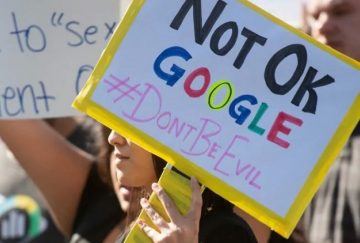 The tech giants are facing a moment of reckoning. Google, Facebook, Amazon, and Uber all grew explosively over the last decade, in part by delivering real convenience and benefits to consumers. For this we forgave their more venial sins, such as unfair competition, copyright infringement, data hoarding, and price discrimination. But recent years have brought one revelation after another around privacy issues—including Facebook’s sharing of data with the dark arts firm Cambridge Analytica—and ever-growing worries about the tech giants’ monopoly powers.
 The president of Ukraine sits in his office, a glum look on his face. He has just been trounced in the election by a political outsider, and isn’t taking it well. When his successor, Vasyl Holoborodko, tries to move into his office, the outgoing president shoots at him through the door with a shotgun, just missing his target. He’s refusing to leave until his demands are met, says an aide: he wants a litre of vodka, several packs of cigarettes and political asylum in Yugoslavia. “But Yugoslavia doesn’t even exist anymore,” says Holoborodko. “He knows, that’s why he asked for the vodka,” the aide replies.
 T
T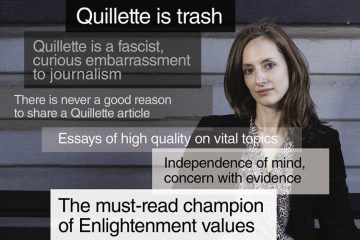 The portrait of university life offered by the online journal Quillette is not a flattering one. Free speech stifled at every turn. Scholars with divergent views relentlessly mobbed. Entire disciplines ruined by left-wing activism. A leafy dystopia populated by irrationally furious undergraduates, pathetically craven administrators, and professors who peddle mindless ideology at the expense of scientific inquiry. It’s enough to make anyone question the mental health of the academy, if not run screaming through the quad.
 As the prospects for a nuclear renaissance in the U.S. based on conventional nuclear technology have dimmed, many nuclear advocates have pinned their hopes on advanced reactors that are smaller and utilize different technologies.
 Right-wing populists have won an unprecedented 57 seats in elections to the European Union’s Parliament, up from 30 in 2014. In Hungary, Viktor Orban’s Fidesz won a majority of 52 percent. In Italy, Matteo Salvini’s Lega topped the poll at 30 percent, in Britain, Nigel Farage’s Brexit Party won, while in France, Marine Le Pen pipped Emmanuel Macron 23 percent to 22 percent. While not quite the populist surge some feared, right-populist momentum continues. Meanwhile, the mainstream Social Democrats and Christian Democrats saw their combined total drop below a majority for the first time, from 56 percent in 2014 to 44 percent as Green and Liberal alternatives gained.
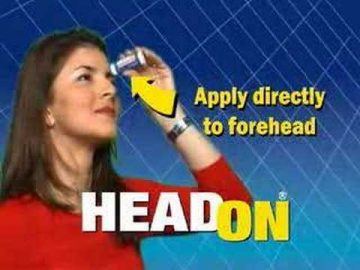 HeadOn was the Max Headroom Incident of the millennial generation. Every time I bring it up, people tell me that they were equally stunned the first time they saw it, and that they remember being so relieved when other people said that they had seen it, too. Companies from Geico to Old Spice to Skittles have all tried their hand at absurdist advertisements, but nothing they’ve produced even remotely achieves the eldritch creepiness of catching the Head On commercial while watching the Weather Channel at 2 a.m. in 2006.
 In big cities particularly, I notice that every new person I meet is manically interested in what I do, and how much of it. I used to be embarrassed by my lack of drive and murmur vaguely about projects and deadlines, but I’m quite happy now to admit the truth, which is that I have very little ambition and no desire to work any harder than I do now, which is honestly not very much. I’ve calculated fairly minutely how much work I need to do to in order to pay my bills and that’s the amount of work I do. No more. Sometimes I get it wrong and need to work much more than usual for a month or two, sometimes I have blissful unexpected mostly vacant weeks. I work about half as much as I did in Ireland, and earn about half as much money – which is fine with me because I’ve started seeing money not as a mark of achievement but as a cumulative display of all the days you’ve spent not doing what you’d like to be doing. I want freedom, not houses. I’d like more money, certainly, but not enough to give up all my time.
 When it comes to intelligence, we all have bad days. Heck, we even have many bad moments, such as when we forget our car keys, forget a friend’s name, or bomb an important test that we’ve taken a day after staying up all night worrying about it. Truth is, none of us– including the world’s smartest human– is perfectly consistent in our cognitive functioning. Sometimes we are at our very best and feel like our brain is on fire, and at other times, we don’t even recognize ourselves. All of this sounds so obvious, but surprisingly the field of human intelligence has not had much to say on the topic. For over the past 120 years, the field has shed far more light on how we differ from each other in our patterns of cognitive functioning than how we each differ within ourselves over time.