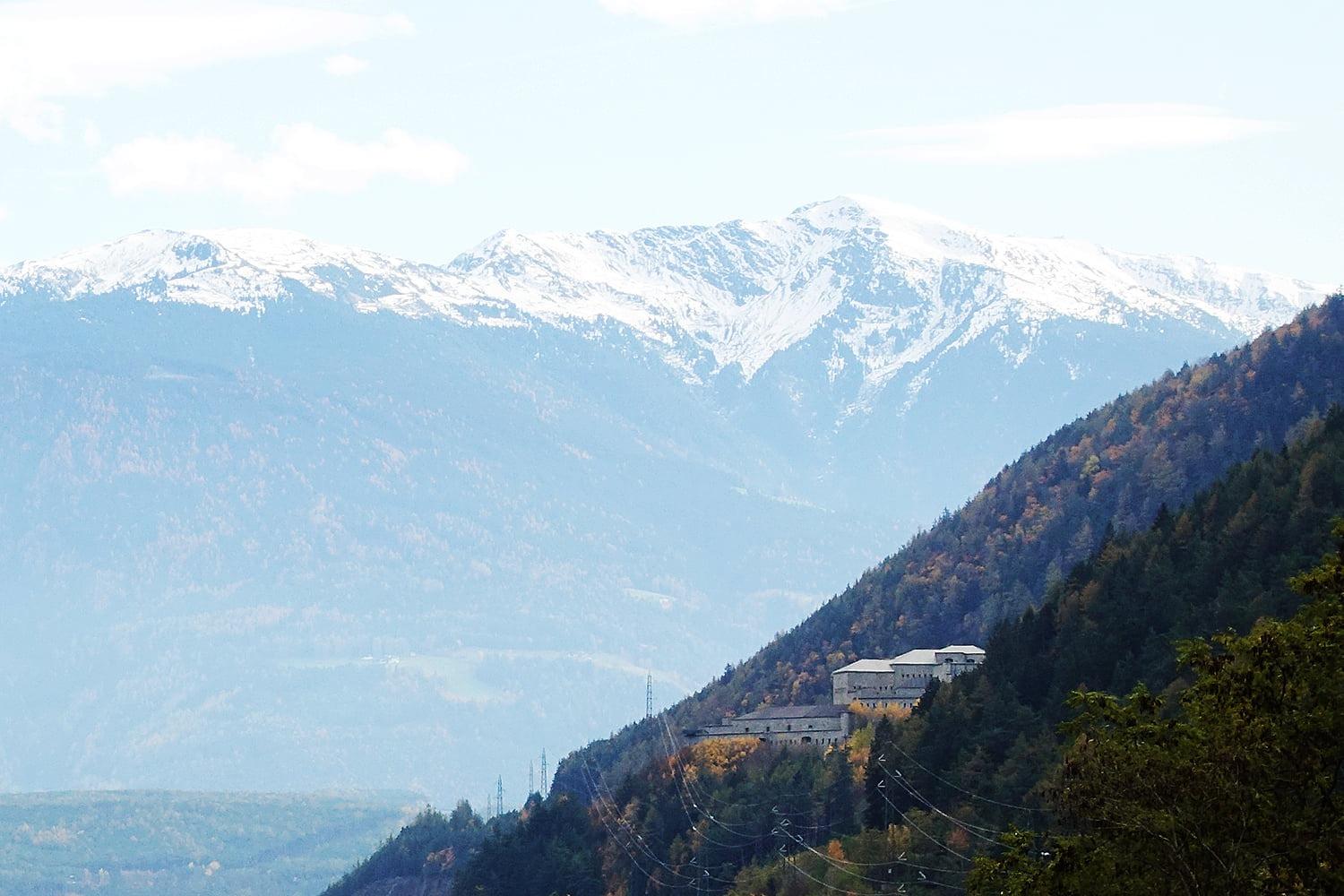
The upper fortress of Franzensfeste, South Tyrol, in November of 2020.

Though we are an aggregator blog (providing links to content elsewhere) on all other days, on Mondays we have only original writing by our editors and guest columnists. Each of us writes on any subject we wish, and the length of articles generally varies between 1000 and 2500 words. Our writers are free to express their own opinions and we do not censor them in any way. Sometimes we agree with them and sometimes we don’t.Below you will find links to all our past Monday columns, in alphabetical order by last name of the author. Within each columnist’s listing, the entries are mostly in reverse-chronological order (most recent first).
The upper fortress of Franzensfeste, South Tyrol, in November of 2020.
by Alexander C. Kafka
What is it about Frank Zappa’s eyes? They leer. They challenge. They invite play and fun and nonsense. But they’re also afraid. They don’t look away. They fix on you defiantly as if he’s expecting to be slapped for something naughty that he said. And he said many naughty things.
One sees a lot of those hypnotizing eyes in the superb new documentary Zappa, directed by Alex Winter. Yes, that Alex Winter, of Bill and Ted’s Excellent Adventure, who is also the serious-minded director of documentaries on the Panama Papers and blockchain. Creating Zappa was an adventure in itself — five years in the making, with access to the artist’s archives and cooperation from the family and a slew of Zappa’s fellow musicians. It was funded through the largest crowdsourced campaign ever for a documentary. Eight-thousand backers invested $1.2 million. It’s the kind of free enterprise Zappa would have applauded.
Winter’s is a wild, often melancholy portrait of a counterculture hero who, in 1993, died from prostate cancer at age 52. It strengthens the case suggested by the 115 albums of Zappa’s music — 53 of them posthumous — that he was a multi-genre composer for whom rock stardom and guitar virtuosity were tools, not ends in themselves. He was also a visual artist, filmmaker, audio innovator, First Amendment freedom fighter, and proud entrepreneur. Zappa produced and briefly even distributed his own material. He also produced albums for Alice Cooper, the GTOs, Zappa’s high-school buddy Captain Beefheart, and other musicians, as well as an album from Lenny Bruce’s last live performance.
by Dwight Furrow
 Look on the back label of most wine bottles and you will find a tasting note that reads like a fruit basket—a list of various fruit aromas along with a few herb and oak-derived aromas that consumers are likely to find with some more or less dedicated sniffing. You will find a more extensive list of aromas if you visit the winery’s website and find the winemaker’s notes or read wine reviews published in wine magazines or online.
Here is one typical example of a winemaker’s note:
The 2016 Monterey Pinot Noir has bright cherry aromas that are layered with notes of wild strawberries and black tea. On the palate, you get juicy, black cherry flavors and notes of cola with hints of vanilla, toasted oak, and well-balanced tannins. A silky texture leads to a long finish.
The purpose of tasting notes is apparently to give prospective consumers an idea of what the wine will smell and taste like. And they succeed up to a point. Wine’s do exhibit aromas such as black cherry, cola, and vanilla.
But do notes like this give you much information about the quality of the wine or what a particular wine has to offer that is worthy of your attention? Read more »
by Eric J. Weiner
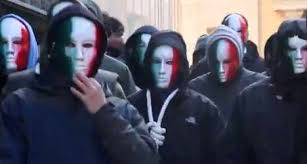 In a recent article in The Atlantic, Shadi Hamid, contributing writer and senior fellow at the Brookings Institution, states reproachfully that “Donald Trump’s election (in 2016) led to a whole cottage industry of thinking that fascism is near, right here at home.” For many scholars and writers in this proverbial “cottage industry,” Joe Biden’s victory will do little to change their minds regarding what they see as the growing threat of fascism in the United States. For Hamid, this is a mistake with serious implications. He is concerned that people who reference fascism to describe what is happening in the United States, either as a warning of the unforeseen terror to come or as an analysis of what is already happening, are confused about what fascism actually is. To highlight the dangers of relativistic thinking in regards to fascism, he quotes George Orwell who wrote, “I have heard it applied to farmers, shopkeepers, Social Credit, corporal punishment, fox-hunting, bull-fighting, the 1922 Committee, the 1941 Committee, Kipling, Gandhi, Chiang Kai-Shek, homosexuality, Priestley’s broadcasts, Youth Hostels, astrology, women, dogs and I do not know what else.” Orwell’s point and Hamid’s fear is that when words/concepts become relative—when signifier and signified float willy-nilly along the shifting winds of power and ideology—they risk undermining the critical capacities of language. More specifically, Hamid argues that the relativity of the term is causing these scholars and commentators to ignore examples of “real” fascism when they occur. The consequence of this ignorance, he argues, negatively impacts the people who are struggling to survive fascist violence throughout the world. Hamid writes,
Words matter because they help order our understanding of politics both at home and abroad. If [Senator Tom] Cotton is a fascist, then we don’t know what fascism is. And if we don’t know what fascism is, then we will struggle to identify it when it threatens millions of lives—which is precisely what is happening today in areas under Beijing’s control. Chinese authorities have tightened their grip on Hong Kong. And while the world watches, they are undertaking one of the most terrifying campaigns of ethnic cleansing and cultural genocide since World War II in Xinjiang province, with more than 1 million Muslim Uighurs in internment camps, as well as reports of forced sterilization and mass rape.
In the face of Hamid’s concerns, and in the wake of Joe Biden’s victory, what should we make of the scholarship and academic journalism that resurrects and reconstructs the concept of fascism to explain what is currently happening in the United States or to warn people about what is politically probable if the Nation doesn’t radically change course? Read more »
by Usha Alexander
[This is the fifth in a series of essays, On Climate Truth and Fiction, in which I raise questions about environmental distress, the human experience, and storytelling. All the articles in this series can be read here.]
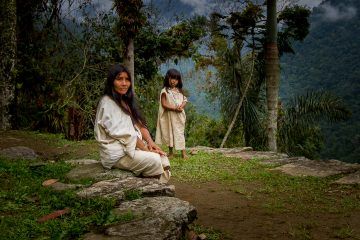 High in the Sierra Nevada de Santa Marta of northern Colombia, the Kogi people peaceably live and farm. Having isolated themselves in nearly inaccessible mountain hamlets for five hundred years, the Kogi retain the dubious distinction of being the only intact, pre-Columbian civilization in South America. As such, they are also rare representatives of a sustainable farming way of life that persists until the modern era. Yet, more than four decades ago, even they noticed that their highland climate was changing. The trees and grasses that grew around their mountain redoubt, the numbers and kinds of animals they saw, the sizes of lakes and glaciers, the flows of rivers—everything was changing. The Kogi, who refer to themselves as Elder Brother and understand themselves to be custodians of our planet, felt they must warn the world. So in the late 1980s, they sent an emissary to contact the documentary filmmaker, Alan Ereira of the BBC—one of the few people they’d previously met from the outside world. In the resulting film, From the Heart of the World: The Elder Brother’s Warning (1991), the Kogi Mamos (shamans) issue to us, their Younger Brother, a warning akin to that which the Union of Concerned Scientists would also later issue in their World Scientists’ Warning to Humanity (1997, with a second notice in 2017): that we must take heed of our damage to the planet; that if we don’t stop what we’re doing to it, we will destroy the world we know.
The Kogi warning, however, is couched in the language and metaphor of their own knowledge system. They speak of The Great Mother, who taught them “right from wrong,” and whose teachings still guide their lives. “The Great Mother talked and talked. The Great Mother gave us what we needed to live, and her teaching has not been forgotten right up to this day,” they tell us. It’s Younger Brother who is causing problems. “They are taking out the Mother’s heart. They are digging up the ground and cutting out her liver and her guts. The Mother is being cut to pieces and stripped of everything,” the Mamos scold. “So from today, stop digging in the Earth and stealing the gold. If you go on, the world will end. You are bringing the world to an end.” You can hear in their tone that it doesn’t occur to them that Younger Brother might not listen. Read more »
by David Oates
How hard it is to watch our national election ordeal as it draws us into yet another week of chicanery and bad faith. How hard to watch. How hard to turn away.
I write this in an attempt to avoid both avoidance and obsession. (Can I do it? I’ve been trying all these horrid four years, with such mixed results.) I reflect that Donald Trump’s ceaseless attention-stealing, itself, is a powerful reason to eject him from our public life. Whatever else this corrupt president turns out to have stolen (and surely there are revelations to come), he has already stolen our time and our attention – hogged the spotlight with a truly weird skillfulness – and crowded nearly all other thoughts off our mental stage.
Bonnie Kristian, a conservative commentator, warns about “politics’ creeping infestation of obligation in our lives,” reflecting that the Founders set up this representative democracy precisely in order to allow citizens their freedom of mind and attention – while the politicians went about conducting the necessary tasks of government. But “Trump is always on our minds, and he is teaching the rest of Washington his methods.” She points out, fairly enough, that this trend predated the Current Occupant. He has merely made it worse – I would add, by several degrees of magnitude. The vacuous emptiness of his nonstop lying expands like a gas, filling all available space.
What is it like, to live under this continuous assault? To have mind and feelings hijacked daily, hourly? Read more »
by Akim Reinhardt
 People are basically good.
God, what a tiresome trope.
It is a desperate and naive sentiment, often advanced by those who can’t bear the truth. I say this as a historian who has studied genocide, ethnic cleansing, slavery, vast, violent, exploitative colonial systems, and more mundane expressions of racism, sexism, homophobia, and classism. But if you’ve neither the time nor the inclination to brush up on 10,000 years of human history as a background for this discussion, then allow me to point you towards the present.
More than 70,000,000 people just voted for Donald Trump. Again.
After four years of observing, on a near daily basis, his presidential grotesquerie. The racism, the sexism, the vindictiveness, the endless vitriol, the knee-jerk authoritarianism and ceaseless attacks on and erosion of American constitutional mechanisms and democratic norms.
The number plagues us like a cancerous tumor unfazed by chemotherapy or radiation, and too large for a scalpel to carve away without disfiguring the corpus: 70,000,000. Read more »
by Jeroen Bouterse
 Here’s an interesting game. You receive 20 dollars, and you and three others can anonymously contribute any portion of this amount to a public pool. The amount of money in this pool is then multiplied by 1.5 and divided equally among all players. Repeat 10 times, then go home with your money. What will happen? How much would you contribute in round one, if you knew nothing about your fellow players?
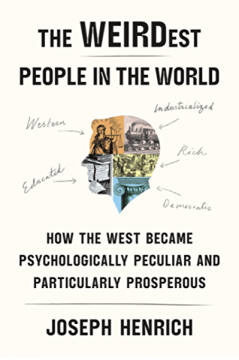
This ‘Public Goods Game’ is one example of the many sophisticated social-psychological experiments that Joseph Henrich brings into play in his recent book The WEIRDest people in the world. It is also a good example of how he puts those experiments to use. One lesson from this game is that people are more cooperative than models of economically rational behavior would suggest (are more homo reciprocans than homo economicus (211)). Another is that average first-round contributions vary significantly between populations. ‘WEIRD’ stands for ‘Western, Educated, Industrialized, Rich, Democratic’, and also serves to emphasize that WEIRD populations are weird in the sense of unusual: they are psychological outliers in a lot of ways.
To stay with the Public Goods Game: Henrich shows that the average share of their endowment that participants from a given country put into the pool in round one correlates negatively with how strongly kinship ties are in that country, as measured either by the so-called ‘Kinship Identity Index’ or by the prevalence of cousin marriage. This is not a surprise to Henrich, who sees the same pattern repeated in other negative correlations: between the strength of kinship ties and the number of blood donations for instance (221), and in general between the strength of kinship and “impersonal prosociality”: a cooperative attitude towards anonymous strangers. Read more »
by Rafaël Newman
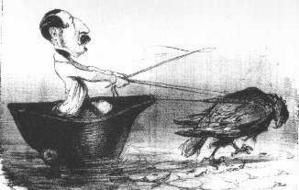
It’s November 9 – what Europeans, with their rational, smallest-to-greatest date format, might call “9/11”, if that particular shorthand hadn’t already been otherwise coopted for the 21st-century world’s symbology. At the same time, Europeans, particularly Germans, would be hard pressed to say which of the several events to have taken place on that date in their history would best qualify for such an abbreviation. Americans in 2001, after all, merely had to overwrite Augusto Pinochet’s coup d’état on September 11, 1973, no great feat of neighborly oblivion.
November 9, meanwhile, is at once the date:
At the head of all of these recurrences, however, there is an even more fateful November 9: the day in 1799, known at the time in the newly adopted Revolutionary Calendar as le 18 Brumaire an VIII, on which Napoleon Bonaparte led the coup that installed him as First Consul, and paved the way to his ultimate establishment as Emperor. Read more »
by Brooks Riley
by Bill Murray
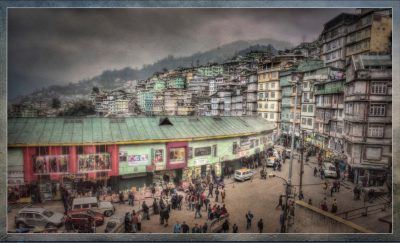
The northern Indian province of Sikkim, between Nepal and Bhutan, borders Tibet. To visit, non-Indians require an “Inner Line Permit/Restricted Area Permit” issued by the Government of Sikkim Tourism Department.
It’s because of history. China chased the Dalai Lama from Lhasa over these mountains and off the throne in ’59. India took in his cadre and donated a whole city, Dharmsala, to their cause. The Chinese have raised hurt feelings to high art, and by this those feelings were gravely wounded.
Besides, the Tibet/Sikkim border isn’t drawn to either sides’ satisfaction. These are barren, forbidding, 12,000 foot mountaintops that nearly 2500 people died fighting over in the 1960s. (The border at Nathula only reopened for trade in 2006.) So they like to keep up with where foreigners are. Read more »
by Sarah Firisen

When I was in my twenties, I didn’t own handbags, I didn’t even have a wallet, I used to stuff my keys and money into a pocket. This was easy when I had one credit card and not a lot of cash. But as I got older, I began to see the sense in carrying some kind of bag, even if I didn’t consider it a fashion choice I was interested in. At some point, I became more interested in the aesthetics of where I put my keys. I started a yearly birthday ritual of buying myself a new nice, practical but not fancy bag. It was usually black or brown so that it went with anything. Then about two years ago that changed. I started a new job, went into the office more, and traveled more. Suddenly, I was open to the possibilities of owning multiple bags, in different colors to go with different outfits. I bought my first designer bag (I was still thrifty about this and went lower end and always on sale, but even so, it was a designer bag). And before I knew it, I had developed a bit of a bag buying habit. I had 4 designer bags and was always forgetting my keys because they were never in the right bag. I was starting to worry about this new buying habit when COVID-19 hit. We went into lockdown and I never went anywhere. When I do go out these days, it’s usually low key and local. I usually don’t even bother putting makeup on let alone worrying about which bag will go with whichever casual and comfortable outfit I have on. And I’m not the only one, “ throughout lockdown, people have been finessing the minutiae of their routines — the preferred shopping route, the ideal outdoor workout — and will likely now shop with these in mind. “Functionally is going to be even more important than it ever was before…She predicts a market for inventive canvas shoppers, lined in something waterproof, or crossbody bags with adjustable straps for hiking or cycling; “geeky stuff like that.”
On one level, there’s nothing particularly noteworthy about this, things happen, the fashion industry responds. But if it turns out that we won’t be going back to offices, or traveling, going to the theatre, or out to bars anytime in the foreseeable future, then this will go from a retail, fashion blip to a moment primed for real innovation. Read more »
by Philip Graham
 Now that a deranged president’s toxic presence will finally—finally!—begin to occupy increasingly smaller tracts of our inner lives, these new days might offer an ideal occasion to celebrate songs that sing of the singular mental spaces hidden inside us all—songs that can help re-acquaint us with ourselves.
You might say that all songs, whatever their subject, are expressions of the interior life. From where else would they arrive? But how many songs explicitly address the structure of this inner world?
My first hint of this particular brand of songcraft began when, a half-year shy of thirteen, I sat on the rug of my Aunt May’s home, the extended family gathered before one of those big box televisions of the early 1960s to watch the Beatles’ debut on the Ed Sullivan Show. I edged as close as I could to the screen because, behind me, my older relatives kept up an annoying patter meant to gently tease me, the representative that evening of an increasingly incomprehensible younger generation: “Look at all that hair,” “Are they gay?” and “The music’s too loud.” Read more »
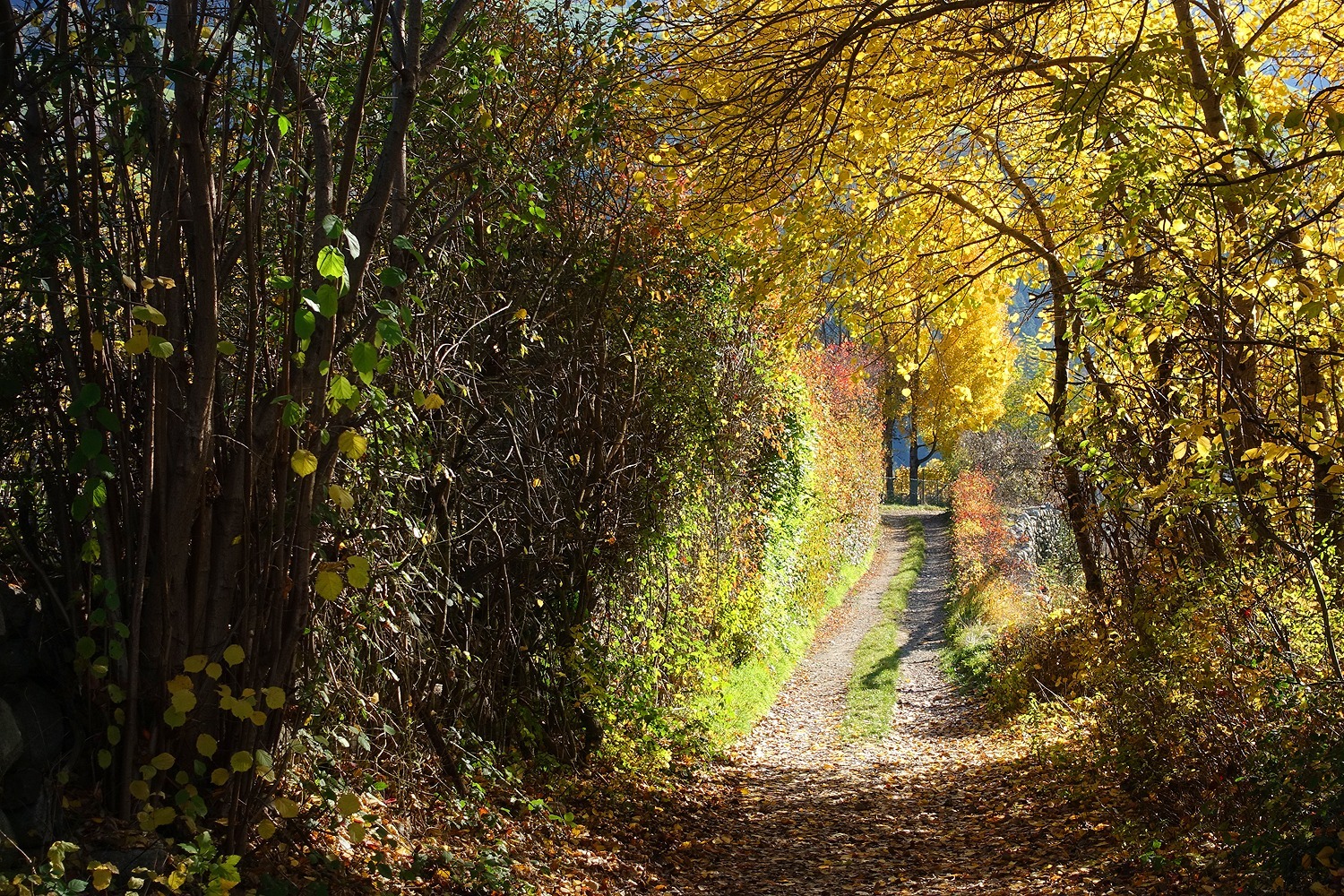
Walking toward Brixen from Elvas in South Tyrol in November of 2020.
by Michael Liss
 Put a small child in a room with a single marshmallow. Tell him that, if he can wait for five minutes, he gets a second one. Leave the room, and see what he does. Can he sit there, staring at that scrumptious-if-a-tad-rubbery mound of goo and powdered sugar and just fight off the urge to grab it, tear it to bits, and, like the Cheshire Cat, leave nothing but a smile?
We, the voters, did it. We passed. Joe Biden will be our next President. America voted for stability and cohesiveness, for deferral of the pleasure of an adrenaline rush in return for a better outcome. We will, on January 20, 2021, be a better country for it.
We need to be better. Love him or loathe him, few could argue that President Trump was not a perpetual disrupter. Time may bring the perspective for more dispassionate analysis of his policies, but, right now, perhaps for just the next year or two, we need a different path.
There is an enemy at the gates we must confront and subdue. To do that, it’s increasingly clear we need an intense effort on the medical side, acceptance of public health measures, and system-wide cooperation. If we don’t get COVID-19 under control, we will not only let death walk amongst us unchallenged, but wreck our economy and our children’s future. Read more »
by Maniza Naqvi
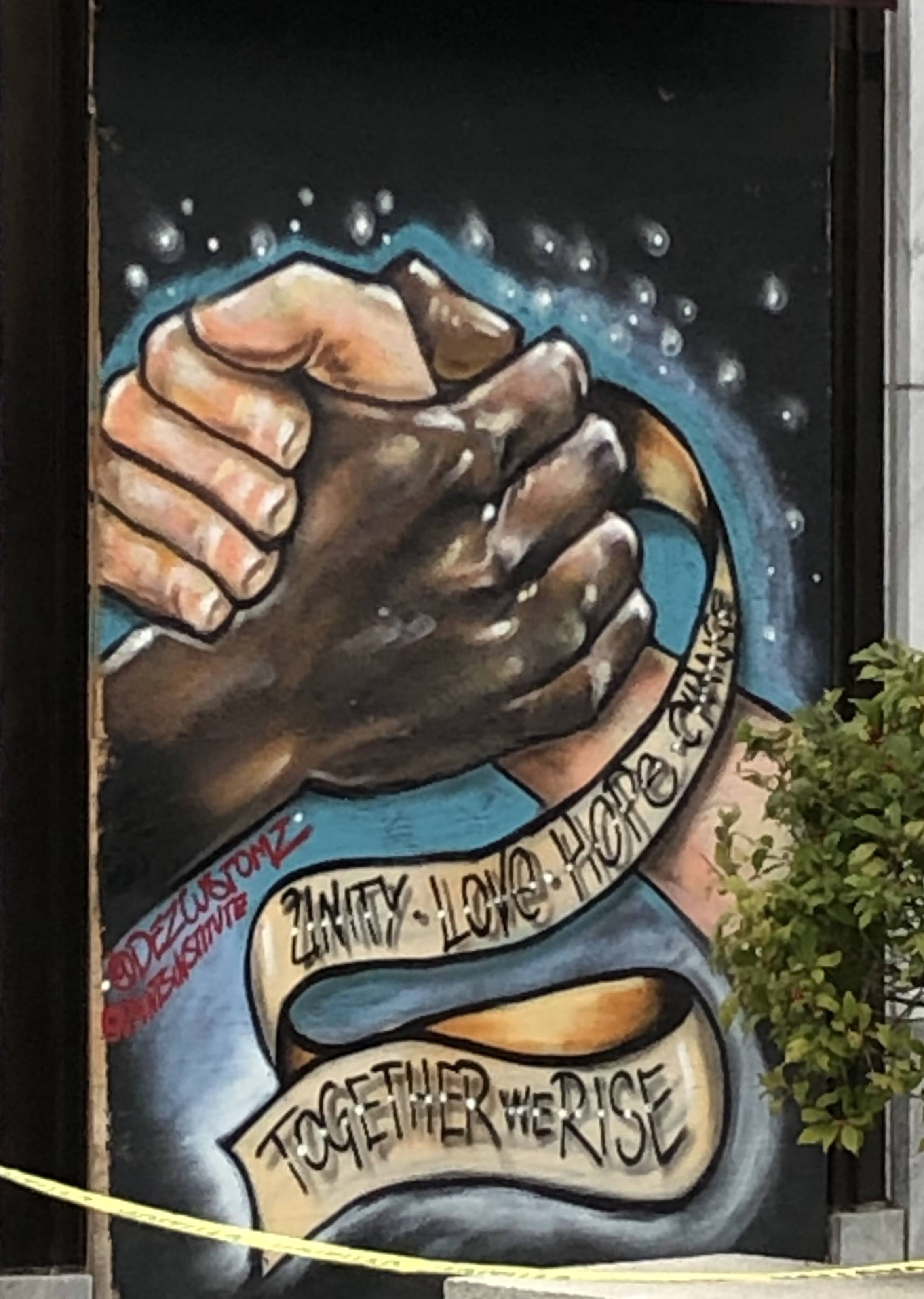 When we are done rhyming words of hope and history to audacity we will need to wake up. When the much needed elation and good cheer wears off, of getting job one done, defeating Trump then the reality will set in.
More than 70 million people voted for Trump. Of which 55% are white women. There were pockets of votes for Trump in the various European, African, Asian and Latino immigrant communities. A percentage of young African American men voted for Trump rejecting perhaps, the ‘polite racism of white liberals” and their corrosive incarceration policies.
Despite everything, including Trump’s corruption, misuse of power, rhetoric, lies, actions, and the mismanagement of the pandemic response; Trump got more than 71 million Americans to vote for him. 8 million more than the votes he got in 2016. Only 5.3 million more voted for Biden in 2020 then did for Trump. And it is women, black and brown who have made the difference for Biden between winning or losing to Trump. It took an old white man with a neo-liberal background to defeat Trump by repeatedly pointing out to his voters that he was not a Progressive. Granted that the heroic leader of the Progressives is old and white too. Read more »
At close to 71 million votes, Donald Trump beat Barack Obama’s 2008 total of 69.5 million, which had been the highest number of votes ever cast for a presidential candidate (Wikipedia). But Joseph Biden got over 75 million votes to win. Those numbers alone make this a landmark election.
The nature of the opposition, the candidates, the voters, the issues, the general state of the nation, that too is important. But I don’t know how to 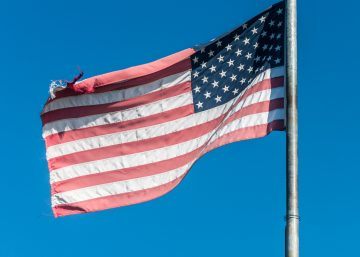 think about that. Though others may have one, I lack an analytic framework. The best I can do is to offer some things I’ve been thinking about.
Be of Good Cheer
Let us start with Episode 223 of the In Lieu of Fun podcast, or whatever it is, from the day after, Nov. 4. It is hosted by Ben Wittes, of the Brookings Institution and Lawfare, and Kate Klonick, who teaches at St. Johns University School of Law. They’ve been hosting this conversation since the beginning of the Covid-19 pandemic.
While the whole conversation is worthwhile, especially some relatively early remarks taking note of the fact that Trump still has a great deal of support, I’m interested in some remarks that Wittes offered at the very end, starting at roughly 55:49 (you have to view it on Youtube). Read more »
by Scott F. Aikin and Robert B. Talisse
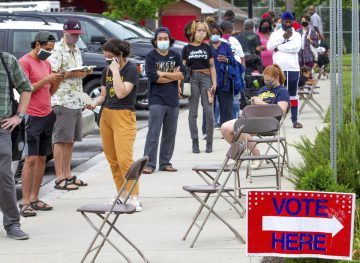
Democracy is the ideal of a self-governing society of equals. An immediate upshot of political equality is political disagreement. Among equals, no one get simply to dictate what others must believe about politics. As equal citizens, each gets to exercise their own political judgment, for better or worse. Democracy hence is the proposition that we can live together as self-governing equals despite ongoing political disagreement.
Democracy is a dignifying proposal. But it’s no picnic. Democracy is rooted in a handful of hard truths that responsible citizens need to keep in mind.
First is that you can’t always get what you want. In fact, you often can’t avoid getting what you don’t want. Knowing the truth about what justice requires or which candidate is best does not entitle you to get your way. Nor does your ability to refute your opponents. Thus, a harder political truth: in a democracy, you can’t always get what you know is right.
That’s not all. When your side loses at the polls, it would be illegitimate for democratic government to enact your will. For electoral losers the principal consolation is that there’ll be another election, and thus another chance to get fellow citizens to see the light. This means that in the wake of defeat, those who care about justice must redouble their effort. Another hard truth: knowing what’s right in politics makes for more work, not less. Read more »
by Jonathan Kujawa
“Odd,” agreed Reg. “I’ve certainly never come across any irreversible mathematics involving sofas. Could be a new field. Have you spoken to any spatial geometricians?” —Douglas Adams, “Dirk Gently’s Holistic Detective Agency”
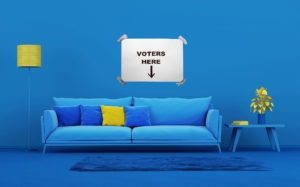
It turns out mathematicians are well-adapted to working from home in the covid-19 pandemic. We don’t need research labs or access to original texts for our research, and teaching math over video chat is infinitely easier than art, music, literature, foreign languages, or practically any other subject. That said, mathematicians get cabin fever, too.
Recently, Anne and I have been talking about rearranging our offices here at home. In the past, they doubled as guest bedrooms and storage for exercise equipment and homeless plants. Which is fine if you’re using them for weekend afternoons and the occasional work-from-home day. But it’s six months in and time for our house to better match the present and foreseeable future.
Our first idea was to replace a guest bed in one office with a couch. Setting aside the difficulty of choosing a new couch sight unseen during a pandemic, there was the more practical problem of choosing one which could actually fit into our house. Read more »