
by Christopher Bacas
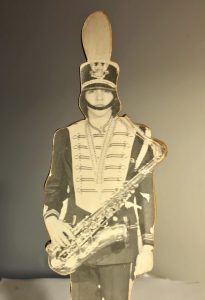 The William Penn High School Marching band was a juggernaut, the coolest team in school. Its director, Holman F James, strode the football field, unzipped windbreaker, cigarette dangling, the Greatest Generation’s bandmaster. A sterling musician, he played trumpet and piano, wrote or arranged all the music and choreographed our field shows. He was also a solider, avid outdoorsman and master craftsman, everything Hugh Hefner should have been.
I got the band music months before our first rehearsals and trained myself to look away from the page as I played. At the first summer music rehearsal, more than two-hundred teens packed the band room. Mr James ran our opener. Sixty-odd woodwinds repeatedly muffed their way through his rapid figurations.
“Whoa. Whoa. Can I hear each of you on that?”
Everyone had a chance to show him our homework. I came prepared. Mr James used me to call out upperclassmen. He wouldn’t accept adolescent sloppiness. Anyone could receive a dressing-down: drum major, soloist or just a rank and file band member with dirty white shoes. Each week, we had uniform inspections and rehearsals on the field. Talking back was unthinkable. Particularly after a kid who cursed him felt Mr James’ dress shoe in his ass. We all watched tears drip from the kid’s eyes as he continued to stand at attention. Read more »
 In the early 1790s, the London intellectual scene was convulsed with the fervor of the ongoing French Revolution. Sympathizers and counter-revolutionaries engaged in a ferocious pamphlet war, initiated by the Unitarian minister Richard Price, rejoined by Edmund Burke in his masterpiece of reactionary rhetoric, Reflections on the Revolution in France, and rejoined again by such writers as Mary Wollstonecraft and Thomas Paine. Political organizations arguing for electoral reform, including the London Corresponding Society and the Society for Constitutional Information, flourished. The resulting conservative backlash culminated in government suspension of habeas corpus and suppression of the free press and free assembly. The decade following the revolution was, all told, a time of tremendous political creativity and turbulence in the Anglophone world.
 JAMES ALLISON LOOKS
  When French President Emmanuel Macron declared during a visit to the Vatican this past summer that, “We have, anthropologically, ontologically, metaphysically, need of religion” (Nous avons, anthropologiquement, ontologiquement, métaphysiquement, besoin de la religion), there was little critical analysis in the press, much less by philosophers and scientists, of the moral, historical, or evidentiary basis of such a sweeping claim by the
 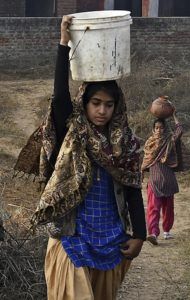 In recent years, a debate has raged in India on what is the level of poverty in the country and whether it has changed, either to reflect the arrival of a new India or the persistence of an old one. Prime Minister Narendra Modi’s government stopped producing official estimates of poverty when it abolished the storied 65-year-old Planning Commission.
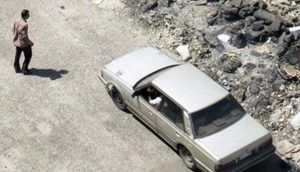 The killing of other human beings in war makes graphic an abiding moral dilemma: You might try to make an evil less outrageous, or you might try to get rid of it altogether—but it is not clear that it is possible to do both at the same time. In one of her Twenty-One Love Poems, Adrienne Rich
  In a recent speech at the United Nations, President Trump
  All women become like their mothers,” says Algernon in The Importance of Being Earnest. “That is their tragedy. No man does, and that is his.” Left hanging there, of course, is the implication that the son’s tragedy is that he becomes like his father instead. In Oscar Wilde’s own case, that might not have been such a terrible thing, at least for his creative productivity. Colm Tóibín’s sparkling little book on Sir William Wilde, WB Yeats’s father John and James Joyce’s father John Stanislaus, seems originally to have been called “Prodigal Fathers” – the phantom title appears on the inside flap of the cover. It may have been dropped because of Sir William, for whom the word – with its implications of wasted talent – is a poor fit. But it certainly works for John Butler Yeats and John Stanislaus Joyce. And yet the joy of Tóibín’s erudite, subtle, witty and often deeply moving biographical essays is that one generation’s paternal prodigality can become the next generation’s powerhouse of neurotic energy.
 This year’s broiling summer made us Brits climate-change enthusiasts and environmental doom-mongers in quick succession. First came delight at the disappearance of the traditional rhythms of the English summer. Barbecues no longer sputtered out with the advent of a tensely awaited shower. Sogginess, the traditional texture of the British family trying to enjoy itself outdoors, dried out. Tedium followed, as the parks, which at the start of the season had seemed so welcoming, began to resemble a desolate dustbowl from “The Grapes of Wrath”. And then came despair. It wasn’t the days that were so bad. Most offices have serviceable air-conditioning. But the nights were stagnant, breezeless hellscapes as British homes, whose cavity walls had been obediently filled with mineral fibre and formaldehyde foam to retain every last whisper of heat during the winter, turned into bakeries. Sleep evaporated along with everything else and the simplest tasks became cryptic. I stood in front of my front door flummoxed when faced with two locks that need opening with different keys. Anxiety levels rose and tempers frayed.
 I was an only child raised by a divorced, working, well-educated, secularist, Westernised mother and an uneducated, spiritual, Eastern grandmother. Born in France, I moved to Turkey with my mother when my parents’ marriage came to an end. Although I was small when I left Strasbourg, I often think about our little flat and remember it as a place full of French, Italian, Turkish, Algerian, Lebanese leftist students who passionately discussed the Marxist philosopher Louis Althusser, read poems by Vladimir Mayakovsky and collectively dreamt about the Revolution. From there I was zoomed to my Grandma’s neighbourhood in Ankara – a very patriarchal and very conservative-Muslim environment. Back then, in the late 1970s, there was increasing political violence and turmoil in Turkey. Every day a bomb exploded somewhere, people got killed on the streets, there were shootings on university campuses. But inside Grandma’s house what prevailed were superstitions, evil eye beads, coffee cup readings and the oral culture of the Middle East. In all my novels there has been a continuous interest in both: the world of stories, magic and mysticism inside the house, and the world of politics, conflict, inequality and discrimination outside the window.
 Mohammed Hanif’s critically acclaimed, Booker Prize-longlisted debut novel A Case of Exploding Mangoes managed to be both a riotous thriller and a merciless political satire. Running like a red thread through its cat’s-cradle makeup of plot arcs and narrative tangents, key exploits and attendant conspiracy theories, was one main strand concerning the mysterious plane crash that killed Pakistan’s military dictator General Zia-ul-Haq.
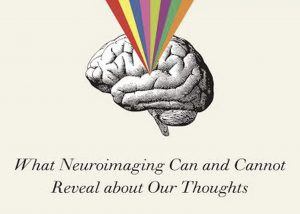 In 2007, The New York Times published an op-ed titled “
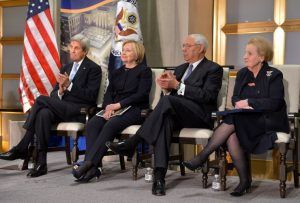 On February 2, 2003, the political scientist John J. Mearsheimer published a co-authored op-ed in The New York Times that lambasted the Bush Administration’s case for invading Iraq. In a carefully laid out argument, Mearsheimer and Stephen Walt, a fellow scholar of international relations, predicted that deposing Saddam Hussein would cause more problems than it solved. They argued that the dictator needed to be contained, and that preventative war was not just unnecessary, but harmful.
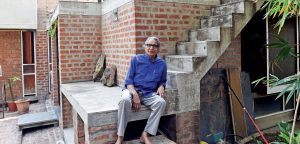 First-time visitors to India are often struck by the abrupt contrasts in the built environment. A realm of older, urban-fabric chaos—one that works extremely well in the manner that pedestrian-oriented cities do anywhere—will suddenly give way to a realm of more recent dysfunctional sprawl. Traditional urban forms in India show an adaptive response to climate and to centuries of patterns of use. But the country’s newer, road-emphasizing development applies 20th-century models of Western planning—models that we in the West have ourselves come to lament. Such urban growth patterns have unintended, undesirable consequences even in places where nearly everyone can afford a car; they can be disastrous in places like India where many people cannot. And it’s not just the road patterns that are ill suited to the country’s needs. Disregard for local circumstances also characterizes much 20th-century Indian architecture—resulting in climate-controlled structures indistinguishable in style from buildings you might see in the United States, Scandinavia, China, or Africa.Realigning contemporary design and architecture to the needs of India has been a major theme in the life’s work of B.V. Doshi. He is the winner of this year’s Pritzker Prize, often described as the Nobel Prize of architecture. It is invariably awarded to architects of great talent, most of whom are very well known. The Pritzker family fortune that funds the award was derived in large part from the Hyatt hotel chain, and the honorees tend to be the sort of starchitects whose name recognition resembles that of the chain—and whose commissions are about as widespread as its locations. Most require a map of several continents, if not the full world, to encompass their work.
 On the night
  The Genizah is a trove of Hebrew documents that were found largely intact in the Ben Ezra Synagogue in Old Cairo. For many reasons, the more celebrated part of the Genizah among contemporary scholars is what we could term its “literary” component: old Hebrew books of many kinds, scrolls and codices, with writings both sacred and secular. Throughout the 20th century, scholars were excited to publish new works of ancient rabbis for instance, or for the first time, their opponents from the first century BCE or the 9th century CE. But the Genizah did not only include literary materials, it was the repository for anything with Hebrew lettering in medieval Fustāt. Letters and legal documents abound. Scholastic interest in this “documentary” Genizah took some time to mature, but its cataloguing and scrutiny in recent decades has yielded a wealth of fine-grained information that medievalists specializing in other geographic areas can only dream of.