The bank effect and the big boat blocking the Suez

Brendan Greeley in the Financial Times:

The hardest thing about teaching someone how to drive a boat is that it’s not at all like driving a car. To steer a car, you turn the wheel until your nose is pointing where you want to go, then you straighten out and go there. This works because the car is attached to the road. It’s when the car itself is no longer attached to the road that things get weird. When you turn too hard, for example, the rubber in your tyres loses purchase on the street, and you are “in drift”. The normal rules no longer apply.

When you drive a boat, you are always in drift. You are attached to nothing. Stuff happens in the water beneath you that does not make any intuitive sense. Sometimes your stern (your tail) moves faster than your bow (your nose), and in a different direction. Sometimes both stern and bow are moving in the same direction at the same speed, but it’s not the direction the bow is pointed. On a boat, you don’t always go where you’re pointed.

On Wednesday, the Golden-Class container ship Ever Given made an unplanned berth in the sand on both sides of the Suez Canal, stopping trade between Europe and Asia.

More here.
Tuesday Poem

Man and Boy

I

‘Catch the old one first’
(My father’s joke was also old, and heavy
And predictable). ‘then the young ones
Will all follow, and Bob’s your uncle.’

On slow bright river evenings, the sweet time
Made him afraid we’d take too much for granted
And so our spirits must be lightly checked.

Blessed be down-to-earth! Blessed be highs!
Blessed be the attachment of dumb love
In that broad-backed, low-set man
Who feared debt all his life, but now and then
Could make a splash like the salmon he said he was
‘A big as a wee pork pig by the sound of it’.

II

In earshot of the pool where the salmon jumped
Back through its own unheard concentric soundwaves
A mower leans forever on his scythe.

He has mown himself to the center of the field
And stands in a final perfect ring
of sunlit stubble.

‘Go and tell your father,’ the mower says
(He said it to my father who told me),
‘I have it mowed as clean as a new sixpence.’

My father is a barefoot boy with news,
Running at eye-level with weeds and stooks
On the afternoon of his own father’s death.

The open, black half of the half-door waits.
I feel much heat and hurry in the air.
I feel his legs and quick heels far away

And strange as my own—when he will piggyback me
At a great height, light-headed and thin-boned,
Like a witless elder rescued from the fire.

by Seamus Heaney
from
Seeing Things
Faber & Faber, 1991

A New Light on DNA Storage

Steve Nadis in Harvard Magazine:

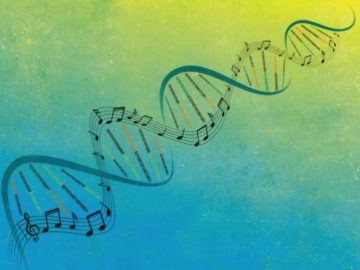
DIGITAL-DATA PRODUCTION is expanding so fast that, within two decades, storing it in flash-drive memory chips could consume 10 to 100 times the anticipated supply of microchip-grade silicon. With new ways of storing information desperately needed, Winthrop professor of genetics George Church is turning to one of the oldest means of doing so: the DNA molecule, which has been replicating and mutating on Earth for three and a half billion years. By 2025, accumulated global data is expected to reach 175 billion trillion bytes—all of which could, in principle, be contained in less than 180 pounds of DNA, housed within a 15-gallon drum. DNA stores information in a “modern” way, explains Church, who heads the synthetic biology group at Harvard’s Wyss Institute for Biologically Inspired Engineering (see “Engineering Life,” January-February 2020, page 37, for more about synthetic biology). Digital information storage, he explains, “is based on just two numbers, 0s and 1s, and DNA is analogous.” Its code has just four letters: A (adenine), T (thymine), C (cytosine) and G (guanine)—the bases or nucleotides comprising the rungs of DNA’s double helix-shaped ladder, which can be arranged in whatever order scientists choose.

In an October 2020 paper in Nature Communications, Church and colleagues described an advance that brings DNA information storage closer to commercial feasibility. They showed for the first time that DNA could be synthesized, and information thereby encoded, in an enzyme-facilitated process controlled by light. The team also demonstrated another first: the use of enzymes to achieve parallel synthesis of multiple DNA strands. They pulled two measures of music from a Super Mario Brothers video game, digitized it, converted it to a DNA code, and synthesized it. The DNA was then sequenced to decipher its code, redigitized, and converted back to a musical format. The point was to test a new approach to synthesis involving both enzymes and light. The first of these steps was demonstrated in 2019 when Church’s group showed that terminal deoxynucleotidyl transferase (TdT)—an enzyme found in immune cells—could be used for DNA synthesis and information storage. TdT works well, says Wyss staff scientist Daniel Wiegand, “because its only job is to find the end of a DNA chain and add a base to it.”

More here.

The quest to tell science from pseudoscience

Michael Gordin in Boston Review:

Where do you place the boundary between “science” and “pseudoscience”? The question is more than academic. The answers we give have consequences—in part because, as health policy scholar Timothy Caulfield wrote in Nature last April during the first wave of COVID-19, “tolerating pseudoscience can cause real harm.” We want to know which doctrines count as bona fide science (with all the resulting prestige that carries) and which are imposters.

This is the “demarcation problem,” as the Austrian-British philosopher Karl Popper famously called it. The solution is not at all obvious. You cannot just rely on those parts of science that are correct, since science is a work in progress. Much of what scientists claim is provisional, after all, and often turns out to be wrong. That does not mean those who were wrong were engaged in “pseudoscience,” or even that they were doing “bad science”—this is just how science operates. What makes a theory scientific is something other than the fact that it is right.

Of the answers that have been proposed, Popper’s own criterion—falsifiability—remains the most commonly invoked, despite serious criticism from both philosophers and scientists. These attacks fatally weakened Popper’s proposal, yet its persistence over a century of debates helps to illustrate the challenge of demarcation—a problem no less central today than it was when Popper broached it.

More here.

Why Philo Matters

Gregory E. Sterling at Marginalia Review:

What should I say about Philo whom critics call…the ‘Jewish Plato’?” So said Saint Jerome, who spent the later years of his life as an ascetic in the cave traditionally associated with the birth of Jesus. He went on to defend Philo’s integration of philosophy and biblical interpretation and was the first to report the widely circulated bon mot among early Christian authors: “either Plato philonizes or Philo platonizes,” recognizing the degree to which Philo had incorporated Hellenistic philosophy–especially Platonism– into Judaism.

It was the knowledge of God that most interested Philo. While he did not restrict this to Platonism, he was particularly attracted to it, especially in the form in which the tradition developed in Alexandria in the first century BCE.

more here.

Gary Panter’s Punk Everyman

Nicole Rudick at the Paris Review:

According to Panter, he didn’t set out to create Jimbo, “he just showed up.” Jimbo made his first public appearance in the punk magazine Slash in 1977 and his cover debut two years later. His pug-nosed mug moved to Françoise Mouly and Art Spiegelman’s radical art-comics anthology Raw in 1981; some of Jimbo’s stories there made up the first Raw One-Shot, a spin-off of the periodical, the following year. He joined an ensemble cast in Panter’s Cola Madnes, written in 1983 but not published until 2000, and landed his first full-length book, Jimbo: Adventures in Paradise, in 1988, published by Raw and Pantheon. Jimbo has since starred in four issues of a self-titled comic published by Zongo in the nineties and stood in for Dante in two illuminated-manuscripts-cum-comic-books: Jimbo in Purgatory (2004) and Jimbo’s Inferno (2006). He is, as you read these words, being sent out into fresh adventures by Panter’s fervid imagination and tireless pen.

more here.

Sunday, March 28, 2021

Periodicity, “Postmodernism”, and the Excesses of the New Realism

Justin E. H. Smith in his Substack Newsletter:

Shortly after September 11, 2001, Bruno Latour for example began to suspect the intellectual fashion to which he himself had contributed so much was at least in part responsible for creating a global environment in which “we each have our own truths”. This realization came for him when, returning to his native village in Bourgogne and speaking with the common people who work the Latour family vineyards, he learned that, for a good number of them, “their own truths” told them it was “the Jews” who brought down the Twin Towers. Other science-studies luminaries too, who had previously delighted in stoking the idea that science is but a discourse alongside others, came to realize that they shared at least some responsibility for a wide array of suspicious attempts to join the narrativity train, to spin the past according to taste, such as the Creation Science Museum of Petersburg, Kentucky, or the crypto-creationist Discovery Institute, both of which were, if run by reactionaries, nevertheless effective illustrations of the usefulness of postmodernism.

The reckoning with what “theory” had wrought was broad and various. Even the Catholic postmodernist philosopher Jean-Luc Marion felt compelled, in the preface to a later edition of his 1982 apophatic summa, God Without Being, to reply to critics who worried that he was tiptoeing right up to the brink of atheism. Don’t worry, he reassured them, notwithstanding the title of this book, God is.

More here.

Moshe Behar on the International Holocaust Remembrance Alliance’s definition of Antisemitism

Moshe Behar at the University of Notre Dame’s website Contending Modernities:

I am a non-white Mizrahi Jewish academic who has been studying Israel/Palestine and the history of Jews in the Middle East for two decades. My family hails from Ottoman Palestine, Egypt, Tunisia, and the Greek islands of Zakynthos and Corfu. All too many of us were murdered by Nazi Génocidaires (and rest assured that we will not forget or forgive). Precisely because of this scholarly and biographic background I was embarrassed to read the letter sent by England’s Secretary of State for Education, Gavin Williamson, to all university vice chancellors. Utilizing an authoritarian tone devoid of understatement, Williamson demanded that all universities in England adopt formally what is called “the working definition of antisemitism” drafted by the International Holocaust Remembrance Alliance (IHRA).

Born in 1976, Williamson has been a Tory politician for 25 years. He and his party have not been noteworthy for their passionate activism against racism, antisemitism included. Nor did Williamson find it problematic to serve under Boris Johnson, author of Seventy-Two Virgins (HarperCollins, 2004), a novel that disappointingly recycled antisemitic tropes and stereotypical portrayals of Jews and other British minority ethnic groups.

The letter Williamson authored is littered with antisemitic tropes.

More here.

How Ancient ‘Deer’ Lost Their Legs and Became Whales

Joshua Rapp Learn in Discover:

The largest animals that have ever existed on our planet descended from a miniature deer-like creature that walked on four legs in the swamps of ancient India.
Cetaceans include everything from dolphins to whales. They are fairly unique among mammals in that they live permanently in the sea — something they share with only a few other types of live-bearing, warm-blooded species.

But their evolutionary ancestors weren’t always the seafaring types. In fact, just 50 million years ago, ancestors of all cetaceans were small creatures called Indohyus that waded through swamps on four legs.

Indohyus basically looked like a tiny little deer, a deer the size of a cat,” says Hans Thewissen, a professor at Northeast Ohio Medical University who has studied whale evolution for years and wrote the book The Walking Whales: From Land to Water in Eight Million Years.

How did these creatures go from that to blue whales the length of about two city buses? It took a lot of small changes over tens of millions of years.

More here.

Imagination is a powerful tool, a sixth sense, a weapon; we must be careful how we use it

Paul Giamatti and Stephen Asma in Aeon:

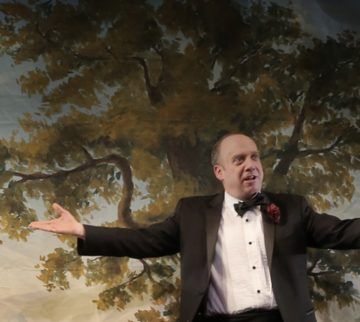
Like other artists, the actor is a kind of shaman. If the audience is lucky, we go with this emotional magician to other worlds and other versions of ourselves. Our enchantment or immersion into another world is not just theoretical, but sensory and emotional. How do actor and audience achieve this shared mysterious transportation? This shared ritual draws upon a kind of sixth sense, the imagination. The actor’s imagination has gone into emotional territories of intense feeling before us. Now they guide us like a psychopomp into those emotional territories by recreating them in front of us.

Aristotle called this imaginative power phantasia. We might mistakenly think that phantasia is just for artists and entertainers, a rare and special talent, but it’s actually a cognitive faculty that functions in all human beings. The actor might guide us, but it’s our own imagination that enables us to immerse fully into the story. If we activate our power of phantasia, we voluntarily summon up the real emotions we see on stage: fear, anxiety, rage, love and more. In waking life, we see this voluntary phantasia at work but, for many of us, the richest experience of phantasia comes in sleep, when the involuntary imagination awakes in the form of dreams.

More here.

Sex and the City: Imagining a Bombay with women in charge

Rafia Zakaria in The Baffler:

I HAVE NEVER BEEN ABLE to visit Bombay, but the city, or rather the ghost of it, lingered in the plotline of my Pakistani childhood. Both sides of my family were from Bombay: on one side were Iranian exiles from the uprooting of the Qajar dynasty in the 1920s, and on the other, Muslim businessmen from the heart of the city. Both sides decided to leave after Partition in 1947 and come to Karachi, where I was born. Disparate as their worlds may have been in Bombay, they had merged in Karachi, then a desert backwater. Neither seemed particularly sanguine about the choice, a judgment I made based on the frequency with which the magical Bombay of their memories and imaginations appeared in conversation. As a Pakistani born in the place wrested from India and the British, I could not go and see the city of Bombay. Naturally this has meant that I relish any chance to catch a glimpse of the “real” Bombay, even if it is provided via the very unreal creations of Bollywood or, more recently, the reality dramas dished up on Netflix. I devoured Indian Matchmaking in an afternoon, the tone and timbre and accent of matchmaker “Seema Aunty” as familiar to me as the soundtrack of my childhood, made up of just such gossipy fare exchanged by my migrated grown-ups. Then came The Fabulous Lives of Bollywood Wives, and now another one, a show called Bombay Begums.

Unlike Indian Matchmaking and Bollywood WivesBombay Begums is a drama, its protagonist played by the actress Pooja Bhatt, a once-upon-a-time Bollywood star looking to make a comeback in the relatively less-ageist environs of the Netflix drama. Her character, Rani Irani, is the just-ascended CEO of a powerful bank (the fictional Royal Bank of Bombay). Having beat out many men for the job, Irani has a lot to prove and she sets about doing just that. She is clad in the most resplendent silk saris, many of which hang in her office, a deliberately feminized backdrop to the conversations about sex or money or bribes that take place in the cream upholstered and tastefully backlit space.

More here.

The infamous “trolley problem” was put to millions of people in a global study, revealing how much ethics diverge across cultures

Karen Hao in the MIT Technology Review:

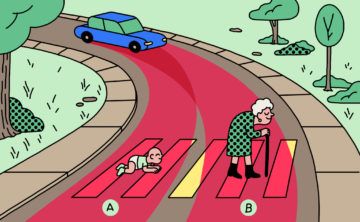
In 2014 researchers at the MIT Media Lab designed an experiment called Moral Machine. The idea was to create a game-like platform that would crowdsource people’s decisions on how self-driving cars should prioritize lives in different variations of the “trolley problem.” In the process, the data generated would provide insight into the collective ethical priorities of different cultures.
The researchers never predicted the experiment’s viral reception. Four years after the platform went live, millions of people in 233 countries and territories have logged 40 million decisions, making it one of the largest studies ever done on global moral preferences.

new paper published in Nature presents the analysis of that data and reveals how much cross-cultural ethics diverge on the basis of culture, economics, and geographic location.

The classic trolley problem goes like this: You see a runaway trolley speeding down the tracks, about to hit and kill five people. You have access to a lever that could switch the trolley to a different track, where a different person would meet an untimely demise. Should you pull the lever and end one life to spare five?

More here.

Sunday Poem

Making

Quilted
patches, unlike the smooth silk loveliness
of the bought,
this made-ness out of self-madness
thrown across their bones to keep them warm.
It does.

Making
under the patches a smooth silk loveliness
of parts;
two bodies are better than one for this quilting,
throwing into the dark a this-ness that was not.
It does.

Fragments
of the splintered irrelevance of doubt, sharp
hopes, spear and splice into a nice consistency as once
under the pen, the brush, the sculptor’s hand
music was made, arises now, blossom on fruit tree bough.
It does.

Exercise
exegesis of the will captures and lays
haloes around bright ankles of a saint.
Exemplary under the tree,
Buddha glows out now
making the intolerable, accidental sky
patch up its fugitive ecstasies.
It does.

From the making, and, made, now making
certain order—this excellent despair
is laid, and in the room the patches of the quilt
seize light and throw it back upon the air.
A grace is made, a loveliness is caught
quilting a quiet blossom as a work.
It does.

And do you,
doubting, fractured, and untaught, St. John of the Cross,
come down and patch the particles and throw
across the mild unblessedness of day
lectures to the untranscended soul.
Then lotus-like you’ll move upon the pond,
the one-in-many, the many-in-one,
making a numbered floral-essenced sun
resting upon the greening padded frond,
a patched, matched protection for Because.
And for our dubious value it will do.
It always does.

by Phyllis Webb
from
Poet’s Choice
Time/Life Books, 1962


Saturday, March 27, 2021

The Apocalyptic New Campus Novel

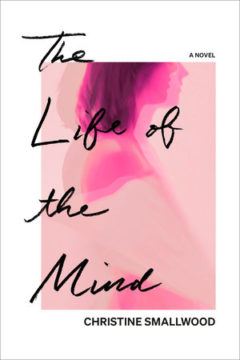
Charlie Tyson reviews Christine Smallwood’s The Life of the Mind in The Chronicle of Higher Education:

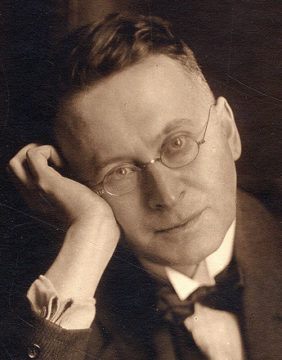
Early in graduate school, I had a curious dream. I had finished my dissertation, but no job was forthcoming. Taking pity on me, my department hired me to perform the functions of a janitor-cum-chambermaid. A pathetic scene followed. I found myself down on my hands and knees, scrubbing the floor tiles of the humanities building, choking on the fumes of cleaning fluid, squeezing my rag into a bucket of dirty suds. Students teemed past holding lattes. My former professors averted their eyes. “At least I can tell people I work at Harvard,” I thought madly, as hot tears spilled down and mingled with the lemon disinfectant.

I recalled this nightmare of bourgeois indignity while reading Christine Smallwood’s debut novel of academic precarity, The Life of the Mind (2021) — the book’s key theme is the production of waste, and the task of cleaning up afterward. Smallwood’s sendup of contemporary academic life follows Dorothy, an adjunct instructor in the English department of a private university in New York City. The novel opens with Dorothy on the toilet in the middle of a bowel movement. It ends with her dumping a sheaf of student essays, each marked with a desultory A-minus, one by one into the trash.

More here.

The new essentialism?

DOD Photo by Navy Petty Officer 1st Class Carlos M. Vazquez II

Simon Garnett in Eurozine:

If we share the assumption that every culture is necessarily incomplete in itself and that there is no such thing as a self-contained, homogeneous culture, then the very definition of a given culture has to include what I would call inter-translatability. In other words, being-in-translation is an essential defining feature of the concept of culture itself.

This passage is taken from an essay by António Sousa Ribeiro published in Eurozine in 2004. Entitled The reason of borders or a border reason?, the piece argues for a ‘relational’ understanding of identity and for ‘translation’ – both in a literal and a figurative sense – as a form of ‘counter-hegemonic globalization’.

I was put in mind of this piece – which itself has been translated into six languages – by the recent debate over the appropriateness of a white person translating the work of a black poet.

The debate has certainly been positive in one respect: namely, in drawing attention to the ‘whiteness’ of the literary translation business and the literary sector generally. While an increasing number of non-white authors are being published, editorial departments in particular lack diversity. As a symbolic gesture, to insist that Amanda Gorman be translated by a black translator made sense.

But, for reasons that may have nothing to do with the original intervention, the debate has also become about something more fundamental: whether the translator’s whiteness renders them incapable of doing justice to the black poet’s work.

More here.

Precarity and Struggle: Kafka, Roth, Kraus

Ari Linden in Public Books:

We know that things in our world have gone awry when Franz Kafka resonates: “The world will offer itself to you to be unmasked, it cannot do otherwise, it will writhe in front of you in ecstasies.” As we all anxiously await a less metaphysical unmasking, such a sentiment speaks to a current mood of tenuous anticipation, as it likely would have in the early 20th century had the text in which it appears been published along with Kafka’s more famous works. Instead, it is included now in a slim volume titled The Lost Writings, composed primarily of short stories and fragments that have been “lost to sight for decades.” Curated by the Kafka scholar and preeminent biographer Reiner Stach and sifted from the Nachgelassene Schriften und Fragmente, these texts have been newly translated into English by Michael Hofmann, two of them for the first time. To give a sense of Hofmann’s literary instincts: “exposed” or “disclosed” would have worked for “Entlarvung” in the aphorism above, but “unmasking” was clearly the right choice.

Scholars have frequently alighted on notions of negativity or absence as the paradoxically defining feature of Kafka’s work. Most recently, Paul Buchholz has written on Kafka’s literary “self-nullification,” which nonetheless contains a quasi-redemptive moment: “a lonely protagonist may erase the world around him, fall into an abyss that he has created for himself, and finally find there the conditions for affirmative community.”

More here.