Tuesday Poem

On a Squirrel, Crossing the Road in Autumn, In New England

It is what he does not know,
Crossing the road under the elm trees,
About the mechanism of my car,
About the Commonwealth of Massachusetts,
About Mozart, India, Arcturus,
That wins my praise. I engage
At once in whirling squirrel-praise.
.
He obeys the orders of nature
Without knowing them.
It is what he does not know
That makes him beautiful.
Such a knot of little purposeful nature!
.
I who can see him as he cannot see himself
Repose in the ignorance that is his blessing.
.
It is what man does not know of God
Composes the visible poem of the world.
…………………………….. Just missed him!
.
Richard Eberhart

from Time/Life Books, 1962

When Constitutions Took Over the World

Jill Lepore in The New Yorker:
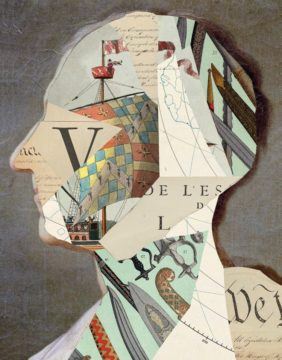
In 1947, Kurt Gödel, Albert Einstein, and Oskar Morgenstern drove from Princeton to Trenton in Morgenstern’s car. The three men, who’d fled Nazi Europe and become close friends at the Institute for Advanced Study, were on their way to a courthouse where Gödel, an Austrian exile, was scheduled to take the U.S.-citizenship exam, something his two friends had done already. Morgenstern had founded game theory, Einstein had founded the theory of relativity, and Gödel, the greatest logician since Aristotle, had revolutionized mathematics and philosophy with his incompleteness theorems. Morgenstern drove. Gödel sat in the back. Einstein, up front with Morgenstern, turned around and said, teasing, “Now, Gödel, are you really well prepared for this examination?” Gödel looked stricken.

To prepare for his citizenship test, knowing that he’d be asked questions about the U.S. Constitution, Gödel had dedicated himself to the study of American history and constitutional law. Time and again, he’d phoned Morgenstern with rising panic about the exam. (Gödel, a paranoid recluse who later died of starvation, used the telephone to speak with people even when they were in the same room.) Morgenstern reassured him that “at most they might ask what sort of government we have.” But Gödel only grew more upset. Eventually, as Morgenstern later recalled, “he rather excitedly told me that in looking at the Constitution, to his distress, he had found some inner contradictions and that he could show how in a perfectly legal manner it would be possible for somebody to become a dictator and set up a Fascist regime, never intended by those who drew up the Constitution.” He’d found a logical flaw. Morgenstern told Einstein about Gödel’s theory; both of them told Gödel not to bring it up during the exam. When they got to the courtroom, the three men sat before a judge, who asked Gödel about the Austrian government.

“It was a republic, but the constitution was such that it finally was changed into a dictatorship,” Gödel said.

“That is very bad,” the judge replied. “This could not happen in this country.”

Morgenstern and Einstein must have exchanged anxious glances. Gödel could not be stopped.

“Oh, yes,” he said. “I can prove it.”

“Oh, God, let’s not go into this,” the judge said, and ended the examination.

More here.

How Intelligent Could Life Be Without Natural Selection?

Arik Kershenbaum in Nautilus:

Natural selection seems, at first glance, to be so frustratingly inefficient. Generation after generation of baby gazelles are born, destined to be eaten by lions. Only by chance is one baby born with longer legs, able to run faster, and so escape being eaten. Of course, the very beauty of natural selection is that it doesn’t require any foresight; natural selection explains life in the universe precisely because there is no presumption of any prior knowledge. No Creator is necessary, because the evolutionary process is guaranteed to proceed even without any predefined rules. Life evolves—albeit slowly—without having to know where it’s going.
But what if it were all different? What would life look like if it did know where it was going?

The 1950s physicist Anatoly Dneprov wrote quirky and characteristically Soviet science fiction. His novel Crabs on the Island tells the story of two engineers conducting an experiment in cybernetics on a deserted island. A single self-replicating robot (a “crab”) is released, and forages for the raw materials to build other robots. Soon the island is overrun with baby robot crabs. But the crabs begin to mutate. Some are larger than others, and ruthlessly cannibalize the smaller robots for spare parts to build even larger robots. How would such an experiment end? Catastrophically, of course, as is consistent with the genre, with robot crabs spreading exponentially across the entire island.

Science fiction can be terribly pessimistic, but that pessimism is unfounded. Other factors are at play. Resources are limited. Eventually, even the crabs on the island run out of materials with which to make new robots. Admittedly, humans have caused tremendous damage to our own planet, but we’ve hardly destroyed the universe. In fact, there’s no indication in the night sky that any organism, biological or artificial, has spread its influence as far and wide as we might expect if they were growing exponentially like robot crabs.

More here.

On Peter Gizzi’s ‘Now It’s Dark’

Terence Diggory at Salmagundi:

An especially mysterious manifestation of the materiality of language in these poems is the projection of voice from, or into, the material world.  Repeatedly, at special moments, things speak:   “the hollyhocks spoke”; “Freezing rain with silver seems to be speaking”; “these colors speak”; “The sky speaks to me”; “The roofs speak”; “the room alive speaks when the corpse speaks…  and the earth speaks”; “the trees and grass are speaking”; “the old sun / is speaking.”  This eruption of voice from things—Gizzi calls it “thinging,”  in a pun on “singing”—seems to mark that recovery of the world that Gizzi associates with elegy in the second “Now It’s Dark” poem. However, in the volume Now It’s Dark,  that recovery is purchased at the price of another loss, that of “the speaking subject,” as it is called in psycholinguistic theory, or the one who says “I,” in the traditional view of lyric poetry.  Drawing on that theory, Language writers accused lyric poetry of escaping into an illusory interior world inhabited by an equally illusory “I.”
more here.

The World’s Oldest Wooden Sculpture

Franz Lidz at the NYT:

The world’s oldest known wooden sculpture — a nine-foot-tall totem pole thousands of years old — looms over a hushed chamber of an obscure Russian museum in the Ural Mountains, not far from the Siberian border. As mysterious as the huge stone figures of Easter Island, the Shigir Idol, as it is called, is a landscape of uneasy spirits that baffles the modern onlooker.

Dug out of a peat bog by gold miners in 1890, the relic, or what’s left of it, is carved from a great slab of freshly cut larch. Scattered among the geometric patterns (zigzags, chevrons, herringbones) are eight human faces, each with slashes for eyes that peer not so benignly from the front and back planes.

The topmost mouth, set in a head shaped like an inverted teardrop, is wide open and slightly unnerving.

more here.

Sunday, March 21, 2021

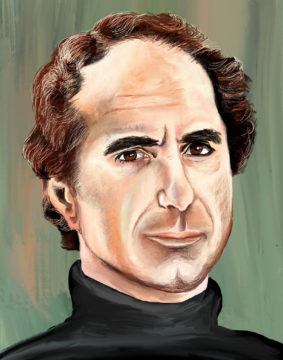
Philip Roth drew and smudged and drew again the line between life and art, and with every book it became harder to distinguish between them

Michael Gorra in the New York Review of Books:

Philip Roth; illustration by Johnalynn Holland

Let’s begin with the body, the corpus to which this six-foot-two lefty was bound. Start with his back. In 1955 he pulled a shift of KP on his last day of basic training and met an industrial-size kettle of potatoes. Hefting it was a two-man job, but the other soldier dropped his end and left him to support its weight alone. Something popped, and the next morning he could barely walk. Try a heating pad, they told him, and an army doctor accused him of malingering. It was never really treated, and the pain never went entirely away. He used a steel back brace for a while, and in the 1970s he sometimes needed a foam neck collar; from middle age on he had to work at a standing desk, spelling himself with long periods of lying on the floor. Only in 2002 did he accept the need for surgery, but by then one disk after another had so fully degenerated that there wasn’t much left to save.

More here.

Humans evolved to run on less water than our closest primate relatives

Robin A. Smith in Duke Today:

When you think about what separates humans from chimpanzees and other apes, you might think of our big brains, or the fact that we get around on two legs rather than four. But we have another distinguishing feature: water efficiency.
That’s the take-home of a new study that, for the first time, measures precisely how much water humans lose and replace each day compared with our closest living animal relatives.

Our bodies are constantly losing water: when we sweat, go to the bathroom, even when we breathe. That water needs to be replenished to keep blood volume and other body fluids within normal ranges.

And yet, research published March 5 in the journal Current Biology shows that the human body uses 30% to 50% less water per day than our closest animal cousins. In other words, among primates, humans evolved to be the low-flow model.

More here.

The Anarchist Abstractionist — Who was Alexander Grothendieck?

Jørgen Veisdal in Cantor’s Paradise:

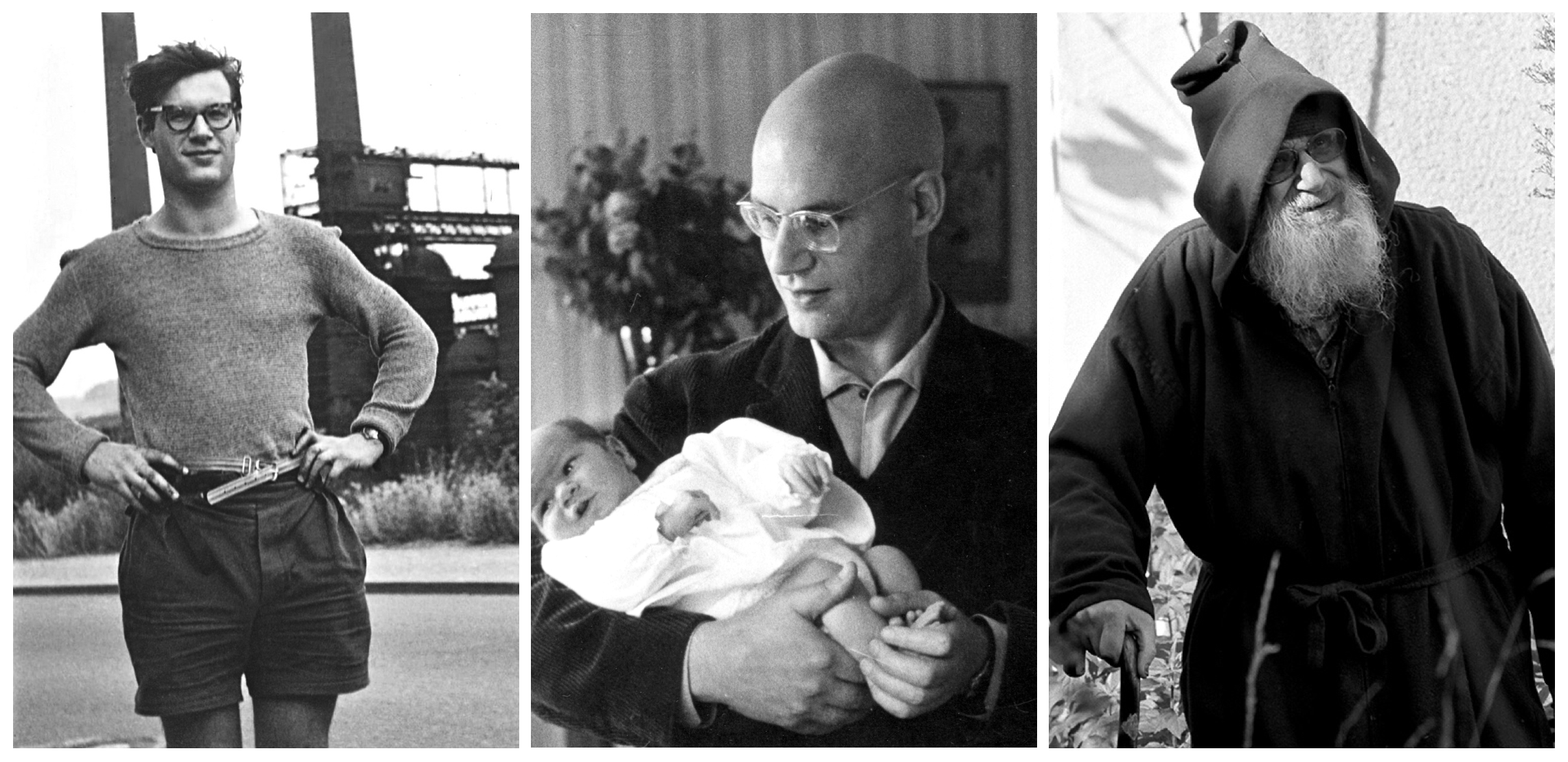
Mathematician Alexander Grothendieck was born in 1928 to anarchist parents who left him to spend the majority of his formative years with foster parents. His father was murdered in Auschwitz. As his mother was detained, he grew up stateless, hiding from the Gestapo in occupied France. All the while, he taught himself mathematics from books and before his twentieth birthday had re-discovered for himself a proof of the Lebesgue measure, a staple of integration theory. Later a rising star in the hot-shot French mathematical milieu of 1950s and 60s, Grothendieck would in his “golden years” from 1955–1970 move from subject to subject, introducing revolutionary new ideas as he went along:
“This just kept happening over and over again, where he would come upon some problem that people had thought about for, in some cases, a hundred years […] and just completely transformed what people thought the subject was about” — Nick Katz, Princeton University

In 1966 he was awarded the Field’s Medal, mathematics’ highest honour for his contributions to algebraic geometry, homological algebra, and K-theory. Four years later, he famously abandoned his professorship at the “French Institute for Advanced Study” for political reasons. Indeed, he left mathematics altogether in 1991 to instead live in seclusion in a remote village at the foot of the Pyrenees Mountains. Rarely ever seen or heard from since, he spent the last twenty-three years of his life in isolation, refusing to communicate with anyone, at times attempting to sustain himself on “a diet of dandelion soup” while writing thousands upon thousands of pages of text on spirituality and a “coming day of reckoning”.

This is the story of Alexander Grothendieck, perhaps the most technically gifted mathematician of the twentieth century.

More here.

A Big Fiscal Push is Urgent, The Risk of Overheating Is Small

Claudia Sahm over at INET:

The $1.9 trillion relief package is on track to pass in March but not without a struggle and with some important details still uncertain. The price tag is big, coming on the heels of the nearly $4 trillion Congress appropriated last year. That’s six times the fiscal relief in the first two years of the Great Recession. Even without the new package, the U.S. federal debt is more than GDP, according to the Congressional Budget Office, a level not seen since World War II.

With the stakes so high, disagreement among economists, even those who normally agree with each other, is heated. The question is whether spending at this level is necessary for full recovery or will instead overheat the economy. It appears that the inflation hawks have lost this skirmish, but the war is only getting started.

In the ranks of the inflation hawks are many revered macroeconomists. Most vocal are Larry Summers, a former Secretary of the Treasury, and Olivier Blanchard, a former Chief Economist at the International Monetary Fund. John TaylorGreg Mankiw, and Bill Dudley have raised similar concerns. On the other side are Janet Yellen, current Secretary of the Treasury, Jay Powell, current Chair of the Federal Reserve, Paul Krugman, a past Nobel Prize winner, and Gita Gopinath, the current Chief Economist at the International Monetary Fund, among others.

More here.

Sunday Poem

I asked myself about the present: how wide it was,
how deep it was, how much was mine to keep.

……………………………… -Kurt Vonnegut

Hiking in the Anthropocene

I read the forest’s memoirs leaf by leaf,
trace each tree’s veins branch by branch,

my skin parched for its poetry. I want
nothing but to reside here in the quiet,

the dappled light of a hidden cove,
the sweet, secret sound of solitude

on the side of a mountain. Far above
the fray, the floodwaters, the rushing

cold calamity in the callous void of
conservation, the total lack of self-

preservation or empathy for earth.
Swaddlings losing our wrappings, we

swirl in eddies spawned by our chaotic,
collective flailing. The flood’s fingerprint

etched in judgement, in memoriam, on
the mountain’s moss-cloaked cheek.

by V.C. McCabe
from
The Echotheo Review

The Making of Edward Said’s ‘Orientalism’

Timothy Brennan in The Chronicle of Higher Education:

Now an academic classic, Orientalism was at first an unlikely best seller. Begun just as the Watergate hearings were nearing their end and published in 1978, it opens with a stark cameo of the gutted buildings of civil-war Beirut. Then, in a few paragraphs, readers are whisked off to the history of an obscure academic discipline from the Romantic era. Chapters jump from 19th-century fiction to the opéra bouffe of the American news cycle and the sordid doings of Henry Kissinger. Unless one had already been reading Edward Said or was familiar with the writings of the historian William Appleman Williams on empire “as a way of life” or the poetry of Lamartine, the choice of source materials might seem confusing or overwhelming. And so it did to the linguists and historians who fumed over the book’s success. For half of its readers, the book was a triumph, for the other half a scandal, but no one could ignore it.

As an indictment of English and French scholarship on the Arab and Islamic worlds, Orientalism made its overall case clearly enough. The field of Oriental studies had managed to create a fantastical projection about Arabs and Islam that fit the biases of its Western audience. At times, these images were exuberant and intoxicating, at times infantilizing or hateful, but at no time did they describe Arabs and Muslims accurately. Over centuries, these images and attitudes formed a network of mutually reinforcing clichés mirrored in the policies of the media, the church, and the university. With the authority of seemingly objective science, new prejudices joined those already in circulation. This grand edifice of learning deprived Arabs of anything but a textual reality, usually based on a handful of medieval religious documents. As such, the Arab world was arrested within the classics of its own past. This much about Orientalism, it seems, was uncontroversial, although readers agreed on little else.

More here.

How to End a Conversation Without Making Up an Excuse

Joe Pinsker in The Atlantic:

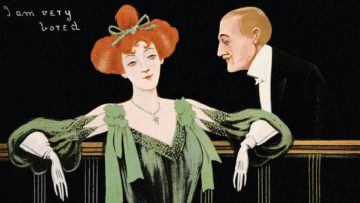
A vintage French postcard illustration featuring a sophisticated, stylishly-attired mature couple seated on opposite sides of a banquette, in Paris, circa June, 1909. (Photo by Paul Popper/Popperfoto via Getty Images)

Later this year, if all goes well, Americans will be awash in social interactions again. At offices and schools, on sidewalks and in coffee shops, we’ll be bumping into one another like it’s 2019. The resulting flood of conversations will be extremely welcome. But less front of mind, at this still socially stifled moment, are the awkwardness and discomfort that will return along with day-to-day interactions. The co-worker who yammers on, the chatty subway seatmate who keeps you from reading your book, the friend of a friend who bores you at parties—they are all very excited to see you again, and have lots to catch you up on.

Perhaps this period before social life fully resumes is an occasion to revisit what we want from conversations and, more to the point, how we end them. In this regard, people generally have a poor sense of timing. “Conversations almost never ended when both conversants wanted them to,” concluded the authors of a study published earlier this month that asked people about recent interactions with loved ones, friends, and strangers. About two-thirds of them said they wanted the conversation to end sooner; on average, that group wanted the conversation to be about 25 percent shorter, Adam Mastroianni, a psychology doctoral student at Harvard and a co-author of the study, told me.

More here.

Saturday, March 20, 2021

COVID-19 is here to stay. Now we must redesign our economies around it.

James Meadway in OpenDemocracy:

The demand for zero COVID rightly sets a high bar for the current lockdown conditions, insisting on working towards the virtual elimination of COVID in Britain. It is critical that, unlike the experience last year, lockdown is not ended too soon. Aiming not only to “protect the NHS”, as is still the aim of government, but to reduce infections to near-zero would place this country (like any other) in a far better place, post-lockdown, than it was in following the first or second lockdown. It is also undeniable that the countries that went in hard against the virus early on, have been reaping the benefits – from Vietnam and Taiwan to New Zealand and Australia.

But it would be a major error to think that zero COVID is a permanent solution to the crisis we are now in. The Left and progressives absolutely must not become enthusiasts for lockdown: it is a terrible necessity, not some desirable point to get to. We should no more be cheering for this than we would cheer for war – a war may well be necessary at some point, but it’s hardly something to be called for gladly. The fact is that we have a terrible disease to deal with, and have to do so in a way that minimises death and illness from the disease – but also, importantly, from how we deal with the disease.

The cost of lockdowns is high: not because Gross Domestic Product takes a knock, or because the government has to borrow money, but because of the strains on mental health, on children’s education, or in the sharp rise in reported domestic violence cases. We should aim to minimise the costs of COVID, but we then need to also minimise the costs of lockdown. This means looking to leave this lockdown at an appropriate point, and acting now to never return to lockdown again.

More here.

Thanks for all the fish

Thomas Moynihan in Aeon:

The year is 1961. As Cold War tensions crescendo, an American neuroscientist named John C Lilly makes a bold claim. He announces that he has made contact with the first ‘alien’ intelligence. But Lilly wasn’t talking about little green men from Tau Ceti, he was talking of minds much closer to home: bottlenose dolphins.

Lilly had spent the previous decade hammering electrodes through animals’ craniums, attempting to map the reward systems of the brain. Having started probing the grey matter of macaques, he was shocked when he acquired some dolphins to test upon. Swiftly, he became convinced of their smarts. Upon hearing dolphins seemingly mimic human vocalisations – in their ‘high-pitched, Donald Duck, quacking-like way’ – he became certain that they also spoke to each other in ‘dolphinese’.

Lilly was the first to really demonstrate how socially intelligent these beings are. Of course, others had long made similar claims. Ancient Greek authors celebrated the nobility and philanthropy of the cetacean, recounting tales of human-dolphin companionship. But, in the modern era, the aquatic mammal fell into disrepute. One 19th-century captain referred to them as ‘warlike and voracious’. In 1836, the French zoologist Frédéric Cuvier remarked on this fall from benevolent angel to carnivorous brute, deeming the wild dolphin a ‘stupid glutton’. But, given their prodigious brains, he was certain of the potential for intelligence. They have no natural competition, thus they have no need to cultivate their intellect. Venturing that humans raised in the same state would also be feral, Cuvier suggested that we civilise dolphins – thereby unleashing their potential for rationality.

More here.

A Proudhon for Postmoderns?

Alexander Zevin in New Left Review:

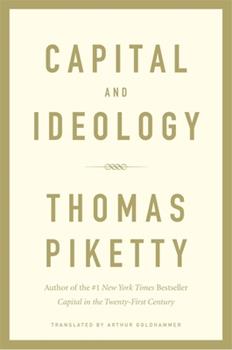
The arrival of Piketty’s latest work, Capital and Ideology, prompts a comparison with another French thinker, who also won widespread fame for a generic attack on inequality published at a time of profound economic crisis. In 1840, Pierre-Joseph Proudhon’s What Is Property? rebutted claims that the answer ‘It is theft!’ was the signal for another 1793. The proposition should be ‘recognized as a lightning rod to shield us from the coming thunderbolt’, he wrote, just as Piketty hoped his warnings that rising levels of inequality in the 21st century could be incompatible with democratic values would produce tax reforms to fend off violent upheavals comparable to those that put an end to the Belle Époque.

Mutatis mutandis, of course. For the journeyman printer, born into a family of Besançon peasants and small-traders, going barefoot to school, read: the son of ex-Trotskyist soixante-huitards, growing up in the leafy Parisian suburb of Clichy Hauts-de-Seine. For La Voix du Peuple, the World Incomes Database; for imprisonment at the Conciergerie, chairs at the lse, Berkeley and ehess; for the people’s bank, the global tax on capital. Proudhon’s pamphlet was also a slower burn than Capital in the Twenty-First Century. It took two years before scandal, prosecution and counter-polemic elevated What Is Property? to international notoriety, hailed as a ‘penetrating work’ in Marx’s paper, the Neue Rheinische Zeitung. When they met in Paris, the young German radicals did their best to educate Proudhon in political economy and the dialectic. In response, six years later, he produced the two fat volumes of his System of Economic Contradictions, or Philosophy of Poverty—drawing from Marx the stinging Poverty of Philosophy. Later, Marx would laughingly chastise himself for having infected Proudhon with Hegelianism—‘for his “sophistication”, as the English call the adulteration of commercial goods.’

More here.

This Veil of Smoke

Erica Eisen in Boston Review:

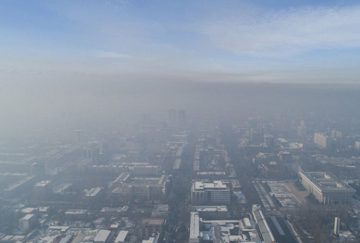
Stepping out of my apartment building in southern Bishkek one cold November morning in 2019, I was met with a smell that I immediately recognized as fire. I had grown up in southern California, remembered drought-spawned chaparral blazes that would leap over highways and engulf whole tracts of housing, closing schools for a week at a time as waves of people fled for the safety of the coast. I remembered a red sun, a grey sky, a rain of ash, and above all else the acrid smell that closed around me now.

But scrolling through news site after news site revealed nothing: no warehouse gone up in smoke, no stray spark from an electrical wire. The men and women who walked past me did so unhurriedly, without panic, seeming not to register the scent of the air, the smudgy sky. Still unsure, I crossed the street to the weekend bazaar, which bustled as usual with butchers, fishmongers, vegetable sellers all calmly bagging produce and doling out change. I picked some potatoes from a tarp, some carrots from a cardboard box. When I returned home I realized that the smell was on my clothes, my hair, my skin. In the ensuing hours and days it would come to leak into the apartment itself, and then I stopped noticing it, and life, as it always does, went on.

More here.