
Category: Archives
Brain wifi
Johnjoe McFadden in Aeon:
 Some 2,700 years ago in the ancient city of Sam’al, in what is now modern Turkey, an elderly servant of the king sits in a corner of his house and contemplates the nature of his soul. His name is Katumuwa. He stares at a basalt stele made for him, featuring his own graven portrait together with an inscription in ancient Aramaic. It instructs his family, when he dies, to celebrate ‘a feast at this chamber: a bull for Hadad harpatalli and a ram for Nik-arawas of the hunters and a ram for Shamash, and a ram for Hadad of the vineyards, and a ram for Kubaba, and a ram for my soul that is in this stele.’ Katumuwa believed that he had built a durable stone receptacle for his soul after death. This stele might be one of the earliest written records of dualism: the belief that our conscious mind is located in an immaterial soul or spirit, distinct from the matter of the body.
More than 2 millennia later, I was also contemplating the nature of the soul, as my son lay propped up on a hospital gurney. He was undertaking an electroencephalogram (EEG), a test that detects electrical activity in the brain, for a condition that fortunately turned out to be benign. As I watched the irregular wavy lines march across the screen, with spikes provoked by his perceptions of events such as the banging of a door, I wondered at the nature of the consciousness that generated those signals.
Just how do the atoms and molecules that make up the neurons in our brain – not so different to the bits of matter in Katumwa’s inert stele or the steel barriers on my son’s hospital bed – manage to generate human awareness and the power of thought? In answering that longstanding question, most neurobiologists today would point to the information-processing performed by brain neurons. For both Katumuwa and my son, this would begin as soon as light and sound reached their eyes and ears, stimulating their neurons to fire in response to different aspects of their environment. For Katumuwa, perhaps, this might have been the pinecone or comb that his likeness was holding on the stele; for my son, the beeps from the machine or the movement of the clock on the wall.
More here.
Let Us Now Praise Tiny Ants
Brooke Jarvis in The New York Times:
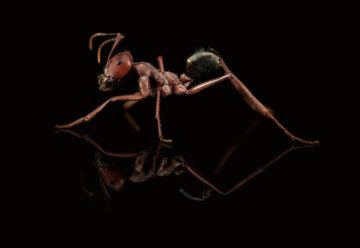 It is telling, the entomologist Eleanor Spicer Rice writes in her introduction to a new book of ant photography by Eduard Florin Niga, that humans looking downward on each other from great heights like to describe the miniaturized people we see below us as looking “like ants.” By this we mean faceless, tiny, swarming: an indecipherable mass stripped of individuality or interest. Intellectually, though, we can recognize that each scurrying dot is in fact a unique person with a complicated and interconnected life, even if distance appears to wipe away all that diversity and complexity. So then why, Dr. Rice asks, don’t we apply the same logic to the ants we’re comparing ourselves to?
We share our world with at least 15,000 unique species of ants — although this is surely an underestimate, as we have no way to count the number of species still unknown to science. It is hard to express how ubiquitous they are. If you were to put all the animal life in a Brazilian rainforest on a scale, more than one-quarter of the weight would come just from ants. Even the sidewalks of New York City — where pedestrians walk unknowingly above armies of pavement ants that undertake huge, deadly turf wars each spring, dismembering each other in epic battles for territory — are teeming. One study found an average of 2.3 ant species on a given city median, doing the invisible work of making fallen potato chips and hot dogs disappear by the pound. Even in our densest habitations, there are orders of magnitude more of them than there are of us.
More here.
Tuesday Poem
Under One Small Star
My apologies to chance for calling it necessity.
My apologies to necessity if I’m mistaken, after all.
Please, don’t be angry, happiness, that I take you as my due.
May my dead be patient with the way my memories fade.
My apologies to time for all the world I overlook each second.
My apologies to past loves for thinking that the latest is the first.
Forgive me, distant wars, for bringing flowers home.
Forgive me, open wounds, for pricking my finger.
I apologize for my record of minuets to those who cry from the depths.
I apologize to those who wait in railway stations for being asleep today at five a.m.
Pardon me, hounded hope, for laughing from time to time.
Pardon me, deserts, that I don’t rush to you bearing a spoonful of water.
And you, falcon, unchanging year after year, always in the same cage,
your gaze always fixed on the same point in space,
forgive me, even if it turns out you were stuffed.
My apologies to the felled tree for the table’s four legs.
My apologies to great questions for small answers.
Truth, please don’t pay me much attention.
Dignity, please be magnanimous.
Bear with me, O mystery of existence, as I pluck the occasional thread from your train.
Soul, don’t take offense that I’ve only got you now and then.
My apologies to everything that I can’t be everywhere at once.
My apologies to everyone that I can’t be each woman and each man.
I know I won’t be justified as long as I live,
since I myself stand in my own way.
Don’t bear me ill will, speech, that I borrow weighty words,
then labor heavily so that they may seem light.
by Wislawa Szymborska
from View With a Grain of Sand
Harcourt Brace, 1993
Milford Graves & Don Pullen – Nommo
The Making of Billy Wilder
Noah Isenberg at The Paris Review:
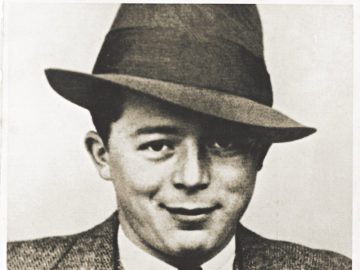 Although Wilder père had other plans for his son—a respectable, stable career in the law, an exalted path for good Jewish boys of interwar Vienna—Billie was drawn, almost habitually, to the seductive world of urban and popular culture and to the stories generated and told from within it. “I just fought with my father to become a lawyer,” he recounted for the filmmaker Cameron Crowe in Conversations with Wilder: “That I didn’t want to do, and I saved myself, by having become a newspaperman, a reporter, very badly paid.” As he explains a bit further in the same interview, “I started out with crossword puzzles, and I signed them.” (Toward the end of his life, after having racked up six Academy Awards, Wilder told his German biographer that it wasn’t so much the awards he was most proud of, but rather that his name had appeared twice in the New York Times crossword puzzle: “once 17 across and once 21 down.”)
more here.
Paranoia’s Pleasures
Zoë Hu at The Believer:
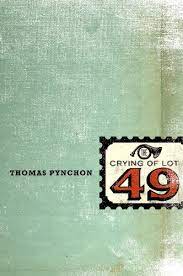 I am a paranoid person, which, if we’re not going to be fussy about clinical definitions, means I feel a constant unreasonable fear, one ruled by no overarching logic or taxonomy. I am paranoid about my relationships and my work. I am paranoid about rising sea levels, air pollutants, tap water, dark parking lots, and the back seat of my car. I am paranoid about whether I’ve locked the door—really, properly locked the door. I experience frequent bouts of paranoia in regards to the men in my life—what do they get up to when I’m not around?—as well as to many men I do not know. I realize I don’t look like the paranoid type, which is culturally coded as someone white and male, so I am also paranoid about other paranoiacs, what they make of my face and my monosyllabic last name.
In other words, I am fixated on what I must regularly confront yet cannot control. It is a very human condition, if not the human condition. Philip K. Dick once said that “the ultimate in paranoia is not when everyone is against you but when everything is against you.”
more here.
Sunday, April 4, 2021
Would the Pandemic Stop Paul Theroux From Traveling? No
Gal Beckerman in the New York Times:
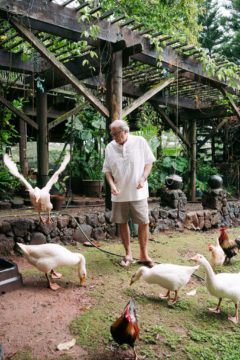 Theroux turns 80 in April. For a generation of backpackers now gone gray, the tattered paperback accounts of his treks through China, Africa and South America were a prod to adventure, bibles of inspiration under many a mosquito net. He has a new novel out from Houghton Mifflin Harcourt in April, “Under the Wave at Waimea,” and his best-known book (and his own favorite among them), “The Mosquito Coast,” has been adapted into a television series starring his nephew, Justin Theroux, also set to premiere next month.
If this seems like a moment to take stock of an intrepid life and an almost extreme output of writing, Theroux does not see himself as anywhere near done. Before Covid-19 struck, he had plans to go to central Africa. He is deep into another novel and finishing up a new story collection. He himself can’t seem to keep track of the number of books he has written: “Fifty-something maybe?” (It’s actually 56.)
More here.
Sunday Poem
The Where in My Belly
Scientists say my brain and heart
are 73 percent water—
they underestimate me.
A small island—minis, I emerged
among Minnesota’s northern lakes,
the where of maanomin—wild rice in my belly.
I am from boats and canoes and kayaks,
from tribal ghosts who rise at dawn
dance like wisps of fog on water.
My where is White Earth Nation
and white pine forests,
knees summer stained with blueberries,
pink lady slippers open and wild as my feet.
I grew up where math was Canasta,
where we recited times tables
while ice fishing at twenty below,
spent nights whistling to Northern Lights.
I am from old: medicines barks and teas;
from early—the air damp with cedar
the crack of amik, beaver tails on water.
Their echo now a warning to where—
to where fish become a percentage of mercury,
become a poison statistic;
to where copper mines back against
a million blue acres of sacred.
I am from nibi and ogichidaakweg
women warriors and water protectors, from seed
gatherers and song makers.
The wet where pulse in my belly whispers and repeats
like the endless chant of waves on ledgerock
waves on ledgerock on ledgerock on waves
on water. . .nibi
by Kimberly Blaeser
From Split This Rock
Listen as Kimberly Blaeser reads “The Where in My Belly”.
Malcolm Cecil (1937 – 2021)
Constance Demby (1939 – 2021)
Freddie Redd (1928 – 2021)
A Black Army Rises to Fight the Racist Right
Graeme Wood in The Atlantic:
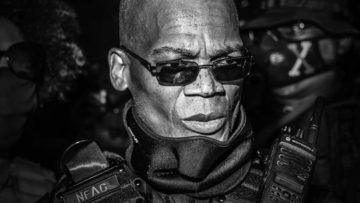
When grandmaster jay walked into Million’s Crab, a seafood joint in suburban Cincinnati, the waitstaff looked alarmed. Million’s Crab is a family restaurant, and on that placid November evening, Jay—the supreme commander of the Not Fucking Around Coalition—was wearing body armor rated to take a pistol round directly to the chest. Dressed from mask to shoes in black, he was four hours late to our meeting, and remorseless. “My time is scarce,” he said, making aggressive eye contact. Indeed, of the two of us, I was the one who felt sheepish, not because I was wasting his time but because it occurred to me that while I waited, I could have warned the servers that my dining companion was often armed and that he might look as if he had just stepped out of The Matrix. He sat across from me, in front of a platter of scallops and shrimp that had been hot when I’d ordered it for him an hour before, when the kitchen was closing. I offered him a plastic bib, which he declined. He wouldn’t eat any food, but he requested a San Pellegrino or, in its absence, filtered tap water.
Grandmaster Jay’s group, the NFAC, is a Black militia whose goals, other than to abjure Fucking Around, are obscure. It has a militarylike structure, fields an army of hundreds of heavily armed men and women, subscribes to esoteric racist doctrines, opposes Black Lives Matter, and follows a leader who thinks we live in a period of apocalyptic tribulation signaled by the movements of celestial bodies. Its modus operandi is to deploy a more fearsome Black militia wherever white militias dare to appear. Eventually, it intends to establish a racially pure country called the United Black Kemetic Nation. (“Kemet,” Jay explained, “is the original name of Egypt, which means ‘land of the Blacks.’”) A patch on Grandmaster Jay’s body armor bore the new nation’s initials, UBKN.
More here.
History’s best comebacks, from Jesus to John Travolta
Matthew Sweet in 1843 Magazine:
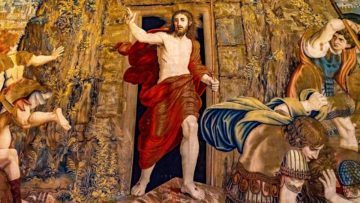 It’s not an age thing. Jesus was in his 30s when he rolled aside the stone from his tomb for Western culture’s foundational did-you-miss-me? moment. Gloria Swanson was 51 when she inhabited the forgotten body of silent-film star Norma Desmond and vogued down the staircase in “Sunset Boulevard”. That’s younger than Naomi Campbell is now. Why do some comebacks inspire and others appal? The best don’t erase the absence that made them possible or ignore its attendant trauma. When Elvis returned to live touring in 1968, audiences went wild for his exertions as much as his voice, and snatched the sweat-damp towels he tossed in their direction. When Monica Seles returned to tennis two years after a man had stabbed her with a nine-inch knife during a game, the crowd cheered her physical and mental victory over her attacker.
The Son of God fits this pattern too. Scourged, crucified, murdered, He returns in a shape fit for ascent to heaven. No more fieldwork, no more lecturing, no more miraculous catering, only the hereafter. And, we’re assured, it’s not just about Him. If we live the right kind of life, we get to do this too. When the band you loved as a teenager proves it can still fill a stadium, or an actor with whom you shared your youth comes back for a second act, it inspires and consoles. Comebacks suggest that the world is not, as some medieval scholars thought, a body in decay; that life isn’t a process of loss or dilution governed by the second law of thermodynamics. We look at the flowers rising in the parks and gardens, and think ourselves green again.
More here.
A Mathematician with No Job and No Home: Paul Erdős
Areeba Merriam in Cantor’s Paradise:
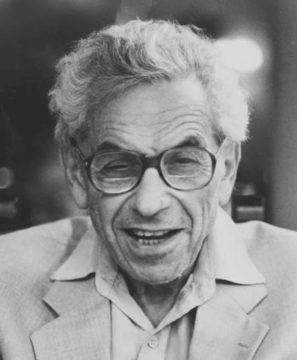 Hungarian-born Paul Erdős (1913–1996) was a legendary mathematician of the 20th century. He is famous for having published more research papers than anyone since Euler. Both of his parents used to teach mathematics.
At 16, his father made him familiar with two of his lifetime favorite subjects; set theory and infinite series. Erdős always remembered his parents with great affection and love. At 17, he started university in Budapest then he left for the US during the pre-war years. At 20, he was successful in constructing an elegant proof of famous Bertrand’s postulate in number theory. It stated, “for every number greater than 1, there always exists at least one prime between it and it’s double”.
His work spread across many fields including discrete mathematics, graph theory, mathematical analysis, approximation theory, set theory, and probability theory. He contributed mainly to the branch of combinatorics known as the Ramsey theory. Much of his research centered around cracking formerly unsolved and open problems of the field, rather than constructing new areas in mathematics.
More here.
Richard King on Meritocracy
Richard King in the Sydney Review of Books:
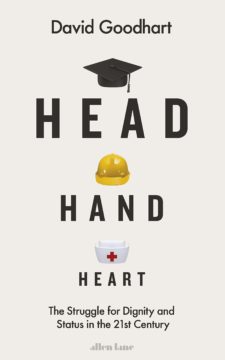 One would have to be a nihilist, of course, not to wish for an end to a pandemic that has claimed well over two and a half million lives. But for those of us interested in ‘interesting times’, and in the opportunities they open up, the global response to COVID-19 has not been without its political excitements. For the second time in twelve years governments around the world moved to underwrite a system that claims to need no government underwriting, with the result that many of the irrationalities of capitalism were thrown into relief. As incomes withered, or dried up completely, many people came to resent the extent to which their lives were governed by non-productive ownership – by rents and mortgages, principally, the profits from which are hoovered up by a parasitic property system and the financiers who sit atop it. At the same time, the invisible hand of the market was shown to be irrelevant to the needs of a society in crisis, while the speed with which the economy tanked, on the back of a dip in discretionary spending, revealed the basic absurdity of a system predicated on consumer choice.
Then there was the really important stuff.
More here.
Torture Is the Nasty Center of the 9/11 Case at Guantánamo
Lisa Hajjar in Markaz Review:
 Since 2010, I have been to Guantánamo 13 times. I can’t go as a scholar conducting research or a concerned citizen, so I go as a journalist. When I tell people that I am heading off to Guantánamo, responses tend to range from bafflement to curiosity. Highly educated and politically-aware acquaintances have said things like: “oh, I forgot that place was still open” and “what’s going on there these days?” The symbolic nadir of the US “war on terror” has faded in popular consciousness without actually fading away. Guantánamo is still open, and one of the things going on there (although disrupted, like everything else, by the global Covid pandemic) is the military commission case against five men charged with plotting the terrorist attacks of September 11, 2001. Those attacks triggered the “war on terror” which is now approaching its twentieth anniversary. The 9/11 case, which started in 2008 and then restarted in 2011, was supposed to provide justice for the thousands of people killed on that terrible day.
More here.
Saturday, April 3, 2021
Time: Philosophy & Physics (Bernard Williams – 1973)
https://www.youtube.com/watch?v=NKVFXKGVWkg
On Sophie Calle
Alice Blackhurst at n+1:

photographed and edited by Claire Dorn
IN 2017, amid the peak of #balancetonporc, France’s equivalent #MeToo movement, record-breaking crowds of women, keen for an experience of communal catharsis, passed through Sophie Calle’s Beau doublé, Monsieur le marquis!—perhaps as foil against the somber cultural malaise elsewhere. The exhibition, a collaboration between Calle and artist Serena Cocone, was hosted at the Musée de la Chasse et de la Nature, in Paris, where among taxidermy wild animals and a fetishist’s array of hunting armory, a selection of Calle’s previous projects, including excerpts from the ongoing text work Des histoires vraies (True Stories) and her 1981 piece La Filature (The Shadow), were reactivated alongside new ones. What might have been an unusual location for the work of an internationally acclaimed artist whose brand chords more with the starry entourages of Fashion Week than with dusty 18th-century archives was, in this case, perfectly apt: Calle, who in Suite vénitienne (one of her earliest works) followed a male acquaintance to Venice on a whim after a brief conversation at a cocktail party, has remained committed throughout her career to exposing and subverting the dynamics of the “chase” that patterns heterosexual life. In a minimally furnished room on the second floor, two new, inter-related series, Le chasseur français (The French hunter) and A l’espère (Lying in wait for), scoured these themes of carnal conquest once more.
more here.
Schumpeter on Democracy
David Runciman on Schumpeterian Democracy.