In Praise of Native Americanism

Justin E. H. Smith in Tablet:
In Call Me Ishmael, Charles Olson’s magnificent 1947 study of Herman Melville’s Moby-Dick, the American poet writes: “I take SPACE to be the central fact to man born in America.” Using a common alternative title for the 1851 novel, Olson compares it to Walt Whitman’s self-published paean to his country: “The White Whale is more accurate than Leaves of Grass. Because it is America, all of her space, the malice, the root.”

For many years, I took Moby-Dick to be American only by technicality: Virtually all of the story takes place on the high seas, with a multiethnic mix of characters; the voice of the author seems more at home in the broader North Atlantic maritime Anglo-Hibernian realm, which by some measures reaches down from Nova Scotia as far south as Cape Cod, than in the depths of the American continent itself.

Melville’s true epitome of America, it seemed to me, was not Moby-Dick, but The Confidence-Man of 1857. This novel, whose events unfold almost entirely in the cramped rooms of a steamboat on the Mississippi River, is as claustrophobic as Moby-Dick is expansive, and as conducive to contraction and paranoia as its predecessor is to the free-ranging and unbounded assertion of will.

More here.

AI Designs Quantum Physics Experiments Beyond What Any Human Has Conceived

Anil Ananthaswamy in Scientific American:

Quantum physicist Mario Krenn remembers sitting in a café in Vienna in early 2016, poring over computer printouts, trying to make sense of what MELVIN had found. MELVIN was a machine-learning algorithm Krenn had built, a kind of artificial intelligence. Its job was to mix and match the building blocks of standard quantum experiments and find solutions to new problems. And it did find many interesting ones. But there was one that made no sense.


“The first thing I thought was, ‘My program has a bug, because the solution cannot exist,’” Krenn says. MELVIN had seemingly solved the problem of creating highly complex entangled states involving multiple photons (entangled states being those that once made Albert Einstein invoke the specter of “spooky action at a distance”). Krenn, Anton Zeilinger of the University of Vienna and their colleagues had not explicitly provided MELVIN the rules needed to generate such complex states, yet it had found a way. Eventually, he realized that the algorithm had rediscovered a type of experimental arrangement that had been devised in the early 1990s. But those experiments had been much simpler. MELVIN had cracked a far more complex puzzle.

More here.

China and the Lure of Global Capitalism

Macabe Keliher in the Boston Review:

In September 1793, British envoy Lord Macartney was given a tour of the Qing summer palace north of Beijing. Earlier in his trip he presented the Qianlong emperor with gifts of two enameled watches of “very fine workmanship,” a telescope, Birmingham sword blades, and fine British clothes, among other items meant to awe the aging monarch with the superiority of British technology and manufacturing and convince him to sign a trade agreement.
When the emperor’s personal assistant and two of the Qing’s most decorated generals led him around buildings filled with treasures and mechanical devices, however, Macartney was aghast. “The pavilions are all furnished in the richest manner,” he wrote, “with spheres, orreries, clocks, and musical automatons of such exquisite workmanship, and in such profusion, that our presents must shrink from the comparison and ‘hide their diminished heads.’” Nor was the emperor impressed: he sent Macartney back with a stern reply to King George, “As your Ambassador can see for himself, we possess all things . . . and have no use for your country’s manufactures.”

More here.

‘Highly Irregular’ Review: An Eloquent Confusion

Henry Hitchings in The Wall Street Journal:

My daughter recently remarked, over breakfast in a cafe, that the customers, rather than the serving staff, should be known as waiters. Then she removed the mantle of cheese from my side order of hash browns and pointed out that these too were poorly named, since they were actually a shade of yellow. She is 3 years old—and though the assertive mode mostly trumps the interrogative, lately she has started asking tough questions about the English language.

If the plural of “mouse” is “mice,” shouldn’t we refer to our neighbors living in “hice”? Can we really make up a story, a face, a magic potion and lost time, and also make up after a quarrel? Soon she will want to know why “of,” unlike other words ending with an “f,” sounds as though it ends with a “v.” From there it will be a short leap to laughing at the “l” in “salmon” and wondering by what strange process, linguistic as well as gastronomic, we ended up with “molten lava cake, laden with melted chocolate.”

…In bite-size chapters, with pungent titles such as “Why Do Noses Run and Feet Smell?,” Ms. Okrent investigates more or less familiar questions: Is the letter “y” a vowel or a consonant? What does it mean to say that the exception “proves” the rule? Why does English have so many synonyms? She also ponders whether “I am woe” would be better than “woe is me”; what egging someone on has to do with eggs; and why we don’t tell a restaurant server, “I’m a large spender. Make it a big pizza.”

More here.

What We Get Wrong About America’s Crisis of Democracy

Adam Gopnik in The New Yorker:

Readers of “Through the Looking-Glass” may recall the plight of the Bread-and-Butterfly, which, as the Gnat explains to Alice, can live only on weak tea with cream in it. “Supposing it couldn’t find any?” Alice asks. “Then it would die, of course,” the Gnat answers. “That must happen very often,” Alice reflects. “It always happens,” the Gnat admits, dolefully.
How the Bread-and-Butterfly survives, given the impossible demands of its diet, is a nice question. Lewis Carroll was in part teasing Darwinian ideas, which depend on a struggle for existence in which, eventually, we all lose—nonexistence being the norm of living things, over time. But the plight of the Bread-and-Butterfly comes to mind, too, when we contemplate what is called, not without reason, America’s crisis of democracy. It always happens. We are told again and again that American democracy is in peril and may even be on its deathbed. Today, after all, a defeated yet deranged President bunkers in the White House contemplating crazy conspiracy theories and perhaps even martial law, with the uneasy consent of his party and the rabid support of his base. We are then told, with equal urgency, that what is wrong, ultimately, is deep, systemic, and Everybody’s Fault. Perhaps there is a crisis of meaning, or of spirit; perhaps it is a crisis caused by the condescension of self-important élites. (In truth, those élites tend to be at least as self-lacerating as they are condescending, as the latest rounds of self-laceration show.)

Lurking behind all of this is a faulty premise—that the descent into authoritarianism is what needs to be explained, when the reality is that . . . it always happens. The default condition of humankind is not to thrive in broadly egalitarian and stable democratic arrangements that get unsettled only when something happens to unsettle them. The default condition of humankind, traced across thousands of years of history, is some sort of autocracy.

More here.

Sunday Poem

Endling

There’s a man who cares
for the last snail of its kind,

Achatinella apexfulva, knows precisely
how much moisture, shade and light

it needs to thrive while it spends
its dwindling time in a glass cabinet.

Don’t think about what you can start,
think about what you can end was the advice

I heard on a time management podcast
while slicing bananas

for my daughter’s breakfast.
The banana comes from Guatemala

where its kind is plagued
by the Fusarium fungus to a possible

almost certain if-it-continues
at-this-rate extinction.

I’ve never been to Guatemala,
seen a rotting banana plant, or touched

a snail’s glossy shell of the kind
that resembles the palette

of a chocolate box— dark brown, chestnut,
white, the occasional splash of mint.

I watch my daughter collect stones
in her plastic bucket, clinking them beside her

as she runs smiling from one corner
of our yard to another — impossible to say

if this July is the warmest month
since the last warmest month,

until it is. My dread, a garden
crawling with invasive insects.

Later, she smashes bananas at the table
between her dirt-crusted fingernails,

laughs at the stickiness while I try to finish
the article I started days ago

about Achatinella apexfulva,
whose largest threat is

(you might’ve guessed) another snail,
Euglandina rosea, aptly named

for its rosy-hued carapace, who will follow
the slimy trail of its gastropod cousin

then yank it from its shell with its serrated tongue
and swallow it like Cronus, shell and all.

When a species is the last of its kind,
it’s called an endling, a word

that reminds me of changeling,
such a fairy-swapped child

I’ve called my own. I’ve made
this place for her: warm, soft,

a place that someday I’ll not
be allowed to enter,

that may not even survive me.

by Sara Burnett
from Pank Magazine


Saturday, July 3, 2021

Crypto-Politics: Is analytic philosophy inherently reactionary?

Lorna Finlayson in Sidecar:

Philosophy in the so-called ‘analytic’ tradition has a strange relationship with politics. Normally seen as originating with Frege, Moore, Russell and Wittgenstein in the early 20th century, analytic philosophy was originally concerned with using formal logic to clarify and resolve fundamental metaphysical questions. Politics was largely ignored, according to the Oxford analyst Anthony Quinton, before the late 1960s. Political philosophy, in fact, was routinely pronounced ‘dead’ at the hands of the analysts – so dead that the tepid output of John Rawls (whose A Theory of Justice was published in 1971) could appear as a revival.

At the same time, analytic philosophers were not uninterested in politics. Bertrand Russell is an especially well-known case, but other figures such as A. J. Ayer and Stuart Hampshire – both supporters of the Labour Party (and in Ayer’s case, later the Social Democratic Party) and critics of the Vietnam War – were also politically involved. The reluctance to engage with politics in their professional capacities might seem thus to reflect not lack of political interest, but a view of philosophy as a largely separate sphere. Russell, for example, wrote that his ‘technical activities must be forgotten’ in order for his popular political writings to be properly understood, while Hampshire argued that although analytic philosophers ‘might happen to have political interests, […] their philosophical arguments were largely neutral politically.’

While at times insistent on the detachment of their philosophy from politics – stretching to a pride in the ‘conspicuous triviality’ of their own activity that the critic of ‘ordinary language philosophy’ Ernest Gellner saw as requiring the explanation of social historians – the analysts at other times floated some quite strong claims as to the political value and potential of their own ways of doing things.

More here.

China and the Lure of Global Capitalism

Macabe Keliher in Boston Review:

In September 1793, British envoy Lord Macartney was given a tour of the Qing summer palace north of Beijing. Earlier in his trip he presented the Qianlong emperor with gifts of two enameled watches of “very fine workmanship,” a telescope, Birmingham sword blades, and fine British clothes, among other items meant to awe the aging monarch with the superiority of British technology and manufacturing and convince him to sign a trade agreement.

When the emperor’s personal assistant and two of the Qing’s most decorated generals led him around buildings filled with treasures and mechanical devices, however, Macartney was aghast. “The pavilions are all furnished in the richest manner,” he wrote, “with spheres, orreries, clocks, and musical automatons of such exquisite workmanship, and in such profusion, that our presents must shrink from the comparison and ‘hide their diminished heads.’” Nor was the emperor impressed: he sent Macartney back with a stern reply to King George, “As your Ambassador can see for himself, we possess all things . . . and have no use for your country’s manufactures.”

At the time of the Macartney mission China was the center of the world economy. The population had already embarked on exponential growth to reach around 350 million in 1800, and the two largest southern port cities, Guangzhou and Foshan, had over 1.5 million people, roughly the urban population of all of Western Europe. Regional specialization had long since taken place, with extensive handicraft and cash crop production contributing to expanding national and international markets, while Chinese merchants had established themselves in the South China Sea creating vibrant trade networks throughout Asia. Europe was only able to access this lucrative market late with the discovery of silver from the Americas, which in turn provided them access to Chinese porcelain, silk, and tea: a diagram of trade flows in the early modern world would show consumer goods flowing out of China and all silver flowing in. Indeed, the best estimates have China accounting for a third of world GDP in 1820, more than all of Europe combined and by far the world’s largest economy. Adam Smith put it most succinctly in the Wealth of Nations (1776), “China is a much richer country than any part of Europe.”

China’s dominance in the global economy would not last.

More here.

Repressing Labor, Empowering China

Ho-fung Hung in Phenomenal World:

Though the lockdown in 2020 threw many workers out of work, the big fiscal stimulus, fueled by government debt and an unprecedentedly large monetary expansion, offered stimulus checks and elevated unemployment benefits to millions of Americans. In 2020, US federal spending grew by 50 percent, making the deficit share of GDP the largest since 1945, and the M2 in the economy grew by 26 percent—the largest annual increase since 1943. Such fiscal and monetary expansion prevented a collapse in consumption. After an initial fall in Spring 2020, US household consumption bounced back and grew by more than 40 percent in the third quarter.

The Amazon syndrome

The boost in consumption made online retail merchants among the biggest beneficiaries of the fiscal and monetary stimulus. Amazon, one of the largest and most profitable companies in the world, saw its profits surge during the pandemic. Revenues and net profits growth for Amazon were 38 and 84 percent respectively for 2020. Simultaneously, Amazon workers got an average pay raise of only 6 percent, including bonuses and extra hazard pay. This disparity indexes exactly how the benefits of the monetary and fiscal expansion are distributed between capital and labor. Given the defeats of unionization drives in Amazon warehouses, we can expect this disparity to persist or get worse.

Amazon’s business is not just a question of capital and labor, but also of international political economy. Measured in gross merchandise value, 40 percent of sales in Amazon are directly from Chinese vendors. During the pandemic of 2020, 75 percent of new sellers on Amazon were from China. Amazon has aggressively recruited Chinese vendors to sell items to its customers directly, despite the concern that this practice elevated the percentage of mislabeled, faked, and unsafe products sold on the platform.

It is not an accident that amidst the pandemic, the US trade deficit in general and the deficit with China reached a historic high, trade war notwithstanding. Amazon is not the only retailer that expanded its sourcing from China during the pandemic.

More here.

Denis Johnson’s Final Book of Fiction

Rachel Kushner at Bookforum:

DENIS JOHNSON UNDERSTOOD the impulse to check out. He understood a lot of things, including the contradictory nature of truth. He himself was the son of a US State Department employee stationed overseas, a well-to-do suburban American boy who was “saved” from the penitentiary, as he put it, by “the Beatnik category.” He went to college, published a book of poetry by the age of nineteen (The Man Among the Seals), went to graduate school and got an MFA, but was also an alkie drifter and heroin addict: a “real” writer, in other words (who, like any really real writer, can’t be pigeonholed by one coherent myth, or by trite ideas about the school of life). Later he got clean and became some kind of Christian, published many novels and a book of outstanding essays (Seek), lived in remote northern Idaho but traveled and wrote into multiple zones of conflict—Somalia, Liberia, Sierra Leone, Afghanistan, and famously, in Tree of Smoke, wartime Vietnam. Perhaps being raised abroad, in various far-flung locations (Germany, the Philippines, and Japan), gave him a better feeling for the lost and ugly American, the juncture of the epic and pathetic, the suicidal tendencies of the everyday joe, which seem to have been his wellspring.
more here.

Villa, Pershing, The Texas Rangers, And An American Invasion

Matthew C. Simpson at The Washington Post:

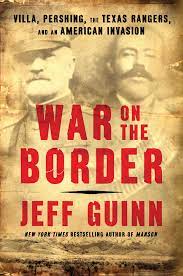
In 1913 and 1914, Mexico suffered under a cruel dictator, Victoriano Huerta, who had gained power by assassinating that nation’s democratically elected president in a U.S.-sanctioned coup. Hoping to restore representative government, four unlikely allies joined forces to defeat Huerta. They called themselves Constitutionalists. The consequences of the Constitutionalists’ victory for both Mexico and the United States are the focus of Texas historian Jeff Guinn’s “War on the Border: Villa, Pershing, the Texas Rangers, and an American Invasion.” It is a story with striking resonance today.

The Constitutionalists’ leader was Venustiano Carranza, a wealthy cattle rancher and politician from northeast Mexico. At his side was Álvaro Obregón, a successful farmer and soldier from Sonora. Although intently opposed to Huerta, Carranza and Obregón were political moderates, reserved in appearance and disposition. The same could not be said of their comrades.
more here.

How Viruses Could Cure Cancer and Save Lives

Nathanial Scharping in Discover:

Sitting in an isolated room at Beth Israel Deaconess Medical Center in Boston, Frank Nielsen steeled himself for the first injection. Doctors were about to take a needle filled with herpes simplex virus, the strain responsible for cold sores, and plunge it directly into his scalp. If all went well, it would likely save his life. Nielsen was a cancer survivor and, once again, a cancer patient. His melanoma, which had responded to conventional treatments the first time around, had returned with a frightening aggressiveness. Within weeks, a lump on his scalp had swelled into an ugly mass. Unlike the first time, options like surgery weren’t viable — it was growing too quickly.

As a last resort, his doctors turned to a cutting-edge drug known as T-VEC, approved in 2015 in the U.S. But the treatment, part of a promising field of cancer care known as immunotherapy, doesn’t sound much like a drug at all. T-VEC consists of a genetically modified virus that acts as both soldier and scout within the body, attacking tumor cells directly and calling in reinforcements from the immune system. Nielsen’s doctors hoped it would team up with the immunotherapy drug Keytruda, which enables the immune system to recognize and destroy tumor cells, to bring his cancer under control.

For nearly a year, Nielsen, a mechanical engineer in central Massachusetts, traveled to Boston every three weeks to have the drug injected into the tumors on his scalp. He would come home with his head swaddled in bloody bandages, aching after as many as 70 separate injections in a single session. There, he would prepare himself for the inevitable fever, nausea and vomiting, as his body reacted to the sudden presence of a live virus.

But the grueling regimen paid off. After the fifth round of treatment, Nielsen says, he began to see a visible change in the lumps on his scalp.

More here.

Saturday Poem

Where

You hear one degree. You hear Fahrenheit.
You hear warm weather in your hometown
And leave before the local news switches: they
Say half a degree, say Celsius, say warming
Global climate, so beeswax melts

Out your ear as it ships
Past the Sirens atop bones with plastic
Six pack yokes around them still choking
Those in rigor mortis. You hear them
As one hurricane siren—not constant, plural

Puddles feet deep of human waste smacking
Against Achilles—and chase them. As it turns out,
At half a degree warmer, all of you go
From underwater Otoh Gunga, Sub Diego, and Atlantis
To Upper and Lower Keys, Atlantic and Ocean City:

You go closer from myth to thawed
Greenland; deep-frozen heat in the sky
With smog and lung with tumor tips car
Exhaust pipes, blocking your airways
Yet trafficking cough drop

Needs; the soil’s dry spots a caught black sea bass,
Flat as a skate: you could skate on drought
To the North Pole and fall
Into the Arctic Ocean, devoid of any ice.
Algae moves out, breaks up with coral,

Who then bleaches their skin and dies,
The hottest day on record breaking
Its own record every two years until
Heat strokes are common colds
Nobody’s immune to, everywhere—

by Prince Bush
from Pank

_______


Cosby Walks

Rafia Zakaria in The Baffler:

BILL COSBY IS FREE. He has been freed from the Pennsylvania prison where he was being held for the past three years and he has gone home, where undoubtedly he will be celebrating tonight. The story of how his conviction for the sexual assault of Andrea Constand was summarily overturned is also an argument for why #MeToo has been so centered on wielding cultural power: shaming and naming rather than the exhausting and unpromising pursuit of legal justice. The legal system as it currently exists is failing women who have been harassed and assaulted by powerful men, and Cosby’s overturned conviction tells a story of these failures.

If there was ever an indictment of the legal system’s inability to provide women who are raped, harassed, and abused by men a clear roadmap to justice, here it is. If there ever was an argument to be made for “canceling” abusive, assaulting, raping men, shamed by society and ostracized by all, here it is. When the precise tools offered by the legal system, its collations of proof, its rules of verification and of admissibility, prove so horrifically ineffectual to meet the needs of women who seek punishment for the men who have sexually assaulted them, then the blunt instruments of cultural upheaval are necessary.

Negative publicity and organized ostracism are blunt tools; there is no independent judge, there are no trained lawyers, there is no hermetic courtroom where what is said and what is presented is strictly controlled. Instead, there is only rage and outrage, the frustrations of half the population that is just fed up with feeling constantly hunted, constantly preyed upon by the other half. Yes, not all men belong to this category, but because all men are not sufficiently interested in speaking up against some men or pointing out how systems of proof and prosecution are not pliant enough to meet the needs of prosecuting sexual crimes, they will have to confront the inexact revenge of cultural revolt.

More here.