
Johanna Thomas-Corr in New Statesman:
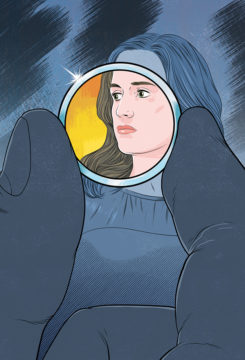 I’m dreaming of a book. It has the lightly worn wit of a Nora Ephron column combined with the empathy of Esther Perel. It combines the savage contrarianism of Rachel Cusk’s Aftermath with the virtuoso noticing of Joan Didion, the force of numbers that powered Caroline Criado Perez’s Invisible Women and the historical sweep of a Thomas Piketty treatise.
It examines the institution of marriage from the inside and out and answers, at last, why we continue to do this thing. Why – no one is forcing us any more! – do so many of us lash ourselves to another imperfect human being forever more and act surprised when this person fails to make us elated all the time? Why are people so outraged when presented with alternatives to a system rooted in the most regressive patriarchal property law? Why do we minimise freedom and maximise submission? Who would do that to the person they claim to love most? Besides half of the British adult population?
More here.
 T
T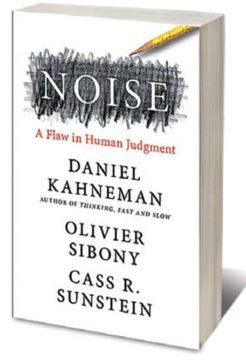 Are crowds smart or dumb? You may have heard the terms “wisdom of the crowds” and the “madness of crowds.” The former idea is that the collective opinion of a group of people is often more accurate than any individual person, and that gathering input from many individuals averages out the errors of each person and produces a more accurate answer. In contrast, the “madness of crowds” captures the idea that, relative to a single individual, large numbers of people are more likely to indulge their passions and get carried away by impulsive or destructive behaviors. So, which concept more accurately reflects reality?
 Last month, while most of the world focused on the war in Ukraine and worried that a beleaguered Russian leadership might resort to nuclear weapons, thus escalating the conflict into a direct war with the U.S.-led NATO nuclear-armed alliance, a nearly tragic accident involving India and Pakistan pointed to another path to nuclear war. The accident highlighted how complex technological systems, including those involving nuclear weapons, can generate unexpected routes to potential disaster—especially when managed by overconfident organizations.
 As a quick stroll on social media reveals, most people love showing that they are good. Whether by expressing compassion for disaster victims, sharing a post to support a social movement, or denouncing a celebrity’s racist comment, many people are eager to broadcast their high moral standing.
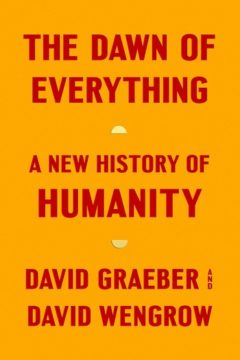 One way to read this unwieldy book, with its sixty-two-page bibliography, is as a grand tour of societies from prehistory to the eighteenth century once classed by anthropologists as “primitive” according to the evolutionary model that Dawn blows to smithereens. The Kwakiutl peoples of the Northwest Coast practiced chattel slavery; their neighbors to the south in what is now California, the Yurok, did not. At Göbekli Tepe in modern Turkey, foragers erected intricately carved megaliths six thousand years before Stonehenge. The Natchez Great Sun wielded absolute power over his subjects but rarely left the Great Village, so most Natchez just stayed out of his reach. The Kwakiutl were aristocratic during winter but splintered into clan formations for the summer fishing season. Cheyenne and Lakota appointed an authoritarian police force to keep order during the buffalo hunt then dispersed into small, “anarchic” bands. The ancient Mesoamerican Olmec of present-day Mexico appear to have organized their society in part around ball games, erecting colossal stone heads depicting helmeted champions. And Chavín de Huántar in northern Peru in the first millennium BCE, with its sophisticated cut-stone architecture and monumental sculpture—well, if the authors are to be believed, it was a gigantic memory palace, a storehouse for imagistic records of shamanic journeys and hallucinogenic visions.
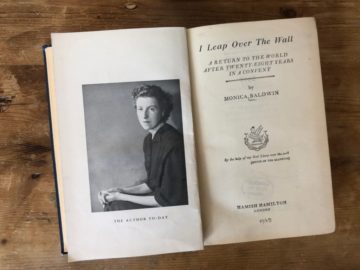 Ten years after Monica Baldwin voluntarily entered an enclosed religious order of Augustinian nuns, she began to think she might have made a mistake. She had entered the order on October 26, 1914, shortly after the outbreak of the World War I, when she was just twenty-one years old. At thirty-one, she hadn’t lost her faith, but she had begun to doubt her vocation; the sacrifices that cloistered life entailed did not come easily to her, and unlike many around her, she hadn’t experienced a “vital encounter” between her soul and God. Eighteen years later, she finally knew for sure: it was time to leave. Granted special dispensation from the Vatican to leave the order but remain a Roman Catholic, Baldwin—who was now forty-nine years old—quit the only adult life she’d known, that of the “strictest possible enclosure,” and emerged back into the world in 1941, into a world that had just plunged, once again, into war.
 W
W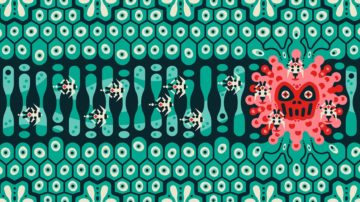 Cancer drugs usually take a scattergun approach. Chemotherapies inevitably hit healthy bystander cells while blasting tumours, sparking a slew of side effects. It is also a big ask for an anticancer drug to find and destroy an entire tumour — some are difficult to reach, or hard to penetrate once located. A long-dreamed-of alternative is to inject a battalion of tiny robots into a person with cancer. These miniature machines could navigate directly to a tumour and smartly deploy a therapeutic payload right where it is needed. “It is very difficult for drugs to penetrate through biological barriers, such as the blood–brain barrier or mucus of the gut, but a microrobot can do that,” says Wei Gao, a medical engineer at the California Institute of Technology in Pasadena.
 I have been doing a great deal of publicity these past weeks for my new book,
  The
The 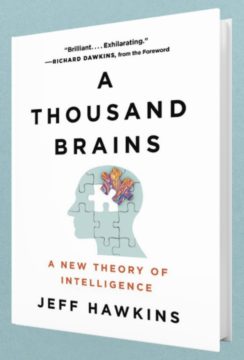 Over the years, I’ve read quite a few books about the brain, most of them written by academic neuroscientists who view it through the lens of sophisticated lab experiments. Recently, I picked up a brain book that’s much more theoretical. It’s called A Thousand Brains: A New Theory of Intelligence, by a tech entrepreneur named Jeff Hawkins.