
In days threatened by disease and war the still quiet
of ordinary boredom might seem desirable.
………………………………………………. —Roshi Bob
Northeast Regional
The all-seats-filled Thursday 3:26
from Boston to New York speeds along
the same familiar route
through tiny Connecticut towns
whose pulse beats only in the narrow corridor
between tracks and docks:
Mystic, New London, Old Saybrook.
They are the kind of New England fishing town
one would imagine from a Longfellow poem,
half-hidden under coastal mist,
where the moisture in the air
creates halos around neon signs on the row of stores
that provide the communities essentials.
—Nails, Pizza, Karate—
where the driftwood that knocks at the hull of moored boats,
the smell of the sea’s salty brine
and the metallic twang of wires
slapping the mast of rocking sailboats
are lost to the traveler
behind the thick-paned windows of the train,
where the steady tedium of clanking rail
is broken only by the sight of the lone seagull
whose ghostly silhouette
glides against the descending dusk.
by Sassan Tabatabai
from Uzunburun
The Pen & Anvil Press, 2011
 The metaverse leapt into popular awareness in 2021, in a world all too prepared for virtual sociality thanks to a year and counting of pandemic social distancing and Zoom Christmases. Last April, Epic Games announced $1 billion in investment to build “revolutionary” connected social experiences. In June, Facebook announced itself as “a metaverse company”, with 10,000 employees working on virtual reality products and experiences, and by October, it had rebranded itself as Meta, driving a flurry of commentary as people scrambled to work out what that might actually mean.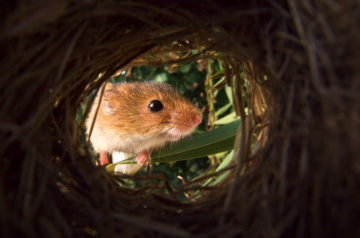
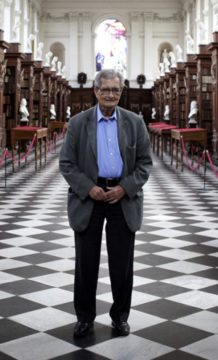 The history of economics owes many of its greatest contributions to the philosophers. Like Adam Smith, John Stuart Mill, Karl Marx and Friedrich von Hayek, Amartya Sen, who won the Nobel Prize for Economics in 1998, has a formidable reputation both as a world authority on development, welfare and famine, and as a distinguished theorist and moral philosopher. Born in Bengal in 1933, Sen’s life has been one of border-crossings – geographic and intellectual – as well as the rejection of narrow identities. He is, as he once put it:
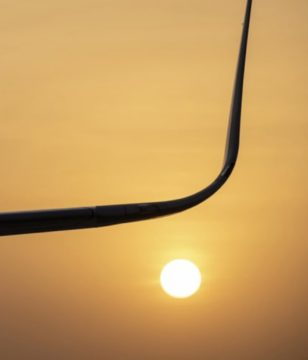 What caught your eye the last time you looked out of your airplane window? It might have been the winglet, a now ubiquitous appendage at the end of each wing, often used by airlines to display their logo and put their branding in your travel pictures.
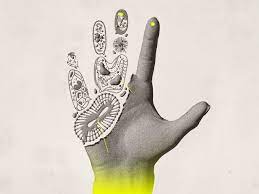 Each year, researchers from around the world gather at Neural Information Processing Systems, an artificial-intelligence conference, to discuss automated translation software, self-driving cars, and abstract mathematical questions. It was odd, therefore, when Michael Levin, a developmental biologist at Tufts University, gave a presentation at the 2018 conference, which was held in Montreal. Fifty-one, with light-green eyes and a dark beard that lend him a mischievous air, Levin studies how bodies grow, heal, and, in some cases, regenerate. He waited onstage while one of Facebook’s A.I. researchers introduced him, to a packed exhibition hall, as a specialist in “computation in the medium of living systems.”
 The first study to compare the accumulation of mutations across many animal species has shed new light on decades-old questions about the role of these genetic changes in aging and cancer. Researchers from the Wellcome Sanger Institute found that despite huge variation in lifespan and size, different animal species end their natural life with similar numbers of genetic changes. The study, published today in Nature, analyzed genomes from 16
  D
D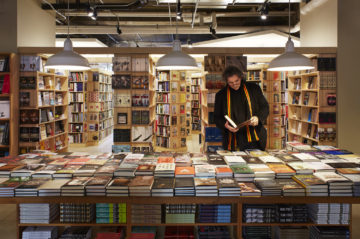 I’m not convinced by moralizing, I’m not convinced by “Amazon is terrible and Netflix is terrible and you should all read more, because movies are stupid.” I don’t believe any of that anyway, and even if I did, it’s not persuasive. We live a completely meaningful life without ever reading a book, full stop. You don’t need books to live a meaningful life. And yet, many people will live a more enhanced life if they read even just a couple more books. And some won’t—I mean, it’s not for everyone. So the work became articulating the pleasures and the purpose and meaning of these spaces, and hopefully doing it in a somewhat entertaining way.
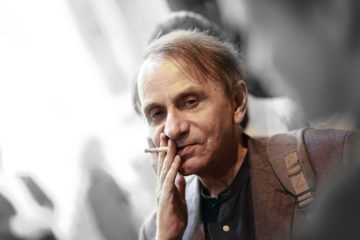 Many people, even in France, have by now forgotten a small detail of the fateful day of Jan. 7, 2015, when members of a Paris al Qaeda cell stormed the offices of the satirical newspaper Charlie Hebdo and murdered 12 cartoonists, writers, and editors. A new issue of the publication had just hit the newsstands, and all over the city, on its cover, was the caricatured image of a sickly, haggard Michel Houellebecq with a pointed magician’s cap, smoking a cigarette, looking like some untouchable warlock. “Predictions of the Magus Houellebecq”, the cover read.
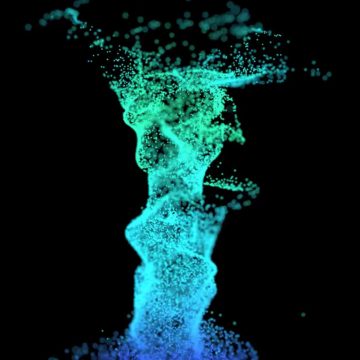 For more than 250 years, mathematicians have been trying to “blow up” some of the most important equations in physics: those that describe how fluids flow. If they succeed, then they will have discovered a scenario in which those equations break down — a vortex that spins infinitely fast, perhaps, or a current that abruptly stops and starts, or a particle that whips past its neighbors infinitely quickly. Beyond that point of blowup — the “singularity” — the equations will no longer have solutions. They will fail to describe even an idealized version of the world we live in, and mathematicians will have reason to wonder just how universally dependable they are as models of fluid behavior.
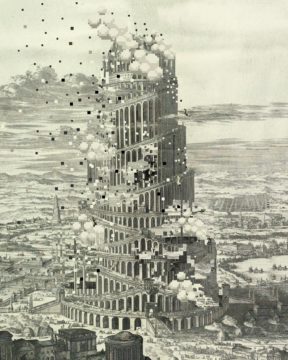 The story of Babel is the best metaphor I have found for what happened to America in the 2010s, and for the fractured country we now inhabit. Something went terribly wrong, very suddenly. We are disoriented, unable to speak the same language or recognize the same truth. We are cut off from one another and from the past.
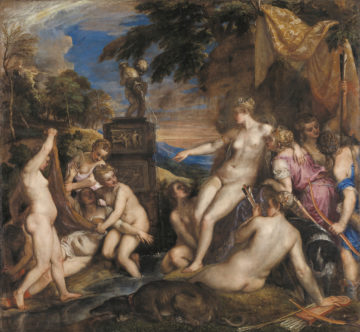 FEW FACES TO MEET the public spotlight in recent years have more to tell about the mental mechanisms of male shame, impunity, and self-absolution than that of the furry brown-and-white-spotted Spanish pointer staring out of Titian’s Diana and Callisto, 1556–59. This dog has been a bad dog, as he seems to know. (I say “he” since, according to the visual logic of gender organizing the suite of pictures of which Diana and Callisto forms one-sixth, Titian’s “big dog” simply can’t be a bitch.)1 Sometime previously, on a hunting trip that took an unexpected twist, this Spanish pointer turned against and devoured his master, Actaeon, a human hunter whom Diana, goddess of chastity, transformed into a stag after he came upon her bathing naked. Diana and Callisto asks its viewer to contemplate the aftermath of that attack; his master having passed through his digestive system, Actaeon’s dog, portrayed in another of the series’ pictures, reappears as a tagalong—or the captive?—of Diana’s band of proto-feminist separatists. Titian gives us the gaze of this pointer at the moment Diana is exiling Callisto, a favorite nymph who broke—unwillingly—her vow of virginity.
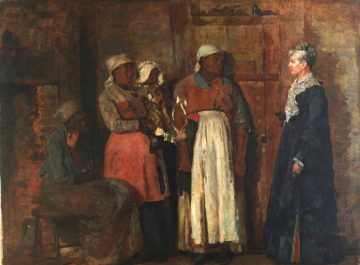 The linchpin of the Met’s show, “The Gulf Stream” intensifies the artist’s racial focus even as it universalizes its sailor’s plight. A single Black man, the drama’s protagonist, is shown bare-chested and casually majestic—“modelled with a musculature and physical power,” Alain Locke wrote in 1936, that “broke the cotton-patch and back-porch tradition” and “began the artistic emancipation of the Negro subject.” But his innate power is to no avail. He lies across the deck of a devastated boat, as gape-mouthed sharks close in; the water nearby is flecked with blood. A few stalks of sugarcane coil across the deck, either a plain fact of his cargo or a sign of centuries of slave trade. “I regret very much that I have painted a picture that requires any description,” Homer replied with typical asperity to questions about its meaning. He also mentioned, though, the influence of Turner’s painting “Slave Ship” (originally titled “Slavers Throwing Overboard the Dead and Dying—Typhoon Coming On”), which Ruskin had once owned but said he found too painful to keep.