The Editorial Board in The New York Times:
Even if we knew it was coming, the shock reverberates.
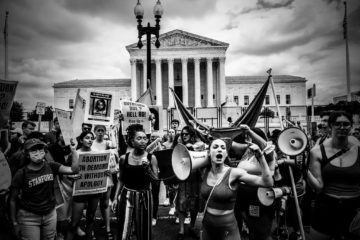 For the first time in history, the Supreme Court has eliminated an established constitutional right involving the most fundamental of human concerns: the dignity and autonomy to decide what happens to your body. As of June 24, 2022, about 64 million American women of childbearing age have less power to decide what happens in their own bodies than they did the day before, less power than their mothers and even some of their grandmothers did. That is the first and most important consequence of the Supreme Court’s decision on Friday morning to overturn Roe v. Wade and Planned Parenthood v. Casey.
The right-wing majority in Friday’s ruling in Dobbs v. Jackson Women’s Health Organization — which involved a Mississippi law that banned most abortions after 15 weeks, well before the line of viability established in Roe and Casey — stated, “It is time to heed the Constitution and return the issue of abortion to the people’s elected representatives.”
The implications of this reversal will be devastating, throwing America into a new era of struggle over abortion laws — an era that will be marked by chaos, confusion and human suffering. About half the states in the United States are expected to enact laws that restrict or make abortion illegal in all or most cases. Many women may be forced by law to carry pregnancies to term, even, in some cases, those caused by rape or incest. Some will likely die, especially those with pregnancy complications that must be treated with abortion or those who resort to unsafe means of abortion because they can’t afford to travel to states where the procedure remains legal. Even those who are able to travel to other states could face the risk of criminal prosecution. Some could go to prison, as could the doctors who care for them. Miscarriages could be investigated as murders, which has already happened in several states, and may become only more common. Without full control over their bodies, women will lose their ability to function as equal members of American society.
More here.

 When Leonard Cohen starts singing “Passing Through” on his 1973
 The Fed’s recipe to bring prices under control will increase the cost of borrowing money, which is good news for creditors, while heavily indebted households that rely on loans for their daily survival will face higher bills.
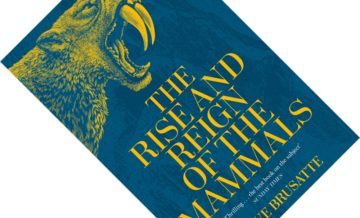 Imagine being a successful dinosaur palaeontologist and landing a professorship before you are 40, authoring a leading dinosaur textbook and a New York Times bestseller on dinosaurs. Imagine achieving all that and then saying: “You know what really floats my boat? Mammals.” After the runaway success of his 2018 book
  The past two years have been particularly challenging for the world’s poorest people, and this is just the beginning. By the end of this year, at least 75 million more people will have been pushed into poverty (living on less than US$1.90 a day) than was expected before the pandemic. The war in Ukraine and rising inflation have exacerbated the effects of the pandemic, as prices for food, fuel and nearly everything else have skyrocketed.
 Hair ice
 In a 6-3 majority ruling on Friday, the Supreme Court overturned Roe v. Wade, the 1973 decision giving women the right to abortion. In anticipation of the ruling last week, the Monitor interviewed Geoffrey R. Stone, author of the legal history “Sex and the Constitution.” The history of abortion in the United States is more complicated than many people realize, says Professor Stone, who teaches law at the University of Chicago. Government regulation of abortion has long been connected to the nation’s religious history, caught in the ebbs and flows of evolving cultural mores that also resulted in national prohibitions against contraception, private sexual behavior, and obscenity.
 As the Fourth of July looms with its flags and its barbecues and its full-throated patriotism, I find myself mulling over the idea of American exceptionalism. What, if anything, makes this country different from other countries, or from the rest of the developed world, in terms of morals or ideals? In what ways do our distinct values inform how America treats its own citizens?
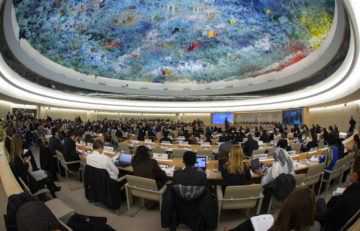 Zachary Manfredi in Boston Review:
 “P
“P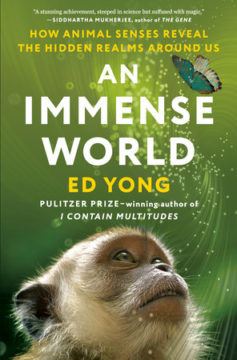 That I found myself surprised at so many moments while reading “An Immense World,” Ed Yong’s new book about animal senses, speaks to his exceptional gifts as a storyteller — though perhaps it also says something regrettable about me. I was marveling at those details because I found them weird; but it turns out, if I try to expand my perspective just a bit, they aren’t so weird after all. One of Yong’s themes is that much of what we think of as “extrasensory” is “simply sensory.” A term like “ultrasound” is “an anthropocentric affectation.” The upper frequency limit for the average human ear may be a measly 20 kilohertz, but most mammals can hear well into the ultrasound range.