
Category: Archives
Under Anesthesia, Where Do Our Minds Go?
Jackie Rochelieu in Nautilus:
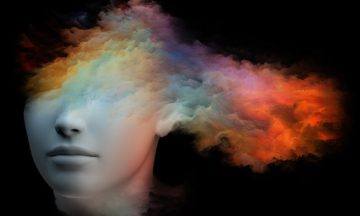 So far, scientists have learned that, generally speaking, anesthetic drugs render people unconscious by altering how parts of the brain communicate. But they still don’t fully understand why. Although anesthesia works primarily on the brain, anesthesiologists do not regularly monitor the brain when they put patients under. And it is only in the past decade that neuroscientists interested in altered states of consciousness have begun taking advantage of anesthesia as a research tool. “It’s the central irony,” of anesthesiology, says George Mashour, a University of Michigan neuroanesthesiologist, whose work entails keeping patients unconscious during neurosurgery and providing appropriate pain management.
Mashour is one of a small set of clinicians and scientists trying to change that. They are increasingly bringing the tools of neuroscience into the operating room to track the brain activity of patients, and testing out anesthesia on healthy study participants. These pioneers aim to learn how to more safely anesthetize their patients, tailoring the dose to individual patients and adjusting during surgery. They also want to better understand what governs the transitions between states of consciousness and even hope to crack the code of coma.
More here.
Three female authors show us how writing can turn adversity into beauty
Sharmila Mukherjee on NPR:
 Three new books spotlight the power of the written word to foster creative responses to confinement and oppression — and to inspire deep change within us.
Azar Nafisi’s Read Dangerously: The Subversive Power of Literature in Troubled Times, Elena Ferrante’s In The Margins: On The Pleasures of Reading and Writing and Anna Quindlen’s Write for Your Life are all about the transformative possibilities that underlie political, social and personal crisis.
Nafisi, best known as the author of Reading Lolita in Tehran, warns readers that America might well be on a slippery slope towards an autocratic government, such as the Islamic regime in her country of origin, Iran. Her book shows the power of great works of literature to resist the dictatorial impulse of today’s American politics. She proposes that we read dangerously — authors whose works challenge comforting clichés and attempt to change the world. Readers will find here incisive analyses of Salman Rushdie, Zora Neale Hurston, David Grossman, Elias Khoury, Margaret Atwood, James Baldwin, Ta-Nehisi Coates and others — authors whose writing is an act of surviving trauma.
More here.
Thursday Poem
There Is a Lake Here
—after Jamal May
.. For New Orleans
There is a lake here.
A lake the size of
outstretched arms. And no,
not the type of arms raised
in surrender. I mean the sort
of arms beckoning to be held.
To wrap themselves around another
and to never let go. And no, the lake
is not a place where people are
drowning. And no, this water is not
that which comes from a storm
or that which turns a city
into a tessellation of broken
windows and spray paint.
There are children swimming here,
splashing one another while
the droplets ricochet between them.
The droplets do not hurt,
they simply roll down the side
of the boy’s cheek. No, the boy is not
using the water to hide his tears.
He is laughing. Eyes cast out across
the water, in awe of how vast it is.
by Clint Smith
from Split This Rock, 12/1/2016
Wednesday, June 29, 2022
Scott Aaronson: Steven Pinker and I debate AI scaling
Scott Aaronson in Shtetl-Optimized:
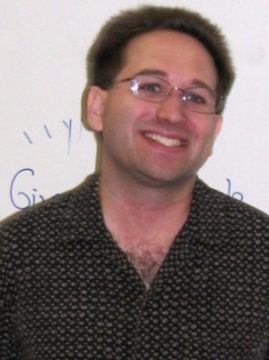 Before June 2022 was the month of the possible start of the Second American Civil War, it was the month of a lively debate between Scott Alexander and Gary Marcus about the scaling of large language models, such as GPT-3. Will GPT-n be able to do all the intellectual work that humans do, in the limit of large n? If so, should we be impressed? Terrified? Should we dismiss these language models as mere “stochastic parrots”?
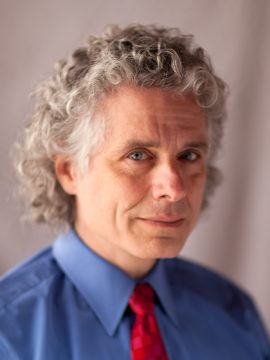 I was privileged to be part of various email exchanges about those same questions with Steven Pinker, Ernest Davis, Gary Marcus, Douglas Hofstadter, and Scott Alexander. It’s fair to say that, overall, Pinker, Davis, Marcus, and Hofstadter were more impressed by GPT-3’s blunders, while we Scotts were more impressed by its abilities. (On the other hand, Hofstadter, more so than Pinker, Davis, or Marcus, said that he’s terrified about how powerful GPT-like systems will become in the future.)
Anyway, at some point Pinker produced an essay setting out his thoughts, and asked whether “either of the Scotts” wanted to share it on our blogs. Knowing an intellectual scoop when I see one, I answered that I’d be honored to host Steve’s essay—along with my response, along with Steve’s response to that. To my delight, Steve immediately agreed. Enjoy!
More here.
After Roe v. Wade: US researchers warn of what’s to come
Mariana Lenharo in Nature:
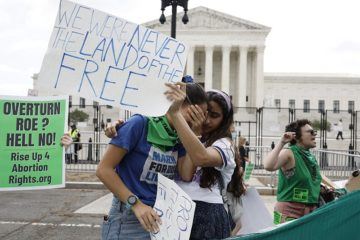 The constitutional right to an abortion has been struck down in the United States. The US Supreme Court announced on 24 June that it would overturn the 1973 landmark decision Roe v. Wade, which had protected abortion access up until the point that a fetus can live outside the womb — typically set at 22 or 24 weeks of pregnancy. Public-health researchers have renewed their warnings about the harms that this decision will bring to the country.
The outcome is not a surprise to them, because an initial draft opinion was leaked to news outlet Politico in May. “All I could add at this point is how disappointing it is to see that the majority opinion, like the leaked draft, ignores the fact that there is solid scientific evidence that this decision will harm women,” says Caitlin Myers, an economist at Middlebury College in Vermont who has studied the financial impacts of abortion restriction.
More here.
Faster Than We Thought
Omar El Akkado in Orion:
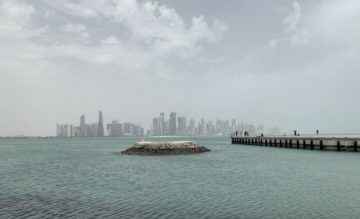 I grew up in Qatar, a tiny peninsula off the eastern coast of Saudi Arabia. Less than a century ago, before the boom, it was a desolate corner of the world, home to Bedouin tribes, shepherds, fishermen, and pearl divers. Today it is, by virtue of its massive oil and gas deposits, the richest country on Earth.
As in Alberta, Texas, and countless other little empires of extraction, money has lubricated a wild and rapid urban transformation in Qatar. The vacant lot where I snuck my first kiss is now a maze of sail-shaped skyscrapers. A playground where I learned to ride a bicycle has been cleared to make room for five-star hotels. The whole area—playground then and hotels now—stands on land originally reclaimed from the sea, in a neighborhood whose old Arabic name, roughly translated, means “the burial site.”
If the speed with which this transformation happened is unique, the trajectory is not. In the age of capitalism everything is a placeholder for its more lucrative replacement. And is there more universal an expression of nostalgia than to return to the site of your first kiss and find it unrecognizable? Time moves this way.
But there is now another kind of obliteration, another kind of burial. Within the next century, possibly within my lifetime, Qatar’s landscape will become uninhabitable.
More here.
Sabine Hossenfelder: Why does Science News Suck So Much?
From aardvark to woke: inside the Oxford English Dictionary
Pippa Bailey in New Statesman:
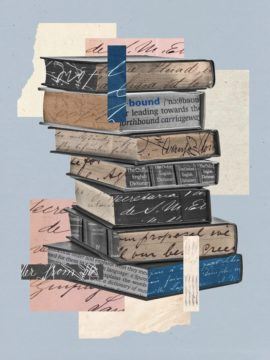 The team at the Oxford English Dictionary felt some nervousness about writing the definition for “Terf”, an acronym for trans-exclusionary radical feminist, which this month has been added to its pages. “To a certain extent, it is like any other word,” says Fiona McPherson, a 50-year-old lexicographer from Grangemouth, Stirlingshire, who has worked at the dictionary since 1997. “But it would be disingenuous to say that it is exactly the same. There seems more at stake. You want to be accurate, you want to be neutral. But it’s a lot easier to be neutral about a word that isn’t controversial.”
The Oxford English Dictionary (OED) has served as a lexical record of the world’s most widely spoken language – and its culture – since it was founded in the mid-19th century. “Post-truth”, for example, was the dictionary’s word of 2016, the year of Brexit and Trump, while in 2020 it elected not to choose one – because no single word could sum up the pandemic experience. Last year, “police brutality”, “deadname”, “cancel culture” and “anti-vaxxer” entered the dictionary for the first time; previous years gave us “fake news” (2019), “Silent Generation” (2018) and “woke” (2017).
The June 2022 update includes several terms that reflect our changing understanding of sexuality and gender: “multisexual”, “pangender”, “gender expression”, “gender presentation” and “enby” (derived from “NB”, meaning “non-binary”), as well as Terf.
More here.
Wednesday Poem
First Flush
At that age when love is more
of an academic necessity than
a cinematic happenstance, you
learn to will your lover to
manifest, conjurer like.
Your viraha, crowded with
the airy mass of calf love,
makes a ritual out of obsession.
When the face of your beloved springs at
the door, you become a believer
overnight. Poetry seems possible.
Absolved of their comic absurdity,
black-n-white film songs turn into
indispensable anthems. Waiting
is a season you never want to
end. Young love is like first
flush tea advertisements —
fresh, light and airy.
Overworked telephone lines
do their best to carry the
hearts electric beats.
Between mangled words and choppy
laughter, a city evening is
redeemed. For the rest of
the season, there’s paper and
pen. Epistolary conveyors that ferry
more pauses than words. The heart
is but a traveling historian.
by Bhaswati Ghosh
from Mono, issue 1
Viraha (Hindi): The realization of love through separation
Cassidy Hutchinson Did Her Job
Michelle Cottle in The New York Times:
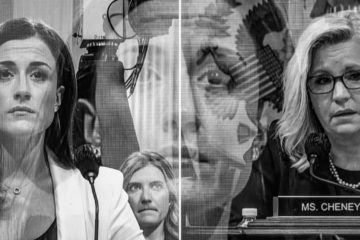 In this age of political cowardice and self-dealing, it can be easy to forget that public service is supposed to be a noble calling — one that at times requires people to step up and do hard, scary things. On Tuesday, a former White House aide named Cassidy Hutchinson reminded us what that looks like. Ms. Hutchinson, who worked for the White House chief of staff, Mark Meadows, in the violent, closing days of the Trump administration, was the surprise witness in a last-minute hearing of the Jan. 6 House committee. With intimate knowledge of what went down inside the Trump West Wing, Ms. Hutchinson shared what she saw and heard during the attack on the Capitol as the defeated president, drunk on disappointment and desperation, tried to cling to power.
She did so knowing full well the abuse and threats that those who cross Donald Trump on even minor matters often suffer. She did so because, unlike so many of the bootlickers with whom Mr. Trump surrounds himself, she still has a spine.
More here.
Ode To Grapefruit
Isobel Wohl at Astra Magazine:
 I have never liked grapefruit. They are hard to peel. A friend of mine once used them to practice tattooing: the leathery skin can stand up to the action of the gun, it turns out, plus it holds ink well enough and provides a sizable canvas. I suppose any fruit that can mimic human skin has the right to resist my fingers as they try to reach its flesh. A large knife would do the trick, but I don’t believe fruit should require butchery. I am an American born in the nineteen-eighties; I was raised in a place and time that had subordinated all other values to blithe consumption. I expect any fruit to denude itself in my hands at the slightest effort, like an eager lover or an EZ-peel clementine.
But when I break the skin of a grapefruit, the pith launches its smell at me. In an instant I am drunk on it.
more here.
The Gospel According to Mavis Staples
David Remnick at The New Yorker:
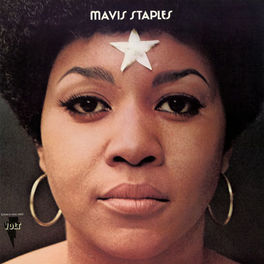 Mavis Staples has been a gospel singer longer than Elizabeth II has worn the crown. During concerts, sometimes, she might take a seat and rest while someone in her band bangs out a solo for a chorus or two. No one minds. Her stage presence is so unfailingly joyful—her nickname is Bubbles—that you never take your eyes off her. Staples sings from her depths, with low moans and ragged, seductive growls that cut through even the most pious lyric. She is sanctified, not sanctimonious. In her voice, “Help Me Jesus” is as suggestive as “Let’s Do It Again.” When she was a girl, singing with her family ensemble, the Staple Singers, churchgoers across the South Side of Chicago would wonder how a contralto so smoky and profound could issue from somebody so young.
She is eighty-two. While singers a fraction of her age go to great lengths to preserve their voices, drinking magical potions and warming up with the obsessive care of a gymnast, she doesn’t hold back.
more here.
Mavis Staples: NPR Music Tiny Desk Concert
Tuesday, June 28, 2022
Mary Gaitskill on the deracination of literature
Mary Gaitskill in UnHerd:
 As a fiction writer who teaches, I often speak about what I love in fiction, what to me makes it powerful and engaging. This is a version of a talk I have been giving for years to students and other interested parties; it is a talk I’ve become — what is the right word? — uncertain about in the last five years, not because I don’t believe what I’m saying or that I care about it less but because I’m not sure that people can find it meaningful anymore.
There are a number of reasons I feel this, most of which have to do with how we take in knowledge and information and how that has changed the nature of perception. I’m not saying anything new here: think iPhones and the constant staring there at, a skull-fracturing change which plainly has consequences beyond how people understand the reading and writing of fiction.
Which by itself — the reading and writing of fiction — is a very hard thing to talk about without falling all over yourself.
More here.
Sean Carroll’s Mindscape Podcast: Andrew Papachristos on the Network Theory of Gun Violence
Sean Carroll at Preposterous Universe:
 The United States is suffering from an epidemic of tragic gun violence. While a political debate rages around the topic of gun control, it remains important to understand the causes and possible remedies for gun violence within the current system. Andrew Papachristos is a sociologist who uses applied network science to study patterns of street violence in urban areas. His research shows that such violence is highly non-random; knowing something about the social networks of perpetrators and victims can help identify who might be at heightened risk of gun violence. It’s an interesting example of applying ideas from mathematics and computer science to real-world social situations.
More here.
Agnes Callard: If I Get Canceled, Let Them Eat Me Alive
Agnes Callard in the New York Times:
 What should my friends do if I am being canceled?
A decade ago, when I was a nonpublic philosopher writing only for a small group of academics, it would never have occurred to me to ask myself this question. But things have changed. These days, anyone with a public-facing persona must contemplate the prospect of having her reputation savagely destroyed.
A few years ago, I wrote an essay that, in passing, questioned faculty solidarity with unionizing graduate students. I had not realized how sensitive that topic was, and I was inundated with angry and hateful messages and a few threats online. In the scheme of things, the episode was quite mild, lasting only a few weeks. But it felt all-consuming at the time. And it was a taste of what could come.
More here.
Is nature friend or foe? Slavoj Žižek and Yuval Noah Harari discuss
Does Hungary Offer a Glimpse of Our Authoritarian Future?
Andrew Marantz in The New Yorker:
 The Republican Party hasn’t adopted a new platform since 2016, so if you want to know what its most influential figures are trying to achieve—what, exactly, they have in mind when they talk about an America finally made great again—you’ll need to look elsewhere for clues. You could listen to Donald Trump, the Party’s de-facto standard-bearer, except that nobody seems to have a handle on what his policy goals are, not even Donald Trump. You could listen to the main aspirants to his throne, such as Governor Ron DeSantis, of Florida, but this would reveal less about what they’re for than about what they’re against: overeducated élites, apart from themselves and their allies; “wokeness,” whatever they’re taking that to mean at the moment; the overzealous wielding of government power, unless their side is doing the wielding. Besides, one person can tell you only so much. A more efficient way to gauge the current mood of the Party is to spend a weekend at the Conservative Political Action Conference, better known as cpac.
On a Friday in February, I arrived at the Rosen Shingle Creek resort, in Orlando. It was a temperate afternoon, and the Party faithful were spending it indoors, in the air-conditioning. I
More here.
A Psychedelic Renaissance at the V.A.
Ernesto Londono in The New York Times:
 The last known experiment at a Department of Veterans Affairs clinic with psychedelic-assisted therapy started in 1963. That was the year President John F. Kennedy was assassinated. “Surfin’ U.S.A.” topped the music charts, and American troops had not yet deployed to Vietnam.
At the time, the federal government was a hotbed of psychedelics research. The C.I.A. explored using LSD as a mind-control tool against adversaries. The U.S. Army tested the drug’s potential to incapacitate enemies on the battlefield. And the V.A. used it in an experimental study to treat alcoholism.
But booming recreational use of drugs, including hallucinogens, sparked a fierce political backlash and helped set in motion the war on drugs, which, among other things, ended an era of research into the therapeutic potential of psychedelics.
More here.