Making ice in Vietnam
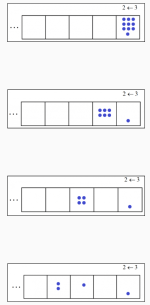
by Jonathan Kujawa I just returned from the joint Vietnam-US math conference held at the International Center for Interdisciplinary Science and Education in beautiful Quy Nhon, Vietnam. While it is a human endeavor, mathematics doesn’t care about gender, race, wealth, or nationality. One of the great pleasures of the math community is finding yourself on…
Fractions, partial fractions, knots, and other treasures
by Jonathan Kujawa Last time we found ourselves discussing the topic of writing numbers in different bases. We happen to like base 10 thanks to our ten figures and ten toes, but base 2 (binary), base 16 (hexidecimal), and base 60 (sexagesimal: thanks, Babylonians!) are also often used. But those are human preferences. Math don’t…
I prefer pi
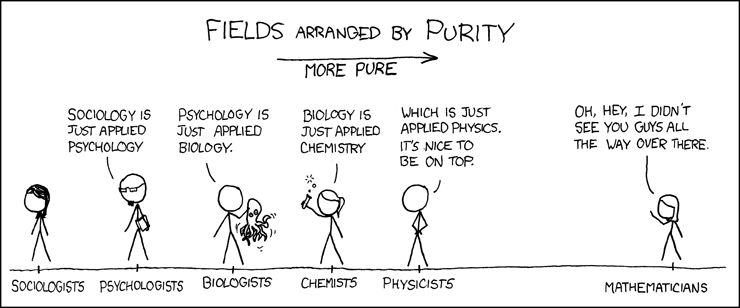
by Jonathan Kujawa If you believe Sheldon Cooper, physicists have a working knowledge of the universe. Mathematicians aren’t so humble. We like to think we aren’t constrained by reality. As is usually the case, xkcd put it well: Mathematicians like to think they are able to transcend time and space at will with a stick…
The vast and mysterious real numbers
by Jonathan Kujawa What is a number? Everyone who takes high school math learns about the real numbers. These are our old friends on the number line. You can hardly do classical algebra or geometry without them. We use the real numbers so often we find them comfortable and familiar. After all, they are just…
On “Math with Bad Drawings” by Ben Orlin
Apportioning Democracy
by Jonathan Kujawa Despite what he may wish, the President of the United States is not a king. We have Congress to act as a check and to ensure the varied opinions of the citizens are represented [1]. In principle, a representative democracy is straight-forward: the voters vote, select their representatives, and the legislature gets down…
Mathiness: the use and abuse of mathematics
by Jonathan Kujawa In a miracle we neither understand nor deserve, some of the most outlandish inventions of mathematicians’ fevered imaginations have later prove eminently useful in the real world. We’ve talked about some of these here at 3QD. From using the stretchy math of topology to identify data clusters in medicine, to using exotic measures of…
A-Tisket, A-Tasket, an Apollonian Gasket
by Jonathan Kujawa Apollonius of Perga (262-190 BC) was a well known and prolific geometer in ancient Greece. He is mainly known for his surviving work on the conic sections. Indeed, he gave us the definition of the ellipse, parabola, and hyperbola we use today. In some circles, Apollonius's most famous theorem is the fact…
The Joy of Fair Division
by Jonathan Kujawa If you have a sibling you are familiar with the problem of dividing up something desirable between selfish people. For some things, like ice cream or money, your only preference is to get as much as you can. If you divide it equally, then at least nobody will be envious of anyone…
All About That Base
by Jonathan Kujawa At the University of Oklahoma last week. While considering topics for this month's 3QD essay, the US Senate voted to approve a tax bill which not only dramatically reshapes US tax law, but says a great deal about our society's values. We're in an era where research and education are dramatically underfunded…
A Sad Concurrence
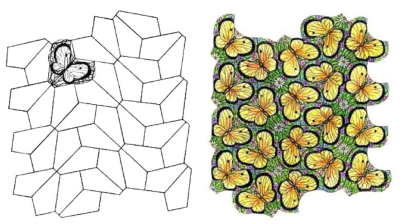
by Jonathan Kujawa As we know from the Law of Small Numbers, coincidences happen. Indeed, Ramsey's Theorem tells us they are downright unavoidable. Unfortunately, not all can be happy coincidences. In the first two weeks of July we lost three remarkable women of mathematics: Maryam Mirzakhani, Marina Ratner, and Marjorie Rice. The most famous was…
A Few Impossible Things Before Breakfast
From Wikipedia. by Jonathan Kujawa Approximately 1900 years ago Theon of Smyrna authored On Mathematics Useful for the Understanding of Plato. In it, Theon wrote: For Eratosthenes says in his writing he Platonicus that when the god pronounced to the Delians in the matter of deliverance from a plague that they construct an alter the…
Random Triangles and Pillow Problems for Insomniacs
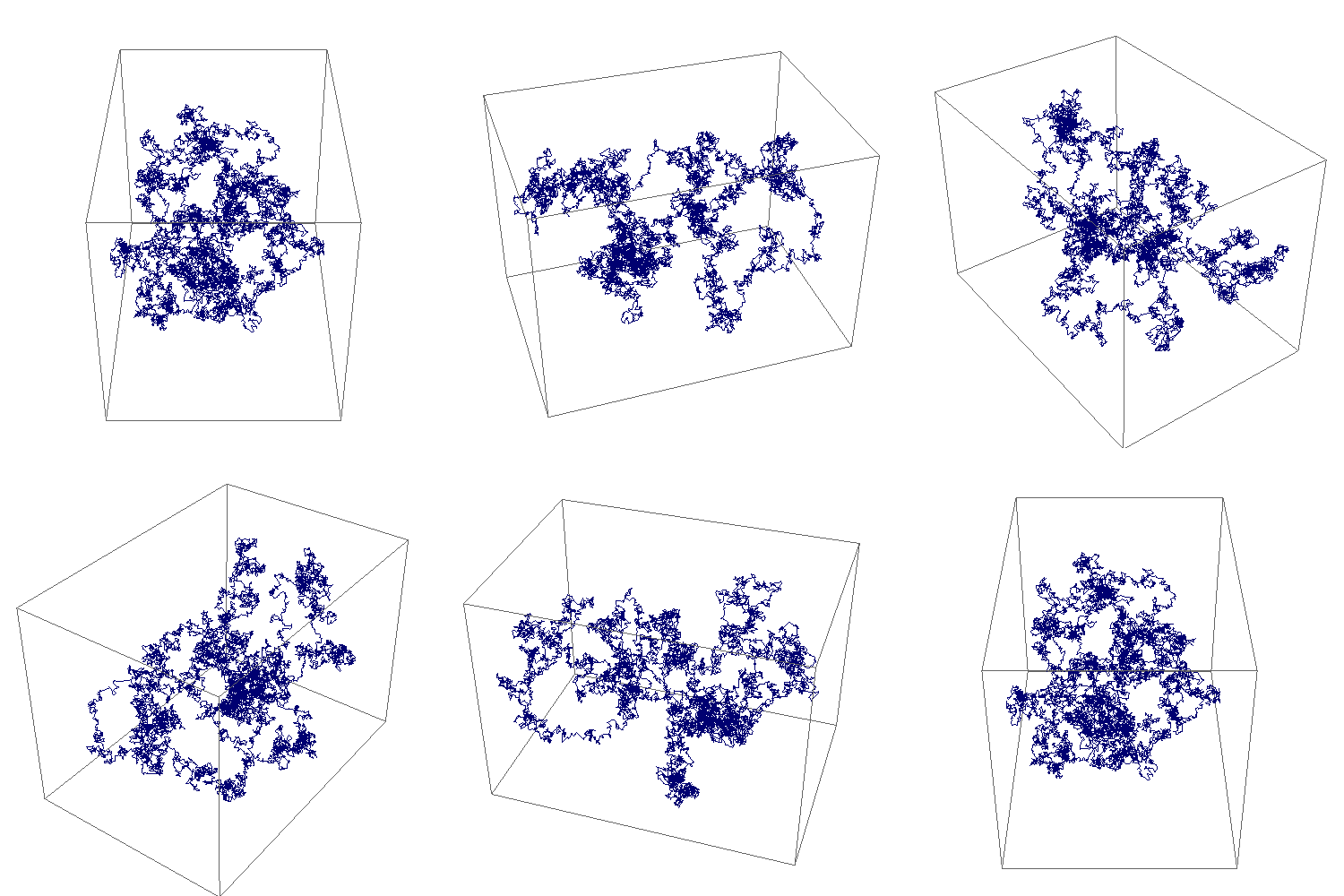
by Jonathan Kujawa While laying in bed on the night of January 20, 1884, Lewis Carroll conjured up the following puzzle: Three Points are taken at random on an infinite Plane. Find the chance of their being the vertices of an obtuse-angled Triangle. That is, since any three points on a sheet of paper can…
Breaking Barriers: On “Hidden Figures” by Margot Lee Shetterly
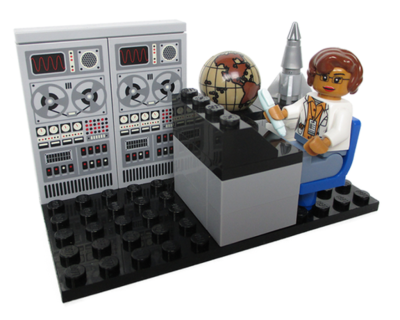
by Jonathan Kujawa "Reduce your household duties! Women who are not afraid to roll up their sleeves and do jobs previously filled by men should call the Langley Memorial Aeronautical Laboratory." In 1935 the National Advisory Committee for Aeronautics (the arm of the US government dedicated to research and development in the new-fangled area of…
The Law of Small Numbers
Richard & Louise Guy [1] by Jonathan Kujawa On the occasion of Richard Guy's 100th birthday. Human beings have a talent for spotting patterns. No doubt this was handy in our early days. If both Ug and Oka were violently ill after eating purple berries from a particular bush, our clan was well served to…
A Question of Counting
by Jonathan Kujawa On November 8th everyone will be counting. Counting can be hard. Especially in messy real world situations like elections. But in pure mathematics we get to decide the questions in which we are interested. We can choose to count countable things. The secret to math is the art of asking “good” questions.…
A Signalling Problem
by Jonathan Kujawa In June here at 3QD we talked about Arrow's Impossibility Theorem. The short version is this: a dictatorship is the only voting system which satisfies a few sensible ground rules. Or, to put it another way, even on an island with only two people, any form of democracy can lead to absurd…
Snowflakes and Cannonballs Stacks
By Jonathan Kujawa Photo by W. Bentley [1] In 1611 Johannes Kepler wrote a scientific essay entitled De Nive Sexangula; commonly translated as “On the Six-Cornered Snowflake”. It was the first investigation into the nature of snowflakes and what we'd now call crystallography. Since he was a gentleman and a scholar back when you could…