
by David Kordahl
A few years ago, while writing about the Golem series by the sociologists Harry Collins and Trevor Pinch, I bought their first coauthored book, Frames of Meaning: The social construction of extraordinary science. I did not read it. Unlike the Golem books, which examined ordinary scientific controversies, Frames of Meaning was at once more ambitious and less successful. Collins and Pinch hoped to witness the birth of a new science, to document a paradigm shift in real time, but ended up as de facto debunkers of the very science whose birth they had set out to observe.
I finally read Frames of Meaning last month. I should have been an ideally sympathetic reader. Like Collins and Pinch, I am an admirer of the physicist-turned-philosopher Thomas Kuhn, who introduced the idea of “paradigm shifts” to intellectuals. Kuhn discussed how difficult it is for historians to evaluate scientific works after a revolutionary rupture, since paradigm shifts alter assumptions about what is in or out of bounds for science, leaving pre- and post-revolutionary scientists with “incommensurable” worldviews.
As young sociologists in the 1970s, Collins and Pinch wanted to study a paradigm shift firsthand. They wondered if parapsychology faced a set of phenomena that would upend scientific norms. Of course, the hope that spooky subjects could yield scientific insights was not itself new. After its founding in the 1880s, the Society for Psychical Research included among its members many of Britain’s leading scientists. Even after physical scientists lost interest in the early twentieth century, psychologists and statisticians continued to collaborate on increasingly controlled experiments in telepathy and ESP. And in the 1970s, such topics seemed poised to reenter the scientific mainstream.
Consider the following. In 1974, Nature published “Information transmission under conditions of sensory shielding,” an article by Russell Targ and Harold Puthoff, physicists at the Stanford Research Institute, who examined the stage magician and paranormal celebrity Uri Geller as their main subject. This article presented cartoons that Geller had drawn without seeing their prepared target images. Given the similarity of the cartoons to their targets, Targ and Puthoff concluded that information had been transmitted by unknown means.
Another detail. In 1975, the book Superminds: An Enquiry into the Paranormal, by the physicist John G. Taylor, reported on Geller’s amazing ability to bend metals. Later that year, New Scientist magazine held a public poll to determine who Britons considered the twenty most significant scientists of all time, and Taylor—alongside Newton, Darwin, and Einstein—made the list.
This was the context into which Collins and Pinch entered, and which had gone away by the 1982 publication of Frames of Meaning. What had it all meant?
The 1970s’ mainstream embrace of “high strangeness”—gurus, psychics, UFO groups, altered states—has always impressed me, maybe because I was born after it was basically over. Collins and Pinch were interested in what general insights about scientific evidence their observations of parapsychologists might reveal, but Frames of Meaning hides within it a story that is historically peculiar, allowing us to peek in on an unusual period in scientific discourse. Given our own strange intellectual moment, I inadvertently found myself connecting the 1970s and the 2020s, both decades full of uncertainty, both trembling with possibility.

***
The history of spooky science has a problem that is acknowledged by both its supporters and detractors. People, when stressed, have a tendency to cheat.
This observation leads different observers to different conclusions. Observers who are broadly supportive of the possibility of paranormal events tend to focus on how paranormal subjects might best demonstrate their gifts. They argue that paranormal effects cannot be produced in the presence of observers who are hostile, since their bad vibes may quash the very effects they are out to observe. Detractors, naturally, focus on the cheating, and regard supporters’ complaints as the whining of sore losers. Excuses are exactly what you would expect from cheaters who are encouraging rubes to believe in things that simply do not exist.
Frames of Meaning occupies a middle ground in this debate. Collins and Pinch saw, in the parapsychologists’ suggestion of observer effects, the spark of a revolutionary paradigm shift. They acknowledged the cheating issue (more on this in a bit), but dodged the central question. “The authors,” they write in the final pages, “do not know whether paranormal metal bending is ‘real’ or not—nor, as sociologists, do they care. It would make not one jot of difference to the analysis.”
One can see why Thomas Kuhn distanced himself from the Kuhnians. But Collins and Pinch are upfront about their own split loyalties. “Incommensurability,” they write in the first chapter, “describes a relationship between two social groups such that no actor can do actions appropriate to both groups at the same time.” They moved among many such groups, sometimes acting as sociologists of science, sometimes as parapsychologists, and sometimes as debunkers of parapsychology.
The book takes a while to get to the debunking. The first four chapters are all background—a chapter on Kuhn, another on Geller and his imitators, a review of whether or not parapsychology is compatible with ordinary science, and a discussion of quantum physics. But the strongest part of the book is its two-chapter account of Harry Collins’s activities as a parapsychologist, when he inadvertently served as a public debunker. The final two chapters, which consider whether paranormal metal-bending shows symptoms of a genuine scientific revolution and summarize the foregoing arguments, are an anticlimax.
In the aforementioned Superminds, John G. Taylor reported on “mini-Gellers”—British youngsters who, after Uri Geller had toured Britain, claimed also to have the ability to bend metal paranormally. When a BBC documentary aired on the subject, Harry Collins was at the University of Bath. A colleague of his, the physicist Brian Pamplin, appeared on a BBC news program where one such mini-Geller demonstrated allegedly paranormal metal-bending for the TV audience. Subsequently, parents of other child metal-benders contacted Pamplin, who recruited colleagues to conduct a formal trial. Collins was known by others at Bath as a sometime parapsychologist, so he was recruited to the effort.
Along with the problem of cheating—and, for the skeptical, intimately connected to it—is the problem that, almost by definition, paranormal events are hard to observe directly. For skeptics, this is no mystery. The skeptical essayist Martin Gardner called Superminds “one of the funniest, most gullible books to ever be written by a reputable scientist” and mocked Dr. Taylor’s suggestion that a “shyness effect” allowed metal to bend paranormally only when it is not watched.
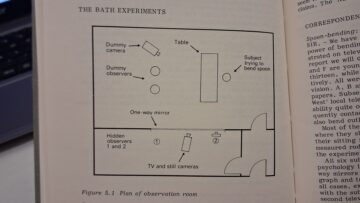
Part of what allowed Gardner to mock Geller and his imitators so confidently was the Pamplin and Collins study itself, though Collins himself did not support this mockery. (Chapters 5 and 6 of Frames of Meaning slip from the “we” of the coauthors to the “I” of the direct observer.) Pamplin and Collins visited the homes of the child subjects and recruited for their study those who were able to bend metal objects—though, like Taylor, they never observed the bending directly.
When the children were brought to the campus, where they could be videotaped, Pamplin and Collins quickly became pessimistic about the “Geller effect”:
A new problem in the way of our maintaining a positive attitude to the experiments was that one of our major reasons for believing strongly in Sally [one of the metal-bending children] was that she had bent a rod that was too strong for any of us to bend by hand. We now discovered that it could be done by putting it under a foot, a method that simply had not occurred to us before. We also realized that on the occasions she had bent these very strong objects, she had been out of our sight completely, so could have used the foot method.
“We can assert that in no case did we observe a rod or spoon bent other than by palpably normal means,” Pamplin and Collins wrote in a letter to the editor that was published in the September 4, 1975 issue of Nature, which gave a brief report on their study without including many procedural details.
***
The response of scientists to the Pamplin and Collins letter was about what you would expect. Skeptics like Martin Gardner would cite the letter across multiple pieces denouncing Uri Geller—even though the results had nothing to do with Geller himself, and even though finding six children who cheat hardly proves anything at all. For parapsychologists, the letter changed nothing. But for scientists like John G. Taylor—recent converts—the question of whether one should consider previously unthinkable possibilities was now slanted toward no.
Taylor eventually withdrew his support for Geller and published a few Nature papers at the end of the decade discussing whether paranormal effects might be attributable to plain old vanilla electromagnetism. For self-described Kuhnian radicals like Collins and Pinch, however, the moral was not about paranormal metal bending, but about Kuhnian paradigm incommensurability.
When they rewatched tapes with an eye toward paranormal possibility, they grew less certain that everything had been “palpably normal.” Was there not a residue of hope? For Collins and Pinch, the interpretation of data depended on how the case was framed. “If the analysis has been convincing,” they conclude in the final pages, “then it will have shown, through an empirical study, that philosophies of science that depend heavily upon the invocation of experimental evidence to decide between major differences in theoretical perspective are not tenable.”
But this is where I depart from Collins and Pinch to make an ill-advised ending pivot toward contemporary events. The strangeness of scientific discourse in the 1970s is not the strangeness of the 2020s, but the echoes are easy enough to hear.
In the 1970s, political disillusionment led many people to turn inward. Tom Wolfe memorably called the 1970s the “Me Decade” and diagnosed, in the flourishing of alternative lifestyles, a broader spiritualist resurgence, a “third great awakening,” as he put it. Disappointed by politics, many came to hope that the familiar world might harbor metaphysical secrets. This suspicion paid some dividends. In How the Hippies Saved Physics, David Kaiser documents how, as Cold War funding for physics decreased after its post-Manhattan Project peak, underemployed Bay Area physicists were drawn to the topics examined in Frames of Meaning. (Uri Geller and John G. Taylor are featured in both books.) Kaiser portrays their quest not as a dead end but a catalyst for the growth of quantum information science.
Still, the quantum breakthroughs of Kaiser’s “hippies” are pretty far from the macroscopic effects that paranormal metal bending seemed to promise. Tests of quantum correlations never leave the realm of puzzles. To appreciate them, one must concentrate. They may or may not reveal metaphysical secrets, but these revelations are subtle, nothing like the psychic pyrotechnics of the movies.
The scientific revelations of the 2020s are less rarefied, though no less surprising. I do not need to rehearse the steady progress of artificial intelligence. Our politics, once again, are a source of justified pessimism on all sides. We, too, conceive ourselves to be on the cusp of a new age, but while the 1970s smelled like incense, the 2020s smell like ozone crackling just before a catastrophe.
Collins and Pinch could declare that it would make “not one jot of difference” whether paranormal metal bending was real or not, but this attitude was tenable only because paranormal metal bending was bracketed off from everyday concerns. Kuhnian relativism struggles to keep up with genuinely new phenomena that become ordinary—the transition from science to technology.
What paranormal metal bending promised, AI has delivered.
Four years ago, I wrote about Blake Lemoine, the Google engineer who claimed that the company’s LaMDA chatbot was conscious before being fired. I argued then that he was mistaken, but the question now seems almost beside the point. Anyone who spends an afternoon with ChatGPT, Claude, or Gemini will notice that each has a distinct personality, and regular users, myself included, may have a faintly embarrassing intimacy with them. (Who else has read all my drafts?)
Last year, I reviewed Adam Becker’s More Everything Forever, a book that criticizes Silicon Valley’s grander ambitions. I found its negativity relentless and blithely chided Becker for taking the techno-optimists too literally. True, they may talk about colonizing Mars and living forever, but is that so bad if it rallies engineers and scientists to develop reusable rockets and effective therapies?
But in recent months, technologists’ ambitions have become more concrete. In northeast Louisiana, not too far from me, construction has begun on Meta’s Hyperion Data Center. In 2024, it was announced as a $10 billion project; this sum has recently been scaled up to $50 billion. At 2,250 acres, this vast complex promises to be nearly three times the size of Central Park in Manhattan. Exponential growth seems like more than a figure of speech when one encounters a facility of such immensity, with thousands of people coaxing it to life.
As these mechanical minds spread across the countryside, we will drive past their gray palaces, much as Pamplin and Collins once drove to see the children. They cannot yet bend metal, but the pessimists predict that it is only a matter of time.
Enjoying the content on 3QD? Help keep us going by donating now.